
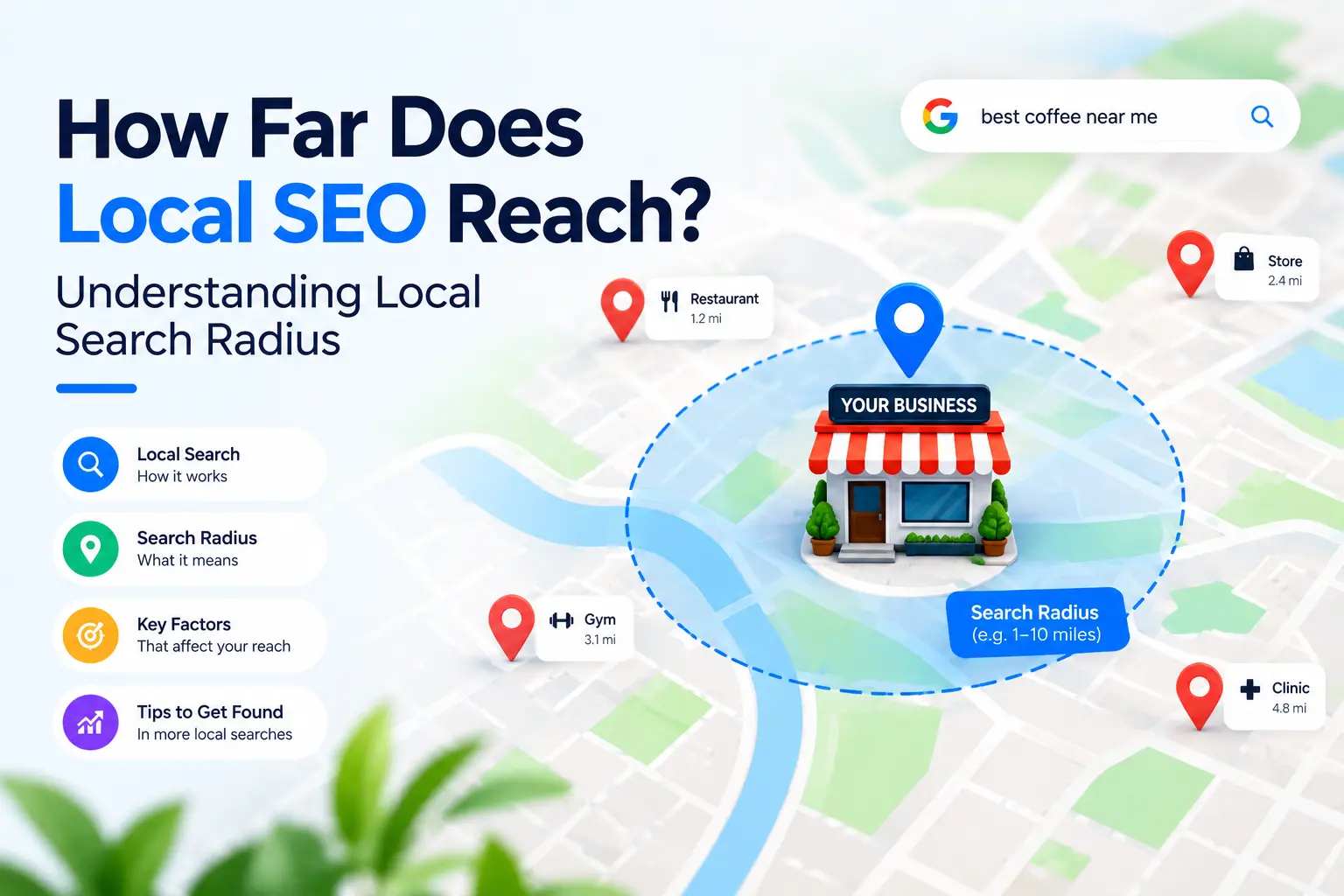
If you run a local business, you have probably typed your own business name into Google from a nearby town and wondered why you did not show up. This is the exact question that brings most business owners to the concept of local search radius: the geographic distance around your business location within which you can realistically expect to rank in Google’s local results. Understanding this concept is not just a technical curiosity — it directly affects how many customers find you, how far they are willing to travel, and how much revenue your business captures from nearby searches.
In this guide, we will break down exactly what this concept means, how Google calculates it, what factors shrink or expand it, and how you can take practical steps to grow your reach. Whether you run a single storefront or a multi-location service business, understanding your local seo radius will help you set realistic expectations and build a smarter local search strategy for the months ahead.
What Is Local SEO Radius?
Local seo radius refers to the geographic area surrounding a business where that business has a realistic chance of appearing in local search results, the local map pack, or Google Maps listings. Unlike traditional organic SEO, which can rank a website for searchers anywhere in the world, local search is inherently tied to geography. This radius is the invisible boundary that determines whether someone three miles away sees your listing, while someone twelve miles away sees a competitor instead.
It is important to understand that local seo radius is not a fixed number stamped onto your Google Business Profile. There is no dial you can set to “5 miles” or “10 miles.” Instead, it is calculated dynamically by Google’s algorithm every time someone performs a search, based on a combination of signals we will explore below. This is why two searchers standing in different parts of the same city might see completely different local pack results for the exact same keyword, even though they searched at the same moment.
For business owners, the practical takeaway is this: your local seo radius is not something you set once and forget. It changes as your optimization improves, as competitors adjust their own strategies, and as Google refines its ranking systems over time. That is exactly why so many businesses invest in a proper local SEO checklist to keep every ranking factor in check on an ongoing basis.
How Does Google Determine Your Local SEO Radius?
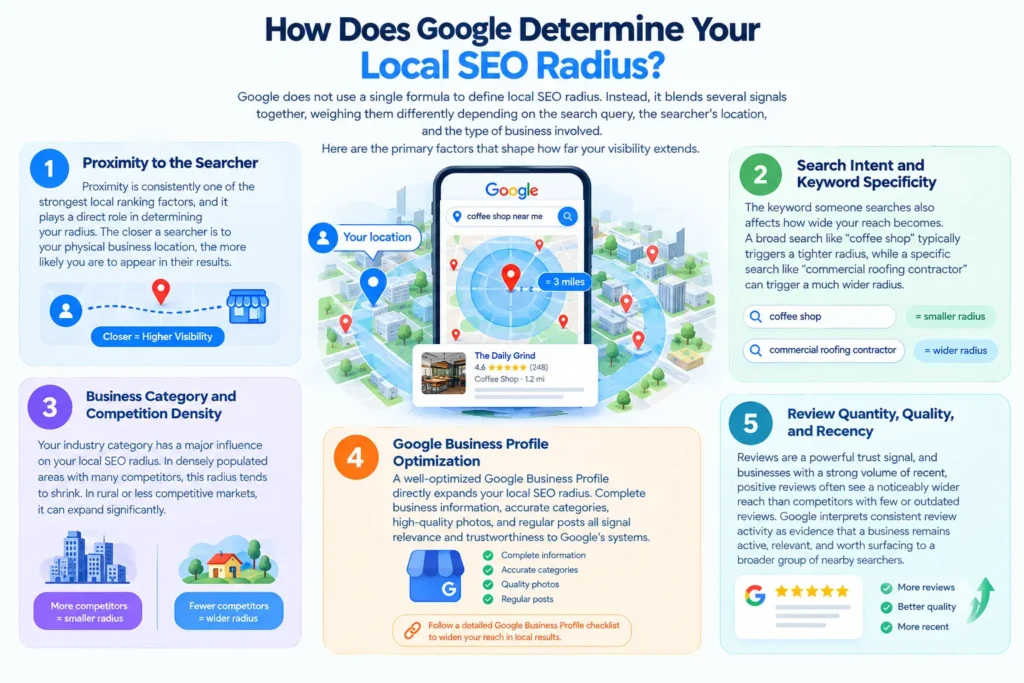
Google does not use a single formula to define local seo radius. Instead, it blends several signals together, weighing them differently depending on the search query, the searcher’s location, and the type of business involved. Here are the primary factors that shape how far your visibility extends.
1. Proximity to the Searcher
Proximity is consistently one of the strongest local ranking factors, and it plays a direct role in determining your radius. The closer a searcher is to your physical business location, the more likely you are to appear in their results. This is why a bakery in one neighborhood might have a local search radius of only two or three miles, while a specialty medical clinic with fewer nearby competitors might see visibility stretching across an entire metro area.
2. Search Intent and Keyword Specificity
The keyword someone searches also affects how wide your reach becomes. A broad search like “coffee shop” typically triggers a tighter search radius because Google assumes the searcher wants something within walking or short driving distance. On the other hand, a more specific search like “commercial roofing contractor” can trigger a much wider radius, since fewer businesses offer that service and searchers are generally willing to travel farther for specialized work.
3. Business Category and Competition Density
Your industry category has a major influence on your local seo radius. In densely populated areas with many competitors in the same category, this radius tends to shrink because Google has plenty of nearby alternatives to show searchers. In rural or less competitive markets, the same radius can expand significantly simply because there are fewer relevant businesses to compete against for the same terms.
4. Google Business Profile Optimization
A well-optimized Google Business Profile directly expands your local seo radius. Complete business information, accurate categories, high-quality photos, and regular posts all signal relevance and trustworthiness to Google’s ranking systems. If you have not already done so, working through a detailed Google Business Profile checklist is one of the fastest ways to widen your reach in local results.
5. Review Quantity, Quality, and Recency
Reviews are a powerful trust signal, and businesses with a strong volume of recent, positive reviews often see a noticeably wider reach than competitors with few or outdated reviews. Google interprets consistent review activity as evidence that a business remains active, relevant, and worth surfacing to a broader group of nearby searchers.
Local SEO Radius vs. Service Area
One common point of confusion is the difference between local seo radius and a “service area” set manually inside your Google Business Profile. These are related but distinct concepts. Your declared service area tells Google which cities or postal codes you are willing to serve, particularly useful for service-area businesses like plumbers, electricians, or cleaning companies that travel to customers rather than operating from a fixed storefront.
Your actual radius, however, is the real-world distance within which you show up in search results — and it does not always match your declared service area. You could list a fifty-mile service area, but if your true reach is genuinely much smaller due to weak signals, you will not show up for searchers at the edges of that declared zone. This is a critical distinction for businesses relying on local SEO strategies instead of traditional organic SEO, since the two require very different geographic assumptions from the outset.
Factors That Expand or Shrink Your Local SEO Radius
Now that we understand what shapes local seo radius at a high level, let’s dig into the specific, controllable factors that can either widen or narrow it over time as your business evolves.
NAP Consistency and Local Citations
NAP stands for Name, Address, and Phone number, and consistency across the web is one of the most overlooked contributors to local seo radius. When your business information matches exactly across directories, review sites, and citation sources, Google gains confidence in your location data, which can meaningfully extend how far your listing travels. Inconsistent or outdated citations, on the other hand, create confusion that quietly shrinks that reach over time. Building out accurate local citations is a foundational step that many growing businesses skip entirely.
Local Keyword Targeting
The way you structure content and keywords on your website also influences your local seo radius. Pages that mention specific neighborhoods, suburbs, or service areas help Google associate your business with a broader geographic footprint than a generic homepage alone. Conducting proper local keyword research allows you to identify exactly which nearby areas searchers are using in their queries, so you can create content that naturally extends your reach into those zones over time.
Local Business Schema Markup
Structured data helps search engines understand your business location, service area, and category with far more precision than plain text alone. Implementing proper local business schema gives Google clearer geographic signals to work with, which can have a measurable effect on local seo radius, especially for businesses operating across multiple towns or service areas.
Local Link Building
Backlinks from other locally relevant websites — chambers of commerce, local news outlets, community blogs, or neighborhood associations — reinforce your geographic relevance in the eyes of search engines. A solid local link building strategy tells Google that your business is genuinely embedded in the community, which tends to widen your reach over time. For a broader perspective on how backlinks affect visibility, this guide on getting backlinks is a useful external resource worth reading.
On-Page and Service Page Optimization
Every service page on your website is an opportunity to reinforce geographic relevance to search engines. Poorly optimized service pages waste this opportunity and can quietly narrow your radius, while well-structured pages that mention specific service areas help expand it instead.
How to Find Your Current Local SEO Radius
Before you can improve your local seo radius, you need to understand where it currently stands today. Here are three practical, low-cost methods for measuring it.
Manual Incognito Searches
Open an incognito browser window and search your target keyword from different physical locations, or use a VPN to simulate different areas around your city. Note where you appear in the map pack and where you drop off entirely from view. This gives you a rough, real-world sense of your current radius without spending anything.
Rank Tracking Grids
Several SEO tools offer “grid tracking” features that plot your ranking position across dozens of points on a map simultaneously. This visual approach is one of the most accurate ways to measure local seo radius, since it shows exactly where your rankings begin to fall off in every direction from your business location, rather than just one.
Google Business Profile Insights
Your Google Business Profile dashboard provides data on how far away customers were when they found your listing, along with the search queries they used to find you. Reviewing this data regularly helps you track whether your reach is expanding or contracting over time, and whether recent optimization efforts, like updates from your local SEO checklist, are actually moving the needle in the right direction.
How to Expand Your Local SEO Radius
Once you know where you stand, here are concrete, actionable steps you can take to grow your visibility further.
1. Strengthen Your Google Business Profile
A complete, active, and accurately categorized profile is foundational to any radius improvement. Fill out every available field, upload fresh photos regularly, and respond to every review you receive, positive or negative. This single step often produces the fastest visible improvement in overall reach within just a few weeks.
2. Publish Location-Specific Content
Create dedicated pages or blog posts that address the neighborhoods, suburbs, and nearby towns you want to reach with your services. This is one of the most direct ways to extend your local seo radius into areas you are not currently ranking in, and it pairs naturally with a solid keyword research process for local businesses you can follow step by step.
3. Earn Reviews Consistently
Set up a simple system to request reviews after every completed job or purchase, rather than asking sporadically. A steady, ongoing stream of reviews — instead of a single burst — signals sustained relevance and helps maintain and expand your reach over the long term. If you need a refresher, this guide on getting more Google reviews covers the basics well.
4. Build Local Citations and Backlinks
Prioritize getting listed on reputable local directories and earning backlinks from community-focused websites in your area. Both activities reinforce your geographic footprint and are proven, durable levers for widening your reach across an entire region rather than just one street.
5. Improve Core Web Vitals and Site Speed
While not exclusively a local ranking factor, a slow or poorly performing website undermines every other optimization effort you make. Search engines factor in core web vitals as part of overall quality assessment, and a technically sound site supports a healthier search radius across the board, not just on individual pages.
6. Optimize for Google Maps Specifically
Since much of local search happens directly on Google Maps rather than the standard search results page, dedicated Google Maps SEO optimization is essential. Accurate pins, complete attributes, and consistent activity on your profile all contribute to a wider local seo radius within the Maps interface itself.
7. Monitor and Respond to Local Algorithm Shifts
Google periodically updates the way it weighs proximity, relevance, and prominence, and these updates can shift your reach without any change on your end. Staying informed about broader industry shifts, and pairing that awareness with a solid SEO strategy, helps you react quickly rather than losing ground for weeks before you notice.
Local SEO Radius for Multi-Location Businesses
Businesses with multiple physical locations face a unique version of this challenge. Each location effectively has its own independent local seo radius, and these radii can overlap, compete with each other, or leave gaps between locations if not managed carefully from the start. If two of your locations are close together, they may inadvertently compete for the same searches, effectively splitting your combined visibility rather than reinforcing it across the wider region.
The solution is to treat each location as its own optimization project: a unique, fully completed Google Business Profile, unique location-specific landing pages, and location-specific citations and reviews for each address. This prevents cannibalization between locations and ensures each one’s search radius is as strong as possible on its own merits, rather than borrowing weakly from a single central page.
Local SEO Radius for Service-Area Businesses
Service-area businesses — plumbers, electricians, HVAC technicians, locksmiths, and similar trades — face a different challenge than storefront businesses because they often do not want their exact home address publicly displayed on the web. This makes local seo radius even more important to understand, since these businesses rely heavily on the declared service area combined with genuine underlying ranking signals rather than a visible storefront alone.
Industries like plumbing, electrical services, HVAC, and locksmith services all depend on a wide, well-maintained local seo radius because customers are actively searching during urgent, time-sensitive situations. For these businesses, a narrow radius can mean losing emergency calls to competitors who show up first, even when that competitor is objectively farther away in actual driving distance. The same logic applies to appliance repair and roofing companies, both of which compete heavily on speed of response and geographic coverage.
Local SEO Radius and Google Algorithm Behavior
It helps to understand that Google is not trying to show searchers the absolute closest business every single time. Instead, it balances proximity against relevance and prominence, meaning a highly relevant, well-reviewed business slightly farther away can still outrank a closer, weaker competitor. This is precisely why two businesses of the same type, located in the same neighborhood, can have dramatically different local seo radius outcomes despite starting from nearly identical geography.
This balancing act is also why this kind of visibility should never be treated as purely a distance problem. Businesses sometimes assume that simply being physically closer to more customers guarantees visibility, when in reality relevance signals like Google Maps optimization and category accuracy often carry just as much weight, if not more, in the final ranking calculation.
Common Mistakes That Shrink Your Local SEO Radius
Even well-intentioned businesses make mistakes that quietly shrink their local seo radius over time without realizing it. Here are the most common ones worth auditing for.
Inconsistent business information. Different addresses, phone numbers, or business names scattered across the web confuse search engines and shrink overall visibility rather than strengthen it.
Keyword stuffing city names unnaturally. Repeating city names excessively across a page can trigger spam filters and actually reduce your local seo radius rather than expand it. Natural, varied language works far better in every case.
Ignoring negative reviews. Unanswered negative reviews can damage trust signals over time, which in turn narrows your reach rather than protecting it.
Duplicate or thin location pages. Creating near-identical pages for every nearby town without unique, valuable content is a common technical mistake that can suppress your local seo radius rather than grow it as intended. Reviewing broader SEO mistakes that hurt rankings is a good place to start auditing your own site for these issues.
Neglecting mobile experience. The majority of local searches happen on mobile devices, and a poor mobile experience undermines every other signal contributing to your reach, no matter how strong those other signals are.
Tools That Help You Track Local SEO Radius
A handful of tools make measuring and tracking your reach far easier than doing it manually every time. Rank tracking platforms with map-grid features let you visualize your local seo radius as a heat map, showing exactly which streets and neighborhoods you currently rank in. Google Search Console and Google Business Profile Insights both offer native, free data that hints at your current reach, even without a paid tool. Combining both free and paid data sources gives you the clearest possible picture of how your local seo radius is trending month over month, rather than relying on guesswork or anecdotal customer feedback alone.
How to Measure Local SEO Radius Success
Improving your local seo radius is only valuable if you can measure the impact over time. Track these metrics consistently:
- Map pack visibility at increasing distances from your business location, not just directly outside your door
- Website traffic from Google Business Profile listings, segmented by distance if your analytics tool supports it
- Phone calls and direction requests originating from farther distances than before your optimization efforts began
- Grid tracking reports, run monthly, to visualize whether your local seo radius is expanding, staying flat, or contracting
Running a periodic local SEO audit is one of the most reliable ways to catch a shrinking local seo radius before it seriously affects your lead flow and monthly revenue. For additional perspective on this topic, external resources like this local SEO guide and this breakdown of Google Business Profile ranking factors offer complementary angles worth reviewing alongside your own audit.
Frequently Asked Questions About Local SEO Radius
Is local seo radius the same for every business? No. It varies significantly by industry, competition level, and even the specific keyword being searched at that moment. A highly specialized business in a low-competition market can have a much larger local seo radius than a common business type in a saturated urban market nearby.
Can I manually set my local seo radius in Google Business Profile? Not directly. You can set a service area, but your actual local seo radius is determined dynamically by Google’s algorithm based on relevance, distance, and prominence signals, not a manual setting you control.
How long does it take to expand a local seo radius? Most businesses see gradual improvement over two to four months of consistent optimization, though highly competitive markets can take considerably longer. Local seo radius tends to grow incrementally rather than overnight, so patience matters here.
Does paid advertising affect local seo radius? Paid ads and your organic local seo radius are calculated separately by Google’s systems. However, the increased visibility, clicks, and engagement from ads can sometimes indirectly support organic signals over time as a secondary effect.
What is the single biggest factor influencing local seo radius? Proximity combined with relevance tends to be the most consistently influential pairing, but no single factor operates in isolation — your local seo radius is always the product of multiple signals working together at once.
Does having multiple pages for one service hurt local seo radius? It can, if those pages are thin or duplicated with little unique value. However, well-differentiated pages targeting genuinely distinct neighborhoods tend to support wider visibility rather than harm it.
Final Thoughts
Your local seo radius is not a fixed line on a map — it is a dynamic, ever-shifting reflection of how relevant, trustworthy, and well-optimized your business appears to Google at any given moment in time. By strengthening your Google Business Profile, building consistent citations, earning genuine reviews, and creating location-specific content, you can steadily expand your reach and capture more customers from a wider area around your business than you currently do.
Treat this radius as an ongoing project rather than a one-time fix you complete and forget. Revisit your strategy regularly, benchmark your current local seo radius against nearby competitors, and keep refining the signals within your control. Over time, a wider local seo radius translates directly into more visibility, more calls, and more revenue for your business, quarter after quarter.
