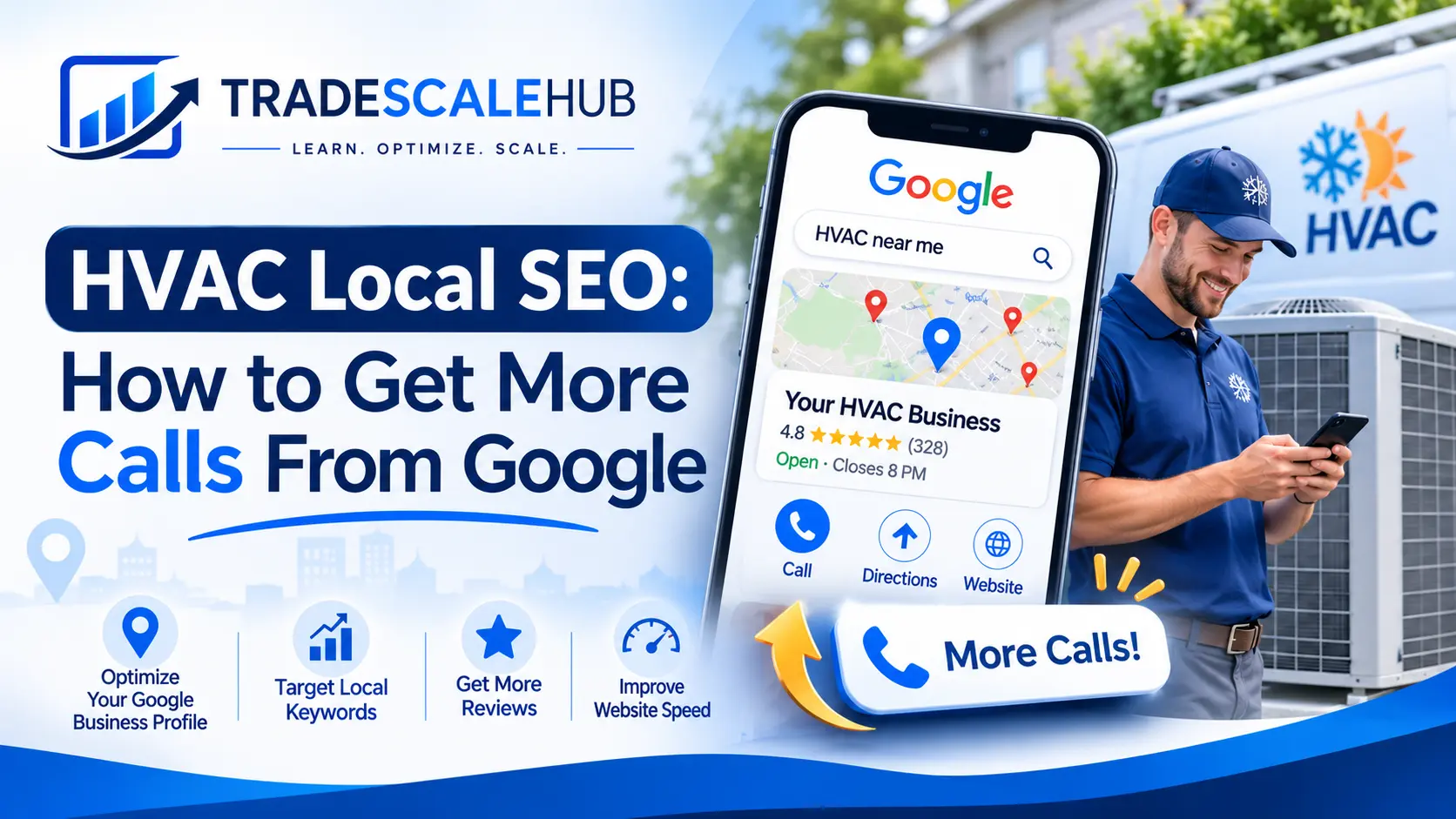
When a furnace dies in January or an air conditioner quits in July, nobody flips through a phone book. They pick up a phone, search Google, and call one of the first three businesses they see. That moment decides who gets the job, and HVAC local SEO is how you make sure that business is yours.
This guide explains HVAC local SEO in plain language. You will learn how Google chooses which heating and cooling companies to show, what to fix on your Google Business Profile and website, how to earn reviews and citations, and how to measure whether more calls are actually coming in. Whether you run a one-truck shop or a multi-crew company, the steps below apply.
What Is HVAC Local SEO?
HVAC local SEO is the practice of improving your online presence so your heating, ventilation and air conditioning company appears when nearby customers search for services like “AC repair near me,” “furnace installation in [city],” or “emergency heating repair.” Instead of competing with every HVAC site in the country, you compete with companies in your own service area.
HVAC local SEO work covers three main surfaces: the Google Map Pack (the three listings with a map), the regular organic results below it, and Google’s AI-generated summaries that increasingly pull from the same signals. A strong HVAC local SEO program improves all three at the same time because they rely on the same foundations: an accurate business profile, relevant website content, trusted reviews and consistent listings across the web.
If you are new to the wider topic, our local SEO guide for small businesses covers the basics, and our dedicated page on HVAC SEO explains how the industry-specific pieces fit together. For another perspective on the fundamentals, this local SEO guide from IFFARIS is a useful companion read.
Why HVAC Local SEO Matters for Your Business
Heating and cooling is one of the most local, urgent and high-value service categories online. A single installation can be worth thousands of dollars, and a maintenance customer can stay with you for a decade. That makes every ranking position valuable.
Here is why HVAC local SEO deserves a place in your marketing budget:
- Searchers are ready to buy. Someone searching “AC not cooling” needs help today. They are not researching; they are choosing a company.
- The Map Pack takes most of the clicks. The three listings at the top capture a large share of calls, especially on mobile.
- Trust is built before the first call. Reviews, photos and a professional website reassure homeowners before they speak to anyone.
- It compounds. Paid ads stop the moment you stop paying. HVAC local SEO keeps producing calls month after month once the foundation is built.
- Seasonal demand is predictable. You can prepare your pages and profile ahead of summer and winter peaks instead of scrambling.
Companies that ignore HVAC local SEO usually depend on lead-selling platforms, where they pay for shared leads and compete on price. Companies that invest in it own their visibility and receive exclusive, higher-intent calls.
How Google Ranks HVAC Companies Locally
Google has said for years that local results are based mainly on three factors: relevance, distance and prominence.
Relevance is how well your profile and website match what the person searched for. If you only list “contractor” as a category, you will lose to a competitor who clearly shows they are an air conditioning repair service.
Distance is how close your business is to the searcher or to the location they typed. You cannot change where your shop sits, but you can understand how far your reach goes. Our article on the local SEO radius explains how Google determines the area where you can realistically rank.
Prominence is how well known and trusted your company appears. Reviews, backlinks, mentions, citations and website authority all feed into it.
Understanding these three signals changes how you plan your HVAC local SEO. Instead of randomly trying tactics, you can ask: Does this improve relevance, reduce the effect of distance, or increase prominence? If the answer is no, skip it. For a deeper breakdown, see our guide to Google Business Profile ranking factors and the IFFARIS explanation of the same factors.
Step 1: Start With an HVAC Local SEO Audit
Before you change anything, find out where you stand. A proper HVAC local SEO audit looks at your Google Business Profile, your website, your listings, your reviews and your competitors.
Check these items first:
- Does your Google Business Profile show the correct name, address, phone number and hours?
- Do you appear in the Map Pack for your top five searches in your main city?
- Does every service you offer have its own page on your website?
- Are your phone number and address identical everywhere online?
- How many reviews do you have compared with the top three competitors, and how recent are they?
- Does your site load quickly on a mobile connection?
Our local SEO audit guide and local SEO checklist walk through each of these checks. If you want a quick technical look, try the free SEO audit tool.
Write down your results. An audit gives you a baseline, and a baseline is the only way to prove later that your HVAC local SEO work is paying off.
Step 2: Optimize Your Google Business Profile
For most heating and cooling companies, the Google Business Profile is the single most important asset in HVAC local SEO. It drives Map Pack visibility, phone calls, direction requests and website visits.
Choose the Right Categories
Pick one primary category that matches your main revenue source, such as “HVAC contractor,” “Air conditioning repair service” or “Heating contractor.” Then add secondary categories for the other work you really do, such as “Furnace repair service” or “Air conditioning contractor.” Do not add categories for services you do not offer. Our partner guide on Google Business Profile categories explains how to choose them.
Fill Every Section Completely
Add your service areas, business hours, holiday hours, a clear description, products and services, attributes and your appointment link. Be honest and specific. A profile that says “24/7 emergency AC repair in Dallas, TX” is more useful than one that says “quality service.”
Add Real Photos Regularly
Upload photos of your trucks, technicians, completed installations and your team. Fresh, real images build trust and improve engagement. See our tips on Google Business Profile photos for what to upload and how often.
Use Posts, Q&A and Services
Publish short posts about seasonal tune-ups, financing offers and maintenance plans. Answer common questions yourself in the Q&A section. Add your core services with short descriptions, as explained in our guide to Google Business Profile services.
For a complete walkthrough, follow our Google Business Profile optimization guide and the Google Business Profile checklist. Treat the profile as a living asset. The strongest HVAC local SEO campaigns update it every week.
One warning: never use a fake address, a virtual office or a keyword-stuffed business name. Profiles break rules quickly and get suspended. If it happens to you, read our article on what to do when a Google Business Profile is suspended.
Step 3: Research Keywords Homeowners Actually Use
Good HVAC local SEO starts with the words customers type. Most heating and cooling searches fall into four groups:
- Emergency intent: “AC repair near me,” “furnace not working,” “24 hour HVAC service”
- Service intent: “air conditioner installation [city],” “duct cleaning [city],” “heat pump repair”
- Commercial intent: “HVAC maintenance plan,” “best HVAC company in [city],” “HVAC financing”
- Question intent: “why is my AC freezing up,” “how much does a new furnace cost”
Emergency and service keywords bring the fastest calls. Question keywords build trust and capture people earlier in their decision. A balanced HVAC local SEO plan targets all four.
Combine each service with each city or neighborhood you serve, then group the terms by page. Our guides to local keyword research and long-tail keywords show how to build that list without expensive tools. Beginners can also read this keyword research basics guide on IFFARIS.
Use Google Search Console to see which queries already bring impressions. Our walkthrough on Google Search Console keywords explains how to turn that data into new content ideas.
Step 4: Build a Website Structure That Supports HVAC Local SEO
Your website must prove to Google that you offer each service in each area. A single “Services” page with a long list will not do that. Strong HVAC local SEO needs a clear structure.
Create Dedicated Service Pages
Build a separate page for each core service: AC repair, AC installation, furnace repair, furnace installation, heat pumps, duct cleaning, indoor air quality, ductless mini-splits and maintenance plans. Each page should explain the problem, your process, pricing factors, brands you work with, your guarantees and a clear call to action. Our guide to service pages SEO gives a page-by-page template.
Create Location Pages the Right Way
If you serve several cities, create a page for each one with unique content: local landmarks, common issues in that climate, real projects and local testimonials. Do not copy one page and swap the city name. Google sees that pattern as thin content. If you operate from several offices, read our guide on multi-location local SEO.
Keep URLs and Navigation Simple
Use short, readable URLs such as /ac-repair/ or /furnace-installation/dallas-tx/. This SEO-friendly URL structure guide explains the details. Keep your phone number in the header and make it tap-to-call on mobile.
For a full blueprint, see our resource on HVAC website SEO. Site structure is one of the most overlooked parts of HVAC local SEO, and fixing it often produces the fastest gains.
Step 5: Write On-Page Content That Converts
Ranking is only half the job in HVAC local SEO. The page must also persuade a worried homeowner to call. Effective HVAC local SEO content does both.
Title tags and headings. Put the service and city near the front of the title, such as “AC Repair in Dallas, TX | Same-Day Service.” Keep titles under about 60 characters. Our guide to local SEO title tags has formulas you can copy, and the meta tag generator helps you preview them.
Opening paragraph. State the service, the city and your main benefit in the first two sentences. Visitors decide in seconds whether they are in the right place.
Trust elements. Show licenses, insurance, manufacturer certifications, warranties, technician photos and review snippets above the fold.
Clear calls to action. Use a phone number, a short quote form and a booking button. Make them visible without scrolling.
Helpful details. Explain how long repairs take, what affects price, signs that a system needs replacement and how maintenance saves money. Detailed answers earn trust and often get pulled into featured snippets and AI summaries.
Avoid keyword stuffing. Write naturally for people first. An HVAC local SEO page that reads like a salesperson wrote it for a search engine will lose both rankings and calls.
Step 6: Earn More Google Reviews
Reviews are one of the strongest signals in HVAC local SEO. They influence rankings, click-through rate and the final decision to call. A company with 300 recent, detailed reviews will usually beat a company with 30 old ones.
Practical ways to collect reviews for HVAC local SEO:
- Ask at the right moment. Request the review when the technician finishes and the customer is happy, by text message with a direct link.
- Make it one tap. Use your Google review short link or QR code.
- Train technicians. Give them a simple script and make reviews part of the job.
- Follow up once. A gentle reminder the next day doubles response rates.
- Reply to every review. Thank positive reviewers and respond calmly to negative ones. Mention the service and city naturally when it fits.
Never buy reviews or offer rewards in exchange for them. Google can remove them and penalize your profile. Our guide on how to get more Google reviews shares templates, and the IFFARIS review guide adds more strategies.
Aim for a steady flow, such as several new reviews every week, rather than a burst followed by silence. Consistency is a quiet but powerful part of HVAC local SEO.
Step 7: Clean Up Citations and NAP Consistency
A citation is any mention of your business name, address and phone number (NAP) on another website, such as Yelp, the Better Business Bureau, Angi, industry directories and local chambers of commerce. Search engines compare these details to confirm your business is real and trustworthy.
If one directory lists an old phone number and another uses “Suite 4” while your profile does not, Google loses confidence. Fix mismatches, remove duplicates and keep every listing identical. Our guide to NAP consistency explains what to check, and our article on local citations lists the directories that matter most. You can also read the IFFARIS guide to local citations.
Prioritize quality over quantity. A listing on a respected HVAC manufacturer’s dealer locator is worth more than a dozen low-quality directories. Clean, consistent citations are the quiet backbone of HVAC local SEO.
Step 8: Add Local Business Schema Markup
Schema markup is code that tells search engines exactly what your page is about. For an HVAC company, LocalBusiness or HVACBusiness schema can describe your name, address, phone number, hours, service area, services and review ratings.
Schema does not guarantee higher rankings, but it removes ambiguity and can make your listing eligible for richer results. Add it to your homepage, contact page and each location page. Our walkthrough on local business schema explains the setup, and the free schema markup generator creates the code for you. Always test the result before publishing.
Structured data is a small technical step with a large payoff, and most competitors skip it. That makes it an easy edge in HVAC local SEO.
Step 9: Build Local Links and Real-World Authority
Backlinks from relevant local sites tell Google that your company is established in the community. In HVAC local SEO, a handful of strong local links usually beats hundreds of random ones.
Good sources for HVAC local SEO links include:
- Local chambers of commerce and business associations
- Sponsorships of youth sports teams, charities and community events
- Manufacturer and supplier dealer pages (Carrier, Trane, Lennox, Rheem and others)
- Local news stories, such as free tune-up drives for seniors or tips for heat waves
- Partnerships with home builders, realtors, property managers and electricians
- Guest articles on local blogs, which our partner article on guest posting for SEO covers
For step-by-step tactics, read our guides to local link building and local backlinks. Avoid paid link schemes and private blog networks. The goal is relevance and real relationships, not volume.
Step 10: Make Your Website Fast and Mobile Friendly
Most emergency HVAC searches happen on a phone, often in a hot attic or a cold living room with a weak signal. If your site takes six seconds to load, the customer taps back and calls the next company.
Focus on these basics:
- Compress and properly size images
- Use reliable hosting and caching
- Remove unnecessary plugins and scripts
- Use a mobile-first design with a sticky call button
- Pass Core Web Vitals on real-user data
Our article on Core Web Vitals explains the metrics, and how to improve website speed provides a checklist. You can test pages with this website speed test guide. Speed will not rescue weak content, but slow pages can quietly cancel the benefit of every other HVAC local SEO improvement you make.
Step 11: Improve Your Map Pack Visibility
The Map Pack is where many HVAC calls start, so it deserves its own focus in HVAC local SEO. Beyond a complete profile, reviews and citations, these tactics help:
- Engagement signals. Calls, direction requests and website clicks from your profile show Google that people want to contact you.
- Local relevance on your website. Embed a map, list your service areas and mention nearby neighborhoods naturally.
- Service-area clarity. List the cities you actually serve rather than an entire state.
- Consistent activity. Posts, photos and review replies show an active, trustworthy business.
Our article on Google Maps SEO optimization goes deeper into ranking in the pack. Remember that Map Pack positions change by searcher location, so check rankings from several points around your service area, not just from your office.
Common HVAC Local SEO Mistakes to Avoid
Many heating and cooling companies lose calls through avoidable errors. Watch for these:
- One page for every service. Google cannot rank a single page for ten different topics.
- Duplicate location pages. Swapping city names without adding real local details gives you thin content.
- Inconsistent business details. Different phone numbers or addresses across the web damage trust.
- Ignoring reviews. Unanswered reviews and long gaps between new ones signal a neglected business.
- Wrong categories. Using only a generic primary category hides you from specific searches.
- No tracking. Without call tracking and analytics, you cannot tell which efforts work.
- Chasing every tactic at once. Spreading effort too thin slows results. Fix the foundation first.
- Expecting overnight results. HVAC local SEO is a long-term channel.
Our general article on common SEO mistakes covers more pitfalls that apply here too.
How to Measure HVAC Local SEO Results
You cannot improve what you do not measure. Track a small set of metrics every month:
- Calls and form leads from Google Business Profile, your website and tracking numbers
- Map Pack rankings for your top services across several locations
- Organic traffic and impressions in Google Search Console
- Review count, rating and review velocity
- Booked jobs and revenue attributed to organic search
Set up Google Business Profile Performance, Google Search Console and a call-tracking number on your site. If you are unsure how to read the data, our guide to the Google Search Console performance report explains each section. Compare numbers month to month and season to season, since heating and cooling demand rises and falls with the weather.
The most important number is not a ranking. It is the number of booked jobs that came from search. A good HVAC local SEO campaign should raise that figure steadily.
How Long Does HVAC Local SEO Take?
Most companies see early movement in 6 to 12 weeks, especially from profile fixes, review growth and citation cleanup. Stronger gains in organic rankings and Map Pack positions usually appear between 3 and 6 months, and competitive cities can take longer. Timing depends on your market, your starting point, your competitors and how consistently you work.
Treat HVAC local SEO like preventive maintenance on a system: regular small actions prevent expensive problems and keep performance high. A simple 90-day plan might look like this:
- Month 1: Audit, fix the Google Business Profile, clean citations, set up tracking.
- Month 2: Build or improve service pages, add schema, launch a review process.
- Month 3: Add location pages, start local link building, publish helpful blog content.
After that, continue improving and expanding. Our overall SEO strategy guide offers a longer growth framework.
DIY or Hire an Agency?
You can handle the basics of HVAC local SEO yourself: claim and complete your profile, ask for reviews and fix your listings. Many owners do this in the first few months. The challenge is time. Between jobs, estimates and payroll, content and link building often stall.
Hiring a specialist makes sense when you want faster results, operate in a competitive market or serve multiple locations. Before you hire, ask for case studies, a clear scope of work, reporting that tracks calls and booked jobs, and no long-term lock-in. Be cautious of guarantees of “number one rankings.” To understand typical costs, read our breakdown of local SEO pricing. If you would like help, you can contact the Trade Scale Hub team.
HVAC Local SEO Checklist
Use this HVAC local SEO list as a quick reference:
- Claim and verify your Google Business Profile
- Choose accurate primary and secondary categories
- Add services, service areas, hours and real photos
- Publish weekly posts and answer Q&A
- Build a separate page for each core service
- Create unique location pages for each city you serve
- Write clear title tags, headings and calls to action
- Add LocalBusiness schema
- Fix NAP inconsistencies and remove duplicate listings
- Collect and reply to reviews every week
- Earn local links from chambers, suppliers and sponsorships
- Improve mobile speed and Core Web Vitals
- Track calls, rankings and booked jobs monthly
Work through the list in order. Each item strengthens the next, and together they form a complete HVAC local SEO system.
Frequently Asked Questions
What is HVAC local SEO?
It is the process of optimizing your Google Business Profile, website, reviews and listings so your heating and cooling company ranks in local search and Map Pack results when nearby customers need service.
How much does HVAC local SEO cost?
Costs vary by market and scope. Many small companies spend a few hundred to a few thousand dollars per month with an agency, while DIY costs mainly time and tools. Our pricing guide explains typical ranges.
Is HVAC local SEO better than paid ads?
They serve different goals. Ads bring fast calls but stop when the budget ends. HVAC local SEO takes longer but builds lasting visibility and usually delivers a lower cost per lead over time. Many companies use both.
How many reviews do I need to rank?
There is no fixed number. Look at the top three businesses in your area and aim to match or exceed their review count, rating and recent activity.
Do I need a separate page for every city?
If you serve several cities and want to rank in each, yes, but each page must have unique, useful content. Avoid copying the same text with a different city name.
Can I do HVAC local SEO myself?
Yes, the basics are manageable for an owner. Complex tasks such as technical fixes, content production and link building are easier with professional help.
Final Thoughts
Homeowners search at their most stressful moments, and the companies that appear first earn the call. HVAC local SEO gives you a reliable way to be there: a complete Google Business Profile, service and location pages that match real searches, a steady stream of reviews, consistent listings, local links and a fast website.
Start with the audit, fix the biggest gaps, and keep improving every month. Over time, the calls will grow and your dependence on shared-lead platforms will shrink. Make HVAC local SEO part of how you run the business, not a one-time project, and Google will keep sending customers to your door.
Ready to go deeper? Explore our HVAC SEO guide, check your content with the keyword density checker, or reach out to our team for a custom plan.
