
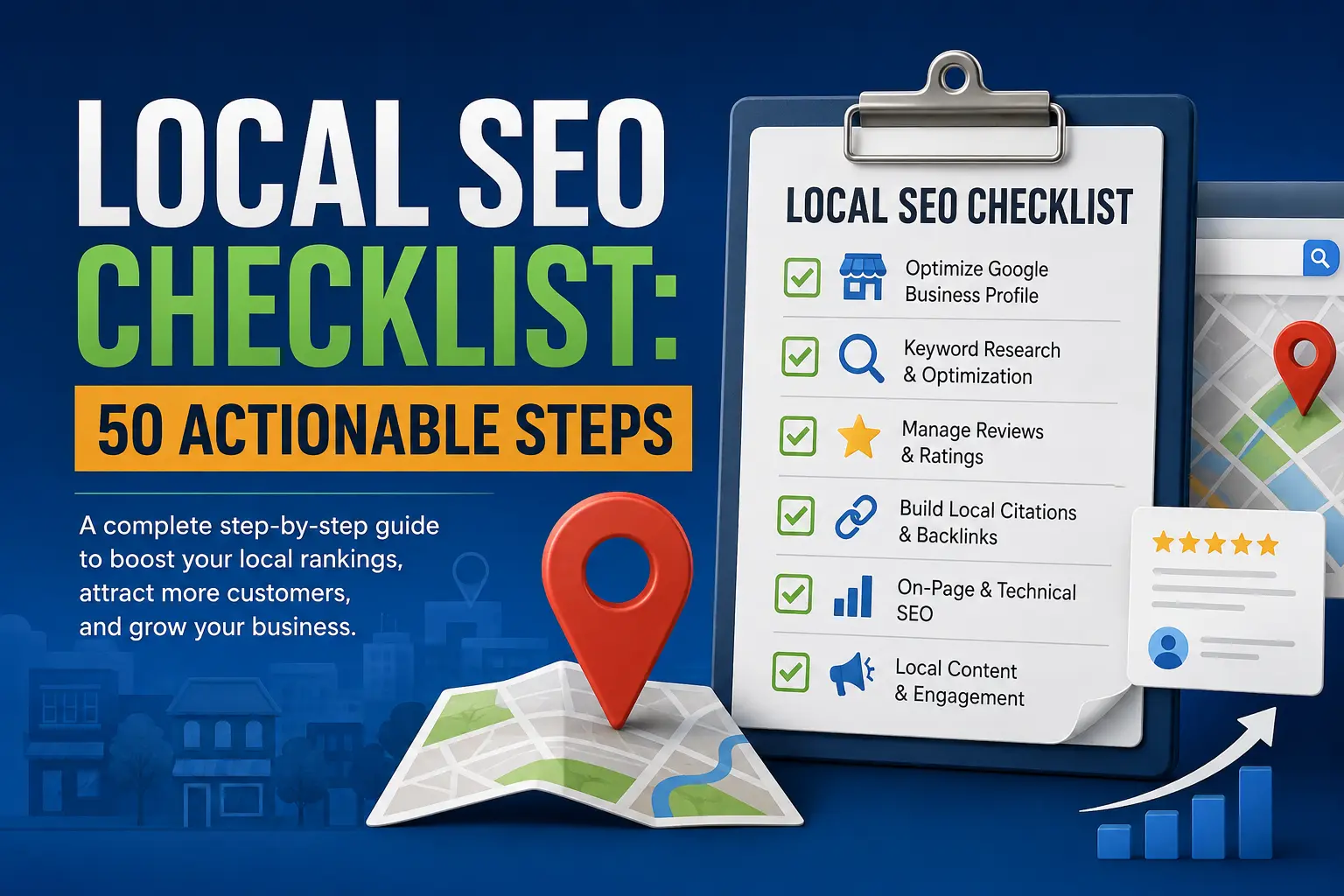
If you run a service business and your phone isn’t ringing from Google, the problem usually isn’t luck. It’s structure. A proper local seo checklist gives you that structure — a clear, ordered sequence of tasks that moves your business from invisible to unavoidable in local search results. This local seo checklist is built specifically for local and trade service businesses — electricians, plumbers, HVAC contractors, locksmiths, appliance repair techs, and similar companies that live or die by local visibility.
Most business owners know they need “better SEO,” but very few have a working local seo checklist they can actually follow step by step. They read one blog post about Google Business Profile, another about citations, another about reviews, and end up with fragments instead of a system. This guide fixes that. Below you’ll find 50 actionable steps organized into logical categories, so you can work through this local seo checklist in order and track your progress as you go.
We’ll cover Google Business Profile optimization, on-page SEO, local citations, review generation, technical SEO, content strategy, and link building — everything a complete checklist needs to actually move rankings. Bookmark this page, because you’ll want to return to this guide every quarter to re-audit your progress.
Think of this as a working document rather than a one-time read. Print it, save it to a shared folder, or turn it into a spreadsheet with a column for “done” and “next review date.” The businesses that see the biggest gains from local search aren’t necessarily the ones with the biggest marketing budgets — they’re the ones who actually finish the list instead of reading about it and moving on.
A checklist only works if someone is accountable for each line item, so if you have a small team, assign owners to each section before you start: one person for Google Business Profile and reviews, another for website content and technical fixes, and a third (or an outside partner) for link building and citations.
It’s also worth setting expectations up front. Local search results shift constantly as Google tests new layouts, weights signals differently by industry, and rolls out algorithm updates. No single document can guarantee a specific ranking position, and anyone who promises that isn’t being straight with you. What this guide can promise is a comprehensive, prioritized set of actions that consistently correlates with stronger local visibility across the trade service industries we work with most — electrical, plumbing, HVAC, locksmith, and appliance repair.
Why You Need a Local SEO Checklist in 2026
Local search has gotten more competitive every year, and 2026 is no exception. AI-powered search results, the local map pack, and organic listings all compete for the same handful of visible spots on a results page. Without a documented local seo checklist, it’s incredibly easy to skip steps, forget maintenance tasks, or focus all your energy on one area (like reviews) while ignoring others (like technical SEO) that quietly sink your rankings.
A checklist like this also protects you from wasted spend. Agencies and freelancers often pitch vague “local SEO packages” without explaining what’s actually being done. When you have your own local seo checklist, you know exactly what should happen and can hold any vendor accountable to it — and you can spot immediately when someone is billing you for work that was never actually completed.
There’s also a competitive angle worth naming directly. Most small and mid-sized service businesses are still not doing local SEO systematically. They might have claimed their Google Business Profile years ago and never touched it again, or they might have a handful of citations from an old directory submission service and nothing since. That means a business willing to work through a genuinely thorough local seo checklist, section by section, gains ground quickly — not because the tactics are secret, but because so few competitors bother to finish the work.
Before diving into the 50 steps, it helps to understand where local SEO fits into your broader marketing strategy. If you haven’t already, review our guide on the complete local SEO guide for small businesses, which lays the foundation this checklist builds on. It’s also worth understanding, at a basic level, how search engines evaluate relevance and authority in the first place — our what is SEO primer is a good starting point if you’re newer to this side of marketing.
Section 1: Google Business Profile Foundations (Steps 1–10)
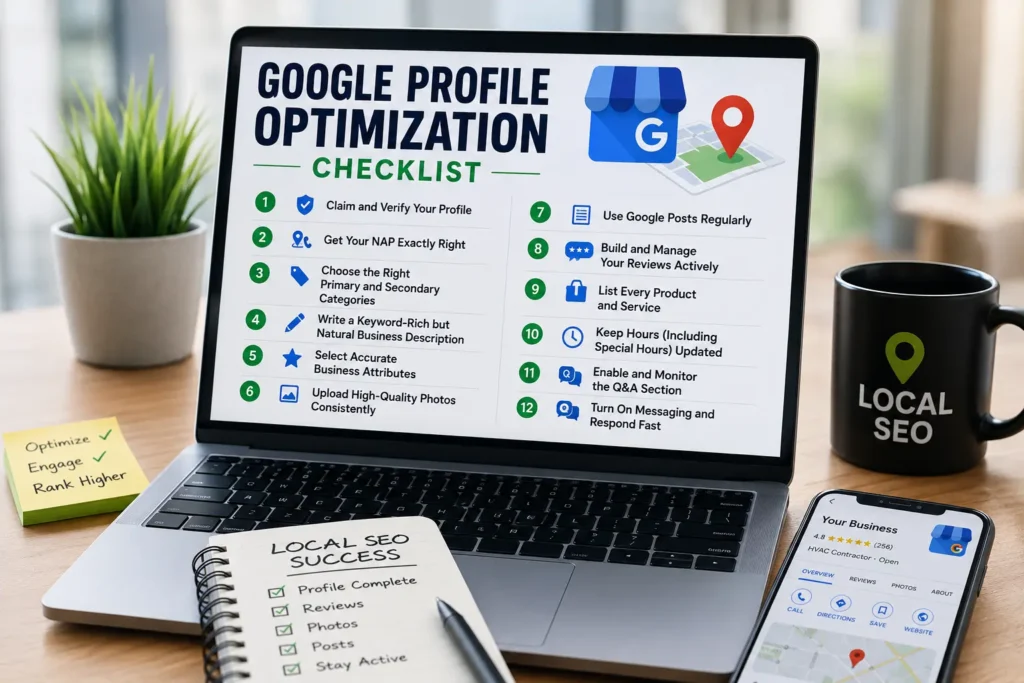
Your Google Business Profile (GBP) is the single most important asset in any local seo checklist, since it directly powers your map pack visibility — the block of three business listings with a map that appears above organic results for most “near me” and city-plus-service searches. If you only have time to do one section this month, do this one first.
- Claim and verify your Google Business Profile. This is step one of any local seo checklist — an unverified or unclaimed listing simply won’t compete.
- Choose the most accurate primary category. Google weighs this heavily, and getting it wrong quietly undermines the rest of your local seo checklist.
- Add every relevant secondary category that genuinely applies to your services, without keyword stuffing.
- Write a complete, keyword-aware business description that mentions your services and service area naturally.
- Use your exact legal business name — no keyword-stuffed variations, which violate Google’s guidelines and can get a profile suspended.
- Add accurate business hours, including holiday hours, and keep them updated.
- Upload high-quality photos of your team, vehicles, completed jobs, and storefront (if applicable).
- Set your service areas correctly if you’re a service-area business without a public storefront.
- Add products and services with descriptions inside your GBP dashboard.
- Enable messaging and Q&A monitoring so you can respond quickly to potential customers.
If your profile has ever been flagged or removed, read our article on why Google Business Profiles get suspended before continuing through this local seo checklist, since a suspended profile can undo months of work.
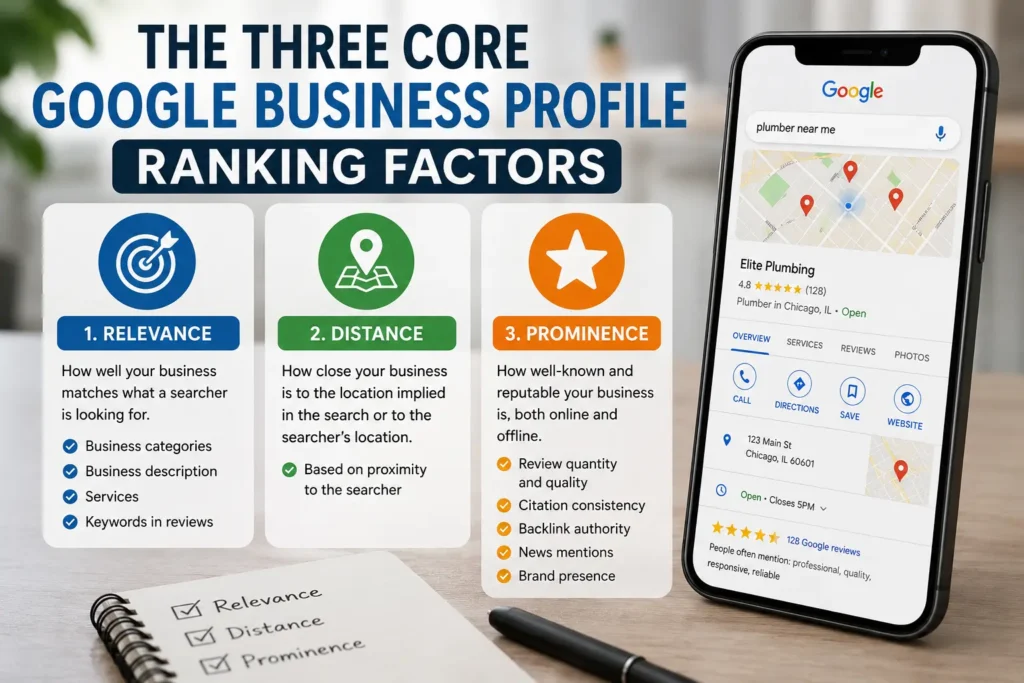
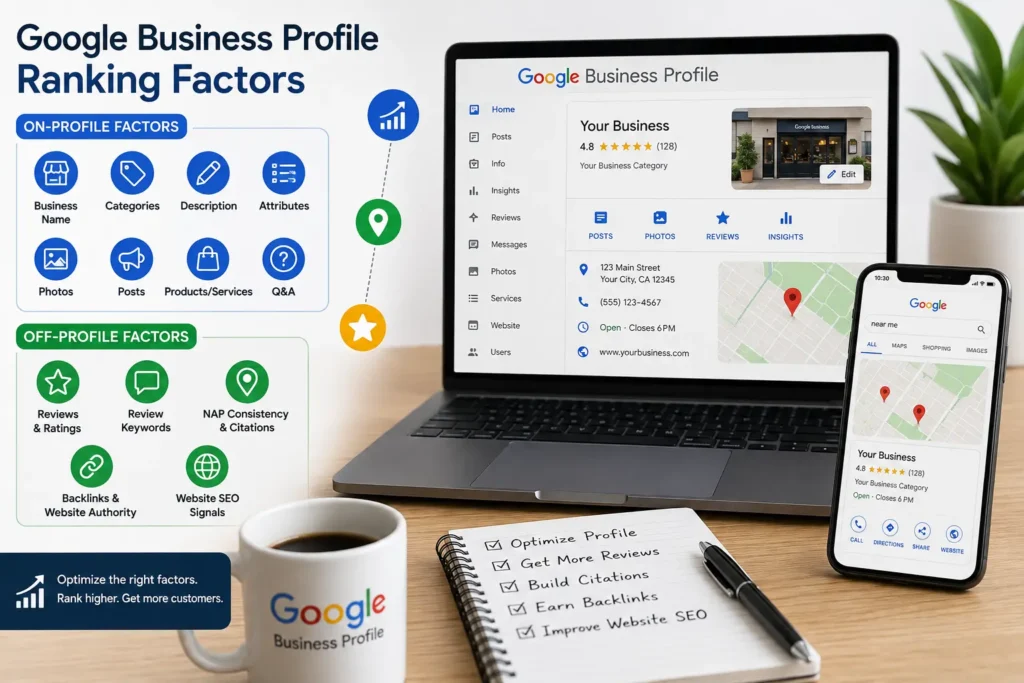
For a deeper technical breakdown of what actually moves the needle inside your profile, our piece on Google Business Profile ranking factors pairs well with this section. On the external side, the guide to Google Business Profile optimization and the breakdown of Google Business Profile ranking factors both offer a second perspective worth comparing against your own setup.
Most of these ten steps take a single afternoon to complete properly, yet a huge share of local businesses never finish them. Set a calendar reminder to revisit your profile monthly — Google adds new features to Business Profile regularly, and profiles that use newer features (like short-form updates or booking links) often get a visibility edge over ones that sit untouched.
Section 2: Reviews and Reputation (Steps 11–17)
Reviews are a ranking factor and a conversion factor at the same time, which is why they earn their own dedicated section in this list. A steady stream of recent, detailed reviews signals to Google that your business is active and trusted, and it signals the same thing to the customer scrolling through search results on their phone, trying to decide who to call.
- Set up a simple review request system — a text, email, or QR code you hand out after every job.
- Respond to every review, positive or negative, within 48 hours.
- Never buy or fake reviews. It’s the fastest way to get your profile suspended and undermine your entire local seo checklist.
- Monitor review velocity so you’re gaining reviews steadily rather than in unnatural bursts.
- Ask satisfied customers to mention specific services in their reviews (naturally, not scripted) — this helps with keyword relevance.
- Track your review score across every platform, not just Google, including Yelp and Facebook.
- Address negative reviews professionally and publicly, showing future customers how you handle problems.
For a full walkthrough of this part of the process, see our guide on how to get more Google reviews. A good rule of thumb: aim for a steady trickle of a few new reviews every week rather than a burst of twenty in one weekend, since the latter pattern can look artificial and occasionally triggers manual review from Google’s spam systems.
Section 3: Local Citations and NAP Consistency (Steps 18–24)
Citations — mentions of your business Name, Address, and Phone number (NAP) across the web — remain a core pillar of local search visibility, even though their influence has shifted somewhat as Google leans more heavily on Business Profile signals. They still matter, particularly for newer businesses that haven’t built up much authority yet.
- Audit your existing citations for inconsistencies in name, address, or phone number.
- Fix inconsistent NAP data across every directory you find.
- Build citations on major data aggregators (like Foursquare and Data Axle) that feed dozens of smaller directories.
- Get listed in industry-specific directories relevant to your trade (HVAC associations, plumbing directories, etc.).
- Get listed in local chamber of commerce and city-specific directories.
- Avoid duplicate listings, which confuse both Google and potential customers.
- Recheck citations quarterly as part of your ongoing local seo checklist maintenance.
This is one of the most overlooked parts of any local seo checklist, so our dedicated guide to local citations is worth reading in full before you start building links.
Section 4: On-Page and Website SEO (Steps 25–33)
Your website is where clicks convert into calls and bookings, making on-page optimization essential to this list. A business can rank well and still lose the job if the page that ranks doesn’t clearly explain the service, show trust signals, and make it obvious how to get in touch.
- Create a dedicated page for every service you offer, rather than cramming everything onto one page.
- Create a dedicated page for every city or neighborhood you serve, when it makes sense for your business.
- Include your target city and service in title tags and H1 headings on every page.
- Write unique meta titles and descriptions for every page — no duplicates.
- Add your NAP information to your website footer on every page, matching your citations exactly.
- Embed a Google Map on your contact page showing your service area or location.
- Add schema markup (LocalBusiness, Service, and Review schema) so search engines understand your business data.
- Make sure your site is mobile-friendly, since most local searches happen on phones.
- Internally link your service pages to your location pages, and vice versa, to reinforce topical relevance.
If on-page fundamentals feel shaky, revisit our guide on on-page SEO before moving further down this local seo checklist.
Section 5: Technical SEO and Site Performance (Steps 34–40)
Technical health quietly determines whether Google can even find and rank the pages you’ve optimized, so it deserves real attention in this local seo checklist. It’s also the section business owners are most likely to skip, simply because the problems aren’t visible on the surface — a page can look perfectly fine to a human visitor while quietly failing to load properly for Google’s crawlers, or loading so slowly on mobile that visitors bounce before the page even finishes rendering.
- Run a full technical SEO audit to catch crawl errors, broken links, and indexing issues.
- Improve your Core Web Vitals scores, since slow-loading pages hurt both rankings and conversions.
- Submit and monitor your XML sitemap in Google Search Console.
- Fix any indexing errors flagged in Search Console before they compound.
- Ensure HTTPS is enabled sitewide with no mixed-content warnings.
- Improve page speed, particularly on mobile, by compressing images and reducing unnecessary scripts.
- Check for and fix duplicate content issues, especially across multiple location pages.
A thorough technical pass is non-negotiable in any local seo checklist — our guides on Core Web Vitals and website speed and SEO go much deeper into this section. For monitoring indexing specifically, see our article on Google Search Console indexing, and for the broader Search Console workflow, our Google Search Console guide is a useful companion.
Section 6: Content and Keyword Strategy (Steps 41–45)
Content is what fills out the rest of this local seo checklist and gives you something new to rank for every month.
- Conduct keyword research specific to your service area, not just generic industry terms.
- Target low-competition, long-tail keywords early, before competing for high-volume terms.
- Publish blog content that answers real customer questions, building topical authority over time.
- Update older content regularly rather than only publishing new posts.
- Track keyword rankings monthly to see which parts of your local seo checklist are paying off.
For help identifying the right terms to target, our guide on low-competition keywords and our piece on keyword research for local businesses both belong on your reading list alongside this local seo checklist.
Section 7: Link Building and Off-Page Signals (Steps 46–50)
The final section of this local seo checklist covers off-page authority — the signals that tell Google other sites trust and reference yours.
- Earn backlinks from local news sites, blogs, and community organizations.
- Sponsor local events or sports teams in exchange for a website mention and backlink.
- Build relationships with complementary local businesses for natural cross-referrals and links.
- Guest post on relevant industry blogs to build authority and referral traffic.
- Audit your backlink profile periodically to disavow spammy or harmful links.
Our guides on link building and link building techniques expand on this final section in more detail. For a broader perspective on acquiring backlinks, the guide on how to get backlinks and the piece on link building strategies are both useful external references.
Off-page work tends to feel less immediately rewarding than the earlier sections, since links take longer to acquire and their impact shows up gradually rather than overnight. Resist the temptation to buy links in bulk from low-quality directories or link farms — that shortcut tends to trigger algorithmic penalties that are far more painful to recover from than the slow, steady approach of earning a handful of genuinely relevant local links each month.
How Often Should You Revisit Your Local SEO Checklist?
A local seo checklist isn’t a one-time project — it’s a maintenance routine. We recommend a full pass through every step in this local seo checklist once a quarter, with lighter monthly check-ins on reviews, rankings, and citation accuracy. Businesses that treat their local seo checklist as an ongoing habit, rather than a single sprint, consistently outperform competitors who set it and forget it.
If you’re not sure where your current gaps are, start with a proper audit. Our local SEO audit guide for 2026 and companion SEO audit checklist will help you benchmark against this local seo checklist and prioritize what to fix first.
Common Mistakes That Undermine a Local SEO Checklist
Even with a solid local seo checklist in hand, businesses still trip up in predictable ways. Inconsistent NAP data across directories is one of the most common issues, quietly confusing Google about which business is “real.” Ignoring negative reviews instead of responding is another — it signals neglect to both Google and potential customers. Skipping technical SEO in favor of only content or only citations is a third mistake; every part of this local seo checklist depends on the others working together.
For a broader look at what tends to go wrong, our article on common SEO mistakes pairs well with this section, and our guide on how to rank on Google covers industry-specific nuances worth layering onto this local seo checklist.
Industry-Specific Notes for This Local SEO Checklist
While the 50 steps above apply to almost any local service business, a few industries benefit from extra attention. Electricians should lean harder into service-area pages and licensing trust signals — see our electrician SEO guide for specifics. Locksmiths face unique review-velocity challenges tied to emergency calls, covered in our locksmith SEO guide. Plumbers should pay close attention to seasonal keyword shifts, discussed in our plumbing SEO guide. HVAC companies benefit from dedicated seasonal landing pages, detailed in our HVAC SEO guide and HVAC website SEO guide. Appliance repair businesses should prioritize brand-and-model specific service pages, covered in our appliance repair SEO guide.
Each of these guides applies the same underlying local seo checklist principles to a specific trade, so use them to fine-tune the general framework above.
Tools That Help You Execute This Local SEO Checklist Faster
You don’t need an expensive software stack to work through this local seo checklist, but a few tools make the process faster. Google Search Console and Google Business Profile Manager are both free and essential — see our guide on how to use Google Search Console if you’re new to the platform. For technical audits, our technical SEO checklist is a solid companion resource. And if you’re curious how AI tools fit into modern workflows, our piece on AI and SEO explains where automation genuinely helps and where it doesn’t.
How Much Time and Budget Should You Set Aside?
One question we hear constantly from trade business owners is how much this actually costs to execute. The honest answer is that most of the steps above cost time rather than money. Claiming and optimizing your Business Profile, requesting reviews, fixing NAP inconsistencies, and writing service pages are all things a business owner or office manager can do without hiring anyone. Where budget typically comes in is citation-building services (which save hours of manual directory submissions), professional photography for your profile and website, and ongoing content production if you don’t have time to write it yourself.
A realistic timeline for a small service business working through this checklist alone, part-time, is about eight to twelve weeks for the first full pass — Google Business Profile and reviews in weeks one and two, citations and on-page fixes in weeks three through six, technical SEO in weeks seven and eight, and content plus link building running continuously afterward. Businesses that bring in outside help typically compress that timeline to four to six weeks, simply because more people are working the list in parallel.
Whatever your budget, resist the temptation to skip straight to link building or paid citation services before your Google Business Profile and website are actually in good shape. Building authority toward a broken or incomplete foundation wastes the investment.
Measuring Progress: What to Track Along the Way
A checklist is only useful if you can tell whether it’s working. Track four numbers on a simple monthly basis: your average map pack position for your top five target keywords, your total review count and average rating, your organic traffic to service and location pages, and your phone call or form submission volume attributed to organic and map pack traffic. None of these require expensive software — Google Search Console and your Business Profile dashboard cover most of it for free.
Resist the urge to check rankings daily. Local rankings fluctuate constantly based on searcher location, time of day, and ongoing algorithm testing, and daily checking mostly just creates stress without useful signal. A monthly or biweekly review is enough to spot real trends.
Frequently Asked Questions About Local SEO Checklists
How long does it take to see results from a local seo checklist? Most businesses start seeing measurable movement within 60–90 days of consistently working through a local seo checklist, though competitive markets can take longer. Google Business Profile changes tend to show impact fastest, while content and link-building steps compound more slowly.
Can I complete this local seo checklist myself, or do I need an agency? Many of these steps — especially Google Business Profile optimization, citations, and review requests — are entirely doable in-house. Technical SEO and ongoing content production are where most business owners eventually bring in help, simply because of time constraints rather than difficulty.
What’s the single highest-impact item on this local seo checklist? For most local service businesses, a fully optimized and consistently updated Google Business Profile combined with steady review generation delivers the fastest visible impact, though none of the other steps in this local seo checklist should be skipped indefinitely.
Does this local seo checklist apply to businesses without a physical storefront? Yes. Service-area businesses simply configure their Google Business Profile service area instead of a public address, and should lean more heavily on service-specific and city-specific landing pages, both covered earlier in this local seo checklist.
Final Thoughts on Building Your Local SEO Checklist
Ranking locally in 2026 isn’t about chasing algorithm secrets — it’s about consistently executing a complete local seo checklist and maintaining it over time. The 50 steps above cover every major pillar: Google Business Profile, reviews, citations, on-page SEO, technical health, content, and link building. Work through this local seo checklist section by section, revisit it quarterly, and pair it with our other guides on SEO strategy and technical SEO for a complete picture of what it takes to rank in your local market.
Businesses that treat their local seo checklist as a living document — not a one-time task — are the ones that stay visible when competitors’ rankings start slipping. Start at step one, work through the list, and give each section room to compound before moving to the next quarter’s review.
