
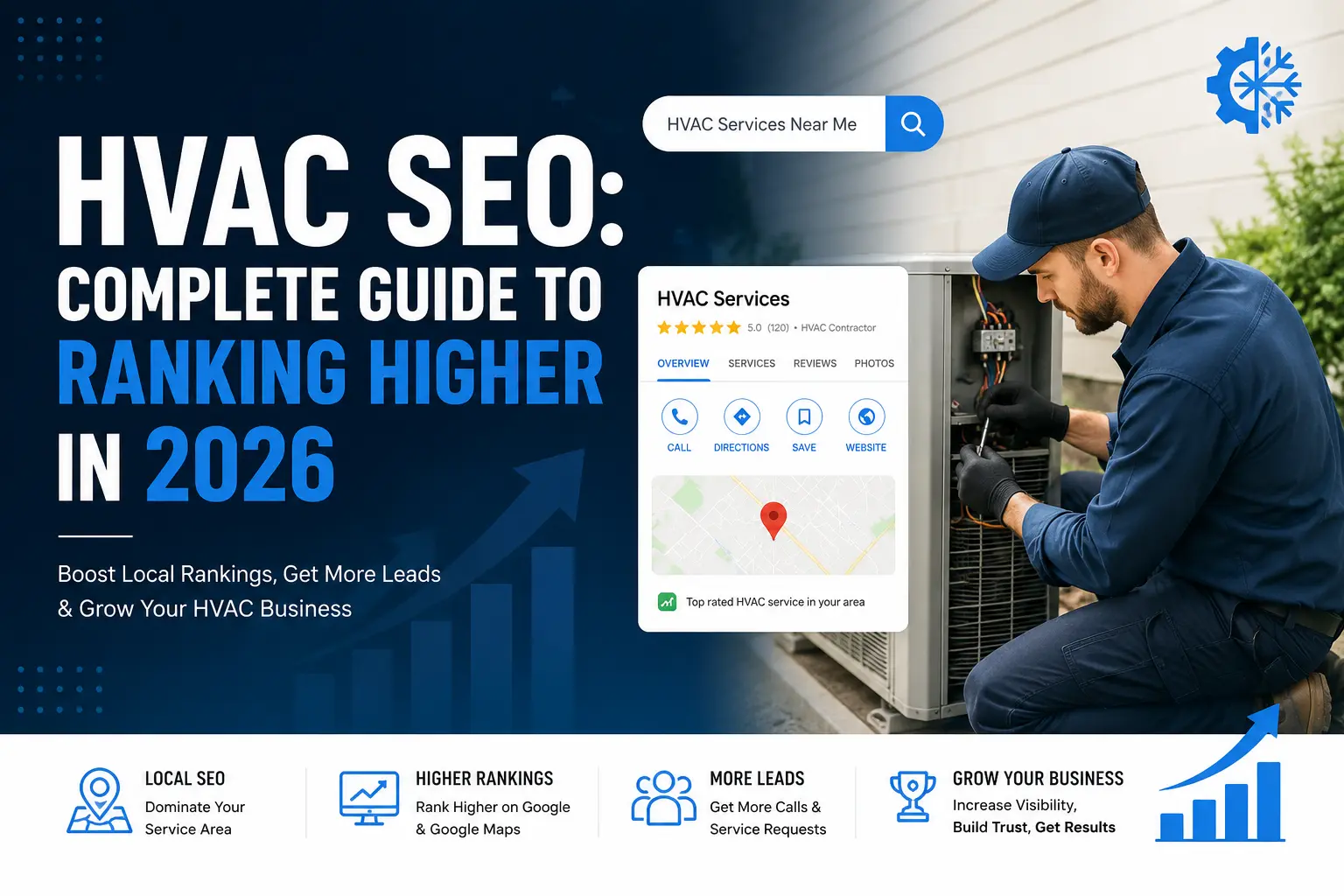
If you own or market an HVAC company, HVAC SEO is one of the most valuable investments you can make in growing your business. When a homeowner’s air conditioner breaks down in July or their furnace fails in January, they almost always turn to Google first — searching “AC repair near me” or “emergency furnace repair” and choosing from whichever companies show up at the top of the results. If your business isn’t there, that call goes to a competitor instead.
HVAC SEO is the process of optimizing your website, Google Business Profile, and online presence so your company ranks higher for the exact searches homeowners and businesses make when they need heating, cooling, or ventilation services. Unlike general marketing, HVAC SEO captures people at the exact moment they’re ready to book — which is why it consistently delivers some of the highest returns of any marketing channel available to contractors.
This guide walks through a complete HVAC SEO strategy built specifically for heating and cooling companies, covering everything from local keyword research and Google Business Profile optimization to on-page SEO, citations, reviews, and the technical fundamentals that keep your site performing well. Whether you run a small residential HVAC business or a larger commercial and residential operation, the same core principles apply.
By the end of this article, you’ll have a clear, practical roadmap for HVAC SEO that you can start applying to your business today.
Why HVAC SEO Matters
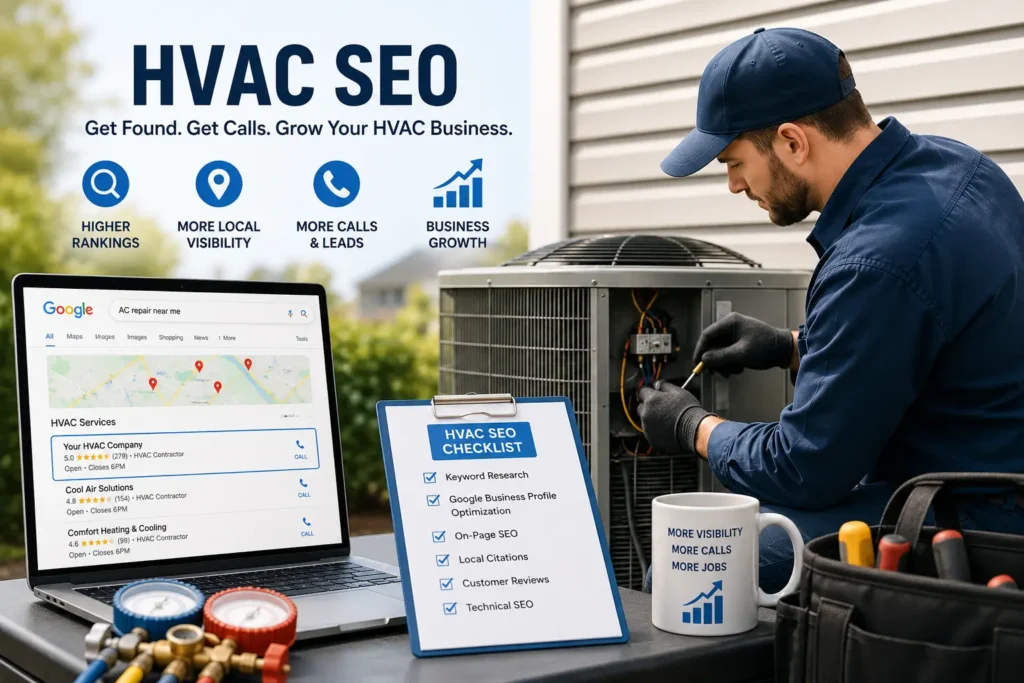
HVAC is one of the most search-driven, high-intent industries in local services. Very few homeowners plan ahead for a broken air conditioner or a failed heater — most searches happen the moment something goes wrong, and the company that appears first, looks trustworthy, and answers the phone quickly usually wins the job. This makes HVAC SEO uniquely valuable compared to industries with longer, more considered buying cycles.
Beyond emergency repairs, HVAC SEO also captures planned work like AC installations, furnace replacements, duct cleaning, and seasonal maintenance agreements — services with significantly higher ticket values than a single repair call. Ranking well for both emergency and planned-service keywords means capturing customers across the entire range of what an HVAC business offers.
The return on investment is also difficult to match with other channels. Once your HVAC SEO foundation is built — an optimized Google Business Profile, a well-structured website, strong reviews, and consistent citations — that visibility keeps generating calls month after month without the recurring cost of paid advertising. For a seasonal, weather-driven business, having reliable organic visibility during your busiest periods can make the difference between a good season and a great one.
How Google Ranks HVAC Companies Locally
Google ranks local HVAC companies using three core factors: relevance, distance, and prominence. Understanding these helps you focus your HVAC SEO efforts where they’ll have the biggest impact.
Relevance measures how well your website and Google Business Profile match a given search. A company that clearly lists “AC installation,” “furnace repair,” and “duct cleaning” as distinct services will out-rank a competitor whose site only mentions “HVAC services” in general terms.
Distance reflects how close your business is to the searcher or the location they’ve specified. HVAC companies serving a wide metro area should account for this by building dedicated location pages rather than relying on a single citywide listing.
Prominence reflects your overall trust and authority — driven by reviews, website quality, citations, and backlinks. This is where most ongoing HVAC SEO work happens, since prominence signals compound over time and are the hardest for competitors to quickly replicate.
HVAC Keyword Research
Effective HVAC SEO starts with understanding exactly what your customers are searching for. HVAC keywords generally fall into a few categories: emergency and repair searches, installation and replacement searches, maintenance searches, and informational searches.
Common examples include:
- AC repair near me
- Furnace repair
- Emergency HVAC repair
- AC installation cost
- Best HVAC company in [city]
- Duct cleaning services
- Heat pump installation
- HVAC maintenance plans
Use tools like Google Autocomplete, Google Keyword Planner, Ahrefs, and Semrush to identify which of these searches carry the most volume in your specific service area, and prioritize keywords with strong commercial or emergency intent over purely informational ones. A well-built HVAC SEO keyword list should feed directly into your website’s service pages, location pages, and blog content.
Optimizing Your Google Business Profile for HVAC SEO
Your Google Business Profile is central to any effective HVAC SEO strategy, since it’s what appears in the map pack for local “near me” searches. Claim and verify your profile, then select “HVAC contractor” as your primary category rather than a broader term like “Contractor.”
List every service you offer individually — AC repair, furnace installation, duct cleaning, indoor air quality services, and maintenance plans should each be listed separately rather than grouped together. Add real photos of your team, trucks, and completed installations, and keep your business hours accurate, including any 24-hour emergency availability.
Use Google Posts to share seasonal reminders (like pre-summer AC tune-up offers) and respond to every review you receive. These ongoing activities are just as important to HVAC SEO as the initial setup, since Google favors profiles that stay active year-round.
Website Optimization for HVAC Companies
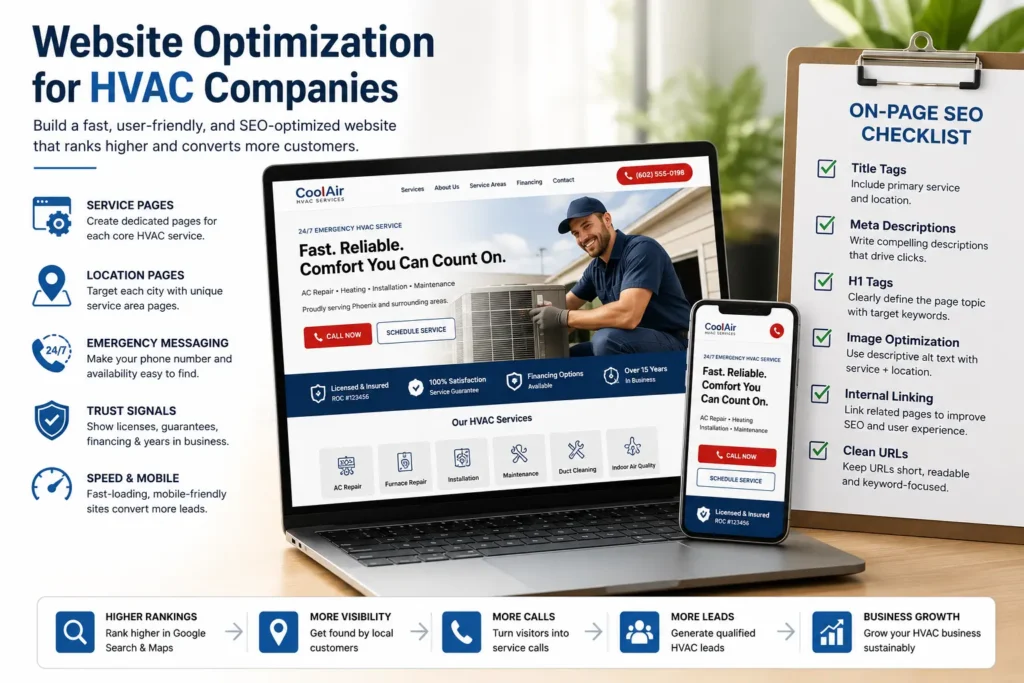
Your website needs to reinforce everything your Google Business Profile communicates. For HVAC SEO specifically, a few elements matter most:
Service pages: Build a dedicated page for each core service — AC repair, furnace repair, installation, maintenance, duct cleaning, and indoor air quality — rather than combining everything onto one general services page.
Location pages: If you serve multiple cities or a wide metro area, create unique, dedicated pages for each major service area rather than duplicating the same content with the city name swapped.
Emergency messaging: Make your emergency availability and phone number impossible to miss, ideally with a sticky click-to-call button, since a large share of HVAC searches are urgent.
Trust signals: Display licensing information, years in business, service guarantees, and financing options prominently, since these directly influence whether a visitor converts.
Speed and mobile experience: Most HVAC searches happen on mobile devices, often from someone standing in a hot or cold house. A slow-loading site loses these visitors quickly.
On-Page SEO for HVAC Websites
On-page SEO ensures each page of your site clearly communicates its topic to both visitors and search engines, supporting your broader HVAC SEO efforts.
- Title tags should include your primary service and location naturally (e.g., “AC Repair in Phoenix, AZ | 24/7 Emergency Service”).
- Meta descriptions should be compelling and accurate, encouraging clicks from the search results page.
- H1 tags should clearly state the page’s main topic, ideally including your target keyword.
- Images should be optimized and include descriptive alt text referencing your service and location.
- Internal links should connect related pages — for example, linking from your AC repair page to your maintenance plans page.
- URLs should be short and readable (e.g., /ac-repair-phoenix rather than a string of parameters).
Local Citations for HVAC Businesses
Local citations — mentions of your business name, address, and phone number across directories — reinforce your legitimacy and support your HVAC SEO rankings. Build citations on major platforms like Yelp, Better Business Bureau, Apple Maps, and Bing Places, then expand into HVAC-specific directories and licensing or trade association listings relevant to your state.
NAP consistency matters enormously here. Even small discrepancies between your website, Google Business Profile, and citation listings can weaken the trust signals Google relies on for local rankings.
Reviews and Reputation for HVAC SEO
Reviews are one of the strongest ranking signals for local service businesses, and HVAC companies depend on them heavily since customers are often making a same-day decision. A steady stream of recent, positive reviews is one of the highest-impact things you can do for HVAC SEO.
Build a simple, repeatable review request process — a text message shortly after a job is completed tends to perform well, since the technician’s visit is still fresh in the customer’s mind. Respond to every review, and address negative feedback professionally and specifically rather than with a generic reply, since future customers read these responses closely before deciding who to call.
Content Marketing and Blogging for HVAC Companies
Publishing helpful, locally relevant content supports HVAC SEO by targeting additional keywords and demonstrating expertise. Useful topics for an HVAC blog include seasonal maintenance tips, signs a furnace or AC unit needs replacement, energy efficiency guidance, and cost breakdowns for common services.
This kind of content also earns natural backlinks and social shares more easily than purely promotional pages, and it gives your website more indexed pages that can rank for a wider range of local searches over time.
Local Link Building for HVAC SEO
Backlinks from other relevant, local websites strengthen your prominence signals and support long-term HVAC SEO growth. Ideas for HVAC companies include partnering with local real estate agents and home inspectors, sponsoring community events, joining your local Chamber of Commerce, and contributing guest content to local home-improvement blogs.
A handful of high-quality, relevant local links typically does more for your rankings than dozens of generic, unrelated ones.
Technical SEO for HVAC Websites
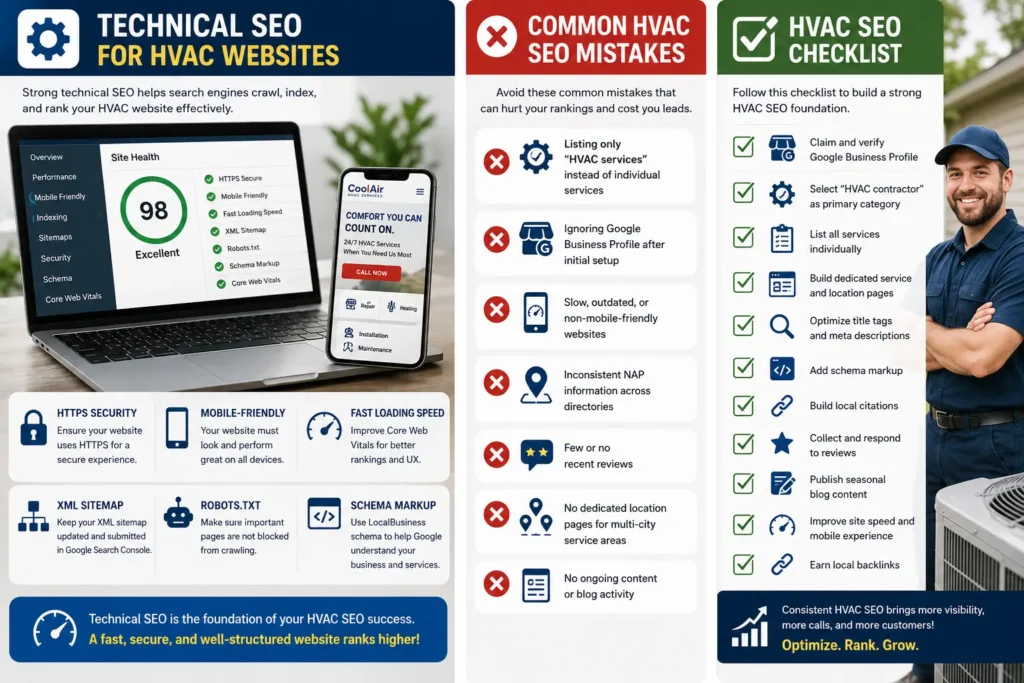
Technical fundamentals ensure Google can properly crawl and index your site, which underpins every other part of your HVAC SEO strategy. Make sure your site runs on HTTPS, is fully mobile-responsive, and loads quickly — Core Web Vitals directly affect both user experience and rankings. Maintain an updated XML sitemap, confirm your robots.txt file isn’t blocking important pages, and implement LocalBusiness schema markup so search engines can clearly understand your services and service area.
Common HVAC SEO Mistakes
Even well-run HVAC companies undermine their own rankings with avoidable mistakes:
- ❌ Listing only “HVAC services” instead of individual services
- ❌ Ignoring Google Business Profile after initial setup
- ❌ Slow, outdated, or non-mobile-friendly websites
- ❌ Inconsistent NAP information across directories
- ❌ Few or no recent reviews
- ❌ No dedicated location pages for multi-city service areas
- ❌ No ongoing content or blog activity
HVAC SEO Checklist
- ☐ Claim and verify Google Business Profile
- ☐ Select “HVAC contractor” as primary category
- ☐ List all services individually
- ☐ Build dedicated service and location pages
- ☐ Optimize title tags and meta descriptions
- ☐ Add schema markup
- ☐ Build local citations
- ☐ Collect and respond to reviews
- ☐ Publish seasonal blog content
- ☐ Improve site speed and mobile experience
- ☐ Earn local backlinks
Frequently Asked Questions
What is HVAC SEO? HVAC SEO is the process of optimizing a heating and cooling company’s website, Google Business Profile, and online presence to rank higher in local search results and attract more calls and bookings.
How long does HVAC SEO take to work? Most HVAC companies begin seeing meaningful improvement within three to six months, though highly competitive metro areas can take longer to see significant local ranking gains.
Is HVAC SEO better than paid ads for HVAC companies? Both have a role. Paid ads generate immediate visibility, while HVAC SEO builds durable, long-term visibility that keeps generating calls without ongoing ad spend. Most successful HVAC companies use both together.
How many reviews does an HVAC company need to rank well? There’s no fixed number, but a steady stream of recent, high-quality reviews consistently correlates with stronger local rankings. Focus on ongoing collection rather than a one-time push.
Do I need separate pages for each HVAC service? Yes. Dedicated pages for AC repair, furnace repair, installation, and maintenance perform significantly better than a single general services page, since each page can target its own specific keywords.
Can I do HVAC SEO myself? Yes, especially foundational work like Google Business Profile optimization and review collection. More competitive or technical elements, like link building and site architecture, often benefit from professional support.
Does seasonal content help HVAC SEO? Yes. Publishing timely content around AC tune-ups before summer or furnace checks before winter helps capture seasonal search demand and keeps your website active in Google’s eyes year-round.
Final Thoughts
HVAC SEO is one of the highest-return investments a heating and cooling company can make, precisely because it puts your business in front of customers at the exact moment they need help. The fundamentals — a fully optimized Google Business Profile, a well-structured website with dedicated service and location pages, consistent reviews, and reliable local citations — work together to build visibility that compounds over time.
Start with your Google Business Profile and service pages, then build outward into reviews, citations, and content. Consistent, ongoing HVAC SEO will keep your phones ringing well beyond any single busy season.
