
If you run a business that depends on customers finding you nearby — a plumber, a dentist, a boutique, a law firm — then local link building is one of the most overlooked levers you have for growing organic visibility. While most SEO conversations focus on national-level backlinks from massive publications, the truth is that this approach often moves the needle faster for small and mid-sized businesses because it’s less competitive, more relevant, and directly tied to the geography Google already associates with your business.
Most business owners assume that earning backlinks requires expensive PR campaigns or years of blogging before anyone notices. That’s true for national link building, but it isn’t true at the city level. Your community already has newspapers, bloggers, associations, schools, and fellow business owners who are actively looking for local stories, partners, and resources to link to. The opportunity is sitting right there — most businesses simply never ask.
In this guide, we’ll break down exactly what this strategy is, why it matters, and 15 practical, city-specific ways to earn backlinks that actually help you rank in your area. Whether you’re just starting your local SEO strategy or refining an existing one, this playbook will give you actionable tactics you can start using today, along with the mistakes to avoid and the tools that make the process easier to manage.
What Is Local Link Building?
Local link building is the process of earning backlinks from websites that are geographically or contextually tied to your city, region, or local community. Unlike generic link building, which focuses on domain authority alone, this approach prioritizes relevance — a link from your city’s chamber of commerce, a local newspaper, or a neighborhood blog signals to Google that your business is a genuine, active part of that community.
These links come from sources like local news outlets, community organizations, local business directories, sponsorships, and partnerships with nearby businesses. The goal isn’t just to increase your backlink count — it’s to build a footprint of local relevance that search engines can use to confirm your business genuinely serves the area you claim to serve.
It also differs from national link building in how it’s measured. A national campaign might chase domain authority scores from industry-leading publications regardless of location. A city-focused campaign instead asks a simpler question: does this link come from a source that a real customer in my area would recognize and trust? If the answer is yes, it’s usually worth pursuing.
Why Local Link Building Matters for Local SEO
Search engines use hundreds of ranking signals, but for location-based searches — think “plumber near me” or “best bakery in [city]” — local relevance and trust carry enormous weight. This is where local link building becomes essential. A handful of well-placed local backlinks can outperform dozens of generic, low-relevance links because they tell Google exactly what your business is and where it operates.
Here’s why this strategy deserves a dedicated place in your SEO plan:
- It reinforces local relevance. Search engines associate your website with the cities and regions linking to it. Consistent link building at the local level strengthens this geographic signal.
- It builds trust and authority. Links from respected local organizations, media, and institutions act as third-party endorsements that are hard to fake.
- It supports your Google Business Profile visibility. A strong backlink profile often correlates with better rankings in the local map pack, alongside solid Google Business Profile optimization.
- It drives referral traffic. Unlike purely SEO-motivated links, these backlinks often bring in real visitors — people reading a community blog or local news story who click through to your site.
- It’s more attainable than national link building. Competing for links from major publications is difficult. Local opportunities — sponsorships, directories, partnerships — are far more accessible for small businesses.
If you haven’t already, it’s worth pairing your local link building efforts with a broader local SEO checklist to make sure your on-page and profile signals are just as strong as your backlink profile. Businesses that rank consistently in the map pack almost always show a mix of strong citations, positive reviews, and a healthy volume of relevant local backlinks working together.
15 Ways to Get Backlinks Through Local Link Building
Below are 15 proven local link building tactics you can implement in your city or town. Not every tactic will apply equally to every business, so pick the ones that align with your industry and resources, then expand from there.
1. Get Listed in Local Business Directories and Citations
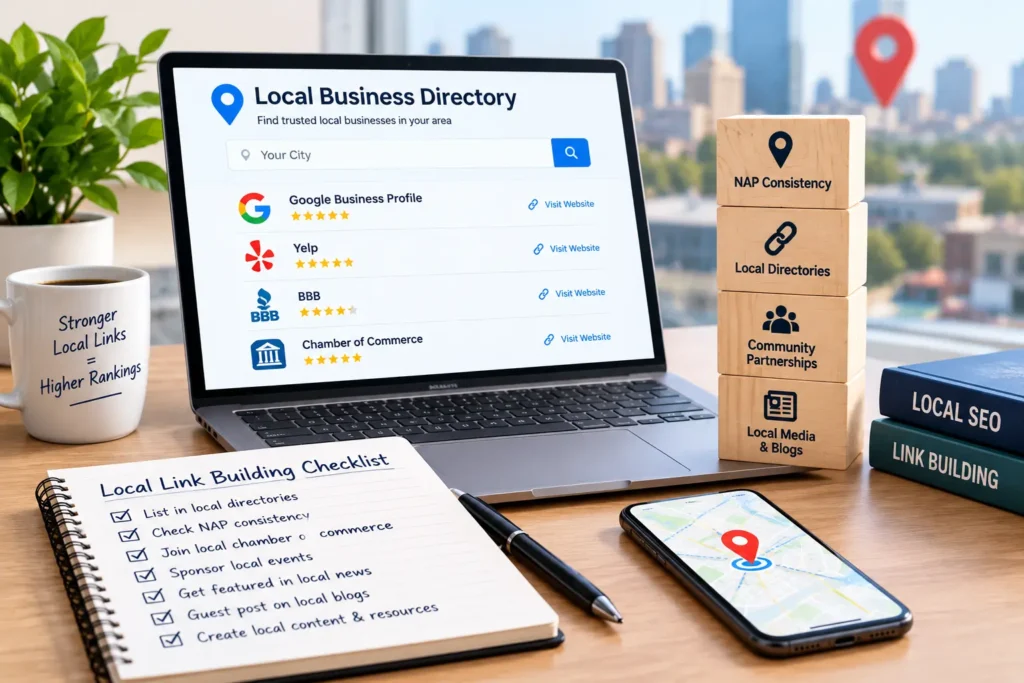
The foundation of any local link building campaign is getting listed in accurate, consistent local directories. These citations — think Yelp, Better Business Bureau, local Chamber of Commerce directories, and city-specific business listings — often include a backlink to your website alongside your business name, address, and phone number (NAP).
Consistency matters enormously here. Before diving into more advanced tactics, audit your existing local citations to ensure your NAP information matches across every platform. Inconsistent citations can actively hurt your results because search engines struggle to confirm which business entity the links belong to. Start with the major national directories, then move on to city-specific listings, industry-niche directories, and any regional platforms unique to your area — each one adds another small but meaningful piece to your local link building foundation.
2. Partner With Your Local Chamber of Commerce
Joining your local chamber of commerce is one of the simplest local link building wins available. Most chambers maintain a member directory on their website, and that listing typically includes a link back to your site. Beyond the backlink itself, chamber membership opens doors to networking events, sponsorship opportunities, and referrals — all of which can feed into further link-earning opportunities down the road.
Many chambers also publish newsletters or “member spotlight” features, giving you an additional local link building opportunity beyond the standard directory listing. If your city has a downtown business association or a neighborhood merchants’ group in addition to the main chamber, join those too — smaller, more niche associations often have less competition for visibility and are more willing to feature new members.
3. Sponsor Local Events, Teams, and Charities
Sponsorships are a highly effective form of local link building because they combine genuine community involvement with a natural backlink opportunity. Local youth sports teams, charity walks, school fundraisers, and community festivals almost always list their sponsors on a dedicated webpage — complete with a link to the sponsor’s website.
When pursuing this tactic, look for recurring annual events so you can build a long-term relationship rather than a one-off transaction. This turns a single link into an ongoing partnership that renews itself year after year, and it also gives your team a natural reason to be photographed at community events, which supports future press coverage and additional links.
4. Build Relationships With Local News Outlets and Journalists
Local newspapers, TV stations, and online news sites are some of the highest-authority sources available for this kind of outreach. Journalists covering community news are often looking for local experts, unique stories, or data to reference. Position your business as a go-to source by pitching relevant story angles: a new product launch, a milestone anniversary, a community initiative, or commentary on a local trend in your industry.
This local link building approach takes patience, but a single feature in a respected local publication can deliver both a powerful backlink and significant brand credibility. Keep a running list of local reporters who cover your industry, follow their work, and engage with their stories before you ever send a pitch — familiarity makes journalists far more receptive when you eventually reach out.
5. Guest Post on Local Blogs and Community Websites
Many cities have active local blogs covering food, lifestyle, business, or neighborhood news. Reaching out to these blogs with a well-crafted guest post pitch is a classic local link building strategy that still works well today. Offer genuinely useful, locally-relevant content — not a thinly veiled advertisement — and most blog owners will happily include a link back to your site in your author bio or within the article itself.
To make this tactic more effective, research the blog’s existing content first so your pitch fits naturally into what they already publish. Suggest two or three topic ideas rather than a single one, and be upfront that you’re not asking to be paid — most independent local bloggers appreciate free, well-written contributions.
6. Create Locally-Focused Content and Resources
Content that’s genuinely useful to your community naturally attracts backlinks. Think city-specific guides (“Best Neighborhoods for First-Time Homebuyers in [City]”), local market reports, or resource pages that other local sites want to reference. This type of “linkable asset” is one of the most scalable strategies for local link building because, once published, it can attract links passively over time without any additional outreach.
Pairing locally-focused content with strong local keyword research ensures your content ranks well on its own while also becoming a magnet for backlinks. The best-performing local assets usually combine original insight — your own data, experience, or observations — with genuinely helpful, evergreen information residents will bookmark and return to.
7. Get Backlinks From Local Business Associations
Beyond the general chamber of commerce, most industries have niche local or regional associations — a local restaurant association, a regional contractors guild, or a small business alliance. Joining these organizations often comes with a directory listing and link, making it another reliable channel for local link building that also builds industry credibility. Many associations run annual awards or certification programs; being listed as a member or award recipient often earns a second, separate link beyond the standard directory entry.
8. Collaborate With Complementary Local Businesses
Cross-promotion with non-competing local businesses is an underused tactic. A wedding photographer might partner with a local florist and venue to create a shared “recommended vendors” page, with each business linking to the others. This kind of mutual arrangement supports local link building for every business involved and often leads to real customer referrals as well. Consider formalizing these relationships with a simple written agreement so the partnership — and the linking arrangement — continues even as staff or ownership changes.
9. Host or Speak at Local Events and Webinars
Hosting a workshop, speaking at a local business meetup, or participating in a panel discussion often earns you a mention — and a link — on the event organizer’s website. This tactic also positions you as an authority in your field, which can lead to further speaking invitations and even more opportunities for local link building down the line. Even a modest webinar or lunch-and-learn hosted for a local trade group can generate a listing on that organization’s events page, complete with a backlink to register or learn more.
10. Leverage Local School and University Partnerships
Sponsoring a scholarship, providing an internship program, or donating to a local school or university can result in a backlink from an extremely authoritative .edu domain. Educational institutions rarely link out, so this tactic, while harder to secure, carries significant weight when it works. Reach out to alumni associations, career services departments, or community outreach offices to explore partnership opportunities, and don’t overlook community colleges and vocational schools — they’re often more accessible than large universities and equally valuable for local link building purposes.
11. Get Featured in Local “Best Of” Roundups
Local publications, blogs, and directories frequently publish “Best of [City]” lists — best coffee shops, best contractors, best dentists. Getting featured in these roundups is a valuable opportunity for local link building because it combines a backlink with strong social proof. Reach out politely to the site owner, introduce your business, and explain why you’d be a good fit for their next roundup update. Keep track of which lists get refreshed annually so you can follow up again the following year if you’re not featured the first time.
12. Use HARO and Journalist Requests for Local Expert Quotes
Platforms that connect journalists with expert sources are a great source of local link building opportunities, especially when you filter for local or regional queries. Reporters covering local business, real estate, or industry trends often need quick expert commentary, and providing a helpful, quotable response can earn you a backlink from a local or even national news site. Respond quickly and keep your answers concise — journalists on tight deadlines favor sources who make their job easier.
13. Build Links Through Local Supplier and Vendor Pages
If you purchase supplies, materials, or services from local vendors, ask whether they maintain a “customers” or “clients” page on their website. Many B2B suppliers list the businesses they work with, along with a link. This is a low-effort but often-overlooked local link building tactic — a few polite emails to existing vendor relationships can uncover easy wins without any cold outreach at all.
14. Create Shareable Local Infographics and Data
Original data and visual content about your local market — housing trends, local economic statistics, seasonal business patterns — can be highly shareable among local bloggers, journalists, and community organizations. This is a more advanced local link building strategy, but it can generate a wave of backlinks if the data is genuinely useful and well-presented. Surveying your own customer base and publishing the results as a simple local report is often enough to get picked up by a community news outlet.
15. Reclaim Unlinked Brand Mentions Locally
Local news sites, blogs, and community pages sometimes mention your business by name without linking to your website. Set up alerts to track these mentions, then reach out politely and ask if they’d be willing to add a link. This “link reclamation” tactic is one of the fastest wins in local link building because the relationship and content already exist — you’re simply asking for the missing link to be added, which usually takes the site owner just a couple of minutes.
Local Link Building Best Practices
As you work through these 15 tactics, keep the following best practices in mind to make your efforts more effective and sustainable:
- Prioritize relevance over volume. A single link from a respected local organization is worth more than dozens of low-quality directory links. Effective local link building is about quality and context, not just quantity.
- Keep your NAP consistent everywhere. Every citation and backlink should reflect the same business name, address, and phone number to strengthen your geographic signals.
- Diversify your link sources. Relying on only one tactic — like directories — limits your potential. Combine several strategies from this list for a more natural, resilient backlink profile.
- Track your progress. Use a spreadsheet or SEO tool to monitor which outreach efforts are converting into actual backlinks, and double down on what’s working.
- Be patient and consistent. This is a long-term strategy. Meaningful results typically build over months, not days, especially when they rely on relationship-building with local organizations.
- Pair links with strong on-page signals. Backlinks work best alongside solid technical foundations — for example, adding local business schema markup helps search engines fully understand the relevance your local link building work is reinforcing.
How to Measure the Success of Your Local Link Building Campaign
Earning links is only half the job — tracking their impact tells you whether your local link building strategy is actually working. A few metrics are worth monitoring on a monthly basis:
- Referring domains from your city or region. Count how many unique local websites link to you, not just the total number of links, since several links from one site carry less weight than links from several different sources.
- Local map pack and organic rankings. Track your position for a handful of core local search terms before and after major link-earning pushes to see whether rankings move in the right direction.
- Referral traffic by source. Your analytics platform can show you exactly how much traffic a local news feature, a chamber listing, or a guest post is sending your way.
- Branded search volume. As your business becomes more visible through local press and community mentions, searches for your business name specifically often increase — a good sign that your visibility efforts are working beyond just backlinks.
Reviewing these numbers quarterly helps you understand which of the 15 tactics above are worth doubling down on and which ones aren’t delivering enough return for the effort involved.
Common Local Link Building Mistakes to Avoid
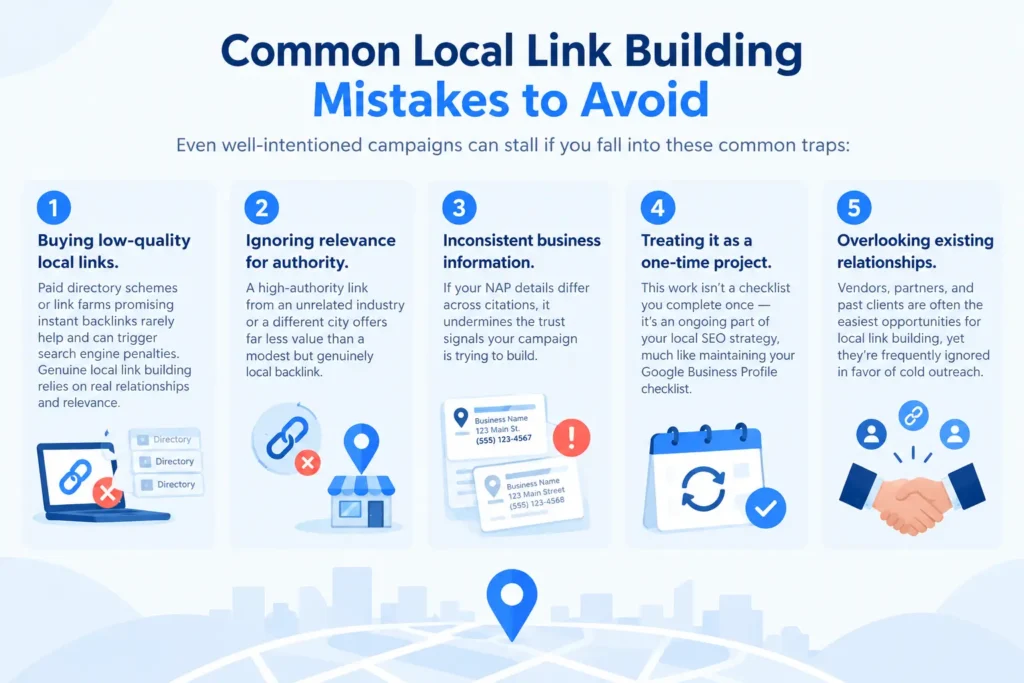
Even well-intentioned campaigns can stall if you fall into these common traps:
- Buying low-quality local links. Paid directory schemes or link farms promising instant backlinks rarely help and can trigger search engine penalties. Genuine local link building relies on real relationships and relevance.
- Ignoring relevance for authority. A high-authority link from an unrelated industry or a different city offers far less value than a modest but genuinely local backlink.
- Inconsistent business information. If your NAP details differ across citations, it undermines the trust signals your campaign is trying to build.
- Treating it as a one-time project. This work isn’t a checklist you complete once — it’s an ongoing part of your local SEO strategy, much like maintaining your Google Business Profile checklist.
- Overlooking existing relationships. Vendors, partners, and past clients are often the easiest opportunities for local link building, yet they’re frequently ignored in favor of cold outreach.
Tools That Support Local Link Building
While relationship-building is at the heart of local link building, a few tools can make the process more efficient:
- Citation management tools to keep your NAP consistent across local directories.
- Backlink monitoring tools to track new and lost links resulting from your outreach.
- Media monitoring or brand alert tools to catch unlinked mentions worth reclaiming.
- Outreach and email tracking tools to manage relationships with journalists, bloggers, and local organizations at scale.
For a broader look at how link building fits into your overall SEO strategy beyond just the local angle, see our detailed guide to link building techniques, and explore additional off-page tactics in this guide to off-page SEO techniques and this roundup of link building strategies.
Frequently Asked Questions
How long does local link building take to show results? Most businesses start seeing meaningful ranking movement within three to six months of consistent effort, though individual links — like a directory listing or a news feature — can go live within days of outreach.
How many local backlinks do I actually need? There’s no fixed number. A handful of highly relevant, authoritative local links typically outperforms dozens of weak, unrelated ones. Focus on steady, consistent growth rather than hitting a specific target.
Can I do local link building without a marketing budget? Yes. Many local link building tactics above — directory listings, HARO responses, vendor page requests, and link reclamation — cost nothing but time and outreach effort.
Does local link building help with the Google map pack specifically? Yes. Alongside your Google Business Profile ranking factors, a healthy local backlink profile is one of the signals that can influence map pack visibility.
Final Thoughts on Local Link Building
Local link building isn’t about chasing as many backlinks as possible — it’s about earning genuine connections within your community that search engines recognize as authentic local relevance. By combining directory listings, sponsorships, media relationships, guest content, and link reclamation, you can build a diverse and durable backlink profile that supports long-term local SEO growth.
Start small: pick two or three tactics from this list that fit your business and resources, execute them consistently, and expand from there. Over time, this strategy will strengthen your local rankings, boost referral traffic, and reinforce your business as a trusted, active part of your city’s community. If you want to go deeper on how backlinks influence rankings more broadly, check out our guide on general backlink strategies and broken link building as complementary tactics to run alongside your local link building campaign.
