
If you own or market a local service business, Google Maps SEO is probably the single highest-leverage skill you can learn this year. When someone searches “electrician near me” or “appliance repair in [city],” Google shows a map with three business listings above the regular organic results. That block is called the Local Pack, and getting into it is what Google Maps SEO is all about. In this guide, we’ll break down how the system works, what actually moves the needle, and how to build a repeatable process that keeps your business visible on the map long term.
What Is Google Maps SEO?
Google Maps SEO is the practice of optimizing your Google Business Profile, website, and off-site signals so your business shows up prominently when people search for services on Google Maps and in the Local Pack. Unlike traditional SEO, which focuses purely on organic rankings in the regular “ten blue links,” this discipline is about winning visibility inside Google’s map-based results — the section most local customers check first before they ever scroll further down the page.
For local service businesses like electricians, plumbers, HVAC companies, locksmiths, and appliance repair technicians, this kind of optimization often drives more calls and leads than standard organic SEO. That’s because when someone types a service query with local intent, Google almost always shows the map pack first. If your business isn’t in it, you’re invisible to a huge share of potential customers, no matter how good your website ranking is.
Understanding Google Maps SEO means understanding three things: how Google decides which businesses to show, what factors influence that decision, and how you can systematically improve each of those factors over time. That’s exactly what we’ll cover in this guide, along with a practical checklist you can start using today.
Why It Matters More Than Ever
Search behavior has shifted dramatically toward mobile and “near me” queries. A huge percentage of local searches now happen on phones, often while someone is already looking for a solution to an urgent problem — a broken water heater, a locked car, a tripped breaker. These searchers rarely scroll past the map. They tap one of the three pins, check reviews, and call.
This is why Google Maps SEO has become a priority for small business owners and marketing agencies alike. A well-optimized Google Business Profile combined with strong local fundamentals can outperform a much bigger competitor with a weaker local presence. It levels the playing field between a solo operator and a large franchise, provided the smaller business invests properly in the process.
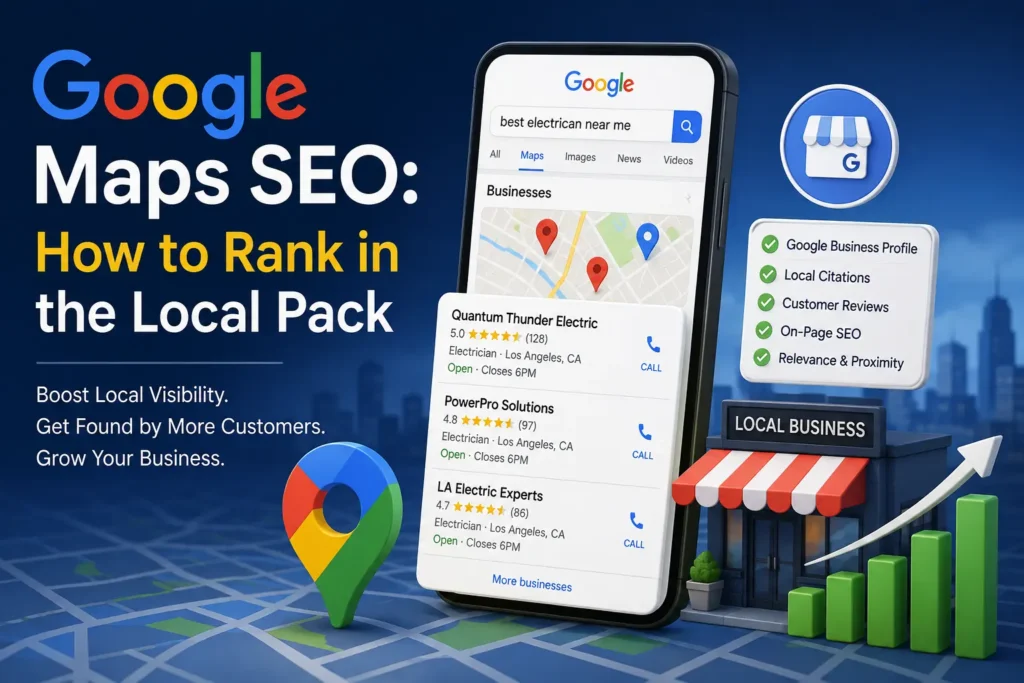
Another reason this matters is trust. Customers increasingly treat the Local Pack as a shortlist of “verified” businesses. A polished profile with reviews, accurate categories, and consistent information signals legitimacy before a visitor even clicks through to your website. Good Google Maps SEO isn’t just about rankings — it’s about conversion, because the profile itself often closes the sale before your site is even visited.
How Google Ranks Businesses in the Local Pack
Google has publicly stated that local ranking is based on three core factors: relevance, distance, and prominence. Every serious Google Maps SEO strategy is built around improving these three pillars, so it’s worth understanding each one individually before moving into tactics.
Relevance
Relevance refers to how well your Google Business Profile matches what the searcher is looking for. If someone searches “emergency locksmith,” Google wants to show businesses whose profile, categories, and content clearly signal locksmith services. Choosing accurate primary and secondary categories is one of the most overlooked parts of Google Maps SEO — many business owners pick a generic category when a more specific one would help their standing significantly.
Distance
Distance measures how far each potential result is from the location term used in the search, or from the searcher’s actual location if no location is specified. You can’t move your business, but you can influence which searches you’re relevant for through service area settings, which is a critical but often ignored piece of this work for businesses that travel to customers rather than operating from a storefront.
Prominence
Prominence reflects how well-known and reputable your business is, both online and offline. This includes review count and rating, citation consistency, backlinks, and overall web presence. Prominence is the factor most influenced by ongoing effort, which is why long-term Google Maps SEO campaigns almost always outperform a one-time profile setup.
Understanding these three pillars is the foundation of any Google Maps SEO campaign. Everything below ties back to improving relevance, distance eligibility, or prominence, so keep them in mind as you work through each step.
Step 1: Fully Optimize Your Google Business Profile
Your Google Business Profile is the centerpiece of Google Maps SEO. Google pulls almost all of the information shown in the Local Pack directly from this profile, so an incomplete or inaccurate listing puts you at a disadvantage before you even start competing.
Start with your business name, address, and phone number (commonly called NAP). These must match exactly across your website, profile, and every citation source, because inconsistency undermines trust signals about which business is “real.”
Next, choose your categories carefully. Your primary category should be the single most accurate description of your core service, and your secondary categories should cover related services you legitimately offer. Category selection is one of the fastest wins in this process because it directly affects relevance for specific search terms.
Write a complete business description using natural language that includes your services and service area, without keyword stuffing. A good description gives Google more context about what you do, while also helping customers understand your offering at a glance — and it supports your broader Google Maps SEO efforts without needing to repeat any single phrase.
Add high-quality photos of your team, vehicles, completed jobs, and storefront if applicable. Profiles with more photos tend to get more clicks and calls, which indirectly supports rankings through improved engagement signals.
Finally, keep your hours accurate and update them for holidays. Nothing damages trust — or your standing in the map pack — like a listing that says “open” when a customer arrives to a locked door.
If you want a step-by-step breakdown of profile setup fundamentals, our guide on optimizing your Google Business Profile walks through the full checklist.
Step 2: Build and Maintain Consistent Local Citations
Citations are online mentions of your business name, address, and phone number on directories, industry sites, and platforms like Yelp, Angi, and the Better Business Bureau. Citation consistency is a foundational trust signal for Google Maps SEO because it helps Google confirm your business is legitimate, active, and located where you say it is.
Inconsistent citations — a slightly different phone number here, an old address there — actively hurt your rankings by creating confusion in Google’s data. Before building new citations, audit your existing ones and correct any discrepancies. Many agencies run a full citation cleanup as the very first task in a new engagement, because fixing errors often produces faster results than building anything new.
Once your existing citations are clean, focus on building new ones on relevant, high-quality directories rather than spammy low-value sites. Industry-specific directories for electricians, plumbers, HVAC contractors, and similar trades tend to carry more weight than generic ones, since they reinforce relevance alongside prominence and directly support your Google Maps SEO goals.
For a deeper walkthrough of this process, see our guide to building local citations correctly.
Step 3: Generate and Manage Reviews Strategically
Reviews are one of the most visible and influential ranking signals in Google Maps SEO. They affect both rankings and conversion — a business with 150 reviews at 4.8 stars will almost always out-convert a competitor with 12 reviews at 4.2 stars, even if the underlying service quality is comparable.
For local ranking purposes, review velocity matters as much as total count. Google appears to favor businesses that earn reviews steadily over time rather than in unnatural bursts. Build a simple, repeatable process: ask every satisfied customer for a review immediately after the job is complete, using a direct link that takes them straight to the review form.
Responding to every review — positive and negative — is also part of a healthy strategy. Thoughtful responses signal to Google, and to future customers reading them, that the business is actively managed and takes feedback seriously. Never buy fake reviews; not only does this violate Google’s policies, but a sudden unnatural spike is exactly the kind of pattern that can trigger a suspension and set your Google Maps SEO progress back to zero.
We cover proven, compliant tactics for earning more reviews in our post on getting more Google reviews.
Step 4: Strengthen On-Page and Technical SEO
While your Google Business Profile is the centerpiece of Google Maps SEO, your website still plays a supporting role. Google cross-references your site to validate relevance and prominence, so a poorly optimized website can quietly cap how far your rankings can climb.
Make sure every core service and location has its own dedicated page rather than being crammed into one generic “services” page. Each page should include your NAP information, clear service descriptions, and natural mentions of your service area. This structure reinforces the relevance signals Google is already pulling from your business profile, tying your on-page SEO directly to your overall local performance.
Site speed and mobile usability also matter. Since most local searches happen on mobile devices, a slow-loading or clunky mobile site can hurt conversions even after Google Maps SEO successfully gets a customer to click through. Review your Core Web Vitals regularly and fix any pages that load slowly.
Schema markup, particularly LocalBusiness schema, gives Google structured, machine-readable confirmation of your name, address, phone number, hours, and service area. While schema alone won’t fix weak fundamentals, it does help reinforce everything else you’ve already built as part of your Google Maps SEO plan.
For the technical side of this work, our on-page SEO guide and Core Web Vitals breakdown are both good next steps.
Step 5: Build Local Backlinks and Community Signals
Backlinks from other local, relevant websites strengthen the prominence factor in Google Maps SEO. Sponsoring a local youth sports team, joining your Chamber of Commerce, partnering with complementary local businesses, or getting featured in a local news story can all generate valuable backlinks that support long-term growth in the map pack.
Unlike generic national link building, local link building doubles as brand-building within your actual service area — the same community your optimization efforts are trying to reach. A backlink from a local newspaper or community organization tells Google, and real customers, that your business is an established, trusted part of the area, not a fly-by-night operation.
Guest posts on industry blogs, interviews with local podcasts, and partnerships with related trades — an electrician partnering with an HVAC company, for example — are all reasonable, sustainable ways to build the kind of authority that Google Maps SEO rewards over time. For a broader look at outreach tactics, check our guide on how to get backlinks.
Step 6: Use Google Posts and Q&A to Stay Active
Google Business Profile includes a “Posts” feature that lets you share updates, offers, and announcements directly on your listing. Regularly publishing posts is an underused Google Maps SEO tactic because it signals to Google that your profile is actively managed, and it gives potential customers a reason to engage before they even reach your website.
The Q&A section is another area worth monitoring. Customers can ask questions directly on your profile, and if you don’t answer them, anyone can — including competitors or people with inaccurate information. Proactively seeding your own frequently asked questions and answering them accurately is a small but meaningful piece of a complete strategy.
Step 7: Track, Audit, and Refine Continuously
Google Maps SEO isn’t a set-it-and-forget-it task. Rankings shift as competitors improve their own profiles, as Google updates its algorithm, and as your citation and review profile evolves. Running a recurring audit — monthly or quarterly depending on how competitive your market is — keeps your efforts moving in the right direction instead of stalling out after the initial setup.
A proper audit should check your current keyword rankings in the map pack, review growth rate, citation accuracy, competitor movement, and any changes to your Google Business Profile that may have reverted. This happens more often than people expect, especially with suggested edits from third parties. Treating Google Maps SEO as an ongoing discipline rather than a one-time project is what separates businesses that dominate the Local Pack from those that briefly rank and then quietly slide back down.
If you haven’t run a full audit recently, our local SEO audit guide and SEO audit checklist are good starting points before you dive deeper into map-specific tactics.
Google Maps SEO for Multi-Location and Service-Area Businesses
Businesses with multiple physical locations face a slightly different version of this challenge. Each location needs its own individual Google Business Profile, its own dedicated landing page on your website, and its own unique set of citations and reviews. Duplicating content across location pages, or trying to rank a single profile for several cities at once, tends to backfire and can actually suppress your Google Maps SEO results across the board.
Service-area businesses that don’t operate from a public-facing storefront — mobile locksmiths, traveling appliance repair technicians, and similar trades — should hide their address on their profile and clearly define their service area radius instead. This setting directly affects the distance factor discussed earlier, and getting it wrong is one of the more common technical mistakes that quietly limits visibility even when every other part of the profile looks strong.
For businesses expanding into new cities, our guide on keyword research for local businesses is a useful companion resource for identifying which service terms are worth targeting first, before you replicate your Google Maps SEO process in a new market.
It’s also worth noting that Google Maps SEO results don’t automatically transfer between locations. Strong prominence in one city rarely carries over to a new profile in a different city, since Google treats each listing as its own entity with its own review history and citation footprint. Budget time for the full Google Maps SEO process at every new location rather than assuming early momentum elsewhere will carry the new listing.
Tools That Support a Google Maps SEO Workflow
You don’t need an expensive software stack to run an effective program, but a few tools make the process considerably faster. Google Search Console shows how your website content is performing for local queries and helps identify pages that need improvement. Google Business Profile’s built-in insights panel shows how customers are finding your listing, whether through direct searches, discovery searches, or maps navigation requests.
Rank tracking tools built specifically for local search — as opposed to standard organic rank trackers — are worth the investment once you’re managing more than a handful of locations, since they can show exactly where you rank at different points around a city rather than just from a single central location. Citation management platforms can also save significant time by pushing updates across dozens of directories at once instead of manually editing each one.
None of these tools replace the fundamentals covered earlier in this guide, but they do make it easier to measure whether your work is actually moving rankings, which is the whole point of investing time into this kind of optimization in the first place.
It’s worth setting up a simple spreadsheet or dashboard early on, even a basic one, to track your core service keywords, your review count, and your citation status month over month. Having this history in one place makes it much easier to spot trends, whether that’s a competitor suddenly pulling ahead or your own listing quietly slipping after a Google algorithm update. Small businesses often skip this step because it feels unnecessary at first, but six months in, that historical data becomes one of the most useful assets in the entire process, since it tells you which changes actually caused a ranking shift versus which ones were coincidental.
Common Mistakes to Avoid
Even experienced marketers make mistakes that quietly undermine their results. A few of the most common:
- Keyword stuffing the business name. Adding extra keywords to your official business name on Google Maps violates Google’s guidelines and can result in a suspension, wiping out months of work overnight.
- Using a virtual office or PO box as your address. Google requires a real, staffed location for most business categories, and using a fake address is one of the fastest ways to get flagged and lose all progress.
- Ignoring negative reviews. Letting complaints sit unanswered damages both conversion rates and the trust signals your rankings depend on.
- Duplicate listings. Multiple profiles for the same business confuse Google and split your prominence signals, weakening your overall performance in the Local Pack.
- Neglecting the website. Treating Google Maps SEO as separate from standard SEO is a mistake — the two reinforce each other, and a weak website caps how well even a perfect profile can perform.
Avoiding these mistakes is often just as valuable as actively building new signals, since fixing existing damage tends to unlock ranking improvements faster than adding anything new.
How Long Does It Take to Show Results?
Most local service businesses start seeing measurable movement within 60 to 90 days of consistent effort, though highly competitive markets — major metro areas with dozens of established competitors — can take longer. Businesses in less competitive niches or smaller cities often see faster results because there’s simply less prominence to overcome.
The timeline also depends heavily on your starting point. A business with a brand-new, empty profile and no citations will take longer to build momentum than one that already has a decent review base but simply needs technical cleanup. Either way, Google Maps SEO rewards consistency far more than intensity — steady monthly effort beats a single aggressive push followed by months of neglect.
Frequently Asked Questions
Does Google Maps SEO cost money? The core work behind Google Maps SEO — profile optimization, review requests, citation cleanup, and content updates — can be done without paid tools, though rank tracking and citation management software can speed things up considerably for businesses managing several locations.
Can I do Google Maps SEO myself, or do I need an agency? Many small business owners handle the basics of Google Maps SEO themselves, especially profile setup and review requests. Agencies tend to add the most value with citation cleanup at scale, ongoing audits, and coordinating website and profile work together over time.
How is Google Maps SEO different from regular SEO? Regular SEO focuses on ranking your website in standard organic results. Google Maps SEO focuses specifically on the map-based Local Pack, which relies heavily on your Google Business Profile rather than just your website content.
How often should I check my Google Maps SEO rankings? A monthly check is usually enough for most local businesses, though competitive markets may benefit from checking Google Maps SEO rankings every two weeks so you can react quickly to competitor changes.
Do I need a website for Google Maps SEO to work? A website isn’t strictly required to appear in the Local Pack, but it strongly supports Google Maps SEO by reinforcing relevance and prominence signals, and it gives customers somewhere to go for more detail before they call.
Building a Repeatable Process
The businesses that dominate the Local Pack long term treat this work as an ongoing operational process, not a one-time project. A simple monthly checklist might include:
- Publish at least two Google Posts.
- Request reviews from every completed job.
- Respond to all new reviews within 48 hours.
- Check and correct any citation inconsistencies.
- Add new photos from recent jobs.
- Review the Q&A section and answer any open questions.
- Check keyword rankings in the map pack for your core service terms.
Following a checklist like this keeps your Google Maps SEO strategy consistent even as day-to-day business operations get busy. Over time, these small recurring actions compound into a durable competitive advantage that’s genuinely difficult for competitors to replicate quickly.
Final Thoughts
Google Maps SEO sits at the intersection of local trust, technical optimization, and ongoing reputation management. It rewards businesses that treat their Google Business Profile as seriously as their website, and it punishes shortcuts like fake reviews or keyword-stuffed business names. For local service businesses — electricians, plumbers, HVAC companies, locksmiths, appliance repair technicians, and similar trades — mastering this discipline is often the single most effective way to generate a steady, predictable stream of new customer calls.
Start with the fundamentals: a fully optimized Google Business Profile, clean and consistent citations, a steady review generation process, and a website that reinforces the same relevance signals. From there, layer in local backlinks, Google Posts, and a recurring audit process. Do this consistently, and Google Maps SEO stops being a mystery and becomes one of the most reliable, repeatable growth channels available to any local business.
