
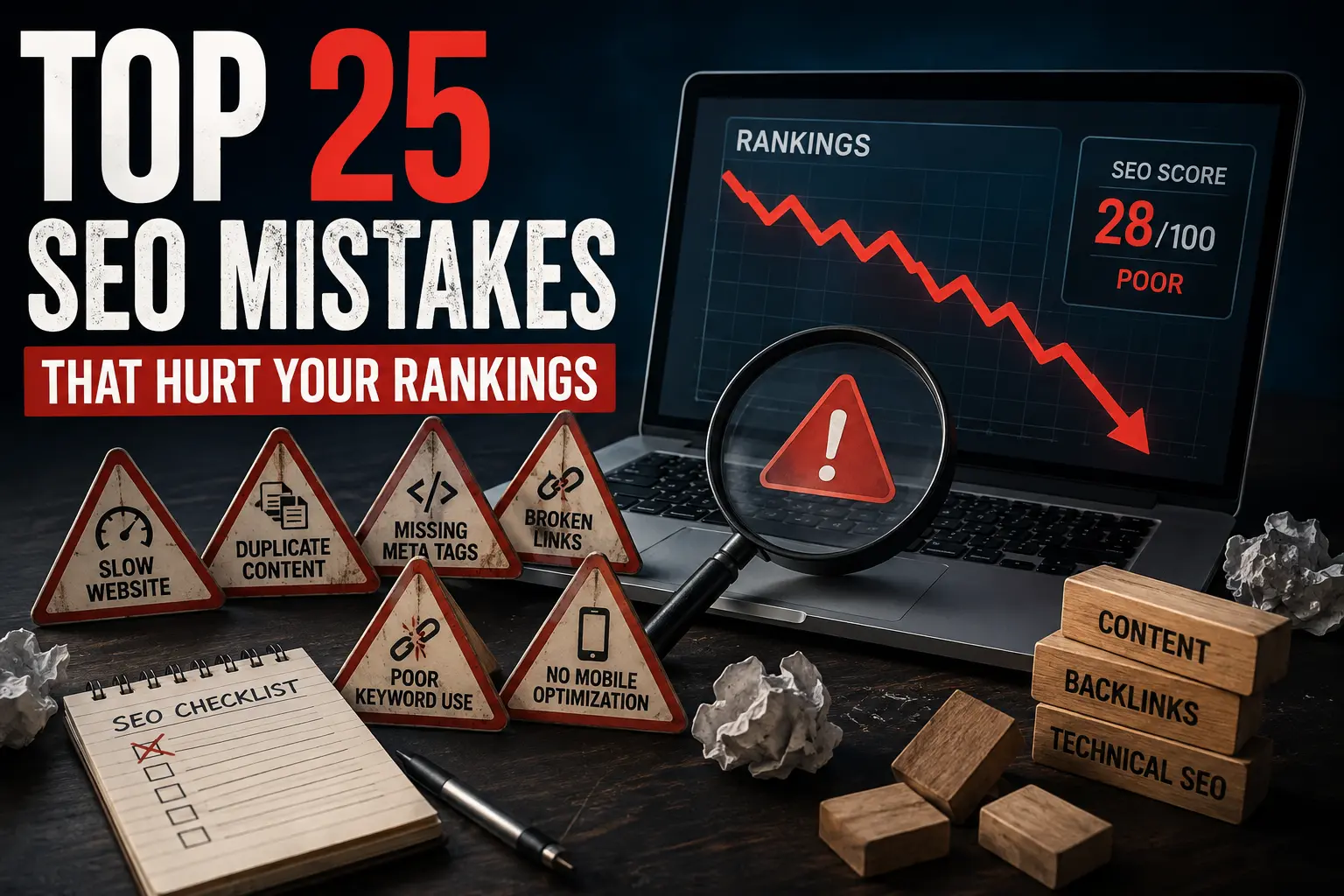
If your traffic has stalled or your rankings keep sliding, the problem usually isn’t bad luck — it’s one (or several) of the classic SEO mistakes that quietly sabotage even well-intentioned websites. Search engines have gotten smarter, competition has gotten fiercer, and the margin for error has gotten smaller. A handful of overlooked SEO mistakes can undo months of hard work on content, design, and outreach.
In this guide, we’re breaking down the 25 most common SEO mistakes we see across small business websites, blogs, and eCommerce stores — and exactly how to fix each one. Whether you’re a beginner running your first site audit or a seasoned marketer reviewing an established domain, this list will help you spot the SEO mistakes that are quietly costing you visibility right now, along with practical, actionable fixes you can implement this week.
If you’re new to the fundamentals first, it’s worth reading what SEO actually is and how search engines work before diving into this list, since understanding the basics makes these mistakes much easier to spot and much faster to correct.
Why SEO Mistakes Matter More Than Ever
Google’s algorithm updates in recent years have rewarded technically sound, genuinely helpful websites and punished sites riddled with SEO mistakes. Even one or two significant SEO mistakes — like poor site speed or duplicate content — can hold an otherwise great website back from page one, no matter how much content you publish or how many backlinks you build. That’s why regularly auditing your site for SEO mistakes should be a non-negotiable part of your ongoing marketing routine, rather than a one-time task you complete and forget about.
A good starting point is running through a proper SEO audit checklist so you catch issues before they compound into bigger ranking losses. Many site owners only start looking for SEO mistakes after traffic has already dropped, when a quarterly review could have caught the problem early and saved months of lost visibility.
It also helps to understand that not every ranking drop has a dramatic cause. Sometimes it’s a single missed redirect, an unoptimized image, or a stale page nobody thought to update in two years. That’s precisely why a systematic, checklist-driven approach beats guessing — it catches the small, unglamorous issues that add up to a big problem over time.
Below, we’ve grouped the 25 issues into five categories — technical, on-page, content, local, and link building — so you can jump straight to the section most relevant to your situation, or work through the entire list from top to bottom for a full-site review.
Let’s get into the list.
Technical SEO Mistakes
Technical issues are some of the most damaging SEO mistakes because they affect how search engines crawl, index, and understand your entire website — not just a single page. If the foundation is broken, even the best content in the world will struggle to rank.
1. Ignoring Core Web Vitals
One of the most common SEO mistakes is neglecting page experience signals like loading speed, interactivity, and visual stability. Google uses Core Web Vitals as ranking factors, and slow, janky pages consistently underperform in search results even when their content is strong. Fix it by compressing images, minimizing JavaScript, deferring non-critical scripts, and using a fast, reliable host. Monitoring these metrics regularly, rather than checking once and moving on, prevents this from becoming a recurring SEO mistake as your site grows.
2. Slow Website Speed
Closely related, a sluggish website is one of the SEO mistakes that costs you both rankings and conversions at the same time. Visitors bounce within seconds of a slow load, and Google notices that behavior through engagement signals. Learn more about how website speed impacts SEO and what specifically to optimize, from server response times to render-blocking resources and image formats.
3. Blocking Important Pages in Robots.txt
A surprisingly common technical SEO mistake is accidentally disallowing key pages in your robots.txt file, which prevents search engines from crawling them at all. This often happens after a site migration, redesign, or when moving a staging site to production and forgetting to remove the disallow rule. Always double-check your robots.txt after any major site change to make sure you haven’t blocked pages you actually want indexed.
4. Not Fixing Crawl and Indexing Errors
Failing to monitor indexing issues is another of the SEO mistakes that silently kills visibility, often for months before anyone notices. Pages that aren’t indexed simply can’t rank, no matter how well they’re written or optimized. Use Google Search Console to monitor indexing regularly and resolve errors as soon as they appear. You can also review a Search Console coverage report walkthrough to understand exactly what each error type means and how urgently it needs fixing.
5. No XML Sitemap or Broken Sitemap
Submitting an outdated, broken, or missing sitemap is a technical SEO mistake that makes it harder for search engines to discover new content efficiently. Keep your sitemap updated and submitted inside Search Console, and check periodically that it doesn’t include redirected, noindexed, or deleted URLs, which can waste crawl budget and confuse search engines about your site’s structure.
6. Not Using HTTPS
Running an unsecured site is still one of the SEO mistakes businesses make even now, even though HTTPS has been a confirmed ranking signal for years. Beyond the ranking impact, an insecure site displays browser warnings that scare visitors away before they even see your content. If your site isn’t secured, migrate immediately and set up proper 301 redirects from the old HTTP URLs.
7. Duplicate Content Across Pages
Publishing near-identical content across multiple URLs — through pagination, filtered category pages, or copy-pasted service pages — is one of the more damaging SEO mistakes, since it confuses search engines about which page deserves to rank. Use canonical tags, consolidate similar pages, and rewrite duplicated sections to be genuinely unique wherever possible.
For a broader look at technical fundamentals, this technical SEO checklist covers 25 things worth auditing beyond what we’ve listed here. You can also review technical SEO best practices for a deeper dive into crawlability, indexation, and site architecture.
On-Page SEO Mistakes
On-page issues are among the easiest SEO mistakes to fix — once you know where to look — because they’re entirely within your control and don’t require outside cooperation like backlinks do.
8. Skipping Keyword Research
Publishing content without proper research is one of the most fundamental SEO mistakes a site owner can make. Without knowing what your audience actually searches for, the exact phrasing they use, and how much competition exists, you’re essentially guessing. Start with solid keyword research for local businesses or explore low-competition keyword opportunities to find realistic ranking targets your site can actually compete for.
9. Keyword Stuffing
On the opposite end, cramming your target phrase unnaturally into every sentence is one of the oldest SEO mistakes in the book, and it’s still surprisingly common. Modern algorithms penalize this heavily because it damages readability and signals manipulative intent rather than genuine expertise. Write naturally, and let related terms, synonyms, and topically relevant phrases carry the rest of the semantic weight instead of repeating one exact phrase over and over.
10. Missing or Weak Title Tags
A vague, generic, or missing title tag is a small but costly SEO mistake that’s often overlooked because it doesn’t seem urgent. Title tags are frequently the first thing users see in search results, and they carry real ranking weight as one of the strongest on-page signals. Keep them under 60 characters, include your primary keyword near the front, and make sure every page has a unique, descriptive title.
11. Ignoring Meta Descriptions
While not a direct ranking factor, skipping meta descriptions is still one of the SEO mistakes that hurts click-through rate significantly. A compelling, keyword-relevant description written to match search intent can be the difference between a click and a scroll-past, even when your ranking position stays exactly the same.
12. Poor Header Structure
Disorganized H1 through H6 tags are a common on-page SEO mistake that makes both content and code harder to interpret. Search engines use headers to understand content hierarchy and topical relevance, and users use them to scan for the information they need. Structure content logically, with one clear H1 and organized, descriptive subheadings that follow a sensible order.
13. Thin or Low-Value Content
Publishing shallow, 300-word pages that don’t fully answer the search intent is one of the most damaging SEO mistakes for long-term rankings, especially in competitive niches. Google increasingly favors comprehensive, genuinely useful content that fully satisfies what a searcher is looking for. Review on-page SEO best practices to make sure your pages are built to satisfy intent, not just hit an arbitrary word count.
14. Ignoring Image Optimization
Uploading unoptimized, uncompressed images without descriptive alt text is a frequently overlooked SEO mistake with a surprisingly large impact. It slows page speed, hurts accessibility, and misses out on meaningful image search traffic entirely. Compress every image before upload and write alt text that actually describes what’s shown.
Content SEO Mistakes
Content-related SEO mistakes are often the hardest to spot because the writing itself may be good — the strategy surrounding it usually isn’t, and that gap is where rankings quietly slip away.
15. Not Matching Search Intent
Writing a product page when users actually want a how-to guide (or vice versa) is a search-intent SEO mistake that tanks rankings no matter how well-written the content is. Always check what type of content currently ranks for your target term — listicle, guide, product page, or comparison — before you start writing.
16. Outdated or Stale Content
Letting old blog posts sit untouched for years is one of the quieter SEO mistakes, and it’s one that compounds silently over time. Search engines favor fresh, updated information, especially in fast-moving industries where statistics, tools, and best practices change constantly. Set a recurring schedule to refresh your best-performing pages at least once a year.
17. No Internal Linking Strategy
Failing to link related pages together is a structural SEO mistake that limits how link equity flows through your site and makes it harder for both users and crawlers to find relevant content. Every new post should link to a few relevant, existing pages — like linking a guide on SEO strategy from a related content piece — to reinforce topical relevance and improve discoverability.
18. Writing for Search Engines, Not Humans
Overly robotic, keyword-stuffed writing that ignores readability is a classic SEO mistake that undermines trust even when it technically ranks. Content should read naturally first and be optimized second, never the other way around, since search engines are increasingly good at evaluating genuine helpfulness over mechanical optimization.
19. Duplicate Title Tags Across Blog Posts
Reusing the same title formula without meaningful differentiation is a subtle content SEO mistake that confuses both search engines and readers trying to tell your articles apart in the search results. Audit your titles periodically to ensure each one is unique, specific, and accurately represents the page’s content.
20. No Clear Call-to-Action
While more of a conversion issue than a direct ranking one, missing CTAs is still worth listing among common SEO mistakes, since traffic without conversion doesn’t meaningfully help the business. High bounce rates and short time-on-page can also indirectly hurt engagement signals search engines factor into quality assessments.
Local SEO Mistakes
For service-based and local businesses, local search errors are some of the costliest SEO mistakes because they directly affect map pack visibility, phone calls, and walk-in customers.
21. Inconsistent NAP Citations
Having mismatched name, address, and phone number listings across directories is a major local SEO mistake that undermines trust signals search engines rely on. Search engines use citation consistency to verify legitimacy, and inconsistent data can suppress local rankings entirely. Clean up your listings using a guide to local citations and audit them at least twice a year.
22. Neglecting Google Business Profile Optimization
An incomplete or poorly optimized Google Business Profile is one of the most common local SEO mistakes small businesses make, and it’s also one of the easiest to fix. Make sure categories, hours, photos, services, and business descriptions are fully filled out and kept current. This Google Business Profile optimization guide and checklist walk through exactly what to fix, and it’s worth understanding the core ranking factors as well as this alternate breakdown of ranking factors too.
23. Ignoring Reviews and Reputation Signals
Not actively generating or responding to reviews is an often-overlooked local SEO mistake, since review volume, recency, and response rate all influence local rankings. Learn how to get more Google reviews consistently, and build review generation into your regular customer follow-up process rather than treating it as an afterthought.
24. Not Building Location-Specific Pages
Trying to rank for multiple cities or service areas from a single generic page is a structural SEO mistake that limits how many searches your site can realistically compete for. Search engines reward dedicated, well-optimized pages for each location or service combination with unique, locally relevant content. See how ranking on Google locally actually works, and review this complete local SEO guide for small businesses or this local SEO overview for a broader framework. Industry-specific approaches matter too — see examples for HVAC companies, plumbing businesses, electricians, and locksmiths.
25. Risking a Google Business Profile Suspension
Using a virtual office, a keyword-stuffed business name, or otherwise violating Google’s guidelines is a serious local SEO mistake that can get your entire profile suspended overnight, wiping out visibility instantly. If this happens, act fast — here’s what to know about why profiles get suspended and how to recover as quickly as possible.
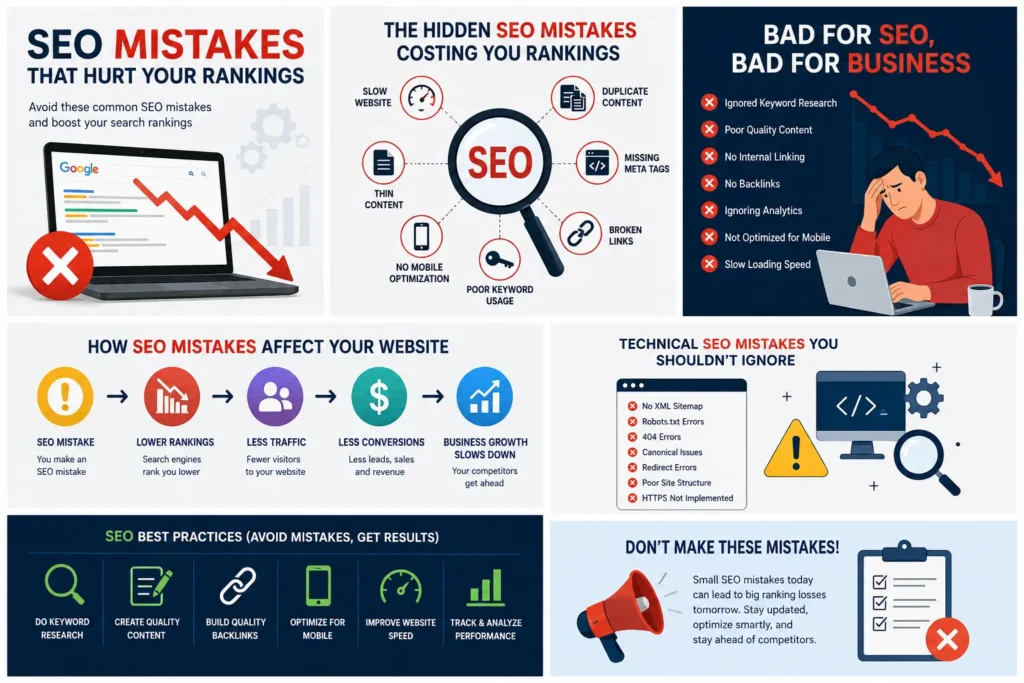
Link Building SEO Mistakes
No list of SEO mistakes is complete without addressing off-page issues, since backlinks remain one of the strongest ranking signals search engines use to evaluate authority.
Buying Low-Quality Links
Purchasing spammy, irrelevant backlinks from link farms or private blog networks is one of the riskiest SEO mistakes a site owner can make — it can trigger manual penalties that take months, sometimes years, to fully recover from. Instead, focus on sustainable link building strategies and proven link building techniques that build authority safely over time, or review this practical guide on how to get backlinks the right way through genuine outreach and relationship building.
Ignoring Anchor Text Diversity
Over-optimizing anchor text with the exact same keyword phrase every single time is a link-building SEO mistake that can look manipulative to search engines and trigger closer scrutiny of your entire link profile. Vary your anchors naturally across branded terms, generic phrases like “click here,” and keyword-rich text used sparingly and contextually.
How to Audit Your Site for SEO Mistakes
Now that you know the most common SEO mistakes, the next step is auditing your own website methodically rather than fixing issues piecemeal as you happen to notice them. Here’s a simple process:
- Crawl your site with a tool like Screaming Frog or Search Console to surface technical SEO mistakes such as broken links, redirect chains, and indexing gaps.
- Review your top pages for on-page SEO mistakes — check title tags, headers, content depth, and internal linking on the pages that already drive the most traffic.
- Check your local presence for inconsistencies or SEO mistakes in your Google Business Profile, citations, and review management.
- Audit your backlink profile for toxic links or missed link building SEO mistakes using a backlink analysis tool.
- Re-check quarterly. SEO mistakes creep back in as sites grow, new pages get published, and platforms update, so ongoing audits matter far more than a one-time fix.
Following a structured SEO audit checklist makes this process repeatable instead of guesswork, and pairing it with a solid SEO strategy ensures you’re not just fixing SEO mistakes reactively but actively preventing new ones from creeping in.
Quick Reference: All 25 Issues at a Glance
Use this checklist as a fast scan before or after your audit:
- Ignoring Core Web Vitals
- Slow website speed
- Blocking important pages in robots.txt
- Not fixing crawl and indexing errors
- No XML sitemap or a broken sitemap
- Not using HTTPS
- Duplicate content across pages
- Skipping keyword research
- Keyword stuffing
- Missing or weak title tags
- Ignoring meta descriptions
- Poor header structure
- Thin or low-value content
- Ignoring image optimization
- Not matching search intent
- Outdated or stale content
- No internal linking strategy
- Writing for search engines instead of humans
- Duplicate title tags across blog posts
- No clear call-to-action
- Inconsistent NAP citations
- Neglecting Google Business Profile optimization
- Ignoring reviews and reputation signals
- Not building location-specific pages
- Risking a Google Business Profile suspension
Bookmark this list and revisit it every time you publish new content or make structural changes to your site. Most ranking declines can be traced back to two or three items on this list, so even a quick monthly scan can catch problems while they’re still easy to fix.
If you manage multiple sites or client accounts, it’s worth turning this checklist into a recurring task inside whatever project management tool your team already uses. Assign an owner to each category — technical, on-page, content, local, and link building — and set a realistic cadence for review. Technical and indexing checks are worth doing monthly since they can silently tank a whole section of a site if left unnoticed, while content freshness and local listing accuracy can reasonably be reviewed on a quarterly basis. The goal isn’t perfection on day one; it’s steady, compounding improvement as each issue gets resolved and stays resolved.
Frequently Asked Questions About SEO Mistakes
What is the most common SEO mistake? Thin content and poor keyword targeting are consistently among the most common SEO mistakes, since they affect whether a page can satisfy search intent at all, regardless of how technically sound the rest of the site is.
How do I know if I’m making SEO mistakes? Traffic drops, stalled rankings, high bounce rates, and unindexed pages in Search Console are all warning signs. Running a full audit against a checklist is the most reliable way to catch SEO mistakes before they cause lasting damage.
Can SEO mistakes cause a Google penalty? Yes. Certain SEO mistakes, particularly manipulative link building, keyword stuffing, and duplicate or thin content, can trigger algorithmic demotions or manual penalties that significantly reduce visibility until they’re corrected.
How often should I check for SEO mistakes? Most sites benefit from a full audit every quarter, with lighter monthly checks on indexing status, Core Web Vitals, and Google Business Profile accuracy in between.
Final Thoughts
Every website, no matter how established or well-funded, is susceptible to SEO mistakes. The good news is that most of these issues — from technical errors to content gaps to local listing problems — are entirely fixable once identified, often without any additional budget beyond your own time. Start by tackling the highest-impact SEO mistakes first: site speed, indexing errors, and Google Business Profile completeness tend to move the needle fastest and deliver visible results within weeks.
Fixing SEO mistakes isn’t a one-time project; it’s an ongoing discipline that separates sites that steadily grow from sites that plateau. Build a habit of auditing, monitoring, and refining, and you’ll steadily climb past competitors who are still making the same SEO mistakes month after month.
