
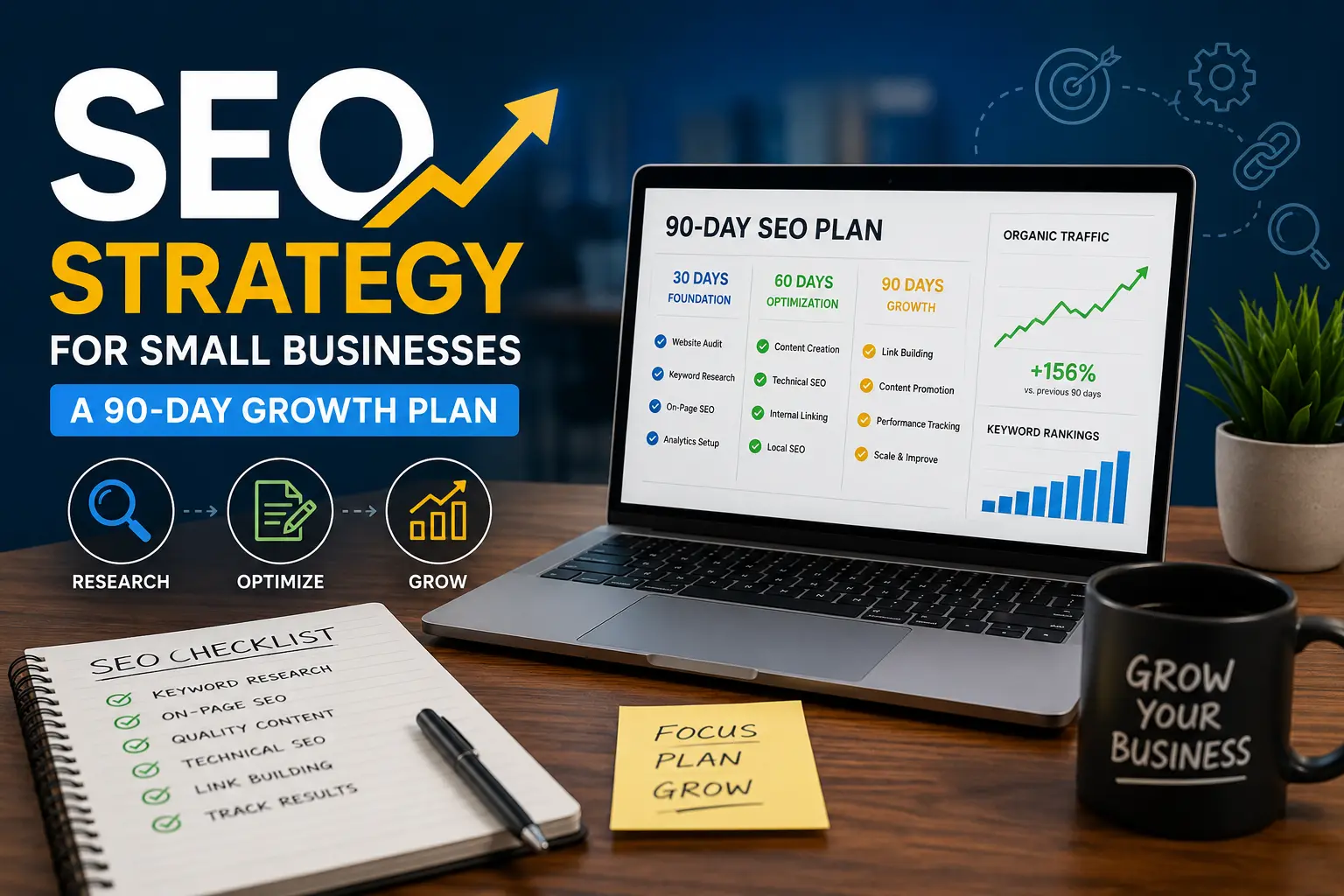
Most small business owners know they need better visibility on Google, but very few actually have a real SEO strategy guiding their efforts. Instead, they publish a blog post here, tweak a title tag there, and hope something eventually moves the needle. Without a structured plan, even genuinely good work tends to produce inconsistent, hard-to-measure results.
This guide lays out a complete 90-day SEO strategy built specifically for small businesses with limited time and budget. Rather than a vague list of tips, it is organized into three clear 30-day phases: foundation, content and on-page optimization, and authority building. By following this SEO strategy step by step, you will move from an unoptimized or neglected website to a structured, measurable system for growing organic visibility.
Whether you run a local service business, an e-commerce store, or a professional practice, the core principles of this SEO strategy apply. Let’s walk through exactly what to do in each phase, and why each step matters.
What Is an SEO Strategy?
An SEO strategy is a structured, prioritized plan for improving a website’s visibility in search engines, built around specific goals rather than a random collection of tactics. A real plan accounts for where a business currently stands, identifies the highest-leverage opportunities available, and sequences the work in a logical order so that later efforts build on a solid foundation instead of competing with unresolved problems.
This distinction matters more than it might seem. Publishing content without first fixing technical issues, or chasing backlinks before your on-page SEO is solid, wastes effort and often produces underwhelming results. A well-sequenced plan avoids this by making sure each phase of work supports the next.
Why Small Businesses Need a Structured SEO Strategy
Small businesses rarely have the luxury of unlimited time or budget for marketing. This makes a clear SEO strategy even more important than it is for larger companies, because every hour spent needs to produce a meaningful return. Without a plan, it is easy to spend weeks on low-impact tasks, like fine-tuning a blog post nobody will read, while ignoring foundational issues, like a broken sitemap or an incomplete Google Business Profile, that are quietly capping growth.
A structured SEO strategy also makes it possible to measure progress. When you know exactly what you did in a given month and why, it becomes far easier to understand what is working and adjust course, rather than guessing at which of a dozen simultaneous changes might be responsible for a ranking shift.
Before You Start: Auditing Your Current Position
Before diving into the 90-day plan, spend a few days understanding where your website currently stands. Any effective SEO strategy starts with an honest audit rather than assumptions about what needs fixing.
Check your indexing status and crawl errors in Google Search Console, review your current Google Business Profile for completeness, and note your current rankings for a handful of important keywords. This baseline gives you something concrete to measure your progress against over the following three months, rather than relying on a vague sense of whether things feel like they’re improving.
Why Sequence Matters More Than Any Single Tactic
It’s worth pausing on why this guide insists on a specific order rather than simply listing everything a business could do and letting the owner pick whatever sounds appealing. Search engines evaluate websites holistically, weighing technical health, content relevance, and external trust signals together rather than in isolation. Publishing excellent content on a site with broken crawlability, or building backlinks to pages that load slowly and convert poorly, wastes effort that a properly sequenced approach would have spent more productively.
This is the difference between a collection of tactics and an actual plan. A tactic is a single action, like writing a blog post or requesting a review. A plan connects a series of tactics in an order that compounds rather than competes. Foundation work in the first 30 days makes the content published in the next 30 days more effective, and that content, in turn, gives the backlinks and reviews earned in the final 30 days something substantial to point back to. Skipping steps or reordering them rarely saves time in practice; it usually just means redoing work later once the missing foundation becomes obvious.
Budget Considerations for a 90-Day Growth Plan
One of the most common questions small business owners ask is how much this kind of plan actually costs to execute. The honest answer depends heavily on how much can be handled in-house versus outsourced. A business owner with a few hours a week to spare can complete much of the foundation phase, including keyword research, Google Business Profile optimization, and basic technical fixes, without spending anything beyond their own time.
Costs typically enter the picture around professional website development, content writing at scale, and specialized technical work like server-level speed optimization. Even so, this kind of growth plan does not require a large recurring marketing budget so much as consistent, correctly prioritized effort spread across the full 90 days. Businesses that try to skip the foundational work in favor of paid shortcuts, like buying low-quality backlinks or mass-producing thin content, tend to see disappointing results regardless of how much they spend, since those shortcuts rarely address the underlying issues holding a website back.
Signs Your Current Approach Isn’t Working
Before committing to this 90-day framework, it helps to recognize the warning signs that typically indicate a business’s current marketing approach lacks real structure:
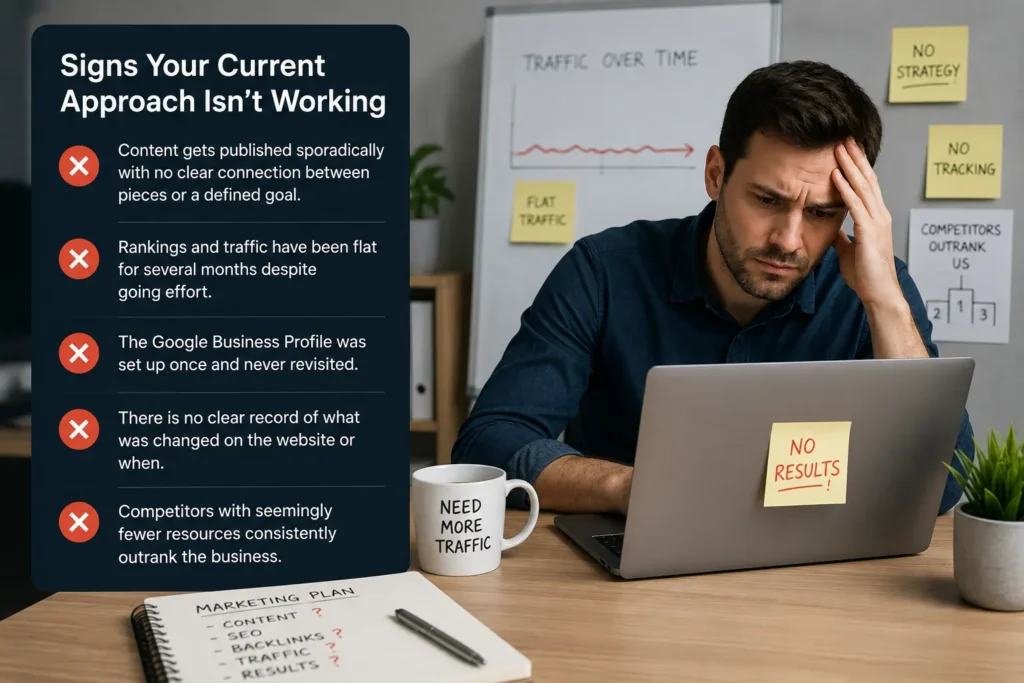
- Content gets published sporadically with no clear connection between pieces or a defined goal.
- Rankings and traffic have been flat for several months despite ongoing effort.
- The Google Business Profile was set up once and never revisited.
- There is no clear record of what was changed on the website or when.
- Competitors with seemingly fewer resources consistently outrank the business.
Recognizing these patterns is often the first step toward committing to a genuinely structured plan rather than continuing to make scattered, hard-to-measure improvements month after month.
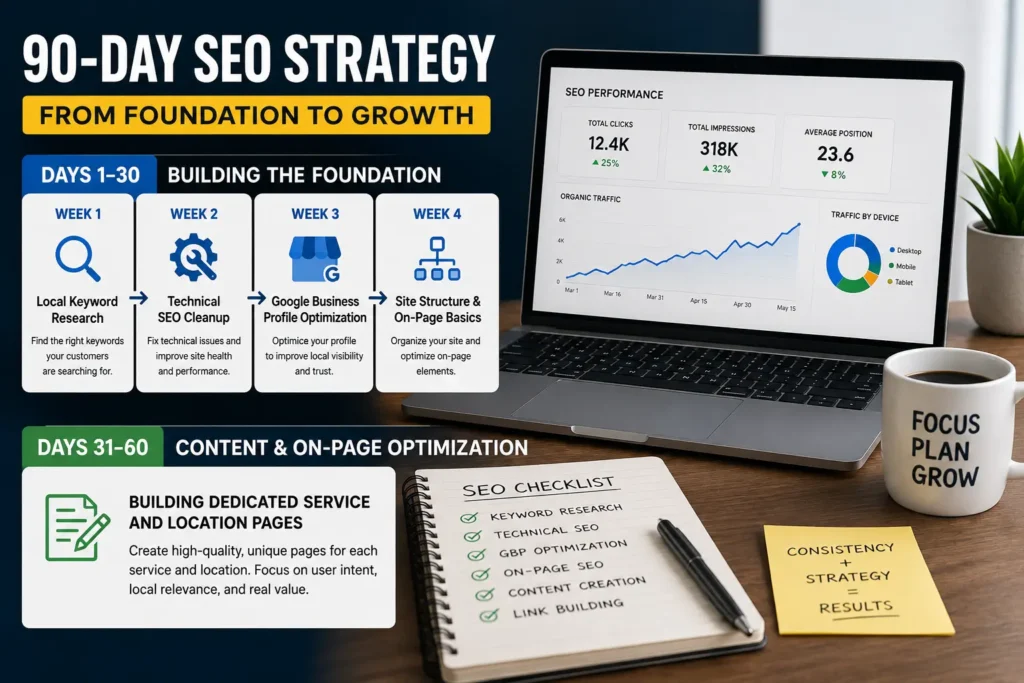
Days 1–30: Building the Foundation
The first 30 days of this SEO strategy focus entirely on foundational work. Skipping this phase to jump straight into content or link building is the most common reason small business SEO efforts underperform.
Week 1: Local Keyword Research
Every strong SEO strategy starts with understanding exactly what your potential customers are searching for. Spend the first week identifying keywords grouped by intent: transactional searches ready to convert, informational searches earlier in the decision process, and local modifiers tied to your specific service areas. Our guide to keyword research for local businesses walks through this process in detail and forms the backbone of everything that follows in your SEO strategy.
Week 2: Technical SEO Cleanup
With your keywords mapped out, shift attention to technical health. Fix crawl errors, confirm your XML sitemap is accurate and submitted, resolve any indexing issues flagged in Search Console, and address obvious page speed problems. Technical issues left unresolved will undermine every other part of this plan, no matter how good your content or backlinks eventually become. Our technical SEO hub covers the full range of issues worth checking during this phase, and our dedicated guides on Core Web Vitals and website speed and SEO go deeper into diagnosing and fixing performance problems specifically.
Week 3: Google Business Profile Optimization
For any business with a physical location or service area, your Google Business Profile deserves dedicated attention within this phase of your SEO strategy. Claim and verify your listing if you have not already, select the most accurate categories, complete every attribute, and upload genuine photos. Our comprehensive Google Business Profile optimization guide and the companion Google Profile optimization checklist provide a complete field-by-field walkthrough. If your listing has run into verification issues in the past, our article on why Google Business Profiles get suspended explains how to avoid repeating those mistakes as part of your ongoing SEO strategy.
Week 4: Site Structure and On-Page Basics
Close out the foundation phase by reviewing your site’s overall structure. Make sure important pages are no more than a few clicks from the homepage, title tags and meta descriptions are unique across the site, and your internal linking connects related pages logically. This structural work is easy to overlook, but it is a critical piece of any growth plan because it determines how efficiently both users and search engines can navigate and understand your website.
Days 31–60: Content and On-Page Optimization
With the foundation in place, the second phase of this SEO strategy shifts toward building out content and strengthening individual pages.
Building Dedicated Service and Location Pages
Using the keyword research completed earlier, build or improve dedicated pages for each core service and, if applicable, each city or neighborhood you serve. Avoid the common mistake of cramming every service onto a single homepage or duplicating near-identical content across location pages with only the city name changed. This phase should produce genuinely useful, unique pages that clearly match specific search intent.
Publishing Supporting Content
Beyond core service pages, publish a handful of supporting articles that address common customer questions, comparisons, or informational searches related to your industry. This content rarely converts as directly as a service page, but it captures additional search traffic and builds topical authority that strengthens your broader SEO strategy over time. Aim for quality and consistency over volume; a handful of genuinely useful articles published steadily will outperform a rushed batch published all at once.
A simple way to generate topic ideas is to review the actual questions customers ask over the phone or in person before booking a job. These recurring, real-world questions almost always mirror what people are searching for online, and turning even five or six of them into clear, genuinely helpful pages during this 30-day window can meaningfully expand the range of searches your site is eligible to appear for. Keep each piece focused on one topic rather than trying to cover everything at once, and link back naturally to the relevant service or location page so readers have an obvious next step.
Strengthening Local SEO Fundamentals
If your business serves a specific geographic area, this is the point in the plan to strengthen the broader local SEO elements beyond your Google Business Profile alone, including citation consistency and location-specific content. Our complete local SEO guide for small businesses covers this in depth and complements the profile-level work completed during the first 30 days.
Reviewing and Refining On-Page Elements
Revisit every page built or updated so far and confirm that headers, image alt text, internal links, and calls to action are all working together toward the same goal. A page that ranks well but fails to convert visitors into leads is only doing half the job an effective plan is meant to accomplish.
Days 61–90: Building Authority and Momentum
The final phase of this 90-day SEO strategy focuses on the signals that build long-term authority and trust: reviews, backlinks, and consistent measurement.
Establishing a Review Generation Process
Set up a simple, repeatable process for requesting reviews after every completed job or transaction. Respond to every review, positive or negative, promptly and professionally. Review velocity, meaning a steady stream of new reviews rather than a single burst, is an important trust signal that supports the rest of your SEO strategy, particularly for local and service-based businesses.
Building Local Backlinks and Relationships
Backlinks from relevant, reputable websites strengthen the authority signals search engines use to evaluate your site. Focus on genuine opportunities: sponsoring local events, partnering with complementary businesses, and contributing expert commentary to local publications. Our guides on link building fundamentals and practical link building techniques cover this process in more depth and should inform how this final phase of your SEO strategy is executed.
Measuring Results and Planning the Next 90 Days
By the end of day 90, compare your current rankings, traffic, and lead volume against the baseline you established at the start. Use Google Search Console alongside your Google Business Profile Insights to understand which parts of the plan produced the strongest results, and which areas still need attention. This comparison becomes the foundation for planning your next 90-day cycle, since an effective SEO strategy is never really finished; it evolves as your business, competitors, and the search landscape all continue to change.
Keep the comparison simple. A short document noting your starting rankings, traffic, and lead numbers alongside what changed each month is usually enough to spot patterns without turning measurement into its own time-consuming project. Look for which specific changes preceded meaningful movement, whether that was a batch of new location pages, a round of review requests, or a handful of new backlinks, and weight your next cycle toward whichever levers produced the clearest results for your particular business and market.
Common Mistakes That Derail an SEO Strategy
Even well-intentioned small businesses fall into predictable traps that undermine an otherwise solid SEO strategy:
- Skipping the technical foundation and jumping straight into content or link building.
- Publishing thin or duplicate content across multiple pages instead of unique, useful material.
- Ignoring the Google Business Profile in favor of website-only efforts.
- Chasing every new SEO tactic without a clear sequence or priority.
- Failing to measure results, making it impossible to know what is actually working.
- Treating SEO as a one-time project rather than an ongoing, cyclical strategy.
- Neglecting reviews and reputation management as part of the broader plan.
Avoiding these mistakes is often more valuable than chasing advanced tactics, since a single unresolved issue can quietly offset months of otherwise solid SEO strategy work.
Tools to Support Your SEO Strategy
You do not need an expensive platform to execute this plan. A handful of accessible tools cover most of what a small business needs throughout each phase of an SEO strategy:
- Google Search Console for monitoring indexing, crawl errors, and organic search performance.
- Google Business Profile Insights for tracking calls, direction requests, and profile views.
- A basic rank tracking tool to monitor keyword position changes over time.
- A site crawler like Screaming Frog for periodic technical audits.
- A simple spreadsheet to log what was changed each month and the results that followed.
Consistent measurement, more than any single tool, is what separates a genuine plan from a loose collection of occasional improvements.
None of these tools need to be expensive or complicated to be useful. What matters is checking them on a predictable schedule, weekly for Search Console and profile insights, monthly for rank tracking, and quarterly for a full technical crawl, rather than only glancing at them sporadically when something feels off. A simple recurring calendar reminder is often enough to keep this habit consistent throughout all three phases of the plan.
Adapting Your SEO Strategy by Industry
While the 90-day framework applies broadly, certain industries benefit from adjusting the emphasis of their SEO strategy. Service-area trades like HVAC companies often need to prioritize location page structure earlier, as covered in our guides on HVAC SEO strategy and HVAC website architecture and on-page SEO.
Emergency-driven trades face their own priorities within this framework. Our plumbing SEO guide, locksmith SEO strategies, and electrician SEO guide each explain how urgency-driven search behavior shifts the priorities of an SEO strategy toward Google Business Profile accuracy and page speed earlier in the process. Businesses handling repeat, brand-specific service work will also find our appliance repair SEO guide useful for avoiding duplicate content issues across similar pages.
How Much Time Does This SEO Strategy Require?
Most small business owners can execute this plan dedicating five to ten hours per week, particularly during the first 30-day foundation phase, which tends to be the most time-intensive. Content creation during days 31 through 60 can be spread out or outsourced depending on available time, and the final phase focused on reviews and backlinks often requires less hands-on time but benefits from consistency over the full 30 days rather than a single concentrated push.
Businesses with more resources can compress this timeline by running phases in parallel or delegating specific tasks, but the sequence itself, foundation before content, content before authority building, should remain consistent regardless of how quickly each phase moves.
It also helps to set realistic expectations with anyone else involved in the work, whether that’s a spouse handling social media, an employee managing the phones, or a freelancer helping with content. A shared understanding of what each 30-day block is meant to accomplish keeps everyone pulling in the same direction, rather than one person quietly abandoning the plan halfway through because early results felt slower than expected. SEO rewards patience applied consistently far more than it rewards intensity applied briefly.
Consider this 90-day plan a starting rhythm rather than a rigid formula. Every business will find that certain weeks take longer than expected, whether that’s tracking down old citation listings, waiting on photography for the Google Business Profile, or drafting the first few pieces of supporting content. That’s normal. What matters most is preserving the underlying sequence: fix the foundation before publishing content, and publish content before actively pursuing backlinks and reviews at scale. Businesses that respect that order, even if the calendar stretches a little, consistently end up further ahead than those that rush straight to the most exciting-sounding tactics first.
Frequently Asked Questions About Building an SEO Strategy
How long before an SEO strategy shows results? Most small businesses see measurable movement within the first 30 to 60 days, particularly around Google Business Profile improvements and technical fixes. More competitive markets may take a full 90-day cycle or longer to show substantial ranking gains.
Can I run this SEO strategy without hiring an agency? Yes. Much of this plan, particularly the foundation and Google Business Profile phases, is achievable for a business owner willing to invest consistent time. Technical fixes and ongoing content production are where outside help most often accelerates results.
What is the single most important part of an SEO strategy for a small business? There is rarely one single factor, but resolving technical issues and fully optimizing your Google Business Profile tend to produce the fastest, most measurable early wins within any SEO strategy.
Should the SEO strategy change after the first 90 days? Yes. An effective SEO strategy evolves based on what the data from the first cycle reveals. Some businesses will need to double down on content, others on backlinks or reviews, depending on where the biggest gaps remain after the initial 90 days.
Is a 90-day SEO strategy realistic for a very small business with limited time? Yes, though the pace may need to stretch beyond 90 calendar days if only a few hours per week are available. The sequence and priorities in this SEO strategy remain valid regardless of how quickly each phase is completed.
What happens after the first 90 days are complete? Most businesses move directly into a second cycle, using the results from the first to guide where to focus next. Some choose to double down on content production if that phase produced the strongest early traction, while others shift more time toward reviews and local link building if authority signals turned out to be the bigger gap. The framework stays the same; only the emphasis within each phase shifts based on real data rather than guesswork.
Final Thoughts on Building an SEO Strategy That Works
A strong SEO strategy is not about doing more; it is about doing the right things in the right order. This 90-day framework, foundation first, then content and on-page optimization, then authority building, gives small businesses a clear, sequenced path instead of a scattered list of tactics competing for limited time and attention.
Start with an honest audit, work through each phase methodically, and measure your results against the baseline you established at the beginning. An SEO strategy built this way compounds over time: each 90-day cycle builds on the last, producing steadier, more predictable growth than businesses that treat SEO as a series of disconnected, one-off efforts.
Commit to this SEO strategy for one full 90-day cycle, review what worked, and repeat. That consistency, more than any single tactic covered in this guide, is what ultimately separates small businesses that win in search from those that stay stuck on page two.
