
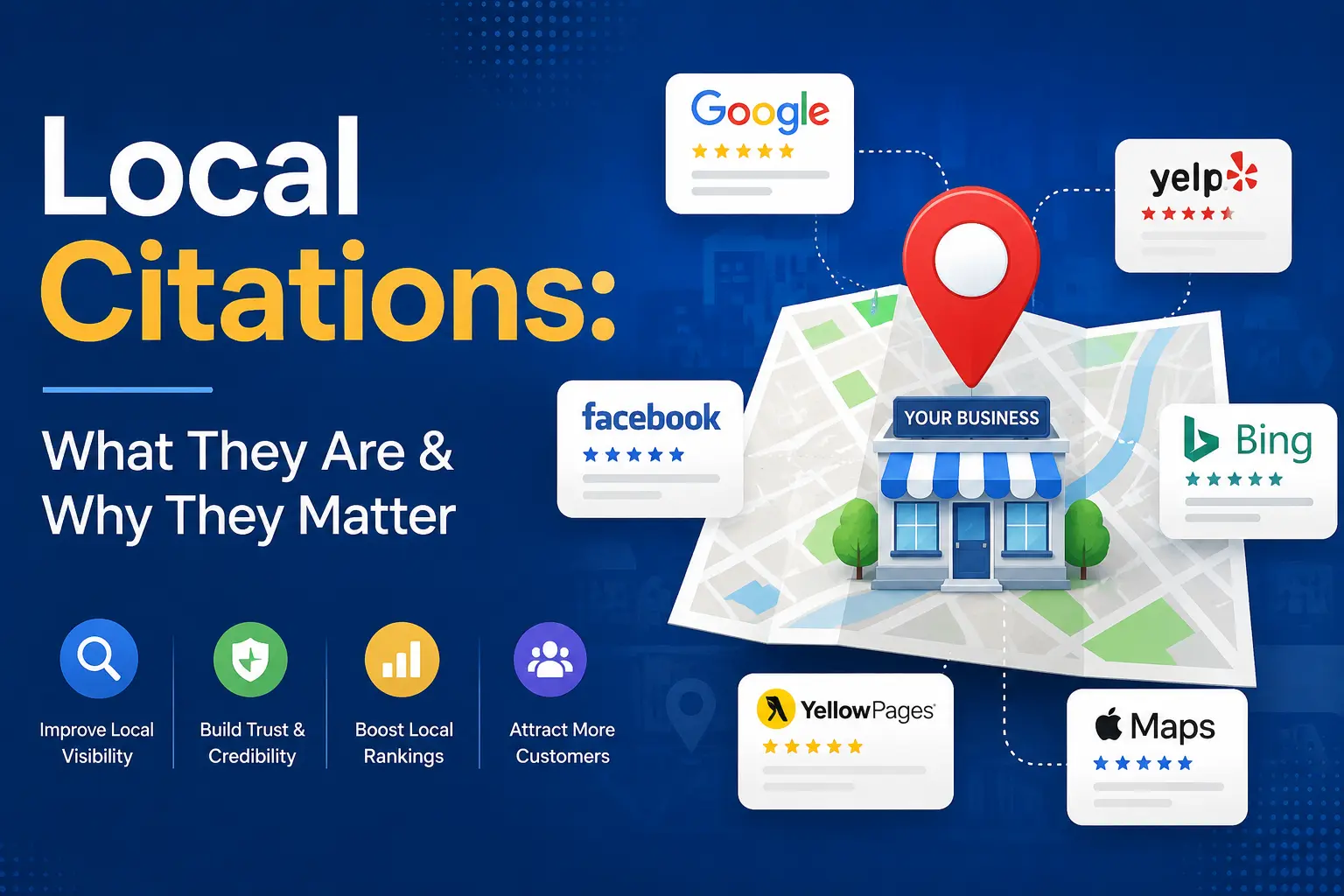
If you run a local business and you’ve spent any time researching local SEO, you’ve probably run into the term “local citations” more than once. It gets mentioned alongside Google Business Profile, reviews, and backlinks — but a lot of business owners still aren’t sure what this actually means in practice, or why agencies treat it as essential rather than a nice-to-have.
This guide breaks down exactly what local citations are, why they matter for your visibility in the map pack and organic search, the different types you’ll encounter, how to build them correctly, and the mistakes that quietly hurt local rankings. By the end, you’ll know precisely how this piece fits into a bigger local SEO strategy — and what to do about it starting today.
What Are Local Citations?
Local citations are any online mention of your business’s name, address, and phone number (commonly shortened to NAP) on a website that isn’t your own. That could be a dedicated business directory like Yelp, a chamber of commerce listing, an industry-specific directory, a local news article, or even a mention embedded inside a blog post.
Unlike a backlink, this type of mention doesn’t always need to include a clickable link back to your website. Search engines like Google can read the plain text — your business name, address, and phone number — and use it as a signal that confirms your business exists, operates where you say it operates, and is a legitimate, verifiable entity. This is exactly why local citations are treated as foundational to local SEO rather than an optional add-on.
Think of a citation as a piece of digital word-of-mouth. Every time your business is listed correctly on a directory, review site, or local publication, it’s another data point telling Google, and potential customers, that your business is real, active, and trustworthy. The more consistent and widespread these mentions are, the more confidence search engines place in your business listing.
It also helps to understand what a citation is not. It’s not a review, though review platforms often double as citation sources. It’s not necessarily a backlink, though some do include one. And it’s not the same as your Google Business Profile, though your profile benefits enormously from a strong surrounding network of listings elsewhere on the web.
Why Local Citations Matter for Local SEO
This piece of the local SEO puzzle matters because it directly influences how search engines evaluate the relevance, prominence, and trustworthiness of a local business — the three factors Google has publicly said determine local pack rankings.
Here’s why local citations carry so much weight:
1. They Validate Your Business Information
When dozens of directory mentions across different platforms list the same business name, address, and phone number, search engines treat that consistency as a trust signal. If your NAP details vary from one listing to the next, it creates confusion, and Google may struggle to confirm which version of your business information is accurate. Consistent local citations remove that ambiguity.
2. They Support Google Business Profile Rankings
Citations play a supporting role in how your Google Business Profile performs in local search. A profile backed by strong, consistent local citations across relevant directories tends to have an easier time establishing prominence — one of the three core ranking factors covered in our breakdown of Google Business Profile ranking factors.
3. They Increase Discoverability
Not every customer finds you through Google. Directory listings placed on niche platforms, review sites, and local news pages create additional discovery paths. Someone browsing a local directory for “electricians near me” might find your business there before they ever search Google directly.
4. They Build Local Relevance Signals
Search engines use these mentions to understand which geographic area and category a business belongs to. If your local citations consistently list the same city, service area, and business category, it reinforces relevance for the searches you actually want to rank for.
5. They Complement Your Broader Local SEO Strategy
Citations don’t work in isolation — they work alongside on-page optimization, reviews, and link building. If you’re just getting started, our complete local SEO guide for small businesses explains how this fits into the bigger picture.
Types of Local Citations
Not all business listings are built the same way. Understanding the different types helps you prioritize where to focus your efforts.
Structured Citations
Structured citations appear on directory-style websites where your NAP information is entered into defined fields — a business name field, an address field, a phone number field, and so on. Examples include Yelp, Yellow Pages, Bing Places, Apple Maps, and industry-specific directories. This is the most common form of local citations and the easiest to track, audit, and correct because the data lives in a predictable format.
Unstructured Citations
Unstructured mentions happen when your business is referenced in a less formal context — a blog post, local news article, event page, or press release — without a dedicated data field. These are harder to control but often carry strong contextual relevance because they appear within genuine, editorial content rather than a directory template.
Implicit vs. Explicit Citations
An explicit mention includes your business name plus your full NAP details. An implicit one might reference your business name and website without listing the address or phone number. Both count toward your overall citation profile, but explicit listings tend to carry more weight for local SEO because they provide the complete data set search engines use for verification.
Niche and Industry Citations
Beyond general directories, industry-specific listings matter too. An electrician benefits from being listed on trade-specific directories the same way an HVAC company benefits from HVAC-focused platforms. If you work in a specific trade, pairing general local citations with niche ones tends to produce stronger results — something we cover in more depth in our industry guides for electrician SEO, plumbing SEO, and HVAC SEO.
NAP Consistency: The Backbone of Local Citations
You’ll hear “NAP consistency” mentioned constantly in conversations about local citations, and for good reason. NAP consistency means your business Name, Address, and Phone number appear identically across every listing, every directory, your website, and your Google Business Profile.
Here’s why this matters so much:
- Search engines cross-reference data. If one directory lists “123 Main Street” and another lists “123 Main St.,” search engines may treat these as slightly different signals rather than confirming the same fact twice.
- Inconsistent citations dilute trust. A pattern of inconsistent listings makes it harder for Google to establish confidence in your business’s location and legitimacy.
- Customers get confused too. If a customer finds an outdated phone number on one of your listings, that’s a lost call, not just a lost ranking signal.
Before building new local citations, always standardize how your business name, address, and phone number should appear. Decide whether you’re “St.” or “Street,” whether you include a suite number, and which phone number format you’ll use. Then apply that format across every listing you create or update going forward.
It’s worth writing this format down somewhere your whole team can access, especially if more than one person is responsible for updating your website, directory profiles, or marketing materials. A single inconsistent entry can undo weeks of careful citation building.
Best Places to Build Local Citations
Not every directory is worth your time. Effective citation building focuses on a mix of general, high-authority platforms and industry- or location-specific ones.
General Business Directories
These are the foundational listings every business should have:
- Google Business Profile (technically not a citation in the traditional sense, but it anchors everything)
- Bing Places
- Apple Maps / Apple Business Connect
- Yelp
- Better Business Bureau
- Yellow Pages
Data Aggregators
Data aggregators distribute your business information to dozens of smaller directories automatically. Submitting accurate information to aggregators like Data Axle, Foursquare, and Neustar Localeze can multiply the number of local citations pointing to consistent data without manual submission to every individual site.
Industry-Specific Directories
Trade-focused listings tend to carry extra relevance because they’re seen by an audience actively searching for that service. A towing company benefits from towing directories, an appliance repair business benefits from appliance repair directories, and a locksmith benefits from locksmith-specific platforms, similar to what we outline in our locksmith SEO and appliance repair SEO guides.
Local and Regional Directories
City chambers of commerce, local business associations, and regional directories provide citations that are highly relevant to your specific service area, which matters more for local pack visibility than broad national directories with no geographic specificity.
How to Build Local Citations Correctly
Building local citations isn’t complicated, but doing it correctly requires a methodical approach rather than a scattershot one.
Step 1: Standardize Your NAP Format
Before creating a single new listing, write down the exact business name, address, and phone number format you’ll use everywhere. This becomes your reference document for every future citation.
Step 2: Audit Your Existing Citations
Search for your business name across major directories to find listings that already exist. Note which ones have outdated or inconsistent information; these need correcting before you build anything new.
Step 3: Claim and Complete Every Listing
When submitting to directories, fill out every available field: business category, hours, service area, description, and photos, rather than just the minimum NAP fields. Complete profiles tend to perform better and provide search engines with more context around your business.
Step 4: Prioritize Quality Over Quantity
A handful of accurate, relevant local citations on respected platforms outperforms dozens of low-quality, spammy directory submissions. Focus first on general directories, then data aggregators, then niche and local platforms relevant to your industry.
Step 5: Monitor and Maintain
Citations aren’t a “set it and forget it” task. If you move locations, change your phone number, or rebrand, every existing listing needs to be updated to reflect the change. Set a recurring reminder to review your citation profile every few months, and treat it as part of your normal maintenance routine rather than a one-off project.
Common Local Citation Mistakes to Avoid
Even well-intentioned businesses make mistakes that reduce the value of their citation profile. Watch for these:
Inconsistent NAP Information
This is, by far, the most common mistake. Slightly different formatting across listings — abbreviations, missing suite numbers, outdated phone numbers — undermines the trust signal local citations are supposed to build.
Duplicate Listings
Creating a second listing on the same directory, often because someone forgot a listing already existed, results in duplicate citations that confuse search engines and can even suppress your Google Business Profile visibility.
Ignoring Niche Directories
Many businesses build listings only on the big, obvious platforms and skip industry-specific directories that might carry more targeted relevance for their category.
Outdated Information After a Move or Rebrand
If you’ve changed your business name, moved locations, or updated your phone number, old local citations with the previous information can actively work against you by sending conflicting signals to search engines.
Low-Quality or Spammy Directories
Not all directories are worth a submission. Citations built on spam-heavy, low-authority sites provide little SEO value and, in some cases, can be associated with practices Google actively discourages.
Treating Citations as a One-Time Project
Local citations require ongoing maintenance. A one-time citation-building push without follow-up monitoring means small inconsistencies creep back in over time as directories update their systems or merge data sources.
How to Audit and Clean Up Local Citations
An audit is the process of identifying every existing mention of your business online and checking it against your standardized NAP format. Here’s a simple approach:
- Search your business name in quotes, along with your city, to surface directories and mentions you may not know about.
- Check major data aggregators first, since they often feed information to dozens of smaller sites.
- Log every listing in a spreadsheet with columns for the platform, current NAP data, accuracy status, and whether it needs correcting.
- Prioritize fixes based on the authority of the directory, starting with major platforms and working down to smaller ones.
- Track your progress and revisit the list quarterly, especially if you’ve made any changes to your business details.
This kind of audit pairs well with a broader technical review of your site. If you haven’t run one recently, our SEO audit checklist is a useful companion resource for catching issues beyond just your citation profile.
Local Citations vs. Backlinks: What’s the Difference?
It’s easy to lump citations and backlinks together since both involve other websites referencing your business, but they serve different purposes.
A backlink is primarily a link-based signal. It tells search engines that another site considers your content valuable enough to link to. Backlinks are covered in detail in our guide to link building techniques.
A citation, on the other hand, doesn’t need a link at all. Its value comes from the accuracy and consistency of your business information, not from link equity. That said, many local citations do include a link back to your website, which means a well-built listing can offer both benefits at once: the trust signal of a consistent citation and the additional value of a referring link.
In short, all directory backlinks can function as local citations, but not all local citations include a backlink. Both are worth pursuing, but they solve slightly different problems within your local SEO strategy.
How Local Citations Affect Google Business Profile and Map Pack Rankings
Google Business Profile is often the first thing people associate with local search visibility, and local citations play a direct supporting role in how that profile performs.
When your Google Business Profile listing is backed by consistent citations across the web, it reinforces the “prominence” ranking factor, one of the three pillars Google uses to rank businesses in the map pack, alongside relevance and distance. Businesses with a thin or inconsistent citation profile often struggle to build the prominence needed to compete for top map pack placement, even if their on-page SEO is otherwise solid.
This is also why review generation and citation building tend to go hand in hand. If you’re working on strengthening your profile, pairing citation building with a strategy for getting more Google reviews tends to produce faster, more noticeable results than focusing on either tactic alone. And once your profile itself is dialed in, our Google Business Profile optimization guide walks through the remaining pieces worth checking.
Measuring the Impact of Your Citation Building Efforts
It’s reasonable to want proof that this work is actually moving the needle. A few ways to measure impact:
- Track local pack rankings for your target keywords before and after a citation-building push.
- Monitor Google Business Profile insights for changes in how customers find your listing, whether through direct searches or discovery searches.
- Watch referral traffic in your analytics platform from directory sites where you’ve built new listings.
- Re-run citation audits periodically to confirm consistency is holding steady across the platforms you’ve claimed.
Keep in mind that local citations tend to work as a cumulative signal rather than an instant ranking boost. It can take weeks for search engines to crawl and process new or corrected data, so patience is part of the process. Businesses that see the strongest results usually treat citation building as a steady, ongoing habit rather than a single sprint.
How Many Local Citations Do You Actually Need?
There’s no universal number, and any guide that promises an exact figure is oversimplifying. What matters more than raw quantity is relevance and consistency. A local business in a competitive market with well-established competitors may need a broader citation profile spanning dozens of directories, while a business in a less competitive niche might see solid results from a smaller, focused set of listings.
Rather than chasing a number, focus on covering the major general directories, the relevant data aggregators, and a handful of industry-specific or local directories that make sense for your business category and location. A tight, accurate citation profile will consistently outperform a large, messy one padded with low-quality submissions.
Local Citations and Keyword Research
One overlooked connection is how citation building ties into keyword strategy. When you’re selecting business categories on directories or writing descriptions for a listing, using the same terminology you’re targeting in your keyword research helps reinforce topical relevance. If you haven’t mapped out the terms your customers actually search for, our guide on keyword research for local businesses is a good starting point before you fill out directory descriptions or citation profiles.
Even small wording choices matter here. If your keyword research shows customers search for “24 hour electrician” rather than “emergency electrician,” using the phrase that actually matches search intent in your directory description helps that listing work harder for you, both for the directory’s own internal search and for how search engines interpret your category relevance.
Local Citations for Multi-Location Businesses
Citation building gets more complex once you have more than one location. Each location needs its own accurate, distinct set of listings, with a unique address and phone number where applicable, rather than a single citation profile shared across every branch.
The biggest risk for multi-location businesses is data drift: one location’s listing gets updated after a move while a sister location’s listing stays untouched, or a general company phone number ends up attached to a directory profile meant for a specific branch. Keeping a master spreadsheet of every location’s NAP details, and cross-checking it against directory listings on a regular schedule, prevents this kind of drift from quietly draining trust in your local citations over time.
Do Local Citations Still Matter With AI-Powered Search?
As AI-driven search features become more common, it’s fair to ask whether older tactics like citation building still carry weight. The honest answer is that the underlying principle behind citations, consistent and verifiable business information available across the web, is exactly the kind of structured data AI systems rely on to answer local queries accurately. If anything, having your business name, address, and phone number represented consistently across many trusted sources makes it easier for both traditional search engines and newer AI-assisted tools to confirm who you are and where you operate. Local citations aren’t going away; they’re becoming part of a wider ecosystem of trust signals that spans traditional search, maps, and AI-generated answers alike.
Building Citations Alongside the Rest of Your Local SEO Stack
Citation building rarely happens in isolation for businesses that are serious about ranking well. It usually sits alongside a handful of other ongoing tasks: keeping your Google Business Profile fresh with new photos and posts, responding to reviews promptly, publishing location-relevant content on your website, and making sure your site itself is technically sound. None of these pieces replace the others. A perfectly optimized website with zero directory presence still struggles to build the trust and prominence signals search engines look for, and a business with dozens of accurate listings but a neglected website misses out on the organic traffic that a strong on-page presence can bring.
A practical way to think about it: citations tell search engines and directories that your business exists and where it operates, while your website and content tell them why a customer should choose you over the competitor down the street. Both halves matter, and treating them as a single connected system, rather than a checklist of unrelated tasks, tends to produce better and more durable results than chasing any one tactic in isolation.
Frequently Asked Questions About Local Citations
Do local citations need a link to count? No. A citation is valid as long as it accurately lists your business name, address, and phone number, even without a hyperlink. That said, listings with links offer added value.
How long does it take for local citations to affect rankings? It varies, but most businesses start noticing gradual improvements over several weeks to a few months as search engines crawl and process the new or corrected data.
Should I hire someone to build local citations for me? It depends on your time and the size of your citation profile. Manual audits and submissions are very doable for a single-location business, but multi-location businesses often benefit from a more systematic, sometimes outsourced, approach.
Can bad local citations hurt my rankings? Inconsistent or duplicate listings won’t necessarily penalize you outright, but they dilute trust signals and can create confusion that indirectly hurts local visibility.
Are local citations still relevant in 2026? Yes. While the local SEO landscape has evolved, this remains a foundational trust and consistency signal that search engines continue to reference when evaluating local businesses.
Final Thoughts on Local Citations
Local citations aren’t the flashiest part of local SEO, but they’re one of the most foundational. They validate that your business is real, reinforce your location and category to search engines, and support the prominence signals that influence Google Business Profile and map pack rankings. The businesses that treat this as an ongoing maintenance task, rather than a one-time checkbox, tend to build a stronger, more trustworthy footprint over time.
If you’re building out your local SEO strategy from the ground up, start with NAP consistency, audit what already exists, prioritize quality directories over sheer volume, and revisit your local citations regularly. Combined with strong on-page SEO, reviews, and a well-optimized Google Business Profile, a clean and consistent citation profile gives your business a real, measurable edge in local search rankings.
For a wider look at how citations, on-page signals, and backlinks work together, this local SEO guide is a helpful further-reading resource as you plan out the rest of your local SEO roadmap.
