
Few industries face a more brutal local search landscape than locksmiths. Between fake listing spam, aggressive lead-gen call centers posing as local companies, and intense competition for emergency service keywords, ranking a genuine locksmith business can feel nearly impossible without the right approach. That is exactly why locksmith SEO deserves its own dedicated strategy rather than a generic local SEO template borrowed from another trade.
Locksmith SEO is the process of optimizing a locksmith business’s website and online presence so it ranks for the searches that actually turn into calls and jobs: “locksmith near me,” “emergency locksmith,” “car lockout service,” and dozens of city-specific variations. Because so much locksmith search volume is driven by urgent, high-intent situations, getting this right can have an outsized impact on revenue compared to industries where customers shop around for days before deciding.
In this guide, we will walk through every major component of locksmith SEO, from keyword research and on-page optimization to Google Business Profile management, technical performance, reviews, and link building. By the end, you will have a complete, practical framework for building locksmith SEO strategies that actually work in a notoriously difficult niche.
What Is Locksmith SEO?
Locksmith SEO refers to the specific set of search engine optimization tactics tailored to locksmith businesses, covering everything from website structure and content to local listings and reputation management. While the underlying principles overlap with general local SEO, this niche has to account for challenges that are unusually severe in this industry, including widespread listing spam, call center competitors, and Google’s own heightened scrutiny of locksmith-related businesses.
Because locksmith searches are often emergency-driven, this strategy also has to prioritize speed and clarity above almost everything else. A potential customer locked out of their car at midnight is not reading a long blog post; they are scanning the map pack and clicking the first legitimate-looking result with a phone number they trust. Effective locksmith SEO is built around winning that exact moment.
Why Locksmith SEO Matters More Than Ever
The locksmith industry has a well-documented problem with fraudulent listings and lead-gen operations that impersonate local businesses to capture calls and route them to unqualified subcontractors. Google has cracked down repeatedly on this behavior, which means legitimate locksmiths practicing honest locksmith SEO now have a real opportunity to stand out, provided they follow the rules carefully.
This crackdown cuts both ways. Genuine locksmith businesses sometimes get caught in the same enforcement sweeps meant for spam operations, especially if their Google Business Profile has inconsistent address information or unusual review patterns. Understanding this risk is a core part of responsible locksmith SEO, and our guide on why Google Business Profiles get suspended is essential reading for any locksmith business owner managing their own listing.
Beyond the spam issue, locksmith SEO matters simply because of how the industry is searched. Almost no one searches for a locksmith days in advance. The vast majority of searches happen in the moment of need, which means ranking in the top three map pack results, or the top organic positions, directly determines whether a business gets the call or loses it to a competitor one search result higher.
Locksmith SEO Keyword Research
Effective locksmith SEO starts with understanding exactly what your potential customers are typing into Google. Locksmith searches generally fall into a few clear categories:
- Emergency intent: “emergency locksmith near me,” “24 hour locksmith,” “locked out of house”
- Automotive intent: “car locksmith,” “key fob replacement,” “car lockout service”
- Residential intent: “rekey house locks,” “lock change,” “residential locksmith”
- Commercial intent: “commercial locksmith,” “master key system,” “business lock repair”
- City and neighborhood modifiers: nearly every one of the categories above gets paired with a specific city or neighborhood name
Building a locksmith SEO keyword strategy around these categories, rather than a single generic term, allows a website to capture the full range of searches a real locksmith business receives. Our guide to keyword research for local businesses covers the broader process of identifying and prioritizing these terms, which applies directly to building out a locksmith SEO content plan.
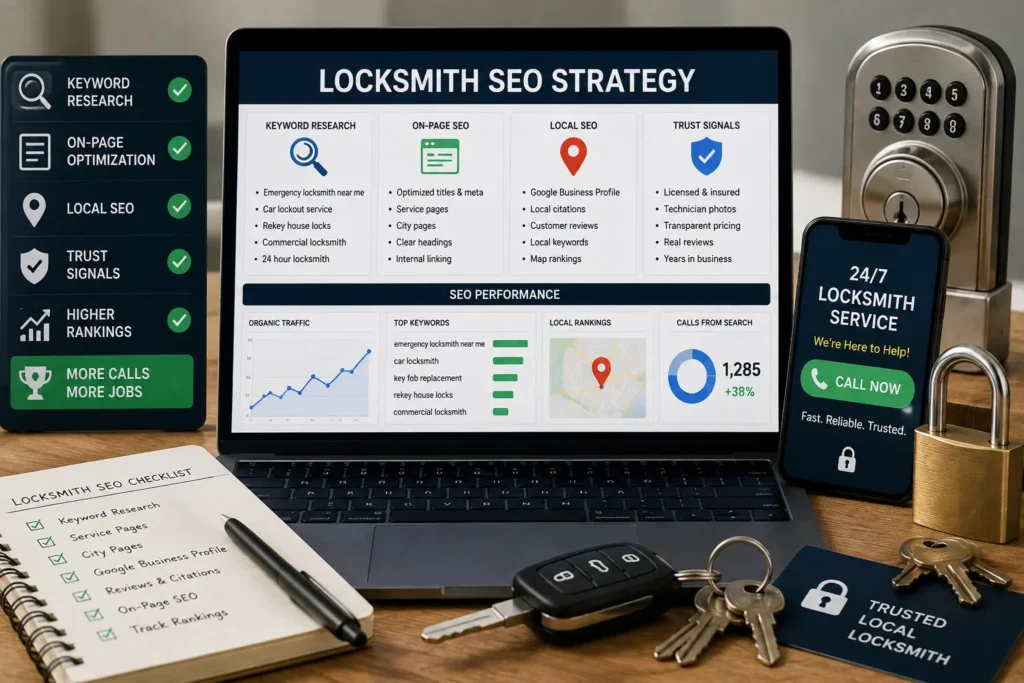
Once you have your keyword list, map each term to a specific page on your website rather than trying to rank one homepage for everything. This structural decision is one of the most important early steps in any serious locksmith SEO campaign.
On-Page Locksmith SEO Essentials
With your keyword map in place, the next phase of locksmith SEO is building out the pages themselves.
Dedicated Service Pages
Create individual pages for each core service: emergency lockout, car key replacement, residential rekeying, commercial locksmith services, and safe installation, if applicable. Each page should include a clear headline containing the target keyword, a description of the service, pricing guidance where possible, and a strong call to action with your phone number visible above the fold. This service-page structure is a foundational element of locksmith SEO that many single-page locksmith websites are still missing.
City and Service-Area Pages
If your locksmith business covers multiple cities or neighborhoods, build a unique page for each significant service area rather than relying on a single generic “service areas” list. Each page should include locally relevant details, such as nearby landmarks or neighborhoods, rather than duplicating the same paragraph with only the city name swapped out. This is one of the more labor-intensive parts of the process, but it is also one of the highest-impact tactics for businesses covering a metro area with several distinct cities.
Title Tags and Meta Descriptions
Every page should have a unique title tag that includes both the service and the location, written naturally rather than stuffed with repeated keywords. A page targeting emergency lockout service in a specific city should have a title tag that clearly reflects that combination, since this is one of the first signals both users and search engines use to judge relevance in locksmith SEO.
Phone Number and Trust Signals
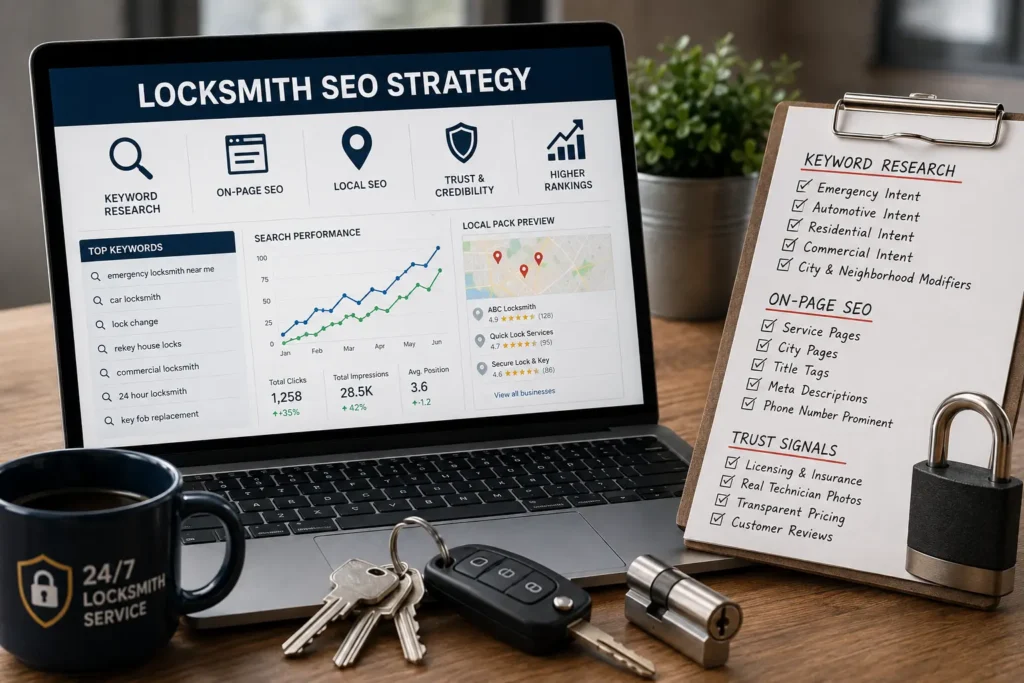
Because so much locksmith SEO traffic converts through phone calls rather than form fills, your phone number should be prominent, clickable on mobile, and consistent across every page. Trust signals like licensing information, insurance details, and years in business should also be visible, since locksmith customers are understandably cautious given the industry’s reputation for scams.
Trust Signals Beyond the Basics
Beyond licensing and insurance details, locksmiths can build additional trust by displaying real technician photos rather than stock imagery, listing specific brands and lock types serviced, and including a straightforward explanation of how pricing works before a technician arrives. Ambiguous or hidden pricing is one of the most common complaints in this industry, and addressing it proactively on the website often reduces hesitation for a customer comparing several options at once. A short, plainly written pricing page or FAQ section that explains typical costs for common jobs, such as a standard rekey or a basic car lockout, can meaningfully increase conversion rates from an already-qualified visitor.
Google Business Profile Optimization for Locksmiths
For locksmith SEO specifically, Google Business Profile optimization carries even more weight than it does for most other local service industries, because the map pack is often where emergency searches are decided in seconds.
Start by choosing the most accurate primary category available, typically “Locksmith,” and add relevant secondary categories for any additional services like safe installation or commercial security work. Fill out your service list completely, upload genuine photos of your team, vehicles, and completed jobs, and keep your business hours accurate, especially if you offer genuine 24-hour service.
Because address accuracy is scrutinized heavily in this industry, make sure your listed address matches your actual, verifiable business location. Locksmith businesses using virtual offices or unverifiable addresses are a common target of Google’s spam enforcement, which can undo months of otherwise solid locksmith SEO work overnight. Our detailed guides on Google Business Profile optimization and the accompanying Google Profile optimization checklist walk through the full setup process step by step, and our breakdown of Google Business Profile ranking factors explains exactly which signals influence map pack placement.
Local SEO and Citation Building for Locksmith Businesses
Consistent business information across the web reinforces trust signals that support locksmith SEO efforts. Build citations on major directories, ensuring your name, address, and phone number match exactly across every listing. Inconsistent citations are a common, quietly damaging issue for these businesses, since they create confusion for both search engines and potential customers trying to verify a business is legitimate.
Beyond generic directories, seek out locksmith-specific and locally relevant citation opportunities, including local chamber of commerce listings, home service marketplaces, and regional business directories. Our broader local SEO guide for small businesses covers citation building strategy in more depth and applies directly to strengthening the foundation of any locksmith SEO campaign.
Technical SEO for Locksmith Websites
A slow or poorly structured website undermines every other part of a locksmith SEO strategy, particularly because emergency searchers will not wait for a slow page to load before calling a competitor instead. Page speed, mobile usability, and clean site architecture all directly support locksmith SEO performance.
Our guides on Core Web Vitals and website speed and SEO explain exactly how to diagnose and fix the technical issues that most commonly slow down small business websites, including locksmith sites built on template platforms with excessive scripts and unoptimized images. Since mobile searches make up the overwhelming majority of emergency locksmith queries, mobile page speed deserves particular attention within any technical audit for this trade.
Monitoring your site’s indexing and crawl health through Google Search Console is another essential habit, since undiscovered crawl errors can quietly prevent new service or city pages from ever being indexed, no matter how well they were written.
Reviews and Reputation Management in Locksmith SEO
Reviews carry unusually heavy weight in this industry because trust is the primary barrier most customers have to overcome before calling an unfamiliar business. A locksmith listing with dozens of recent, detailed, positive reviews signals legitimacy in an industry where customers have learned to be skeptical.
Build a consistent process for requesting reviews after every completed job, whether through a simple text message link or a follow-up email. Respond to every review, positive or negative, professionally and promptly. Negative reviews addressed with a calm, solution-oriented response often do more to build trust with future customers than having no negative reviews at all, since they demonstrate how the business handles problems.
Review velocity matters as much as review volume here. A steady, ongoing stream of new reviews signals an active, currently operating business, which is especially important in an industry where fraudulent listings often appear and disappear quickly.
Link Building for Locksmith Businesses
Earning backlinks from relevant, authoritative websites strengthens the prominence signals that support locksmith SEO rankings over the long term. Locksmith businesses can pursue several practical link building avenues: sponsoring local community events, partnering with real estate agents or property management companies who regularly need locksmith referrals, and contributing expert commentary to local news stories about home security.
Our guides on link building fundamentals and practical link building techniques cover the broader strategy behind earning quality backlinks, which applies directly to strengthening a campaign’s off-page authority over time.
Common Locksmith SEO Mistakes to Avoid
The locksmith industry has some unique pitfalls that make certain mistakes especially costly for locksmith SEO:
- Using a virtual office or unverifiable address to appear closer to customers, which risks Google Business Profile suspension.
- Creating multiple listings for the same business in different cities to game local rankings, a tactic Google actively penalizes.
- Copying service page content word-for-word across multiple city pages instead of writing unique, locally relevant copy.
- Neglecting mobile page speed, which directly costs emergency calls from impatient searchers.
- Ignoring negative reviews instead of responding professionally, which damages trust in an already skeptical market.
- Inconsistent NAP information across directories, which undermines both local SEO and Google Business Profile ranking factors.
- Treating locksmith SEO as a one-time setup rather than an ongoing process of review generation, content updates, and citation maintenance.
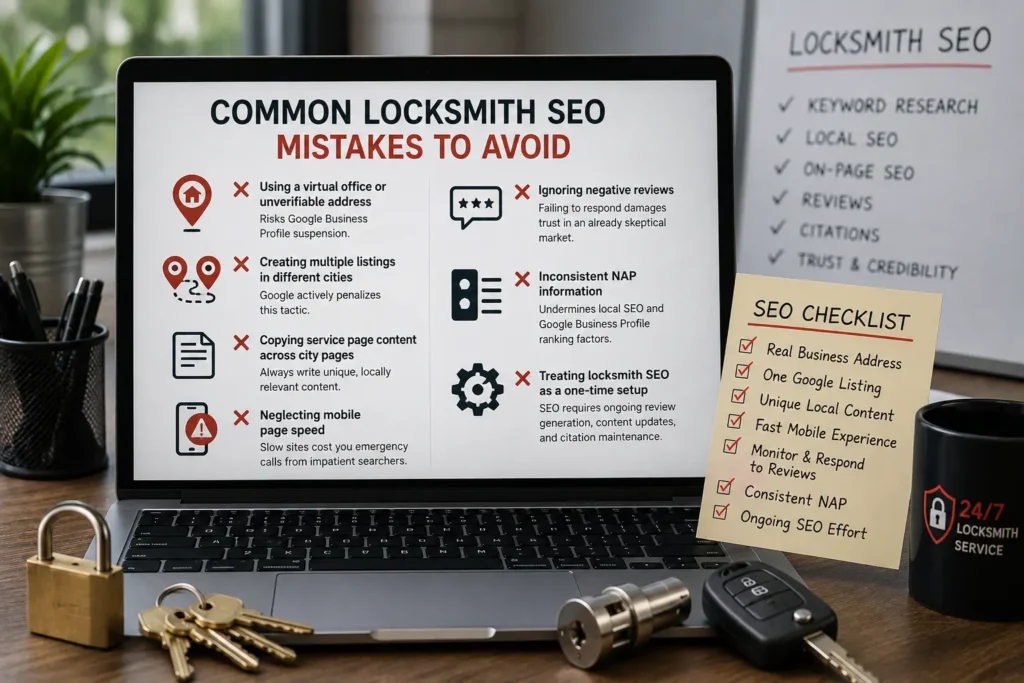
Avoiding these mistakes is often more valuable than chasing advanced tactics, since even one of these issues can trigger a suspension or ranking suppression that erases months of otherwise solid locksmith SEO work.
A Practical Locksmith SEO Checklist
Use this checklist as a starting framework for building or improving your locksmith SEO strategy:
- Map your keywords by intent and location, covering emergency, automotive, residential, and commercial searches.
- Build dedicated service pages for each core offering with clear, unique content.
- Create individual city or service-area pages for every significant location you cover.
- Optimize your Google Business Profile completely, using an accurate, verifiable address.
- Build consistent citations across relevant directories with matching NAP details.
- Improve site speed and mobile usability, prioritizing fast load times for emergency searchers.
- Set up a review request process that runs after every completed job.
- Respond to every review within 24 to 48 hours.
- Pursue relevant local backlinks through partnerships and community involvement.
- Audit your listing and website quarterly to catch inconsistencies before they become penalties.
Working through this checklist methodically gives a locksmith business a structured, defensible locksmith SEO foundation rather than a scattered collection of one-off tactics.
Content Strategy Beyond Service Pages
While service and location pages form the backbone of most locksmith SEO campaigns, a supporting blog can capture additional long-tail searches and build topical authority over time. Useful topics include practical guidance like “what to do if you’re locked out of your car,” seasonal reminders about rekeying after moving into a new home, and explainers on smart lock installation or commercial master key systems.
This kind of content rarely converts as directly as a service page, but it does two things well: it captures searches from people who are not yet in an emergency situation but will remember the business later, and it gives Google additional, genuinely useful pages to associate with the site’s overall authority on locksmith topics. A locksmith website that only has five thin service pages and nothing else tends to struggle to build the depth of relevance that stronger competitors eventually accumulate.
Aim for consistency over volume. A handful of well-researched, genuinely helpful articles published over several months will do more for a locksmith website than a rushed batch of thin, generic posts published all at once and then abandoned.
Locksmith SEO for Multi-Location and Franchise Businesses
Businesses operating multiple locksmith locations under one brand face additional structural decisions. Each location should have its own Google Business Profile, its own dedicated page on the website, and enough unique, locally specific content to avoid being flagged as duplicate or thin. Sharing a single generic page across all locations, with only the city name changed, is one of the fastest ways to undermine an otherwise solid strategy.
Internal linking between locations also matters. A well-structured site links from each city page to nearby service areas and to the relevant core service pages, helping both users and search engines understand the full footprint of the business. Franchise or multi-location locksmith operations that invest in this structure typically outperform single-location competitors in surrounding markets, simply because they can capture search demand across a wider geographic area without diluting their authority through duplicate content.
Coordinating review generation across locations is equally important. Reviews left for the wrong location, or concentrated entirely on one branch while others sit empty, create an uneven trust profile that can hold back growth in newer or smaller markets.
Staffing and dispatch logistics also play a quiet role here. If a customer calls a location page for a city where response times are actually slower than advertised, the resulting frustration shows up in reviews and can drag down the reputation of an otherwise well-optimized listing. Keeping service-area claims honest and realistic protects both the customer experience and the review profile that so much of this strategy depends on.
How Locksmith SEO Compares to Other Local Service Industries
While the core principles of local SEO apply broadly across service industries, locksmith SEO faces a uniquely high level of scrutiny and competition compared to trades like HVAC, plumbing, or appliance repair. Our guides on HVAC SEO strategy and HVAC website architecture and on-page SEO cover a trade with heavy seasonal demand but far less listing fraud, offering a useful point of comparison for understanding what makes this niche especially demanding.
Similarly, our plumbing SEO guide and appliance repair SEO guide both share overlapping tactics with this space, particularly around emergency service positioning and review generation, even though those industries do not typically face the same volume of fraudulent competitor listings that locksmiths deal with daily.
Frequently Asked Questions About Locksmith SEO
How long does locksmith SEO take to show results?
Most locksmith businesses see initial movement within four to eight weeks after implementing core locksmith SEO fixes, particularly around Google Business Profile optimization and citation cleanup. Competitive metro markets may take longer, especially where fraudulent listings are actively being cleared out by Google.
Why do so many locksmith listings get suspended?
Google applies heightened scrutiny to locksmith listings because the industry has a documented history of address spoofing and lead-gen fraud. Legitimate businesses practicing honest locksmith SEO should ensure their address, phone number, and business details are fully accurate and verifiable to avoid being caught in enforcement sweeps meant for bad actors.
Is paid advertising necessary alongside locksmith SEO?
Not necessarily, but many locksmith businesses use paid search or local service ads alongside organic efforts during the ramp-up period, then rely more heavily on organic and map pack rankings once their SEO foundation matures.
What is the most important ranking factor for locksmith SEO?
Google Business Profile accuracy and review activity tend to have the most immediate impact for locksmith SEO, given how heavily emergency searches rely on the map pack rather than traditional organic results.
Can a new locksmith business compete with established competitors using locksmith SEO?
Yes, particularly in markets where established competitors have neglected their online presence or are relying on fraudulent listings that are increasingly being removed. A new business with an accurate profile, genuine reviews, and solid technical fundamentals can often outrank older, poorly maintained competitors within a matter of months.
Measuring What’s Working
Tracking the right metrics keeps optimization efforts grounded in results rather than guesswork. Beyond overall organic traffic, pay close attention to call volume from the website and Google Business Profile, direction requests, and rankings for your highest-intent terms like “emergency locksmith [city]” and “car lockout [city].” A jump in impressions without a corresponding increase in calls often points to a messaging or trust problem on the landing page itself, not a ranking problem.
Google Business Profile Insights and Search Console together provide most of the data needed for ongoing measurement. Track these numbers monthly rather than daily; local search results can fluctuate day to day for reasons unrelated to the quality of the work being done, and short-term noise can lead to unnecessary second-guessing of a strategy that is actually working. Look instead for the broader trend line over eight to twelve weeks, which gives a much clearer picture of whether the fundamentals covered throughout this guide are moving the business in the right direction.
Final Thoughts on Locksmith SEO
Locksmith SEO is uniquely challenging because it combines the urgency of emergency service search behavior with an industry-wide trust problem caused by years of fraudulent listings. Businesses that take the time to build an accurate, well-optimized, technically sound online presence are rewarded with an outsized advantage, since so many competitors are either cutting corners or getting caught in Google’s ongoing spam enforcement.
Start with the fundamentals: an accurate, fully optimized Google Business Profile, dedicated service and location pages, a fast and mobile-friendly website, and a consistent review generation process. From there, layer in citation building, technical maintenance, and local link building to strengthen your position over time. A locksmith business that treats this as an ongoing discipline, rather than a one-time project, will consistently outperform competitors who set things up once and never return.
Done consistently, locksmith SEO turns a notoriously difficult, spam-heavy niche into a genuine competitive advantage, capturing the emergency calls and long-term customers that keep a locksmith business growing year after year.
