
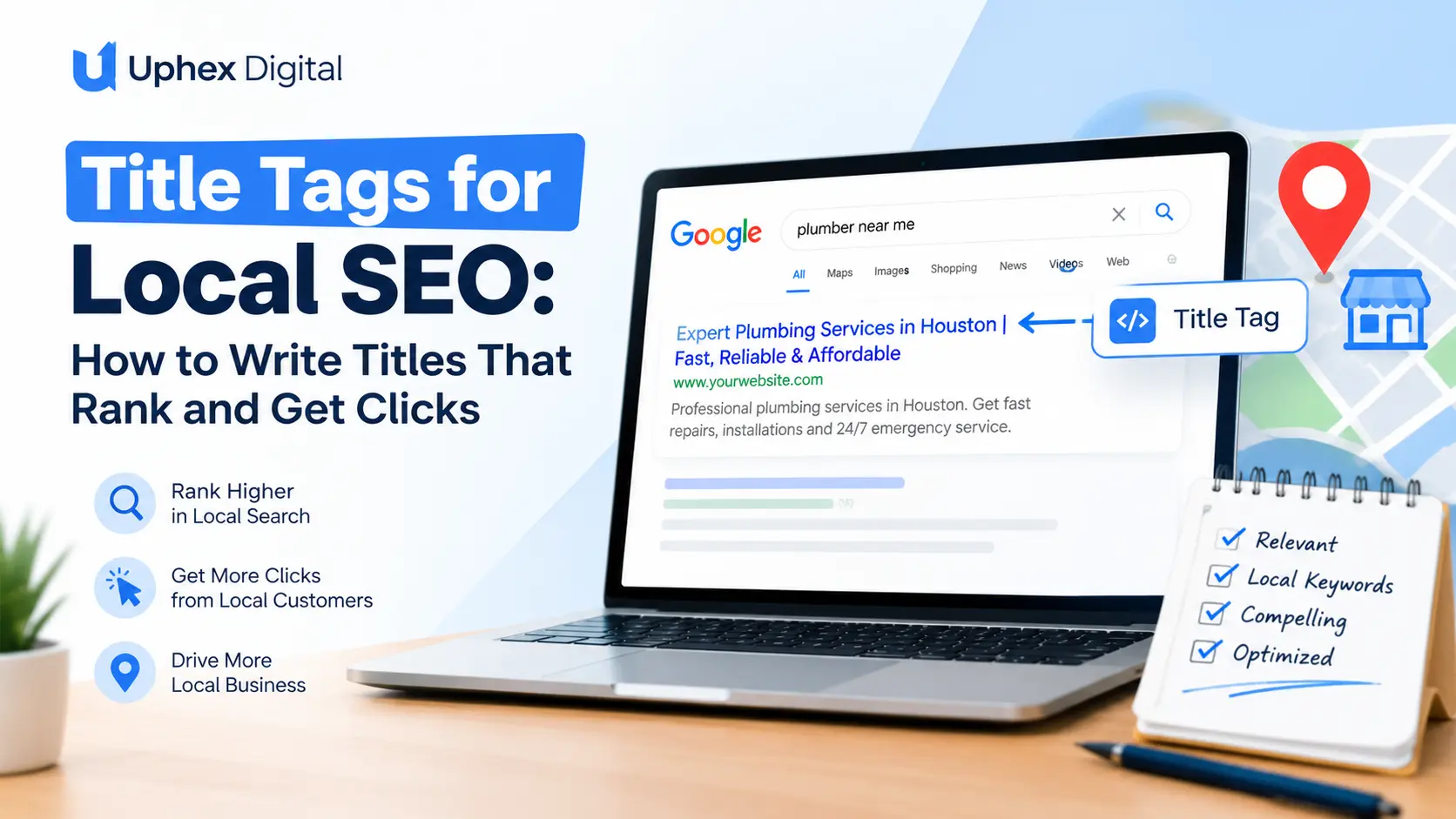
Open Google on your phone and search for an electrician, a tow truck, or an appliance repair technician near you. Before you read a single page, your eyes scan a column of blue headlines. In about three seconds you decide which one deserves your tap. That headline is the title tag, and for a local business it is often the difference between a ringing phone and a missed job.
Most trade and service business owners treat the title as an afterthought. They paste in their company name, add “Home” or “Services,” and move on. Meanwhile, a competitor with a tighter, more specific headline earns the click, the call, and the booking. Well-crafted local seo title tags do two jobs at once. They tell Google exactly which service and which city a page is about, and they convince a real person that your result is the one worth choosing.
This guide walks you through everything you need to write local seo title tags that rank and get clicks. You will learn what a title tag is, how Google reads it, how long it should be, which formulas work for service pages and city pages, and how to avoid the mistakes that quietly hold local websites back. You will also see ready-to-use examples for electricians, appliance repair companies, towing services, HVAC contractors, and locksmiths.
If you are building out your wider on-page SEO strategy, local seo title tags are the best place to start, because it is one of the few elements that influences both rankings and click-through rate at the same time.
➡️ Quick Answer: The best local seo title tags put the service first, add the city, include one clear reason to choose you, and stay near 50 to 60 characters.
👉 What You Will Learn in This Guide
- ➡️ What a title tag is and how Google reads it
- ➡️ How long your titles should be
- ➡️ Five copy-and-paste title formulas
- ➡️ Real examples for electricians, HVAC, towing, locksmiths, and appliance repair
- ➡️ The mistakes that quietly hurt rankings
- ➡️ How to test and measure every change
What Are Local SEO Title Tags?
A title tag is an HTML element that defines the title of a web page. It lives in the head section of your code and looks like this: <title>Emergency Electrician in Dallas, TX | Spark Electric</title>. Search engines display it as the clickable headline in results, browsers show it on the tab, and social platforms often use it when someone shares the link.
Local seo title tags are title tags written with local intent in mind. They combine three ingredients: the service a customer wants, the place they want it, and a reason to choose your business. A generic title says “Plumbing Services.” A local title says “24/7 Emergency Plumber in Austin, TX | Free Estimates.”
The difference sounds small, but it changes how Google classifies the page. When someone searches “emergency plumber austin,” the search engine looks for pages that clearly match both the service and the location. Strong local seo title tags make that match obvious without forcing the algorithm to guess.
Title Tag vs. Meta Title vs. H1
These terms get mixed up constantly, so let us separate them:
- Title tag (meta title): The headline shown in search results and browser tabs. In most WordPress setups you edit it in an SEO plugin.
- H1 heading: The main visible headline on the page itself. It can match the title tag or differ slightly.
- Meta description: The short summary under the title in search results. It does not directly affect rankings, but it affects clicks.
| Element | Where It Appears | Main Job | Affects Rankings? |
|---|---|---|---|
| Title tag (meta title) | Search results and browser tab | Win the click and signal relevance | Yes |
| H1 heading | Top of the page | Confirm the topic to the visitor | Yes |
| Meta description | Under the title in search results | Persuade the searcher | Indirectly, through clicks |
When people say “meta title,” they almost always mean the title tag. Throughout this article, local seo title tags and meta titles refer to the same thing.
Why Local SEO Title Tags Matter for Rankings and Clicks
Local seo title tags earn their importance in two separate ways, and a smart strategy respects both.
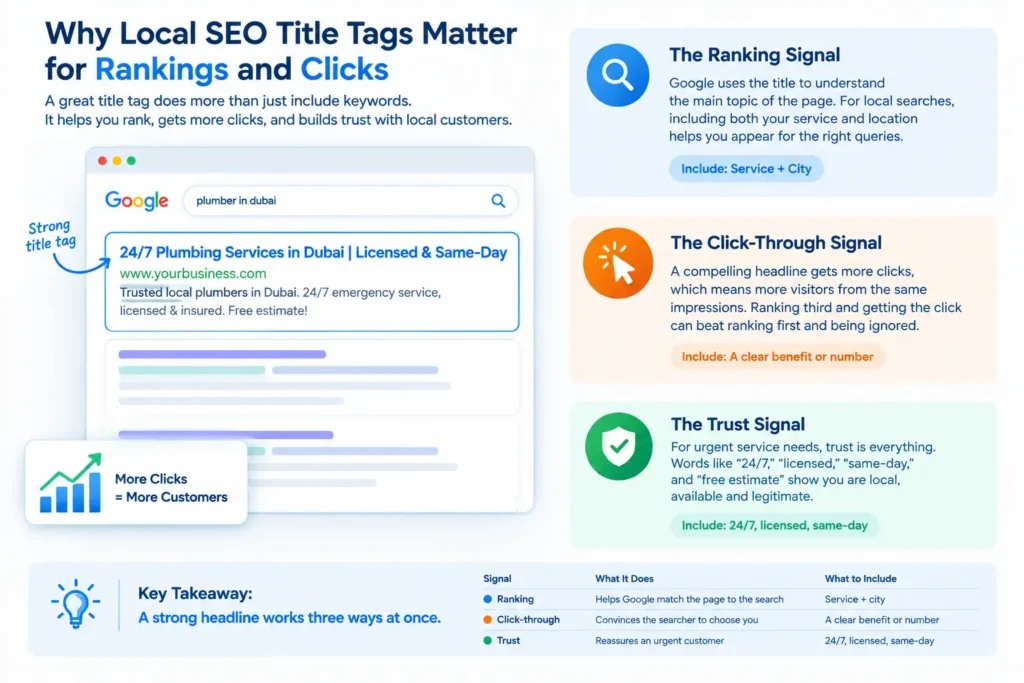
The Ranking Signal
Google has confirmed for years that the title is a meaningful relevance signal. It is not the only factor, and stuffing keywords will not rescue a weak page, but the title helps the search engine understand the primary topic of the document. For a local query, that topic must include a service and a geographic modifier. Pages whose local seo title tags contain both usually have an easier time appearing for the exact searches that bring in customers.
The Click-Through Signal
Ranking third and getting the click can beat ranking first and being ignored. A compelling headline improves click-through rate, which means more visitors from the same impressions. More clicks from the same position is effectively free traffic. If you want to see how this plays out in practice, the Google Search Console guide on this site shows how to find pages with high impressions and weak click-through rates, which are the best candidates for a title rewrite.
The Trust Signal
For service businesses, trust decides everything. Someone with a flooded basement or a dead refrigerator is not browsing casually. They are scanning for signals that you are local, available, and legitimate. Words such as “24/7,” “licensed,” “same-day,” and “free estimate” inside local seo title tags answer those questions before the visitor even lands on your site.
➡️ Key Takeaway: A strong headline works three ways at once.
| Signal | What It Does | What to Include |
|---|---|---|
| Ranking | Helps Google match the page to the search | Service + city |
| Click-through | Convinces the searcher to choose you | A clear benefit or number |
| Trust | Reassures an urgent customer | 24/7, licensed, same-day |
How Google Reads and Rewrites Titles
Before you write anything, you should understand that Google does not always display the title you submit. Over the past few years, the search engine has rewritten a large share of titles in results. It tends to do this when a title is too long, stuffed with repeated keywords, generic, or mismatched with the page content.
Why Google Rewrites Titles
Google rewrites when it believes another piece of text describes the page better. Common triggers include:
- Titles that exceed the display limit and get truncated.
- Titles that repeat the same phrase multiple times.
- Boilerplate titles such as “Home” or “Untitled.”
- Titles that do not match the H1 or the main content.
- Titles made up only of a brand name.
How to Reduce the Risk
The fix is simple: write natural, accurate headlines that reflect what the page really covers. When your local seo title tags describe the page honestly and stay within length limits, Google usually leaves them alone. If you see a rewrite in your results, treat it as feedback. Compare the displayed version with what you wrote, and ask what the search engine found lacking.
The Anatomy of a High-Performing Local Title Tag
Every effective set of local seo title tags follows a structure. You can adjust the order, but the building blocks stay the same.
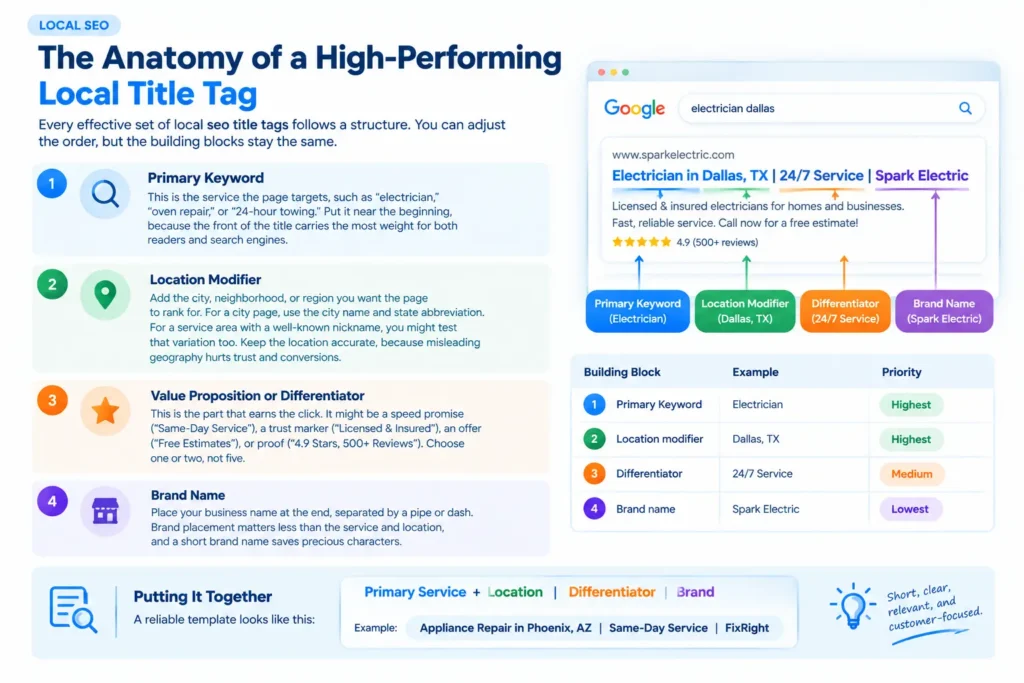
Primary Keyword
This is the service the page targets, such as “electrician,” “oven repair,” or “24-hour towing.” Put it near the beginning, because the front of the title carries the most weight for both readers and search engines.
Location Modifier
Add the city, neighborhood, or region you want the page to rank for. For a city page, use the city name and state abbreviation. For a service area with a well-known nickname, you might test that variation too. Keep the location accurate, because misleading geography hurts trust and conversions.
Value Proposition or Differentiator
This is the part that earns the click. It might be a speed promise (“Same-Day Service”), a trust marker (“Licensed & Insured”), an offer (“Free Estimates”), or proof (“4.9 Stars, 500+ Reviews”). Choose one or two, not five.
Brand Name
Place your business name at the end, separated by a pipe or dash. Brand placement matters less than the service and location, and a short brand name saves precious characters.
| Building Block | Example | Priority |
|---|---|---|
| Primary keyword | Electrician | Highest |
| Location modifier | Dallas, TX | Highest |
| Differentiator | 24/7 Service | Medium |
| Brand name | Spark Electric | Lowest |
Putting It Together
A reliable template looks like this:
Primary Service + Location | Differentiator | Brand
Example: Appliance Repair in Phoenix, AZ | Same-Day Service | FixRight
Title Tag Length: Characters vs. Pixels
Length is where many local seo title tags fail. Google does not truncate by character count. It truncates by pixel width, which is roughly 580 to 600 pixels on desktop. In practice, that translates to about 50 to 60 characters, depending on the letters used. Wide letters like “W” and “M” consume more space than “i” or “l.”
Practical Length Guidelines
- Aim for 50 to 60 characters for most titles.
- Keep the most important words in the first 40 characters, so they survive even if truncation occurs.
- Use a SERP preview tool in your SEO plugin to check pixel width before publishing.
- Do not obsess over hitting exactly 60. A clear 52-character title beats an awkward 60-character one.
| Title Length | Result | Action |
|---|---|---|
| Under 30 characters | Wastes space | Add location and benefit |
| 50 to 60 characters | Usually displays fully | ✅ Ideal range |
| 61 to 70 characters | May be cut off | Shorten or move key words forward |
| Over 70 characters | Likely truncated or rewritten | ❌ Rewrite |
➡️ Pro Tip: Put the service and city in the first 40 characters, so they stay visible even if the end is cut.
Mobile results can show slightly different truncation, and since most local searches happen on phones, front-loading the service and city is a smart habit. When you audit your local seo title tags, check both desktop and mobile previews if your tools allow it.
Research First: Find the Keywords Customers Actually Use
Great local seo title tags start with real search language. Writing “HVAC Solutions Provider” when customers type “AC repair near me” wastes your most valuable headline space.
Start With Customer Language
Ask your team what callers say on the phone. People rarely use industry jargon. They say “my fridge stopped cooling,” “car locked out,” or “lights keep flickering.” Those phrases reveal the intent behind the search and point you toward the keywords that lead to jobs.
Check the Search Results Yourself
Search for your target service and city, and read the top ten titles. Notice which words repeat, which promises competitors make, and what is missing. If every result says “Affordable,” you may stand out with “Upfront Pricing” or “Flat-Rate.” This competitive scan costs nothing and often delivers the best title ideas.
Use Keyword Tools Wisely
Keyword tools estimate volume, but local volume is often undercounted because tools lump small cities together. Use tools for direction and your own Search Console data for confirmation. If you need a refresher on building a keyword list, the local SEO guide at Iffaris covers the process step by step.
Match Search Intent
Group your target terms by intent. Someone searching “how to reset a breaker” wants information, while someone searching “electrician near me” wants to hire. Your informational blog posts and your service pages need different local seo title tags. Service pages should lead with the service and city. Blog posts can lead with the question or benefit.
Proven Formulas for Local SEO Title Tags
Formulas speed up your workflow, keep your site consistent, and make local seo title tags easier to scale. Here are the patterns that work best for local businesses.
Formula 1: The Core Service Page
[Service] in [City, State] | [Benefit] | [Brand]
- Emergency Electrician in Dallas, TX | 24/7 Service | Spark Electric
- Garage Door Repair in Tampa, FL | Same-Day Fixes | DoorPro
This is the workhorse for local seo title tags because it delivers the service, the place, and a persuasive reason in one line.
Formula 2: The City Landing Page
[Service] [City] – [Trust Marker] | [Brand]
- Towing Service Houston – Licensed & Insured | RapidTow
- Water Heater Repair Denver – Free Estimates | HotFlow
City pages exist to capture searches in specific service areas. Each page needs a unique title, never a copy with only the city swapped in a templated way that adds no value.
Formula 3: The Homepage
[Primary Service] & [Secondary Service] in [Main City] | [Brand]
- Plumbing & Drain Cleaning in Seattle, WA | BlueRiver Plumbing
The homepage should target your broadest, most valuable local term. Avoid the lazy “Home | Brand” format, which wastes the most visible page on your site.
Formula 4: The Question or Guide (Blog Posts)
[Question or Benefit] + [Local Angle]
- How Much Does an Electrician Cost in Chicago? 2026 Price Guide
- Is Your Furnace Failing? 7 Warning Signs Every Minneapolis Homeowner Should Know
Blog posts attract top-of-funnel visitors, and a local angle filters the audience toward people who can actually hire you.
Formula 5: The Offer or Promotion Page
[Offer] on [Service] in [City] | [Brand]
- $49 AC Tune-Up in Las Vegas, NV | Limited Spots | CoolBreeze
Use promotional titles for landing pages built around a campaign. Our service page SEO guide explain how to align the page content with the promise made in the headline.
📌 Formula Cheat Sheet
| Page Type | Formula | Best For |
|---|---|---|
| Core service page | Service in City, State | Benefit | Brand | Main money pages |
| City landing page | Service City – Trust Marker | Brand | Service areas |
| Homepage | Primary & Secondary Service in Main City | Brand | Brand and broad terms |
| Blog post | Question or Benefit + Local Angle | Top-of-funnel traffic |
| Offer page | Offer on Service in City | Brand | Campaigns |
Local SEO Title Tag Examples by Industry
Seeing local seo title tags in context helps you adapt the ideas to your own business. Here are examples for common trade verticals, with notes on why they work.
Electricians
- Licensed Electrician in Orlando, FL | Panel Upgrades & Repairs | BrightLine
- 24/7 Emergency Electrician Near Me in Orlando | Fast Response
Electrical work involves safety and urgency, so credentials and availability belong in the headline.
Appliance Repair
- Appliance Repair in Charlotte, NC | Same-Day Washer & Fridge Fix | FixIt Pros
- Dryer Not Heating? Repair in Charlotte | Free Diagnosis
For appliance repair, naming the specific appliance often wins clicks, because people search by problem. Our guide to appliance repair SEO goes deeper on structuring service pages by appliance type.
Towing Services
- 24-Hour Towing in Atlanta, GA | 20-Minute Average Arrival | AtlasTow
- Roadside Assistance & Flatbed Towing Atlanta | Call Now
Towing searches are urgent and often made in stressful moments. Speed claims and a clear call to action matter more here than in almost any other trade.
HVAC Contractors
- AC Repair in Phoenix, AZ | Same-Day Service | Licensed HVAC | CoolAir
- Furnace Installation Denver | Free Quotes | 0% Financing
Seasonal timing influences HVAC searches, so update titles before summer and winter peaks.
Locksmiths
- Locksmith in Miami, FL | 24/7 Lockout Service | Mobile & Licensed
- Car Key Replacement Miami | Fast On-Site Service | KeyMasters
For locksmith businesses, authenticity is a big deal because the industry attracts scam listings. Words like “licensed” and “local” reassure searchers.
⚡ Industry Quick View
| Industry | Lead With | Trust Word to Test |
|---|---|---|
| Electricians | Emergency or panel work | Licensed |
| Appliance repair | Specific appliance | Same-day |
| Towing | Speed of arrival | 24-hour |
| HVAC | Season and service | Free quotes |
| Locksmiths | Lockout type | Mobile & licensed |
Writing Local SEO Title Tags for Multi-Location Businesses
Businesses with several branches or a wide service area face a real challenge. You want each location to rank, but you cannot publish identical titles across dozens of pages.
Give Every Location Page a Unique Title
Each location page deserves its own local seo title tags that reference the specific city, a distinct service emphasis, and, where possible, a local proof point. For example, “HVAC Repair in Plano, TX | Serving Collin County Since 2008” differs meaningfully from “HVAC Repair in Frisco, TX | Same-Day Appointments.”
Avoid Doorway Pages
Do not create dozens of near-identical city pages just to chase keywords. Google considers thin, templated location pages low value. Create a page only when you genuinely serve that area and can add unique content, such as local project photos, reviews from that city, and details about local codes or conditions.
Connect Titles to Your Business Profile
Your page titles should align with the information in your Google Business Profile, including your primary category and service areas. Consistency reinforces relevance. If you have not optimized that profile yet, start with our Google Business Profile optimization guide so your page signals and profile signals tell the same story.
How to Increase Click-Through Rate With Better Titles
Ranking gets you seen. The title gets you chosen. Several tactics improve the click-through rate of local seo title tags without sacrificing relevance.
Lead With the Customer’s Need
Speak to what the searcher wants, not what you do. “Burst Pipe Repair in Boston | Plumbers on Call 24/7” beats “Boston Plumbing Company Services” because it mirrors the urgent need.
Add Numbers and Specifics
Numbers stand out visually in crowded results. “20-Minute Average Response” or “500+ Five-Star Reviews” carries more weight than vague claims like “Fast Service” or “Great Reviews.”
Use Power Words With Restraint
Words such as “Free,” “Same-Day,” “Guaranteed,” “Licensed,” and “Trusted” lift clicks, but overuse looks spammy. One or two per title is plenty. The best local seo title tags sound like a confident professional, not a used-car ad.
Include a Subtle Call to Action
Phrases like “Call Now,” “Get a Free Quote,” or “Book Online” work on service and landing pages. Place them after the primary keyword and location, never in front.
Common Mistakes That Weaken Local SEO Title Tags
Even experienced marketers repeat these local seo title tags errors. Review your site for each one.
Keyword Stuffing
Titles like “Plumber Austin | Austin Plumber | Plumbing Austin TX | Best Plumber Austin” look desperate and trigger rewrites. Mention the primary phrase once, naturally. Strong local seo title tags read like a human wrote them for a human.
Duplicate Titles Across Pages
When many pages share the same headline, Google struggles to pick the right one for a query, and your pages compete with each other. Run a crawl and fix duplicates first, because they are common and easy to repair.
Brand-Only or Generic Titles
“Home,” “Services,” and “Contact Us” give no information. Every page needs descriptive local seo title tags that reflect its unique purpose.
Ignoring the Location
A great service headline without a city may rank nationally but fail locally. Unless the page targets a very broad audience, include the place.
Too Long or Too Short
Titles over 60 characters get cut off, and titles under 30 characters waste opportunity. Find the middle ground.
Misleading Promises
Claiming “Cheapest Prices” or “Number 1 Rated” without proof may win a click but loses trust and increases bounce rate. Advertising rules can also apply to superlatives, so make claims you can support.
Mismatch Between Title and Content
If the title promises “Emergency Electrician” and the page is a general company overview, searchers leave quickly, and Google may rewrite the headline. Always align the title with the content, the H1, and the user’s expectation.
🚫 Mistakes at a Glance
| Mistake | Why It Hurts | Quick Fix |
|---|---|---|
| Keyword stuffing | Triggers rewrites | Mention the phrase once |
| Duplicate titles | Pages compete | Write unique titles |
| Generic titles | No relevance signal | Add service and city |
| Missing location | Weak local match | Include the city |
| Wrong length | Truncation | Stay near 50 to 60 characters |
| Misleading claims | Lost trust | Claim only what you can prove |
How to Implement Local SEO Title Tags in WordPress
Knowing how to write local seo title tags is half the job. Implementing it correctly is the other half.
Using an SEO Plugin
Plugins such as Rank Math and Yoast let you edit the title for every page and post. Open the page, scroll to the SEO panel, and fill in the title field. Use the preview to check truncation, and keep an eye on the focus keyword indicator, although you should never sacrifice readability just to satisfy a color-coded score.
Setting Templates
Both plugins let you define default title templates for post types and taxonomies. Set a sensible default, such as “%title% | %sitename%,” then override it manually on your most important pages. Do not rely on templates alone for money pages, because those deserve hand-crafted local seo title tags.
Working With Page Builders
If you build pages in Elementor, remember that the page builder controls the layout, while the SEO plugin controls the title. Do not confuse the visible heading widget with the title tag. Set both deliberately, so the H1 and the title support each other without being identical copies.
Prioritize Your Pages
You may have hundreds of pages, so work in order of value:
- Homepage
- Core service pages
- City or service area pages
- High-impression blog posts
- Everything else
This approach brings the biggest gains first, and it keeps the project from feeling overwhelming.
Supporting Elements That Work With Your Titles
Local seo title tags do not work alone. Several other elements amplify it.
Meta Descriptions
Treat the meta description as the second half of your headline. It should expand on the promise, include the location again, and end with a call to action. A detailed walkthrough is available in this guide to on-page SEO checklist.
H1 and Heading Structure
Your H1 should closely echo the title but does not need to match word for word. Use H2s and H3s to cover subtopics and related local terms.
Schema Markup
LocalBusiness schema helps Google confirm your name, address, phone, service area, and category. When your structured data matches your local seo title tags and page content, the signals reinforce each other. For help with markup basics, see this technical SEO checklist.
Consistent NAP and Citations
Your business name, address, and phone number should look the same everywhere. If you want to strengthen those signals, the guide to local citations shows where to list your business and how to keep details uniform.
Technical Health
A perfect headline cannot fix a slow or broken site. Make sure the page loads quickly and passes the basics covered in our Core Web Vitals guide. Running a regular SEO audit also helps you catch missing, duplicate, and truncated titles before they cost you traffic.
How to Test and Measure Your Title Tags
Publishing is not the end. The best local seo title tags come from iteration.
Establish a Baseline
Before you change any local seo title tags, export your current impressions, clicks, click-through rate, and average position from Google Search Console for the pages you plan to edit. Without a baseline, you cannot prove improvement.
Change One Thing at a Time
If you rewrite local seo title tags, a meta description, and the page content on the same day, you will not know what caused the result. Update the title first, wait for recrawling, and measure.
➡️ Pro Tip: Save a screenshot of the old result before you edit. It makes before-and-after comparisons easy.
Allow Enough Time
Google needs to recrawl and reprocess the page. Give each change at least two to four weeks before judging it, and compare against the same period to account for seasonality. Trade businesses often see strong seasonal swings, so a winter furnace page and a summer AC page behave differently.
Look at the Right Metrics
Track click-through rate first, then average position, then calls, form submissions, and booked jobs. A title that lifts CTR but attracts the wrong audience may not help revenue. The point of local seo title tags is leads, not vanity traffic.
Learn From Winners and Losers
When a rewrite performs well, note the pattern and apply it to similar pages. When it falls flat, revert or try a different angle. Over several months, you will build a playbook specific to your market.
⏱️ Testing Timeline
| Week | Action |
|---|---|
| Week 0 | Export Search Console baseline |
| Week 1 | Publish the new title |
| Weeks 2 to 4 | Wait for recrawl and data |
| Week 5 | Compare CTR, position, and calls |
| Week 6 | Keep, tweak, or revert |
A Practical Checklist for Writing Local SEO Title Tags
Use this list every time you publish or update a page:
- ✅ The primary service appears near the front.
- ✅ The city or service area is included and accurate.
- ✅ The length is roughly 50 to 60 characters, and the key terms appear within the first 40.
- ✅ There is one clear differentiator, not a pile of claims.
- ✅ The brand name sits at the end or is omitted when space is tight.
- ✅ The title is unique across your site.
- ✅ The headline matches the page content and the H1 intent.
- ✅ The wording sounds natural when read aloud.
- ✅ A meta description supports the title and repeats the location.
- ✅ Performance is tracked in Search Console after publishing.
If a page passes this checklist, its local seo title tags are in good shape.
Frequently Asked Questions About Local SEO Title Tags
How long should local SEO title tags be?
Aim for about 50 to 60 characters, or roughly 580 pixels on desktop. Put the service and city in the first 40 characters so they survive any truncation.
Should I include my city in every title tag?
Include it on pages that target a local search, such as service pages, city pages, and the homepage. Informational blog posts do not always need a city, though a local angle can help when the topic is location-specific.
Should the brand name go first or last?
For most local pages, put it last. The service and location are what searchers look for. The exception is your homepage or a page targeting your own brand name, where leading with the brand can make sense.
Can I use the same title on multiple pages?
No. Duplicate titles confuse search engines and make your pages compete with each other. Write unique local seo title tags for every important page.
How often should I update my local seo title tags?
Review your local seo title tags at least twice a year, and sooner when impressions are high but clicks are low. Seasonal businesses should adjust ahead of peak demand.
Do title tags still matter in 2026?
Yes. Even with AI-generated answers and changing results pages, the title remains a core signal and the first thing people read. Clear, accurate local seo title tags help both traditional rankings and the way AI systems understand and cite your pages.
Does Google always show my title tag?
Not always. Google rewrites titles it considers too long, too repetitive, or inaccurate. Writing descriptive, natural headlines greatly reduces rewrites.
Do keywords in the title tag matter more than in the H1?
The title tag generally carries more weight for relevance and is far more visible in search results, but both should work together. Use your primary phrase in both without making them identical.
Final Thoughts
A title tag is only a line of text, yet it is one of the most efficient levers in local search. It tells Google what a page is about, it tells a stressed customer why you are the right call, and it costs nothing to improve. Businesses that take the time to craft strong local seo title tags often see higher click-through rates, better qualified visitors, and more calls from the traffic they already earn.
Start with your homepage and your top five service pages. Apply the formulas for local seo title tags in this guide, keep each headline unique and honest, check the length, and measure the results in Search Console. Then move on to city pages and high-impression posts. Treat the process as ongoing, because markets, seasons, and search results change.
➡️ Remember: write for the person in a hurry. When your local seo title tags answer “who, what, where, and why you” in a single glance, rankings and clicks tend to follow.
