
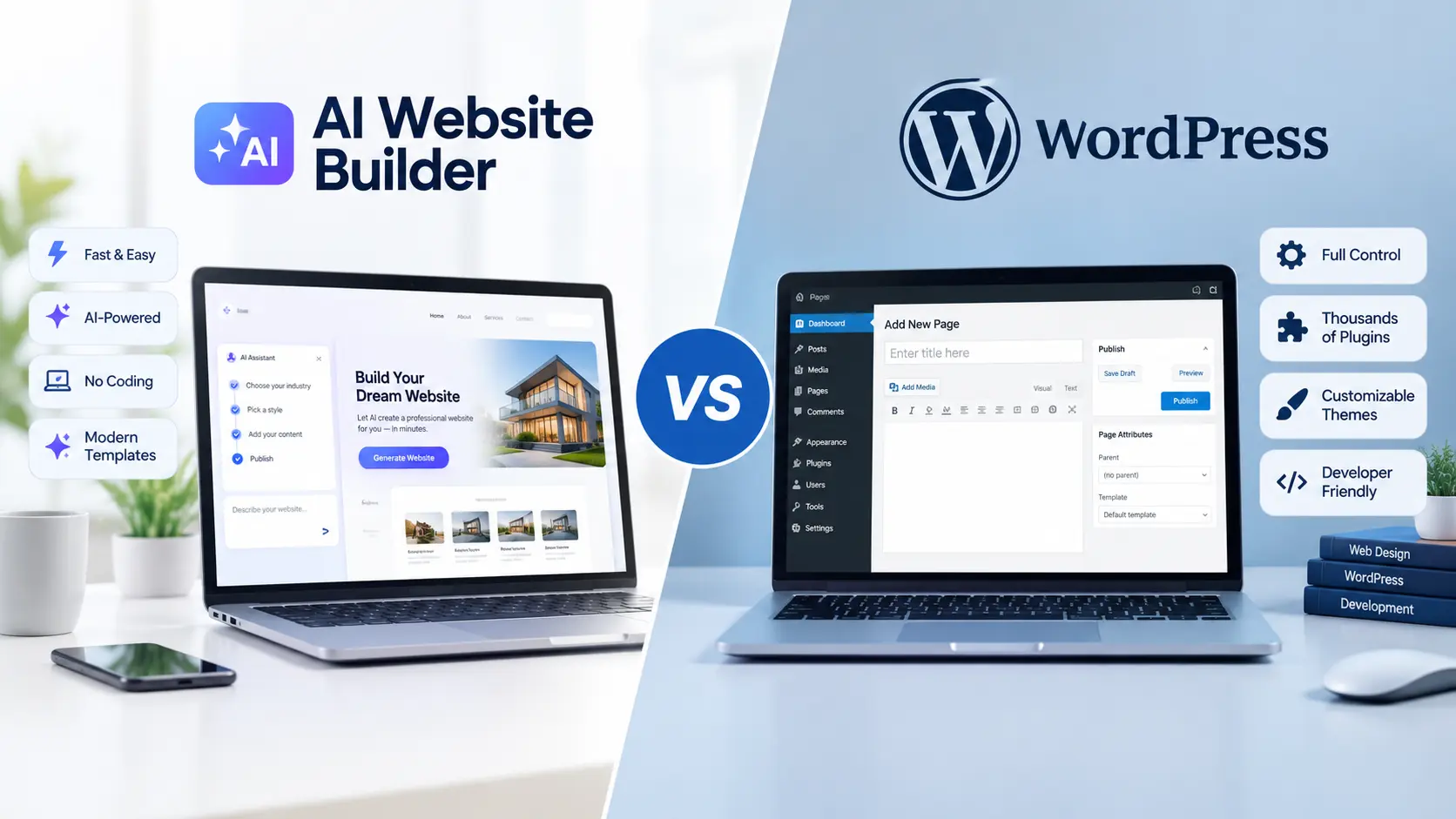
Choosing between an ai website builder vs wordpress is one of the first big decisions you make when you launch a business online. Both options can produce a professional site. Both have loyal fans. Yet they work in very different ways, and the wrong pick can cost you months of rework, extra money, and lost search traffic.
The debate has grown louder as artificial intelligence has moved from a novelty into everyday web design. Today you can type a short description of your business and get a full website in minutes. At the same time, WordPress still powers a huge share of the internet and keeps evolving. So in the ai website builder vs wordpress race, which one deserves your time and budget?
This guide breaks down the ai website builder vs wordpress question in plain language. You will see how each platform handles design, SEO, speed, cost, security, and growth. You will also learn which type of business fits each option, so you can decide with confidence instead of guessing.
What Is an AI Website Builder?
An AI website builder is a platform that uses artificial intelligence to generate a website from your input. You usually answer a few questions, such as your business name, industry, and style preferences. The tool then writes sample copy, picks a layout, chooses colors and fonts, and assembles pages for you.
Most platforms bundle everything into one subscription: hosting, a domain option, templates, a visual editor, and basic security. You never touch a server or install software. If you want a deeper look at how these tools work behind the scenes, our guide to the AI website builder explains the technology and the common mistakes to avoid.
Key Strengths of AI Website Builders
- Speed: A first draft appears in minutes, not weeks.
- Low technical barrier: No coding, plugin hunting, or server setup.
- All-in-one pricing: Hosting, templates, and support sit under one bill.
- Built-in design guardrails: The AI keeps spacing, fonts, and mobile layouts tidy.
Key Limitations of AI Website Builders
- Limited control: You work inside the walls of the platform.
- Template sameness: Many AI-generated sites look alike.
- Portability issues: Moving your site to another host can be hard or impossible.
- Feature ceilings: Advanced integrations may not exist or may cost extra.
If you want to compare specific tools before you decide, read our roundup of the best AI website builder options and the features worth looking for.
What Is WordPress?
WordPress is an open-source content management system, or CMS. You install it on your own hosting account, choose a theme, and extend it with plugins. Because the software is free and open, thousands of developers build themes, plugins, and tools around it.
There are two versions, and people often confuse them. WordPress.com is a hosted service, while WordPress.org is the self-hosted software you control fully. Our article on the WordPress website explains the differences between the two in detail.
Key Strengths of WordPress
- Full ownership: You control your files, database, and content.
- Huge ecosystem: Plugins exist for nearly every feature you can imagine.
- Flexible design: You can build anything from a simple blog to a membership platform.
- Strong SEO foundation: Clean code, flexible URLs, and powerful SEO plugins.
Key Limitations of WordPress
- Learning curve: Beginners must learn hosting, themes, plugins, and updates.
- Maintenance work: Updates, backups, and security checks fall on you.
- Plugin conflicts: Too many plugins can slow or break a site.
- Variable costs: Premium themes, plugins, and developers add up.
AI Website Builder vs WordPress: Quick Comparison
Before diving deeper, here is a snapshot of the ai website builder vs wordpress comparison across the factors that matter most.
| Factor | AI Website Builder | WordPress |
|---|---|---|
| Setup time | Minutes to hours | Hours to weeks |
| Technical skill needed | Very low | Low to moderate |
| Design freedom | Moderate | Very high |
| SEO control | Basic to moderate | Advanced |
| Hosting | Included | You choose |
| Maintenance | Handled by platform | Handled by you or a pro |
| Scalability | Limited by platform | Highly scalable |
| Ownership and portability | Often restricted | Full ownership |
| Typical cost | Predictable subscription | Flexible, varies widely |
This table gives you the short answer. The sections below explain why each difference matters in real life.
Ease of Use: AI Website Builder vs WordPress
Ease of use is where the ai website builder vs wordpress contest looks most one-sided. An AI builder wins the first round for beginners. You describe your business, review the generated draft, tweak a few headings, and publish. A small restaurant, freelancer, or consultant can go live in an afternoon.
WordPress asks more of you. You need to buy hosting, install the software, pick a theme, configure settings, and add plugins for forms, SEO, and security. None of this is impossible, and many tutorials exist, but it takes time. Our step-by-step WordPress website setup guide shows how long the process really takes when done properly.
That said, speed at launch is not the only measure. A site that goes live in one hour but needs a rebuild in one year is not truly faster. When weighing an ai website builder vs wordpress, think about total effort across the life of the site, not just day one.
Verdict: In the ai website builder vs wordpress contest on ease of use, AI builders win on launch speed and simplicity. WordPress wins when you are willing to invest time for long-term flexibility.
Design and Customization
AI builders produce clean, modern layouts quickly. The AI handles spacing, typography, and responsive behavior, which protects beginners from common design errors. However, you are limited to the blocks, sections, and styling options the platform allows. If you want a unique interactive feature or a custom layout, you may hit a wall.
WordPress gives you almost unlimited design freedom. You can choose from thousands of themes, use page builders, or hire a developer to create a fully custom design. You can edit templates, add custom code, and fine-tune every pixel.
This is the heart of the ai website builder vs wordpress trade-off: convenience versus control. If your brand depends on a distinctive look and feel, WordPress is the safer long-term choice. If a clean, professional page is enough, an AI builder is perfectly fine.
For businesses that want professional help, the WordPress website design process outlines what a custom build includes, from planning to launch checklists.
Verdict: For customization, the ai website builder vs wordpress result favors WordPress. AI builders win for effortless, consistent layouts.
SEO Capabilities: AI Website Builder vs WordPress
SEO is where many business owners should pay the closest attention. Your website only helps if people can find it, so the ai website builder vs wordpress decision must include search performance.
SEO on AI Website Builders
Modern AI builders include basics such as editable page titles, meta descriptions, image alt text, XML sitemaps, and mobile-friendly layouts. Some even suggest keywords or draft content. For a small site with a handful of pages, this can be enough to get started.
The weakness is depth. You may not be able to edit your URL structure freely, add advanced schema markup, control robots rules, or fine-tune technical settings. AI-written copy can also feel generic, and generic content rarely ranks well. Remember that search engines reward original, helpful pages, not mass-produced text. To understand how AI fits into search strategy, read about AI and SEO and the AI SEO tools that actually help.
SEO on WordPress
WordPress is famous for SEO flexibility. You can customize permalinks, edit every meta tag, add structured data, create categories and tags, and control indexing page by page. SEO plugins add checklists, schema options, redirects, and sitemap controls. If you plan to compete for competitive keywords, this depth matters.
Our resources on WordPress SEO and the on-page SEO fundamentals show exactly which settings to configure. For local service businesses, you can also add local business schema to help search engines understand your services and location.
In the ai website builder vs wordpress SEO battle, WordPress usually holds the advantage because it removes technical ceilings. That said, an AI builder with good content can still outrank a neglected WordPress site. The tool matters less than the quality of your pages and the strategy behind them.
Verdict: On SEO, the ai website builder vs wordpress result favors WordPress for advanced needs. AI builders are acceptable for simple sites with limited competition.
Website Speed and Performance
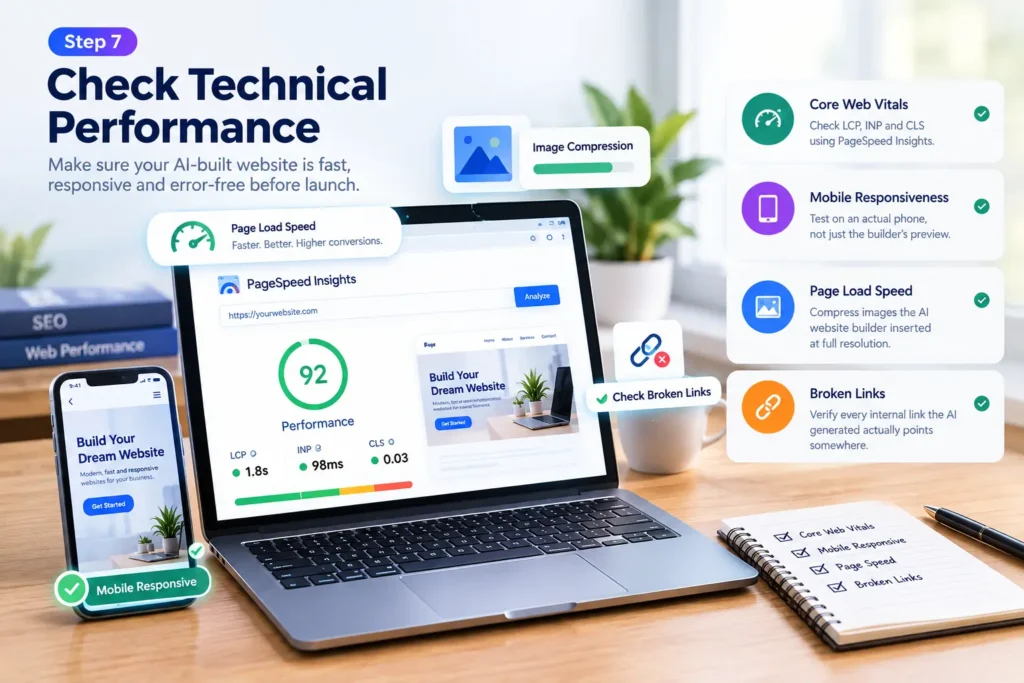
Speed affects both rankings and conversions. Visitors leave slow pages quickly, and Google measures real-world performance through Core Web Vitals.
AI builders often perform reasonably out of the box because the platform controls hosting, caching, and code. You do not need to tune anything. The downside is that you also cannot fix problems the platform creates, such as heavy scripts or bloated page code you cannot remove.
WordPress performance depends on your choices. A lightweight theme, quality hosting, image compression, and caching can make a WordPress site extremely fast. But a cheap host, bulky theme, and twenty unnecessary plugins can make it painfully slow. Our guides on how to improve website speed, website speed SEO, and Core Web Vitals walk through the fixes, while this WordPress website speed guide focuses on the platform itself.
When you compare an ai website builder vs wordpress on speed, the honest answer is that AI builders offer a safer average and WordPress offers a higher ceiling. A well-optimized WordPress site can beat almost any builder, but a careless one will lose.
Verdict: The ai website builder vs wordpress speed contest is a tie in practice. AI builders are easier to keep fast, while WordPress can be faster with effort.
Cost: AI Website Builder vs WordPress
Money often drives the ai website builder vs wordpress decision, so let us look at where costs come from.
AI Website Builder Costs
Most AI builders charge a monthly or annual subscription. The plan typically covers hosting, templates, security, and support. Higher tiers unlock more pages, ecommerce features, or removal of platform branding. The benefit is predictability: you know your bill in advance.
Watch for add-ons. Custom domains, extra storage, premium integrations, and ecommerce transaction fees can raise the real price beyond the headline number.
WordPress Costs
The WordPress software is free, but a real website is not. Expect to pay for:
- Domain name
- Hosting
- Premium theme (optional)
- Premium plugins (optional)
- Security and backup tools
- Developer or designer help (optional)
- Ongoing maintenance
A basic WordPress site can cost very little if you do the work yourself. A custom business site can cost far more when you hire professionals. The range is wide because you decide how much to buy.
For many small businesses, the ai website builder vs wordpress cost question comes down to time versus money. AI builders save time and charge for it monthly. WordPress can save money but spends your time or a professional’s time instead.
Verdict: On cost, the ai website builder vs wordpress winner depends on your budget: AI builders win on predictable, low starting cost. WordPress wins on long-term value if you need flexibility.
Scalability: AI Website Builder vs WordPress
A website should grow with your business. This is where the ai website builder vs wordpress decision can quietly become expensive.
AI builders work well for brochure-style websites with a few pages. As you add hundreds of pages, complex product catalogs, memberships, booking systems, or multilingual content, you may reach the platform’s limits. Moving to another platform later usually means rebuilding from scratch.
WordPress scales in almost any direction. Large news sites, online stores, learning platforms, and directories all run on it. You can add features as you need them and upgrade hosting as traffic grows.
If you expect your website to be central to your marketing for years, plan for scale now. The best way to avoid a painful migration later is to choose the platform that matches your three-year goals, not just this month’s needs.
Verdict: For growth, the ai website builder vs wordpress verdict goes to WordPress for complex projects. AI builders suit small, stable sites.
Security and Maintenance: AI Website Builder vs WordPress
Every website needs security and upkeep, and the ai website builder vs wordpress difference here is about responsibility.
With an AI builder, the platform handles updates, backups, SSL certificates, and server security. This removes a major burden. You rely on the provider to patch vulnerabilities, which is convenient but means you have no control if something goes wrong.
With WordPress, you or your developer must keep the core software, themes, and plugins updated. Skipped updates are a leading cause of hacked sites. You also need backups, malware scanning, and strong login protection. Use our website security guide and the website maintenance checklist to build a routine. Choosing trustworthy extensions also matters, and this guide to WordPress plugins explains how to pick them safely.
Some owners assume WordPress is insecure. In truth, a well-maintained WordPress site is secure, and a neglected one is vulnerable. The same logic applies to any platform: security depends on habits as much as technology.
Verdict: For hands-off security, the ai website builder vs wordpress edge goes to AI builders. WordPress wins only if you commit to regular maintenance.
Ownership, Portability, and Lock-In
Ownership is the most overlooked part of the ai website builder vs wordpress debate. With an AI builder, your site lives inside the platform. If you cancel your subscription or the company changes its pricing, you may lose your design and layout. Exporting content is often limited to text and images, and you cannot take the working site elsewhere.
With self-hosted WordPress, you own your files and database. You can switch hosts, hire any developer, or change your theme without losing your content. That freedom is valuable for businesses that treat their website as a long-term asset.
This does not make AI builders a bad choice. It simply means you should read the terms, understand export options, and decide whether lock-in is acceptable for your situation.
Verdict: On ownership, the ai website builder vs wordpress winner is clearly WordPress.
Ecommerce and Advanced Features
If you plan to sell online, take extra care with the ai website builder vs wordpress decision.
Many AI builders include simple store features: product pages, a cart, and payment processing. These work well for a small catalog. Limits appear when you need advanced shipping rules, subscriptions, wholesale pricing, custom checkout flows, or deep inventory tools.
WordPress paired with a dedicated ecommerce plugin can handle large catalogs and custom workflows. You can connect accounting software, email marketing, CRM tools, and analytics. The trade-off is setup effort and ongoing maintenance.
The same pattern applies to bookings, memberships, forums, and course platforms. AI builders offer lightweight versions, while WordPress offers full-featured systems through plugins.
Verdict: In ecommerce, the ai website builder vs wordpress answer is simple: AI builders suit small shops. WordPress suits serious or growing ecommerce.
AI Website Builder vs WordPress for Different Users
The right answer depends on who you are. Here is how the ai website builder vs wordpress choice looks for common situations.
Freelancers and Solopreneurs
If you need a simple portfolio or service page quickly, an AI builder is hard to beat. You can launch fast, update it yourself, and focus on clients. Upgrade later if your needs grow.
Local Service Businesses
Plumbers, electricians, HVAC companies, and similar trades depend on local search. They benefit from structured service pages, location pages, schema, and fast mobile performance. WordPress usually serves them better because of its SEO depth. Start with the local SEO guide for small businesses and learn how to build effective service pages that win leads.
Bloggers and Publishers
Content-heavy sites need categories, tags, archives, internal linking, and editorial workflows. WordPress was built for this. In the ai website builder vs wordpress comparison for publishers, WordPress wins easily.
Startups Testing an Idea
In the ai website builder vs wordpress choice for startups, an AI builder lets you test messaging and collect emails without a big investment. You can move to WordPress once the idea proves itself.
Agencies and Developers
Agencies need flexibility, client handoff options, and the ability to customize. WordPress remains the standard choice because it supports white-label work and custom development.
Online Store Owners
Small stores can start on an AI builder. Growing stores usually move to WordPress with an ecommerce plugin for deeper control.
Can You Use Both? A Hybrid Approach
You do not always have to choose a single side in the ai website builder vs wordpress debate. Many smart teams combine them.
For example, you could use AI tools to draft page outlines, headlines, and product descriptions, then publish everything on WordPress with human editing. Others use an AI builder for a quick landing page and keep a WordPress site for their main content and SEO.
The key is to treat AI as an assistant, not a replacement for strategy. AI can speed up research and drafting, but a person should review accuracy, tone, and originality before anything goes live. Search engines and readers both reward content that shows real experience and clear usefulness.
Common Mistakes When Choosing a Platform
Whichever side of the ai website builder vs wordpress question you favor, avoid these frequent errors:
- Choosing only on price. A cheap platform that limits growth becomes expensive later.
- Ignoring SEO needs. Check URL control, schema options, and technical settings before committing.
- Publishing AI content without editing. Generic copy weakens trust and rankings. Review our list of common SEO mistakes to see what hurts sites most.
- Forgetting about maintenance. WordPress needs updates, and AI builders need subscription monitoring.
- Skipping the export check. Know how to leave a platform before you join it.
- Overloading with plugins or apps. More add-ons usually mean slower pages and more risk.
- Not tracking results. Without data, you cannot tell whether your site is working. Set up Google Search Console from day one.
How to Decide: A Simple Framework
Use these questions to settle your own ai website builder vs wordpress decision.
- What is your timeline? If you need a site this week, lean toward an AI builder.
- What is your technical comfort level? If you dislike technical tasks and have no helper, an AI builder reduces stress.
- How important is organic search? If SEO is your main growth channel, lean toward WordPress.
- How unique must the design be? Strong branding needs favor WordPress.
- How big will the site become? Large or complex sites favor WordPress.
- Do you want full ownership? If yes, choose self-hosted WordPress.
- What is your real budget, including time? Count your hours as a cost, not just your cash.
If most of your answers point toward speed and simplicity, choose an AI builder. If most point toward control, SEO, and growth, choose WordPress. If your answers are mixed, start with the one that solves your biggest immediate problem and plan the next step.
AI Website Builder vs WordPress: Frequently Asked Questions
Is an AI website builder better than WordPress for beginners?
For absolute beginners who want a simple site fast, an AI builder is usually easier. WordPress is beginner-friendly after a short learning period, but it requires more setup. The ai website builder vs wordpress answer for beginners depends on whether you value speed or long-term flexibility more.
Which is better for SEO in the ai website builder vs wordpress debate?
WordPress generally offers more SEO control, including custom URLs, advanced schema, and detailed technical settings. AI builders cover the basics and can rank for low-competition terms. Content quality and strategy matter more than the platform alone.
Is WordPress cheaper than an AI website builder?
In the ai website builder vs wordpress cost comparison, it depends. WordPress can cost less if you handle the work yourself and use free tools. AI builders charge a steady subscription that includes hosting and support. When you add professional help, premium plugins, and maintenance, WordPress costs can rise above a builder subscription.
Can I move from an AI website builder to WordPress later?
Yes, but it is rarely a one-click process. You can usually copy your text and images, then rebuild the design in WordPress. Plan for redirects so you keep your search rankings during the move.
Will AI replace WordPress?
Unlikely in the near term. AI is becoming part of WordPress itself through plugins and content tools, so the ai website builder vs wordpress divide may blur over time. Many people will use both together.
Is an AI website builder good enough for a business website?
For many small businesses, yes. If you need a handful of pages, a contact form, and basic online presence, a quality AI builder is enough. Growing businesses with strong SEO goals usually outgrow it.
Which is more secure in the ai website builder vs wordpress comparison?
Both can be secure. AI builders handle security for you, while WordPress security depends on updates, strong passwords, and good plugins. Neglect, not the platform, causes most security problems.
Final Verdict: AI Website Builder vs WordPress
So, which is better in the ai website builder vs wordpress showdown? The honest answer is that neither wins every time.
Choose an AI website builder if you want a fast, low-maintenance website for a small business, a portfolio, a test project, or a simple online presence. It saves time, reduces technical stress, and gives you a polished result with minimal effort.
Choose WordPress if you want control, strong SEO, room to grow, and full ownership of your website. It rewards the extra effort with flexibility that no closed platform can match.
If you are still unsure, start by listing your goals for the next three years. Websites that support lead generation, content marketing, and local search almost always benefit from WordPress. Websites that need to exist quickly with little upkeep fit an AI builder well.
Whatever you choose, remember that the platform is only the container. Your results come from useful content, clean technical foundations, fast pages, and a consistent SEO strategy. Pick the tool that fits your goals today, keep an eye on your growth tomorrow, and you will be far ahead of the owners who chose a platform because it was trendy.
Ready to explore your options further? Compare the best AI website builder tools or read our overview of how a website builder works, then use the framework above to make your final call. If you want expert help with the ai website builder vs wordpress decision, our team at TradeScale Hub can guide you toward the right setup for your business.
