
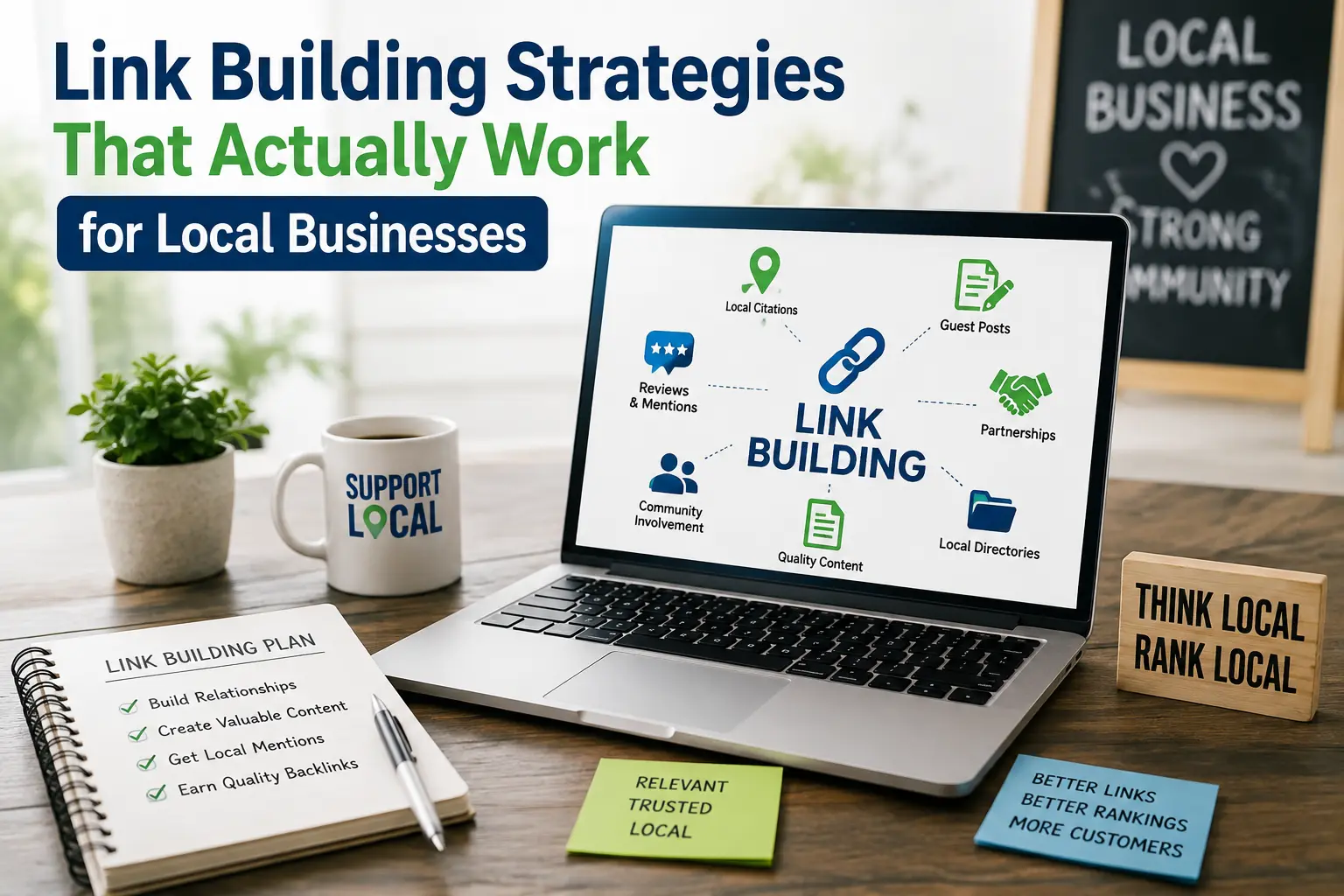
Link building is one of the most misunderstood parts of local SEO. Business owners hear the term and picture shady tactics from a decade ago — link farms, paid link networks, spammy comment sections — and understandably want nothing to do with it. But modern this practice, done correctly, is one of the most reliable ways to build authority, outrank competitors, and earn a permanent place in local search results.
This guide breaks down exactly what this outreach process means today, why it still matters in 2026, and which specific strategies actually move the needle for local businesses — plumbers, electricians, HVAC contractors, towing companies, appliance repair shops, and any other business that depends on local search traffic. By the end, you’ll have a practical, repeatable link building framework you can start using this week.
What Is Link Building?
Link building is the process of earning hyperlinks from other websites that point back to your own website. Each of these backlinks acts as a signal to Google that other sites consider your content trustworthy, relevant, or valuable enough to reference. The more high-quality links you earn, the more authority Google assigns to your site, which directly influences how well you rank for the keywords that matter to your business.
Link building isn’t just about quantity. A single link from a well-respected local news site or industry association can carry more weight than a hundred links from low-quality directories. That’s why effective backlink outreach today focuses on relevance and trust rather than volume, a shift that has completely changed how smart businesses approach the practice.
If you’re still building the foundation of your local SEO strategy, it’s worth reading our local SEO guide for small businesses first, since link building works best when it’s layered on top of solid on-page SEO and a fully optimized Google Business Profile.
Why Link Building Matters More Than Ever for Local Businesses
Google’s algorithm uses hundreds of ranking factors, but backlinks remain one of the strongest signals of authority and trust, especially in competitive local markets. Here’s why this discipline deserves a dedicated strategy rather than an afterthought:
- Authority signals. Every quality backlink tells Google that a real, independent website vouches for you. Consistent link building compounds this trust over time.
- Referral traffic. Beyond SEO value, links from relevant sites send real visitors — potential customers — directly to your website, which is a benefit this work delivers even before any ranking movement happens.
- Competitive differentiation. Most local businesses never invest in link building at all, which means the ones that do gain a significant, often long-lasting advantage over competitors who rely purely on on-page tactics.
- Long-term compounding value. Unlike paid ads that stop working the moment you stop paying, links you earn through these efforts continue passing authority for years.
- Faster movement out of competitive plateaus. Businesses stuck on page two often have strong on-page SEO but a thin backlink profile — link building is usually the missing piece that pushes them onto page one.
If your business still isn’t showing up in local search despite doing everything else right, a weak backlink profile is a common culprit. Our breakdown of why businesses don’t show up on Google covers several visibility issues, and a lack of this practice is frequently one of them.
How Link Building Affects Local Search Rankings
Local rankings are influenced by relevance, distance, and prominence, and earning backlinks feeds directly into the prominence factor. Prominence measures how well-known and well-referenced your business is — both online and offline — and backlinks are one of the clearest digital signals Google uses to measure it.
Link building also indirectly boosts relevance. When you earn a link from a page discussing “best HVAC contractors in [city],” the surrounding content and anchor text reinforce exactly what your business does and where it operates, strengthening your topical relevance in Google’s eyes. This is why earning links from contextually relevant sources — local news, industry publications, community organizations — is so much more valuable than random, unrelated links.
There’s also a domain authority component. As your overall backlink profile grows through consistent earning links, your entire website gains more authority, which lifts the ranking potential of every page on your site, not just the one page a link happens to point to.
It’s worth understanding what a “good” link actually looks like before diving into tactics. Not every hyperlink is created equal. Google evaluates the authority of the linking domain, the relevance of the linking page’s topic to yours, the placement of the link within the content (a link buried in a footer carries less weight than one placed naturally within an article), and whether the link appears to be earned editorially rather than paid for or manipulated. Keeping these quality signals in mind will save you from wasting time on tactics that produce links Google largely ignores.
Another useful mental model is to think of your backlink profile the way a bank thinks of a credit history. A handful of accounts with a long, clean track record and a good relationship with trusted lenders carries far more weight than dozens of new, thin accounts opened all at once. Link building works the same way — a steady, natural pattern of earning links over months and years builds far more trust with Google than a sudden burst of hundreds of links appearing overnight, which often looks suspicious rather than impressive.
The Complete Link Building Checklist for Local Businesses
Below is a practical, step-by-step backlink acquisition checklist. You don’t need to execute every tactic at once — pick two or three to start, master them, then expand your backlink efforts as you see results.
1. Build a Foundation of Local Citations
Citations — mentions of your business name, address, and phone number on directories like Yelp, Angi, the Better Business Bureau, and industry-specific directories — are technically a form of link building, even when the link itself is “nofollow.” They establish consistency and trust signals that make every other backlink effort more effective. Start by claiming and completing your profile on the major general directories, then move into niche directories specific to your trade.
2. Get Listed With Local Business Associations
Chambers of commerce, local business bureaus, and trade associations almost always offer a member directory with a link back to your website. This is one of the easiest wins in local link building because the process is straightforward — join, pay any applicable membership fee, and claim your listing — and the links tend to come from high-trust, locally relevant domains.
3. Sponsor Local Events, Teams, or Charities
Sponsoring a little league team, a charity 5K, or a community festival often earns you a link on the event’s website in exchange for your support. This form of your backlink profile has the added benefit of genuine community goodwill and brand visibility beyond just the SEO value, making it one of the most sustainable long-term backlink tactics for local businesses.
4. Partner With Complementary Local Businesses
An HVAC company and a plumbing company aren’t direct competitors, but they serve overlapping customers. Reaching out to complementary local businesses to exchange recommendations, guest posts, or resource mentions is a natural and scalable link building strategy that Google views favorably because the relationship is genuinely relevant.
5. Pursue Guest Posting on Relevant Industry Blogs
Guest posting — writing a valuable article for another website in exchange for a link back to your site — remains one of the most effective backlink strategies when done selectively. Target sites that are genuinely relevant to your industry or local area, write something genuinely useful rather than thin, promotional content, and avoid mass guest-posting networks that Google has learned to discount.
6. Use HARO and Journalist Request Platforms
Services that connect journalists with expert sources (commonly known by the acronym HARO, or similar modern platforms) let you pitch quotes for articles in exchange for a link. This is a powerful link building channel because the resulting links often come from high-authority news and media sites that would otherwise be nearly impossible to earn a link from directly.
7. Create Linkable Assets
The most scalable long-term backlink strategy is creating content genuinely worth linking to — original research, local market data, comprehensive guides, free tools, or unique visual assets. When you publish something genuinely useful, other websites link to it naturally without you ever having to ask, which is the most sustainable form of link building over the long run. A detailed guide like our keyword research resource is exactly the kind of linkable asset that attracts organic mentions over time.
8. Try Broken Link Building
Broken backlink outreach involves finding dead links on relevant websites (using a tool that checks for 404 errors) and reaching out to suggest your own content as a replacement. Because you’re helping the site owner fix a real problem, this tactic tends to have a higher response rate than a cold link request with nothing to offer in return.
9. Reclaim Unlinked Brand Mentions
Sometimes another website mentions your business by name without linking to you. A quick, polite email asking them to turn that mention into a clickable link is one of the fastest link building wins available, since the site owner already thought highly enough of you to mention you in the first place.
10. Get Listed on Resource and “Best Of” Pages
Many websites maintain curated resource pages or “best local businesses” roundups. Finding these pages in your industry and reaching out to be included is a repeatable backlink tactic, especially if you can demonstrate genuine value, strong reviews, or a unique specialty that fits the page’s theme.
11. Leverage Supplier and Manufacturer Directories
If you install or service specific brands of equipment — HVAC units, appliances, EV chargers — many manufacturers maintain a “find a dealer” or “certified installer” directory that links back to partner businesses. This is an often-overlooked link building opportunity that’s essentially free once you’re a certified or authorized dealer.
12. Run Digital PR Campaigns
Digital PR takes this discipline a step further by proactively creating newsworthy stories — surveys, local market reports, unique data — and pitching them to journalists and local media outlets. It requires more effort than most tactics on this list, but a single successful digital PR campaign can generate dozens of high-authority links at once.
Local-Specific Link Building Tactics Worth Prioritizing
While the checklist above applies broadly, local businesses have a few unique link building advantages that national brands don’t.
Local news coverage. Local newspapers and news websites are often hungry for community stories. A well-pitched story about your business — a milestone, a community contribution, a unique service — can earn you a backlink win from a genuinely authoritative local domain.
Local blogger and influencer outreach. Many cities have local lifestyle bloggers or micro-influencers who cover small businesses. A small collaboration, review, or feature is an approachable link building tactic that doubles as marketing.
University and school partnerships. If you offer internships, sponsor a school program, or participate in a career day, many educational institutions link back to partner businesses on .edu domains, which carry significant authority in most backlink strategies.
Government and municipal listings. City websites often maintain business directories or vendor lists. These government-domain links are difficult to obtain through any tactic other than genuine registration, making them a valuable and often underused piece of local link building.
Setting Up Link Building for a Brand-New Website
If your website is brand new, your link building approach in the first few months looks different than it does for an established site with years of history. Here’s a practical sequence for the first 30 days:
Week 1: Foundation. Claim your Google Business Profile, complete your citations on the five or six most important general directories for your industry, and make sure your website itself has clean, crawlable pages worth linking to before you ask anyone for a link.
Week 2: Easy wins. Join your local chamber of commerce, submit your site to any relevant industry associations, and reach out to any suppliers or partners who maintain a “find a dealer” or partner directory. This early stage of link building establishes a baseline of trustworthy, relevant domains pointing to your new site.
Week 3: Relationships. Reach out to two or three complementary local businesses about a simple cross-promotion or mention exchange, and check whether any existing customers or partners have websites where a natural mention could turn into a link.
Week 4: First outreach campaign. Identify five relevant blogs or local publications and pitch a genuinely useful guest post or story idea. A new site’s first external, editorially earned link is often the hardest to get, but each one after that becomes progressively easier as your site accumulates trust.
New websites often make the mistake of either ignoring link building entirely for the first year, waiting until content is “ready,” or rushing into low-quality directory submissions in bulk. Neither approach works well. A steady, patient link building cadence from day one — even just two or three quality links a month — builds a far healthier foundation than either extreme.
Competitor Backlink Analysis: Finding Opportunities Fast
One of the fastest ways to find realistic backlink opportunities is to study exactly where your competitors are already getting their links. Using a backlink tool, pull the referring domains for the two or three competitors who consistently outrank you, then look for patterns:
- Shared directories or associations you haven’t joined yet
- Guest post sites that have published multiple competitors and are clearly open to industry contributors
- Local sponsorships or community pages where a competitor is listed and you could realistically be included too
- Resource pages that already link to a competitor and might reasonably add you as well
This kind of reverse-engineering makes link building far more efficient because you’re not guessing which sites might be receptive — you already have evidence that they’ve linked to a business just like yours before. Repeating this competitor analysis every quarter keeps your backlink pipeline full of realistic, already-validated opportunities.
Anchor Text Strategy for Natural Link Building
The clickable text of a link — the anchor text — sends its own signal to Google about what the linked page is about. A healthy link building profile has a natural mix of anchor text types:
- Branded anchors (your business name) should make up the largest share, since that’s how most genuine links naturally get written
- Naked URL anchors (the raw web address) occur frequently in citations and directories
- Generic anchors like “click here” or “learn more” appear in a meaningful portion of natural links
- Partial-match or exact-match keyword anchors (like “HVAC repair in Austin”) should make up only a small percentage of your overall backlink profile
Over-relying on exact-match keyword anchors is one of the clearest signs of manipulative link building to Google’s algorithm, so resist the temptation to request a specific keyword-rich anchor text every time you earn a link. In most cases, it’s better to let the site owner write the anchor text naturally, since that variation is exactly what makes a backlink profile look organic rather than engineered.
Common Link Building Mistakes That Can Hurt More Than They Help
Not every backlink tactic is a good one. Avoid these common mistakes:
- Buying links in bulk. Paid link schemes violate Google’s guidelines and can result in a manual penalty that tanks your rankings. No amount of short-term convenience is worth the risk to your long-term link building strategy.
- Using link farms or private blog networks. These networks of low-quality, interconnected sites are easy for Google to detect and can do more harm than good.
- Over-optimizing anchor text. If every single link uses the exact phrase “best plumber [city],” it looks unnatural. A healthy backlink profile has varied, natural anchor text.
- Ignoring relevance. A link from an unrelated site in a completely different industry or country provides little value and can occasionally raise red flags if it happens repeatedly.
- Chasing volume over quality. Ten links from respected, relevant sites will outperform two hundred links from spammy directories every time. Quality should always be the priority in link building.
- Neglecting this practice entirely. The opposite mistake is just as common — businesses that build a great website and stop there, never reaching out for a single link, leaving significant ranking potential untapped.
- Expecting instant results. Backlink acquisition is a compounding strategy. A handful of new links this month won’t move your rankings overnight, but a consistent link building habit over six to twelve months produces dramatic, durable results.
Link Building for Different Local Industries
While the fundamentals of earning links apply everywhere, certain industries have unique opportunities worth prioritizing.
HVAC and Home Services
HVAC companies can lean on manufacturer certification directories, local chamber memberships, and seasonal PR angles (heat wave safety tips, winter preparation guides) as reliable link building sources. For a broader SEO foundation to pair with these efforts, see our guide to HVAC SEO strategy and HVAC website optimization.
Appliance Repair
Appliance repair businesses benefit from manufacturer “authorized repair” directories and neighborhood-level community sponsorships. Local backlink outreach here tends to work best combined with the trust-building tactics covered in our appliance repair SEO guide.
Towing and Roadside Services
Towing companies can build links through partnerships with local auto shops, insurance agents, and municipal contracts, all of which are natural link building opportunities that also generate direct referral business.
Professional and Digital Service Agencies
Agencies can pursue guest posting, case study features, and digital PR more aggressively than trade businesses, since thought-leadership content naturally attracts links from industry blogs and publications discussing marketing and SEO topics.
Link Building and Content Strategy Go Hand in Hand
You can’t build links to content that doesn’t exist or isn’t genuinely worth linking to. Before ramping up outreach, make sure you have strong pages worth pointing links at — whether that’s a cornerstone guide, a well-optimized service page, or a data-driven blog post. Combining this discipline with strong on-page fundamentals like the ones covered in our website speed and Core Web Vitals guide ensures the traffic those links send actually converts once it lands.
It’s also worth understanding how link building fits alongside other ranking factors. Our overview of key local SEO ranking factors explains how backlinks work together with citations, reviews, and on-page elements, and this piece on how local SEO increases profits shows the business impact of a well-rounded strategy that includes consistent this work.
Tools That Support Link Building
Several tools make link building more efficient and help you track results over time:
- Ahrefs, SEMrush, or Moz: Industry-standard platforms for finding backlink opportunities, analyzing competitor link profiles, and tracking your own these efforts progress.
- Google Search Console: A free way to see which links Google has already discovered pointing to your site, useful for verifying that your link building efforts are actually being indexed.
- Broken link checkers: Tools like Check My Links or Ahrefs’ broken link checker make the broken-link tactic described earlier far faster to execute.
- Outreach and email tools: Platforms that help manage and track outreach campaigns keep your outreach pipeline organized instead of scattered across spreadsheets and inboxes.
- HARO-style journalist platforms: Essential for the digital PR and journalist-outreach side of this practice.
- A simple spreadsheet: Track every prospect, contact date, follow-up date, and outcome. Most successful link building campaigns come down to disciplined follow-up as much as clever tactics.
A Sample 90-Day Link Building Roadmap
If you want a structured plan rather than an open-ended list of tactics, here’s how a 90-day backlink roadmap could look for a local business starting from scratch:
Days 1–15: Audit and foundation. Check your current backlink profile using a free tool, identify any spammy or broken links to disavow, and complete your listings on the major citation directories relevant to your industry. This diagnostic phase tells you exactly where your link building program needs to start.
Days 16–30: Low-hanging fruit. Join your local chamber of commerce, get listed on two or three relevant local directories, and reclaim any unlinked brand mentions you can find through a simple brand-name search. This phase of earning links typically produces the fastest visible wins.
Days 31–60: Outreach and relationships. Identify ten to fifteen relevant sites for guest posting or resource-page inclusion, and begin outreach. Simultaneously, pursue one or two local sponsorship or partnership opportunities. This is the most labor-intensive phase of link building, but also the one that builds the strongest long-term foundation.
Days 61–90: Content and PR. Publish one genuinely link-worthy piece of content — original data, a comprehensive guide, or a useful tool — and pitch it to relevant journalists or bloggers. By day 90, a disciplined backlink roadmap should have produced a noticeably stronger, more diverse backlink profile than where you started.
After the initial 90 days, shift into an ongoing maintenance rhythm: a few hours of link building outreach every week, one new piece of linkable content per quarter, and a backlink audit every six months to make sure your profile stays clean and healthy.
How to Measure Link Building Success
Backlink outreach isn’t something you do blindly — track these metrics to know whether your efforts are working:
- Referring domains. The number of unique websites linking to you matters more than raw link count, since ten links from ten different domains is stronger than ten links from one domain.
- Domain authority or domain rating. While not an official Google metric, these third-party scores give you a useful proxy for how your link building is affecting your overall site authority.
- Keyword ranking movement. Track your core keywords before and after major this discipline pushes to correlate cause and effect.
- Referral traffic. Check Google Analytics for visitors arriving from the sites you’ve earned links on — a healthy link building campaign sends real traffic, not just SEO value.
- Link relevance and quality. Periodically review your backlink profile to confirm the links you’re earning are genuinely relevant rather than just numerous.
If any of these metrics stall, it’s a sign your backlink strategy needs fresh tactics — a new content asset, a different outreach angle, or an unexplored niche of directories and partners.
How Often Should You Work on Link Building?
Link building isn’t a project with a finish line — it’s an ongoing part of your marketing rhythm. A sustainable cadence looks like this:
- Weekly: Spend a few hours on outreach, whether that’s guest post pitches, broken-link outreach, or unlinked mention reclamation.
- Monthly: Review new backlinks in Search Console, check for any spammy links to disavow, and evaluate which backlink tactics are producing results.
- Quarterly: Publish one new linkable asset and run a fresh competitor backlink analysis to spot opportunities you’ve missed.
- Annually: Conduct a full backlink audit, reassess your overall link building strategy against your business goals, and identify which channels deserve more investment going forward.
Frequently Asked Questions About Link Building
How many backlinks do I actually need? There’s no fixed number. A handful of high-quality, relevant links often outperforms hundreds of low-quality ones. Focus your link building efforts on relevance and authority rather than hitting an arbitrary count.
Is link building still effective in 2026? Yes. Despite algorithm updates over the years, backlinks remain one of Google’s strongest ranking signals, and link building continues to be one of the highest-leverage investments a local business can make in its SEO.
How long does link building take to show results? Most businesses start seeing ranking movement from consistent link building within two to four months, though highly competitive markets may take longer. Earning links is a compounding strategy, so results tend to accelerate the longer you stay consistent.
Can I do link building myself, or do I need an agency? Small business owners can absolutely handle basic backlink outreach — directories, sponsorships, partnerships — on their own. Agencies add the most value with guest posting outreach, digital PR, and content-driven link building, which require more time and relationship-building than most owners can dedicate.
Is it safe to buy backlinks to speed up link building? No. Purchased links that violate Google’s guidelines can trigger a manual penalty that seriously damages your rankings. Sustainable link building always comes from genuine relationships, real content, and legitimate directories.
What’s the difference between link building and citation building? Citation building focuses specifically on consistent NAP mentions across directories, while link building is the broader practice of earning any hyperlink back to your site from relevant, authoritative sources. Citations are technically one small piece of a complete backlink strategy.
Does internal linking count as link building? Not typically — internal linking (connecting pages within your own site) is a separate but complementary practice. True link building refers to earning links from external websites, though a strong internal linking structure helps distribute the authority those external links bring in.
Link Building for Multi-Location Businesses
Multi-location businesses face a distinct challenge: earning links that support each individual location page rather than just the homepage. A five-location plumbing company benefits far more from a link pointing directly to its “Austin plumbing services” page than from a generic link to the homepage that provides no location-specific relevance.
To do this well, pursue local directory listings, sponsorships, and partnerships separately for each city or region you serve, and make sure the outreach for each location links to that location’s dedicated page rather than defaulting to the main site. This location-specific approach to acquiring backlinks strengthens the individual pages that actually need to rank in each local market, rather than concentrating all your authority on a single homepage that can only rank for one place at a time.
It also helps to build relationships with regional media and business groups in each market you operate in, rather than assuming a single national PR push will benefit every location equally. A feature in a Denver business journal does very little for your Phoenix location’s local rankings, so multi-location businesses should think of their outreach efforts as several parallel campaigns rather than one unified one.
One efficient way to manage this at scale is to create a simple tracking sheet with a row for every location and columns for target directories, sponsorship opportunities, and outreach targets specific to that market. This keeps a multi-location program organized and prevents any single location from being neglected while attention focuses on whichever market happens to be top of mind.
Digital PR Campaign Ideas for Local Service Businesses
If you’re looking for a concrete starting point beyond the general checklist above, here are several campaign concepts that consistently earn coverage and backlinks for local service businesses:
- Seasonal safety guides. A “winter heating safety checklist” from an HVAC company or a “storm season electrical safety tips” piece from an electrician gives local news outlets a timely, useful story to run, especially around seasonal weather events.
- Original local survey data. Surveying your own customer base or a sample of local residents about a relevant topic — home maintenance habits, energy costs, appliance lifespans — creates original data that local journalists are often eager to cite.
- Community milestone stories. A business anniversary, a significant number of jobs completed, or a notable community contribution gives local reporters a genuine human-interest angle worth covering.
- Expert commentary on trending topics. Positioning your business owner or lead technician as a go-to expert source for local reporters covering relevant trends — rising energy prices, extreme weather, housing market shifts — creates recurring opportunities rather than a single one-off feature.
- Before-and-after project showcases. A dramatic renovation, repair, or installation project with strong visuals can attract coverage from local lifestyle publications looking for genuinely interesting content to share with their audience.
Each of these ideas works because it gives a journalist or publication a real reason to feature you — not because you asked for a link, but because you gave them something worth publishing. That distinction is what separates outreach that gets ignored from outreach that consistently earns high-quality coverage and backlinks.
Link Building Trends Worth Watching in 2026
The tactics that work shift over time, and staying current keeps your strategy ahead of competitors who only revisit their approach occasionally.
AI-generated content and link quality scrutiny. As more websites publish AI-assisted content at scale, Google has gotten better at distinguishing genuinely valuable pages from thin, mass-produced ones. This raises the bar for what counts as a worthwhile link building target — a site padded with low-effort content is less likely to pass meaningful authority even if it agrees to link to you.
Digital PR outpacing traditional guest posting. As generic guest-posting networks have become easier for Google to detect and discount, businesses are shifting effort toward genuine digital PR — original data, expert commentary, and newsworthy angles — as their primary strategy, since these links tend to be harder to fake and carry more weight.
Increased value on local and hyperlocal sources. As Google continues refining how it evaluates prominence for local search, links from genuinely local sources — city publications, neighborhood associations, regional business groups — are proving increasingly valuable relative to generic national directories.
Video and multimedia earning links. Businesses producing short, useful video content are increasingly finding that video assets get embedded and linked to by other sites more readily than plain text pages, opening up a newer avenue for this kind of outreach.
Greater scrutiny of link exchanges. Reciprocal linking between the same two sites over and over has always carried some risk, but algorithms are getting sharper at spotting patterns of excessive reciprocal exchanges, making genuinely one-directional, editorially earned links more valuable than ever.
Staying on top of these shifts doesn’t require chasing every new tactic the moment it appears, but a quarterly review of what’s working — and what’s starting to lose effectiveness — should be part of your standing strategy.
Combining Link Building With a Strong Website Experience
Earning a link is only half the equation — what happens after someone clicks through matters just as much. If your outreach is excellent but your website loads slowly, looks outdated, or doesn’t clearly explain what you do, you’ll waste a meaningful share of the traffic and trust those efforts generate. Make sure your site loads quickly, especially on mobile, since a slow experience undermines the credibility a hard-earned link is supposed to build. Our guide on website speed and Core Web Vitals is a useful companion resource here, and this piece on warning signs your website might be hurting sales covers additional experience issues worth fixing before you scale up outreach.
Treating this practice and your on-site experience as two halves of the same strategy — rather than separate projects — is ultimately what turns earned authority into real, measurable business growth.
Final Thoughts on Link Building
Link building remains one of the most powerful, durable investments a local business can make in its SEO strategy. Every quality link you earn — from a chamber of commerce listing to a feature in local news — adds another layer of trust and authority that helps you outrank competitors who are relying on website design alone.
Treat earning links as an ongoing discipline rather than a one-time campaign, pair it with the content and on-page fundamentals covered throughout our site, and stay patient — the businesses that commit to consistent link building for six months or longer are almost always the ones dominating their local map pack a year from now.
If you want more guidance on building out a complete local SEO strategy alongside your backlink efforts, explore our industry-specific SEO guides or learn more about Trade Scale Hub. And if you’d like help putting a link building plan into action for your business, feel free to reach out to us — we’re happy to help.
