
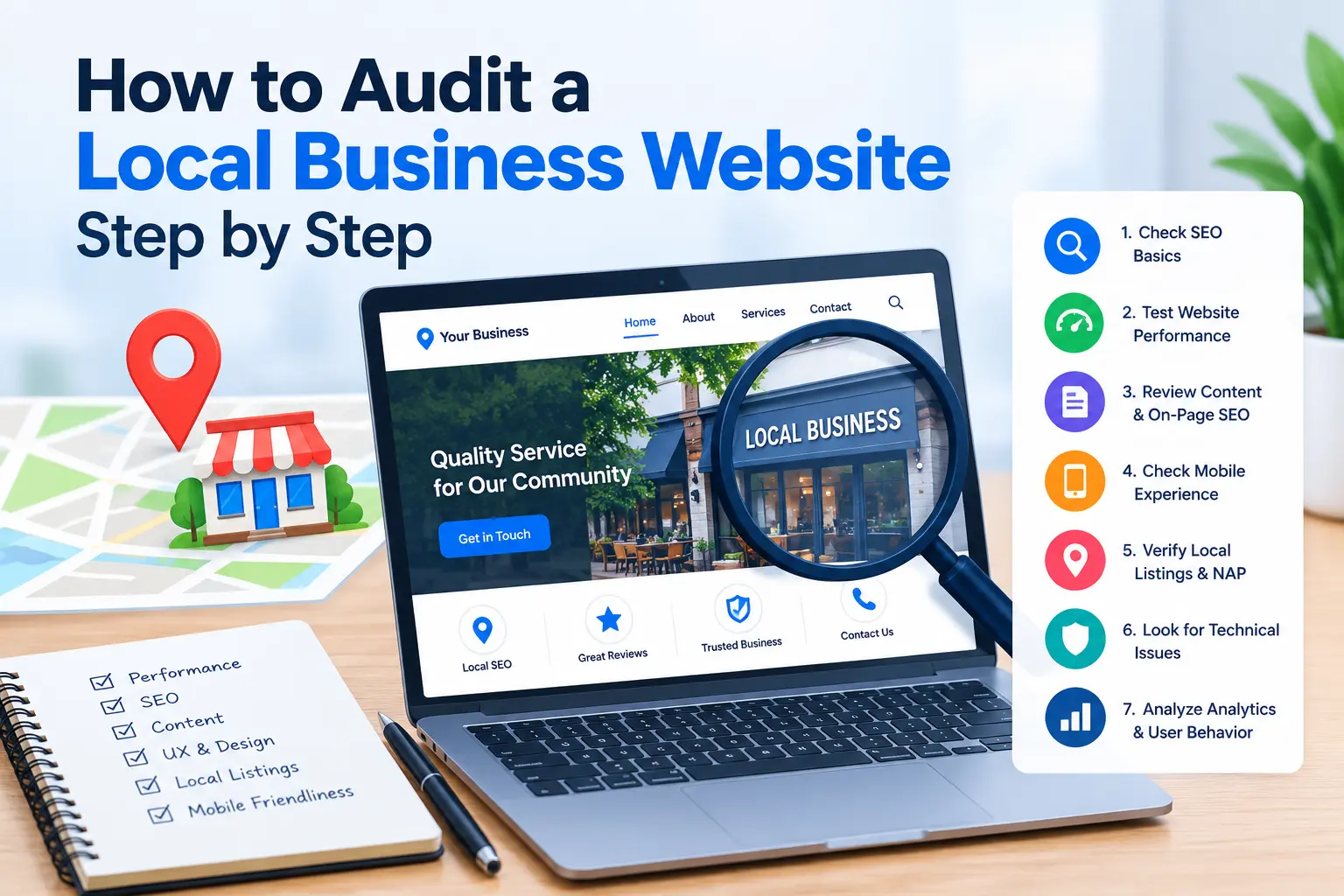
If your local business website has stopped bringing in calls, form fills, or foot traffic the way it used to, the fastest way to find out why is to run a local SEO audit. A local SEO audit is a structured review of every factor that affects how a business ranks in local search results and the Google Maps pack — from your Google Business Profile to your website’s technical health. Instead of guessing what’s wrong, a proper review gives you a prioritized list of fixes based on real data.
This guide walks you through a complete, step-by-step local SEO audit process that you can run on your own website, or on a client’s website if you manage local SEO for a living. By the end, you’ll know exactly how to structure the process, what to check at every stage, and how to turn your findings into an action plan that actually moves rankings.
If you want a broader foundation first, our complete local SEO guide for small businesses covers the basics before you dive into the audit itself. And if you’re auditing a service-area business specifically, pair this with our local SEO checklist for a quick-reference version of everything below.
What Is a Local SEO Audit?
A local SEO audit is a full diagnostic review of the ranking signals that determine whether a local business shows up in the Google Map Pack, local organic results, and “near me” searches. Unlike a general SEO audit, which looks at a website broadly, a local SEO audit focuses specifically on location-based ranking factors: Google Business Profile optimization, NAP consistency, local citations, location-specific on-page SEO, and localized technical performance.
A thorough local SEO audit typically examines:
- Google Business Profile setup and optimization
- NAP (Name, Address, Phone) consistency across the web
- Local citations and directory listings
- Local keyword targeting and on-page SEO
- Website technical health (speed, mobile, indexing)
- Google Search Console data and crawl errors
- Backlink profile and local link building
- Online reviews and reputation signals
- Competitor local SEO performance
Running a local SEO audit isn’t a one-time task. Search algorithms change, competitors adjust their strategies, and business details shift over time, so most agencies repeat this process every three to six months to catch new issues before they hurt rankings.
Why a Local SEO Audit Matters for Service Businesses
For local service businesses — electricians, plumbers, HVAC companies, locksmiths, roofers — the local pack and Maps results drive the majority of new customer calls. A local SEO audit matters because it uncovers exactly which ranking factor is holding a business back, rather than leaving owners to guess whether the problem is their website, their citations, or their reviews.
We see this constantly when auditing industry-specific sites. An HVAC SEO audit often surfaces different issues than a locksmith SEO audit or a plumbing SEO audit, simply because search intent and competition vary by trade. That’s exactly why a structured local SEO audit process — rather than a generic checklist — produces better results.
Step 1: Audit the Google Business Profile
Google Business Profile (GBP) is usually the single biggest factor in local pack rankings, so it’s the natural starting point for any local SEO audit.
During this stage of your local SEO audit, check:
- Business name accuracy — no keyword stuffing in the name field
- Primary and secondary categories — the most specific, relevant categories available
- Business description — clear, keyword-relevant, and free of spam
- Hours of operation — accurate and updated for holidays
- Service areas — correctly configured for service-area businesses
- Photos and videos — recent, high-quality, and geo-tagged where possible
- Q&A section — monitored and answered
- Products/services list — filled out completely
- Booking or messaging features — enabled if relevant
Use our Google Business Profile checklist as a companion during this part of the local SEO audit, and cross-reference it against the Google Business Profile ranking factors that actually influence local pack placement. A profile that looks complete on the surface can still be missing category-level or attribute-level details that a full review would catch.
Step 2: Check NAP Consistency and Local Citations
The next stage of a local SEO audit looks outward, at how consistently the business’s Name, Address, and Phone number (NAP) appear across the web. Inconsistent NAP data across directories, social profiles, and citation sites confuses Google’s local algorithm and can suppress rankings even when the website itself is strong.
To audit citations properly:
- Pull a full citation report from a tool like Moz Local, BrightLocal, or Whitespark
- Compare every listing against the official NAP on the website and GBP
- Flag inconsistent, duplicate, or outdated listings
- Prioritize fixing high-authority directories first (Google, Bing, Apple Maps, Yelp, industry-specific directories)
- Build new citations on relevant, high-quality directories the business is missing from
This step of a local SEO audit is often the most time-consuming, but it’s also where a lot of “invisible” ranking issues get discovered. Our guide to local citations breaks down which directories matter most, and the local citations resource on our sister site covers citation-building tactics in more depth.
Step 3: Review Local Keyword Targeting
No local SEO audit is complete without checking whether the website is actually targeting the keywords local customers search for. A common mistake is optimizing for broad, non-local terms (“plumber”) instead of location-modified terms (“emergency plumber in [city]”) that convert better and face less competition.
During this part of the local SEO audit, review:
- Whether service pages target city, neighborhood, or region-specific keywords
- Whether title tags and H1s include location modifiers
- Whether keyword intent matches what the page actually offers
- Whether low-competition, long-tail local keywords are being missed
Our local keyword research guide walks through the process step by step, and the keyword research for local businesses resource pairs well with it. If you’re specifically hunting for easier-to-rank opportunities, our post on low-competition keywords is worth reviewing alongside this stage of the local SEO audit.
Step 4: Run an On-Page SEO Audit
Once keyword targeting is confirmed, the local SEO audit moves to on-page elements — the parts of the website that tell both users and Google what each page is about and where it serves customers.
Check the following on every key page:
- Title tags — unique, keyword-relevant, with location included where appropriate
- Meta descriptions — compelling, under 160 characters, include a call to action
- H1 and header structure — logical hierarchy, one H1 per page
- Service page content depth — enough unique content to satisfy search intent
- Internal linking — service pages linked from the homepage and relevant blog content
- Image alt text — descriptive, includes relevant local context where natural
- Schema markup — LocalBusiness schema implemented correctly
Service pages deserve special attention in a local SEO audit because they’re usually the pages that convert visitors into leads. Our guide to SEO for service pages covers exactly what a strong service page needs, and the local business schema guide explains the structured data piece in detail. For a broader on-page framework, the on-page SEO checklist is a solid companion resource.
Step 5: Perform a Technical SEO Audit
Technical issues can quietly undermine every other effort, which is why technical health gets its own dedicated stage in a local SEO audit. A site that’s slow, poorly indexed, or broken on mobile will struggle to rank no matter how strong its content or citations are.
Technical checks to run as part of a local SEO audit include:
- Core Web Vitals — LCP, INP, and CLS scores across key pages
- Mobile usability — since most local searches happen on mobile devices
- Site speed — server response time, image optimization, caching
- Crawlability — robots.txt and XML sitemap configuration
- Indexing status — confirming important pages are indexed, not excluded
- HTTPS and security — valid SSL, no mixed-content warnings
- Broken links and 404 errors — cleaned up or redirected properly
Our Core Web Vitals guide and website speed for SEO post go deeper into performance fixes, while the technical SEO checklist from our sister site rounds out this stage of the local SEO audit with 25 additional technical items worth checking.
Step 6: Review Google Search Console Data
Google Search Console (GSC) is one of the most underused tools in a local SEO audit, yet it contains direct data from Google about how the website is actually performing — impressions, clicks, average position, and indexing issues.
During this stage of the local SEO audit, review:
- Performance report — which queries and pages drive impressions and clicks
- Coverage/indexing report — pages excluded, errors, or warnings
- Core Web Vitals report — field data straight from real users
- Mobile usability report — mobile-specific errors
- Manual actions — any penalties that need addressing
Our breakdown of the Google Search Console performance report explains how to read this data correctly, and our post on Search Console indexing covers common indexing problems local businesses run into. For a step-by-step walkthrough, how to use Google Search Console is a helpful companion resource for this part of the local SEO audit.
Step 7: Audit the Backlink Profile and Local Link Building
Backlinks remain a strong ranking factor, and a local SEO audit should always include a review of the site’s link profile — both the quality of existing backlinks and the opportunities being missed for local link building.
In this stage of the local SEO audit, look at:
- Total referring domains and their authority
- Toxic or spammy backlinks that may need disavowing
- Local link opportunities: chambers of commerce, local news, sponsorships, industry associations
- Competitor backlinks the business hasn’t earned yet
Our guide to local link building covers strategies specific to service-area businesses, and the link building and link building techniques posts round out the broader picture. On the external side, link building strategies offers additional tactics worth cross-referencing during this stage of the local SEO audit.
Step 8: Audit Reviews and Reputation Signals
Review signals — quantity, recency, rating, and response rate — directly influence local pack rankings, which makes them a required checkpoint in any local SEO audit. A business with dozens of recent, well-responded-to reviews will consistently outrank a competitor with a thin or stale review profile, all else being equal.
Check the following during this part of the local SEO audit:
- Total review count compared to top local competitors
- Average star rating and any recent negative trends
- Review recency — are new reviews coming in consistently?
- Owner response rate and response quality
- Reviews on secondary platforms (Facebook, Yelp, industry-specific sites)
If review volume is low, our guide on how to get more Google reviews outlines practical, compliant ways to build this up as a direct follow-on action from your local SEO audit.
Step 9: Benchmark Against Local Competitors
A local SEO audit isn’t complete in isolation — it needs context. Pull up the businesses currently ranking above yours in the map pack and local organic results, and compare their GBP completeness, review counts, citation volume, backlink profile, and on-page optimization against your own findings.
This competitive layer often reveals the real gap: sometimes a website is technically solid but simply outranked by competitors with stronger review velocity or more local citations. Understanding the difference between local SEO and traditional SEO helps frame this comparison correctly, since ranking factors and competitive benchmarks differ between the two.
Pick three to five direct competitors who consistently appear in the map pack for your target keywords, and build a simple side-by-side comparison table. Note their GBP category selection, approximate review count and rating, whether their site loads quickly on mobile, how many unique service pages they’ve built, and roughly how many citations they hold on major directories. Patterns tend to jump out quickly — maybe every competitor above you has fifty or more reviews while you have a dozen, or maybe they all have dedicated pages for each neighborhood they serve while your site has one generic service page. Those patterns should shape which fixes get prioritized first, since matching or beating the specific factors driving competitor rankings usually moves the needle faster than working through a generic checklist in order.
Common Issues a Local SEO Audit Uncovers
After running dozens of these audits across different trades, a few issues show up again and again:
- Incomplete or miscategorized Google Business Profiles
- Inconsistent NAP data across major directories
- Thin or duplicate service page content
- Missing or broken LocalBusiness schema
- Slow-loading pages that hurt Core Web Vitals
- Few or no location-specific keywords on service pages
- Stagnant review growth
- Weak or nonexistent local link building
Our post on common SEO mistakes covers several of these in more detail, and if a Google Business Profile has been suspended entirely, our guide on Google Business Profile suspensions explains why it happens and how to recover — a scenario every local SEO audit should watch for.
Building a Local SEO Audit Checklist
To keep this process repeatable, it helps to work from a standing checklist rather than starting from scratch each time. At minimum, your local SEO audit checklist should include sections for:
- Google Business Profile
- NAP consistency and citations
- Local keyword targeting
- On-page SEO and schema
- Technical performance
- Search Console data
- Backlinks and local link building
- Reviews and reputation
- Competitor benchmarking
For a ready-made version of this, our local SEO audit guide for 2026 and SEO audit checklist give you a downloadable starting point so every review follows the same consistent process.
Tools to Use During a Local SEO Audit
Running a thorough local SEO audit by hand is possible, but the right tools speed up every stage and catch issues manual review can miss. A practical toolkit typically includes:
- Google Business Profile Insights — built-in performance data straight from Google, showing how customers find and interact with the listing
- Google Search Console — impressions, clicks, indexing status, and Core Web Vitals field data
- Google PageSpeed Insights or GTmetrix — detailed speed and Core Web Vitals diagnostics for individual pages
- Screaming Frog or Sitebulb — crawls the entire site to surface broken links, duplicate titles, missing alt text, and indexing issues
- BrightLocal, Moz Local, or Whitespark — citation tracking, rank tracking, and review monitoring built specifically for local businesses
- Ahrefs or SEMrush — backlink analysis, competitor research, and keyword gap reports
None of these tools replace the judgment a trained eye brings to the process, but together they turn a slow manual review into a repeatable system. Most agencies build a standard workflow around two or three of these tools so every audit follows the same steps and nothing gets skipped between visits.
Budget matters too. A solo owner checking their own single-location business can get most of the way there with free tools alone — Google Business Profile Insights, Search Console, and PageSpeed Insights cover the essentials without any subscription cost. Agencies managing dozens of client sites, on the other hand, usually find the time saved by paid platforms like BrightLocal or Ahrefs pays for itself quickly once citation tracking and competitor monitoring are factored in across every account.
Auditing Multi-Location and Service-Area Businesses
Multi-location businesses add an extra layer of complexity, since every location effectively needs its own mini-review within the larger process. Each location page should have its own optimized Google Business Profile, unique on-page content, and location-specific citations — duplicating a single template across locations is one of the fastest ways to trigger ranking suppression or even profile suspension.
For service-area businesses without a public storefront, the review shifts slightly: instead of verifying a physical address on every page, focus on whether service-area settings are configured correctly in Google Business Profile, whether each service area has genuinely unique supporting content, and whether citations reflect the service radius accurately rather than a single fixed location. Skipping this distinction is a common reason otherwise solid businesses underperform in the areas they serve. Reviewing each location or service area individually, rather than treating the business as a single entity, is one of the more overlooked parts of a proper evaluation — and it’s exactly what separates a surface-level check from a genuine local SEO audit.
Frequently Asked Questions
How long does a local SEO audit take? For a single-location business, a thorough review typically takes anywhere from four to ten hours depending on site size and how many citation sources need checking. Multi-location businesses take proportionally longer, since each location needs its own mini-review within the audit.
Can I run a local SEO audit myself, or do I need an agency? Small business owners with some technical comfort can absolutely run a basic version using free tools like Google Business Profile Insights and Search Console. Larger sites, competitive markets, or businesses that have already tried DIY fixes without success usually see faster results working with someone experienced in this kind of audit.
What’s the difference between a local SEO audit and a general SEO audit? A general SEO audit looks at overall site health and organic visibility. A local SEO audit adds a location-specific layer — Google Business Profile, NAP consistency, citations, and map pack rankings — that a generic review often overlooks entirely.
Do I need to redo the whole audit every time, or just check a few things? A full review every three to six months is ideal, but lighter monthly check-ins on reviews, Google Business Profile activity, and Search Console performance help catch problems between full audits without redoing every step from scratch.
How Often Should You Run a Local SEO Audit?
Most local businesses benefit from a full local SEO audit every three to six months, with lighter monthly check-ins on Google Business Profile activity, review growth, and Search Console performance. Businesses in highly competitive markets — or those recovering from a ranking drop — should run this review more frequently, since small issues compound quickly in competitive local pack rankings.
If you’ve recently changed your website structure, migrated domains, rebranded, or expanded into new service areas, run a fresh audit immediately rather than waiting for the next scheduled review. Structural changes are one of the most common triggers for ranking drops that a timely local SEO audit can catch before they cause lasting damage.
Turning Local SEO Audit Findings Into an Action Plan
A local SEO audit is only useful if its findings turn into prioritized action. Once you’ve completed each stage above, organize issues into three tiers:
- High priority — issues directly suppressing rankings (GBP suspension, NAP chaos, missing indexing)
- Medium priority — issues limiting growth (thin content, weak schema, slow pages)
- Low priority — polish items (minor copy tweaks, additional photos, small schema enhancements)
Work through high-priority items first, then revisit the findings every 60–90 days to track progress and catch anything new. For businesses ranking well already, use the audit as a growth tool — pushing into Google Maps SEO refinements and expanded local keyword coverage once the core issues are resolved. If you’re also curious how AI is reshaping search, it’s worth factoring that context into how you prioritize longer-term action items too.
Documenting and Reporting Your Findings
The final piece often gets skipped: writing up what you found in a way that’s easy to act on later. A good report doesn’t need to be fancy — a shared spreadsheet or a simple document works fine — but it should capture the current state of each ranking factor, the specific issue identified, the recommended fix, and who’s responsible for making the change.
This matters more than it sounds. Six months from now, when you sit down to review progress, you want to be able to compare current numbers against a documented baseline rather than relying on memory. Screenshot key metrics — Google Business Profile insights, Search Console impressions, current citation count, review totals — before you start making changes. That baseline becomes the yardstick for proving the work paid off, whether you’re reporting to a client or just tracking your own progress over time.
If you manage several locations or client sites, standardizing this report format across every one of them makes future comparisons much faster, and it turns what could be a one-off exercise into a genuinely repeatable system your whole team can follow.
Final Thoughts
A local SEO audit is the fastest way to understand exactly why a local business isn’t showing up where it should — and exactly what to fix first. By working through Google Business Profile optimization, citation consistency, local keyword targeting, on-page and technical SEO, Search Console data, backlinks, reviews, and competitor benchmarking, you get a complete picture instead of a guess.
Treat your local SEO audit as a recurring process rather than a one-time project, and pair it with the checklists and guides linked throughout this post to turn every finding into a concrete improvement. Businesses that audit consistently — and act on what the audit finds — are the ones that stay ahead in local search.
