
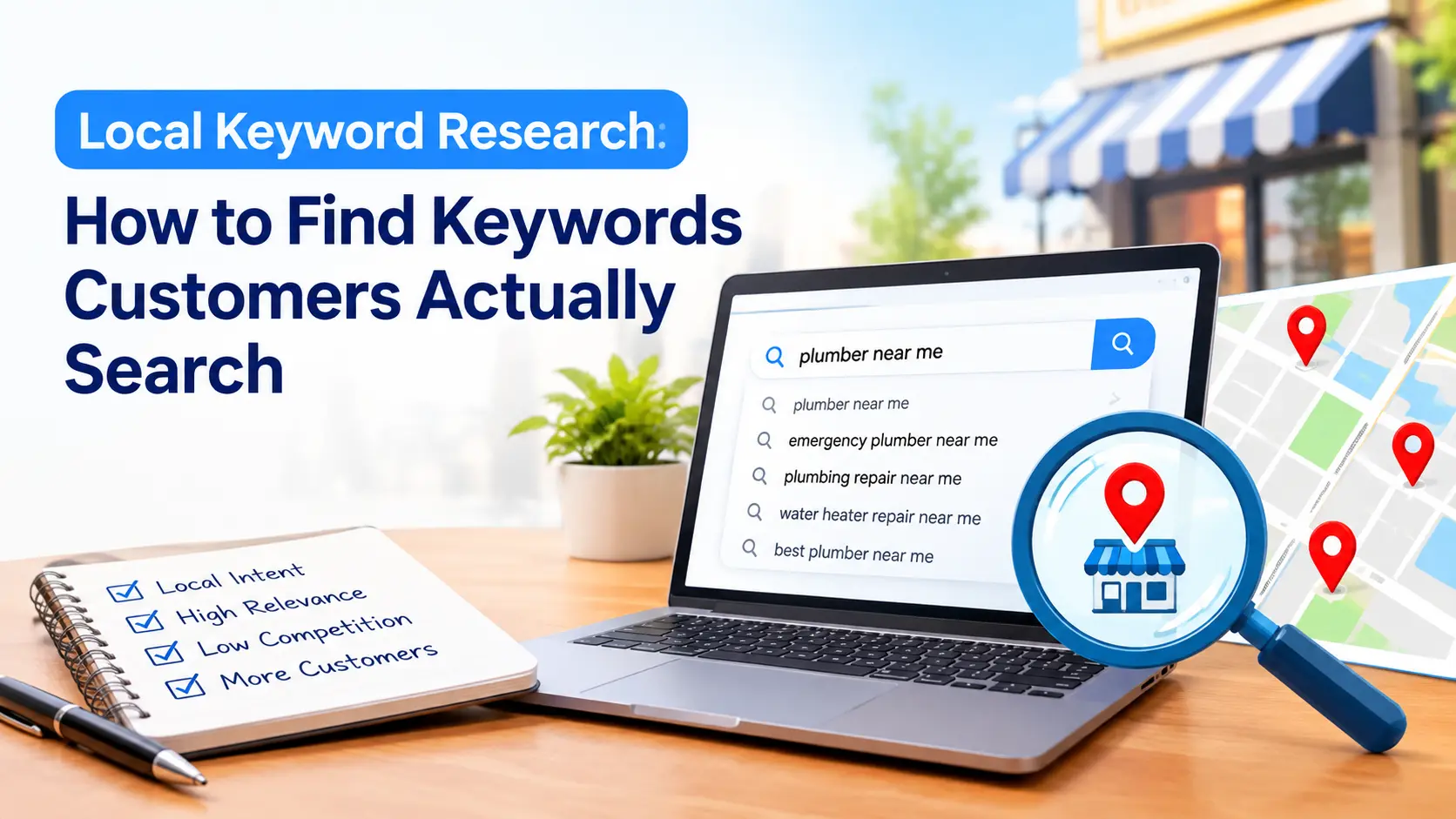
If you run a service business and your website isn’t showing up when nearby customers search for help, the problem almost always starts in the same place: local keyword research. You can have a beautifully designed site, fast load times, and glowing reviews, but if you’re not targeting the exact phrases your customers type into Google before they call you, none of that matters. This process connects what people in your city are actually searching for with the pages on your website that can answer them.
This guide walks through what local keyword research is, why it’s different from generic keyword research, and exactly how to do it — step by step — so you can build a content and SEO plan around terms that bring in real leads, not just traffic. By the end, you’ll have a repeatable framework you can run for every service you offer and every city you serve.
What Is Local Keyword Research?
Local keyword research is the process of finding and analyzing the search terms people use when they’re looking for products or services in a specific city, town, or service area. Instead of chasing broad, national keywords, this approach focuses on phrases that combine a service with a location — think “emergency plumber Dallas” or “AC repair near me” — because those are the searches that actually convert into calls, form fills, and booked jobs.
Unlike general SEO, which might target informational or nationwide commercial terms, local keyword research is built around intent tied to geography. A homeowner searching “roof leak repair Austin TX” isn’t browsing — they’re ready to hire someone today. That’s why this practice is the foundation of every effective local SEO strategy, and it’s the step most small business websites skip or do poorly.
If you want a broader view of how local search fits into your overall strategy, our local SEO vs SEO breakdown explains where local keyword research sits inside the bigger picture, and how it differs from the wider discipline of search engine optimization as a whole.
Why Local Keyword Research Matters for Service Businesses
Every trade and local service business — electricians, HVAC technicians, plumbers, locksmiths, appliance repair companies, roofers — competes in a market where customers search with urgency and specificity. Local keyword research matters because it tells you exactly what language your prospective customers use, which pages you need to build, and which gaps your competitors haven’t filled yet.
Here’s what a proper local keyword research process gives you that guesswork can’t:
- Higher-intent traffic. This process surfaces phrases from people ready to hire, not just people reading articles for general information.
- A content roadmap. Once you know the terms customers use, you know exactly which service pages and blog posts to create, and in what order.
- Better Google Business Profile visibility. The findings inform the categories, services, and posts you add to your profile, which directly affects your map pack rankings.
- Lower competition opportunities. This kind of research often reveals long-tail, low-competition keywords that national competitors ignore because they’re too specific to be worth their time.
- Stronger conversion rates. Because the traffic you attract is searching near you with an immediate need, it converts at a much higher rate than generic informational traffic.
Skip local keyword research and you’re essentially guessing at what to write, hoping the right customers stumble onto your site. Do it properly, and every page you publish has a clear purpose tied to real, measurable search demand.
Local Keyword Research vs. Regular Keyword Research
It helps to understand exactly how local keyword research differs from standard keyword research, because the tools and thought process shift once location enters the equation.
Regular keyword research typically asks: “What are people searching for related to this topic?” A local approach asks a more specific question: “What are people in this city, searching for this service, typing into Google right now?” That distinction changes everything about how you approach the rest of the process.
With local keyword research, you’re not just looking at search volume — you’re layering in several extra dimensions:
- Geographic modifiers — city names, neighborhoods, “near me,” zip codes
- Local intent signals — words like “emergency,” “same day,” “24 hour,” “local”
- Map pack behavior — how people search when they want to see options on a map versus a list of articles to read
- Service-area language — how customers describe your service in their own words, which may differ from the industry terminology you use internally
A national keyword research project might target “best coffee makers.” A local one for a coffee shop would instead target “coffee shop open now near [neighborhood].” The volume is smaller, but the intent is dramatically higher — which is the entire point of researching keywords tied to a physical service area rather than a nationwide audience.
Types of Local Keywords to Target
Before diving into the process, it helps to understand the categories of terms that thorough local keyword research typically uncovers. Most efforts turn up five main types of keywords.
1. Service + City Keywords
These are the backbone of local keyword research: “[service] + [city]” combinations like “electrician Phoenix” or “HVAC repair Tampa.” These keywords tend to have clear commercial intent and are usually the primary target for your homepage or main service pages.
2. “Near Me” Keywords
“Near me” searches have exploded over the past several years, and any local keyword research process needs to account for them specifically. Google interprets “plumber near me” using the searcher’s actual location, so ranking for these terms depends heavily on your Google Business Profile and on-page local signals — something we cover in depth in our Google Business Profile checklist.
3. Service + Neighborhood or Suburb Keywords
This research shouldn’t stop at the city level. Breaking searches down by neighborhood or suburb — “appliance repair near [neighborhood]” — often reveals lower-competition, highly specific opportunities that a citywide page won’t fully capture on its own.
4. Long-Tail Local Keywords
These are longer, more descriptive phrases such as “how much does emergency locksmith cost in [city]” or “best rated roofing company near [zip code].” Long-tail terms are a critical part of local keyword research because they’re easier to rank for and often signal a searcher who is very close to making a decision.
5. Voice and Conversational Local Keywords
With voice search growing, this research increasingly needs to account for conversational phrasing like “who’s the best HVAC company near me” or “where can I find a locksmith open right now.” These keywords tend to mirror natural speech more closely than typed queries do.

How to Do Local Keyword Research: A Step-by-Step Process
Now let’s get into the actual process. This is the exact framework we use when doing local keyword research for trade and service business clients, from a brand-new site to an established one that needs a refresh.
Step 1: Start With Your Core Services
Before any tool comes into play, list every individual service you offer. A generic “HVAC” business page misses a huge amount of potential compared to separate pages for “AC installation,” “furnace repair,” “duct cleaning,” and “AC repair.” Local keyword research works best when it starts from a granular service list, because each service represents its own keyword cluster.
Step 2: Layer In Your Service Areas
Next, list every city, town, and neighborhood you actually serve. This is the geographic half of the process. Combine each service from Step 1 with each location from this list to generate your first round of seed keywords — “furnace repair Denver,” “furnace repair Aurora,” and so on.
Step 3: Use Google’s Own Suggestions
Google autosuggest and the “People also ask” and “related searches” sections are free, high-value sources for local keyword research. Type your service and city combination into Google and note what autocompletes. These suggestions come directly from real search behavior, making them one of the most reliable free tools available.
Step 4: Mine Google Business Profile Insights
If you already have an active Google Business Profile, the search terms report is a goldmine for local keyword research. It shows you the exact queries that led customers to your profile — data you can’t get anywhere else. Pair this with the guidance in our Google Maps SEO optimization guide to turn those insights into map pack rankings, and see our Google Maps SEO resource for the ranking side of the equation.
Step 5: Check Google Search Console
For an existing website, Google Search Console shows which queries are already driving impressions and clicks. This is one of the most underused resources in local keyword research because it reveals keywords you’re already ranking for on page two or three — often the easiest wins to push onto page one. Our Google Search Console guide walks through how to pull and interpret this data yourself.
Step 6: Analyze Competitors Ranking in the Map Pack
Search your core service and city terms and look at who ranks in the local map pack. Visit their websites and note the service pages, headlines, and FAQ sections they’ve built. This kind of competitive analysis is a core part of local keyword research because it shows you what Google already considers relevant for that search — and where the content gaps are that you can fill better than they have.
Step 7: Use Keyword Research Tools to Validate Volume and Difficulty
Free and paid tools — Google Keyword Planner, Ubersuggest, Ahrefs, SEMrush, and similar platforms — let you check estimated search volume and difficulty for the terms you’ve gathered. This step turns your raw list into a prioritized, data-backed plan. Don’t discard low-volume local terms too quickly, though; a keyword with 20 monthly searches can still be worth targeting if it converts well and has almost no competition.
Step 8: Mine Customer Language From Reviews and Calls
One of the most overlooked sources in local keyword research is your own customer interactions. Read through your Google reviews, listen to call recordings, and check support tickets for the exact phrases customers use to describe their problem. Tools alone tend to miss this — real customers rarely talk like SEO software does.
Step 9: Group Keywords Into Topic Clusters
Once your list is built, group related terms into clusters by service and intent. This clustering step determines your site structure: each cluster typically becomes its own service page, supported by blog content that targets related long-tail variations uncovered during your research.
Step 10: Map Keywords to Pages
Finally, assign each cluster from your local keyword research to a specific page — existing or new. Avoid targeting the same keyword on multiple pages, which creates internal competition. A clear map between your keyword findings and your site’s pages keeps your on-page SEO focused and avoids diluting your rankings across near-duplicate content.
Best Tools for Local Keyword Research
While the process matters more than any single tool, here are the resources most commonly used:
- Google Search (autosuggest, People Also Ask, related searches) — free and always current
- Google Business Profile Insights — direct search term data from your own profile
- Google Search Console — shows real queries already driving impressions to your site
- Google Keyword Planner — volume estimates, though local-level data can be broad
- Ahrefs / SEMrush / Ubersuggest — deeper volume, difficulty, and competitor keyword data
- AnswerThePublic — useful for uncovering question-based, conversational opportunities
- Local competitor websites — free insight into which terms Google already associates with your service and area
No single tool covers everything on its own. An effective local keyword research process usually blends free Google-native sources with at least one paid tool for volume validation, then cross-checks the results against real customer language.
Common Local Keyword Research Mistakes to Avoid
After reviewing hundreds of local service websites, the same mistakes show up again and again in how businesses approach local keyword research:
- Targeting only city-level keywords and ignoring neighborhoods. This limits how much of your service area you can realistically rank for.
- Ignoring “near me” searches because they lack a location name. Any thorough local keyword research process needs to account for these even though they don’t literally contain a city.
- Copying competitor keyword lists without validating local demand. What works in one city may not reflect actual search behavior in yours.
- Skipping long-tail terms because the volume looks small. Low volume plus low competition plus high intent often outperforms a high-volume term you’ll never realistically rank for.
- Doing the research once and never revisiting it. Search behavior shifts, new neighborhoods develop, and your service area may expand, so local keyword research should be revisited every few months.
- Not using the data to inform Google Business Profile categories and services. Your findings should shape your GBP listing as much as they shape your website.
- Stuffing keywords unnaturally into content. Even with a target keyword count in mind, the content built from local keyword research should still read naturally to a human visitor first and a search engine second.
If you’re auditing an existing site, our local SEO checklist and SEO mistakes guide pair well with fixing gaps your keyword research uncovers.
How to Use Local Keyword Research Results
Finding the keywords is only half the job. Here’s how to actually put the results of your local keyword research to work across your site.
Build Dedicated Service + Location Pages
Every meaningful cluster from your research should become its own page rather than being crammed into a single generic service page. A roofing company serving five cities benefits from five focused location pages instead of one page trying to rank everywhere at once — a strategy covered further in our roofing SEO guide.
Optimize Titles, Headers, and Meta Descriptions
Use the exact phrases uncovered in your local keyword research inside your page titles, H1s, and meta descriptions. Search engines and searchers both respond to seeing their exact query reflected back at them in the results and on the page itself.
Feed Your Google Business Profile
Add the services and categories your research identified directly to your Google Business Profile, and reference those same terms in your GBP posts and Q&A section for extra map pack relevance.
Build Local Citations With Consistent Language
Your local citations across directories should use the same service descriptions your local keyword research surfaced, reinforcing topical relevance across the web, not just on your own site.
Create Supporting Blog Content
Long-tail and question-based terms from your local keyword research make excellent blog topics that funnel readers toward your service pages. This is also where internal linking between related posts and service pages compounds your rankings over time, and where a broader SEO strategy ties everything together.
Track and Refine
Once pages are live, monitor rankings and impressions in Google Search Console. This isn’t a one-time task — the data you gather post-launch feeds the next round of local keyword research and content decisions, closing the loop between what you publish and what actually ranks.
Local Keyword Research by Industry
Different trades search differently, and local keyword research should reflect that. A few examples:
- Electricians: Research for electrical contractors often surfaces urgent terms like “electrician near me now” alongside project-based searches like “panel upgrade cost [city].” See our electrician SEO guide for more.
- HVAC: Seasonal patterns matter heavily here — local keyword research for HVAC companies should account for spikes in “AC repair” searches in summer and “furnace repair” in winter. Our HVAC SEO resource covers this in detail.
- Locksmiths: Emergency intent dominates. Research for locksmiths typically centers on “locked out,” “car key replacement,” and “emergency locksmith” combined with location, as detailed in our locksmith SEO guide.
- Plumbers: Local keyword research for plumbing businesses often splits between emergency terms (“burst pipe repair near me”) and planned-project terms (“water heater installation cost [city]”) — explored further in our plumbing SEO guide.
- Appliance repair: Brand and appliance type both matter here, so research should include combinations like “refrigerator repair [city]” and “[brand] appliance repair near me,” covered in our appliance repair SEO guide.
Across every one of these industries, the underlying local keyword research process stays the same — only the specific terms, seasonal patterns, and urgency signals change from trade to trade.
Local Keyword Research and Your Broader SEO Strategy
Local keyword research shouldn’t happen in isolation. It should feed directly into your overall SEO strategy, your site’s technical SEO foundation, and your broader local SEO guide for small businesses planning. Treat it as the starting input for every content and optimization decision, not a box you check once and forget about for a year.
For businesses just getting oriented with the basics before diving into local keyword research, Iffaris’s overview of how SEO works is a useful primer, and their local SEO guide covers how this research connects to ranking factors beyond just keywords, like reviews, citations, and on-page trust signals.
A Simple Local Keyword Research Example
To see how this comes together, imagine a mid-sized plumbing company serving three cities. Their local keyword research process might look like this: they start with a service list (drain cleaning, water heater repair, leak detection, emergency plumbing), cross it with their three cities, then pull suggestions from Google autosuggest and their Google Business Profile search terms report. Within a day, they typically have a working list of 60 to 100 keyword variations.
From there, they group the list into clusters — one cluster per service, with city variations nested underneath — and map each cluster to either an existing page or a new one that needs to be built. The long-tail, question-based terms that don’t fit neatly into a service page become blog posts that link back to the relevant service page, spreading authority across the site instead of concentrating it all on the homepage. That’s the practical output of a well-run local keyword research process: a clear, prioritized to-do list instead of a vague sense that “we should probably do more SEO.”
Seasonal and Timing Considerations
Search behavior for local service businesses isn’t static throughout the year, and this is a factor many businesses forget to build into their keyword planning. Demand for HVAC-related searches shifts dramatically between summer and winter, roofing searches spike after storms, and appliance repair queries often climb around major holidays when ovens and refrigerators get heavier use. Reviewing search volume trends over a full 12-month cycle, rather than a single snapshot, gives you a much more accurate picture of when to publish new pages, refresh existing ones, and increase your Google Business Profile posting frequency.
It’s also worth checking whether certain neighborhoods or suburbs show different seasonal patterns than your city as a whole. A coastal suburb might see storm-related searches spike earlier than an inland neighborhood in the same metro area, for example. Building this timing layer into your planning process helps you get ahead of demand instead of reacting to it after competitors have already captured the traffic.
How Long Does It Take to See Results?
This is one of the most common questions business owners ask once their keyword list is built and pages start going live. Realistically, expect three to six months before new or optimized pages start climbing meaningfully in the map pack and organic results, though some low-competition, highly specific terms can rank within a few weeks. Established sites with existing authority tend to see faster movement than brand-new domains. The key is consistency: publishing and refining pages on a steady schedule, rather than launching a burst of content once and going quiet, tends to produce far better long-term results.
Frequently Asked Questions About Local Keyword Research
How often should I do local keyword research? Revisit it every three to six months, or whenever you add a new service or expand into a new service area. Search behavior and competition both shift over time, and last year’s list can quickly go stale.
Do I need paid tools for local keyword research? No. Google autosuggest, Search Console, and Google Business Profile Insights alone can carry most efforts for a small service business. Paid tools help with volume validation but aren’t strictly required to get started.
How many keywords should come out of local keyword research? There’s no fixed number, but a thorough process for a multi-service local business typically produces 50 to 150 keywords once you factor in services, locations, and long-tail variations — grouped into a much smaller number of topic clusters.
Should every keyword get its own page? No. Group closely related terms into clusters and target each cluster with one strong page rather than creating a thin page for every single keyword your local keyword research turns up.
What’s the biggest sign that local keyword research is working? An increase in phone calls, form submissions, and map pack visibility for your target cities — not just an increase in overall traffic. This process is about intent and conversion, not raw volume for its own sake.
Final Thoughts
Local keyword research is the single highest-leverage activity you can do before writing another page of content or spending another dollar on local SEO. It tells you exactly what your customers are searching for, in their own words, in your specific service area — and it removes the guesswork from deciding what to build next. Whether you’re just starting out or auditing an existing site, treat local keyword research as an ongoing habit rather than a one-time project, and let the data guide your service pages, your Google Business Profile, and your content calendar. Businesses that take this process seriously consistently outrank competitors who are still targeting generic, non-local terms — and that gap only grows over time.
