
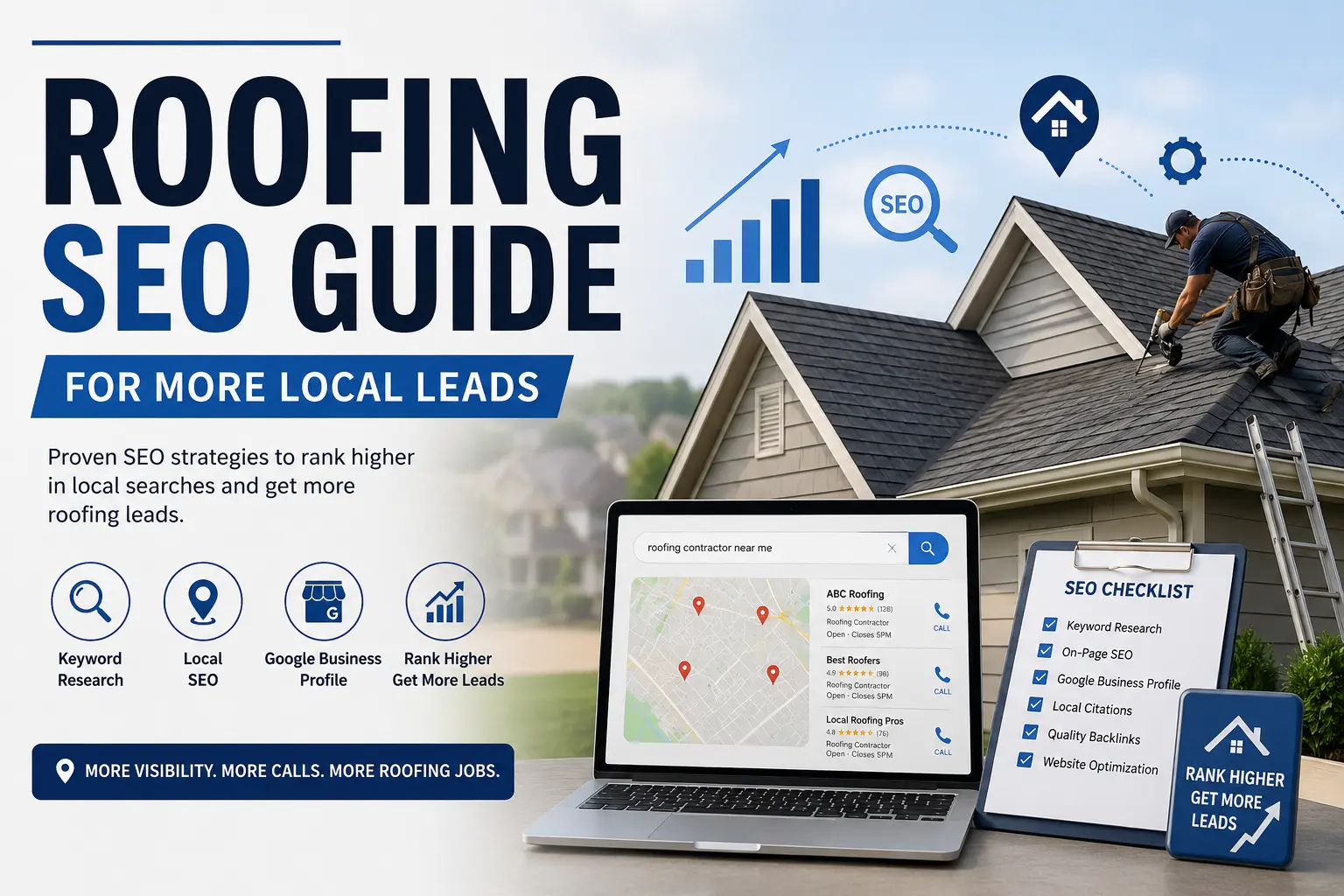
Every roofing company depends on one thing more than any other marketing channel: being found by homeowners at the exact moment they need a roof repaired, replaced, or inspected. That’s where roofing SEO comes in — the process of optimizing your website, Google Business Profile, and online content so your roofing company shows up when local homeowners search for terms like “roof repair near me” or “roofing contractor in [city].”
Unlike national brands that can rely on paid ads and brand recognition, most roofing businesses win or lose customers based on local visibility. A homeowner with a leaking roof rarely scrolls to page two of Google — they call one of the first three companies they see. This is exactly why roofing SEO has become one of the highest-ROI marketing investments available to contractors today, delivering a steady stream of inbound calls and quote requests without the constant cost of pay-per-click advertising.
In this guide, we’ll walk through every part of a working roofing SEO strategy — from keyword research and on-page optimization to Google Business Profile management, link building, technical SEO, and the common mistakes that quietly kill rankings. By the end, you’ll have a clear roadmap for turning your website into a lead-generation asset instead of a digital brochure nobody visits.
Why Roofing SEO Matters for Local Contractors
Roofing is a highly localized, high-intent service. Nobody searches for “roof replacement” out of curiosity — they search because they have a problem right now, whether it’s storm damage, a leak, or an aging roof that’s due for replacement. This makes roofing SEO different from SEO in less urgent industries. Your goal isn’t just to rank for broad terms; it’s to rank for the exact phrases homeowners type in during a moment of need.
There are three reasons roofing SEO consistently outperforms other channels for contractors:
- Trust before contact. Homeowners rarely hire a roofer sight unseen. Ranking organically for roofing SEO terms builds credibility before the phone even rings, because a business that appears at the top of Google feels more established than one running only ads.
- Compounding value. Unlike pay-per-click campaigns that stop generating leads the moment you stop paying, roofing SEO builds an asset. A well-optimized page can keep generating calls for years with minimal ongoing investment.
- Higher-intent traffic. Someone actively searching “emergency roof leak repair [city]” is far closer to hiring than someone scrolling social media. Roofing SEO captures this high-intent, ready-to-buy traffic at the moment it matters most.
If you’re still deciding how much of your marketing budget to shift toward organic search, it helps to understand what SEO is at a foundational level before layering roofing-specific strategy on top of it.
Keyword Research: The Foundation of Roofing SEO
Every roofing SEO campaign starts with knowing exactly what your customers type into Google. Guessing keywords is one of the fastest ways to waste months of effort on content nobody searches for. Instead, an effective approach relies on mapping keywords to real customer intent.
Roofing keywords generally fall into four categories:
- Service keywords: “roof replacement,” “roof repair,” “roof inspection,” “roof leak repair”
- Local modifiers: “roofing contractor near me,” “roofer in [city],” “[city] roof repair”
- Material or job-type keywords: “metal roof installation,” “shingle roof replacement,” “flat roof repair”
- Problem-based keywords: “roof leaking after rain,” “storm damage roof repair,” “how much does a new roof cost”
A strong roofing SEO plan blends all four categories rather than chasing only high-volume terms. Long-tail, problem-based phrases often convert better because the searcher has a specific, urgent need. This is a core principle covered in most keyword research for local businesses frameworks, and it applies directly to campaigns in this industry.
Don’t overlook low-competition, long-tail terms either. Success here doesn’t always require ranking for “roofing contractor” nationally — it requires ranking for “[your city] roofing contractor” and dozens of related variations. Reviewing a list of low competition keywords can reveal quick-win opportunities that larger competitors have ignored.
Once you’ve built your keyword list, group them by service page. Your roofing SEO strategy should map each keyword cluster to a dedicated page — one for roof repair, one for roof replacement, one for roof inspections, and one for each major city or neighborhood you serve.
On-Page SEO for Roofing Websites
On-page optimization is where roofing SEO strategy meets execution. Even the best keyword research is wasted if your pages aren’t structured to rank. Here’s what matters most for this part of the process:
Title Tags and Meta Descriptions
Every service page needs a unique title tag that includes your primary keyword and city, such as “Roof Repair in Multan | Fast, Licensed Roofing Contractors.” Meta descriptions should include a clear call to action and reinforce urgency, since roofing customers often need same-day or emergency service.
Header Structure
Use one H1 per page that matches search intent, followed by logical H2 and H3 subheadings that break down services, process, and pricing factors. This structure helps both users and search engines understand the page, which is a core tenet of solid on-page SEO practice that directly supports roofing SEO performance.
Service Area Pages
If you serve multiple towns or neighborhoods, create individual service area pages rather than one generic “areas we serve” page. Each page should have unique content describing local landmarks, common roofing issues in that area (like hail damage in certain regions), and localized testimonials. This is one of the most overlooked roofing SEO tactics — thin, duplicate service-area pages rarely rank, while unique, locally written ones consistently do.
Content Depth
Google favors pages that thoroughly answer the searcher’s question. A roof replacement page should cover cost factors, materials, timelines, warranty information, and financing options — not just a paragraph and a contact form. Comprehensive content is one of the most reliable roofing SEO levers because it satisfies search intent completely, reducing bounce rates and increasing time on page.
Internal Linking
Link your blog posts to your service pages, and link your service pages to each other where relevant. For example, a blog post about storm damage should link to your roof repair service page. This internal linking structure strengthens your roofing SEO by distributing page authority throughout your site and helping Google understand your site’s topical focus.
Google Business Profile Optimization for Roofers
For most roofing companies, the Google Business Profile (formerly Google My Business) is just as important as the website itself. Local search results almost always display a “map pack” of three businesses above organic listings, and appearing there requires dedicated roofing SEO attention on your profile.
Key optimization steps include:
- Choosing accurate primary and secondary categories (e.g., “Roofing Contractor,” “Roof Repair Contractor”)
- Adding service areas that match your actual coverage zone
- Uploading real job photos regularly, including before-and-after shots
- Keeping business hours accurate, especially for emergency availability
- Responding to every review, positive or negative
Reviews deserve special attention within a roofing SEO strategy because review volume and recency are strong local ranking signals. Learning how to get more Google reviews and building a simple post-job review request process can meaningfully move your local rankings within a few months.
It’s also worth understanding the broader Google Business Profile ranking factors that influence map pack visibility, since these factors work alongside your website’s roofing SEO to determine local search placement. For a deeper checklist-style approach, this local SEO checklist walks through profile optimization step by step.
Local Citations and NAP Consistency
Local citations — mentions of your business Name, Address, and Phone number (NAP) across directories like Yelp, Angi, HomeAdvisor, and industry-specific roofing directories — remain a meaningful part of any roofing SEO strategy. Inconsistent NAP data across the web confuses search engines and can suppress local rankings even when your website itself is well optimized.
A proper citation strategy for roofing SEO includes:
- Auditing existing citations for inconsistencies in business name, address format, or phone number
- Claiming and completing profiles on major general directories
- Building citations on roofing-specific and home-improvement directories
- Monitoring for duplicate listings that split your local ranking signals
For a full breakdown of how citation building supports local visibility, this guide on local citations covers the process in detail, and the same principles apply directly to roofing SEO citation cleanup.
Content Marketing and Blogging for Roofing SEO
Many roofing companies treat their blog as an afterthought, but a consistent content strategy is one of the most underused roofing SEO tactics available. Blog content lets you target the problem-based and informational keywords that service pages can’t naturally cover, while also building topical authority that helps your entire site rank better.
Strong blog topics for this strategy include:
- “How much does a new roof cost in [city]?”
- “Signs your roof needs replacing before winter”
- “What to do after storm damage to your roof”
- “Metal roof vs. asphalt shingles: which is right for your home?”
- “How long does a roof replacement take?”
Each blog post should link back to relevant service pages, reinforcing your site’s internal structure and giving readers a clear next step. Consistency matters more than volume — publishing one well-researched post per week will do more for your roofing SEO than publishing five thin, generic posts and then going quiet for months.
It also helps to stay current on how search behavior is evolving. Reviewing how AI and SEO intersect can inform how you structure content going forward, since AI-driven search features are increasingly summarizing informational queries before users even click through.
Link Building for Roofing Companies
Backlinks remain one of the strongest ranking signals in any SEO campaign, and roofing SEO is no exception. However, roofing companies don’t need thousands of links — they need relevant, local, and industry-appropriate ones.
Effective link building tactics for this industry include:
- Local sponsorships: Sponsoring a local sports team or community event often earns a link from the organization’s website.
- Supplier and manufacturer partnerships: Many roofing material manufacturers maintain “find a contractor” pages that link back to certified installers.
- Local news and press: Offering expert commentary on storm damage stories or home improvement trends can earn coverage and links from local news outlets.
- Guest posts on home improvement blogs: Contributing genuinely useful content to relevant blogs builds both authority and referral traffic.
For a structured approach to acquiring these links, this resource on link building techniques and this guide on how to get backlinks both offer tactics that translate well into roofing SEO campaigns specifically. General link building fundamentals also apply, since link acquisition in this space follows the same core principles as any other local service industry.
Technical SEO Considerations for Roofing Websites
Technical SEO issues can quietly cap the effectiveness of an otherwise strong roofing SEO strategy. If your site is slow, difficult to crawl, or not mobile-friendly, none of your content or link-building work will reach its full potential.
Priority technical areas to address include:
Site Speed
Roofing customers are often searching from a phone in a stressful moment — during or right after a storm. A slow-loading site loses these visitors before they even see your services. Improving website speed directly supports roofing SEO performance because Google factors page experience into rankings, and impatient users simply leave slow sites.
Core Web Vitals
Metrics like loading performance, interactivity, and visual stability all factor into how Google evaluates your site. Understanding Core Web Vitals and fixing common issues — like unoptimized images or render-blocking scripts — is a technical roofing SEO task that pays off across every page on your site.
Mobile Optimization
The majority of roofing searches happen on mobile devices. Click-to-call buttons, easy-to-tap contact forms, and fast mobile load times aren’t optional extras for roofing SEO — they’re baseline requirements.
Crawlability and Indexing
Make sure Google can actually find and index your pages. Using Search Console to monitor indexing status helps catch issues like accidentally blocked pages or broken sitemaps before they silently damage your roofing SEO results. A broader technical SEO checklist is also useful for a full-site technical audit.
Common Roofing SEO Mistakes to Avoid
Even well-intentioned roofing companies make mistakes that hold back their rankings. Here are the most common ones we see in roofing SEO audits:
- Duplicate service area pages. Copy-pasting the same content across multiple city pages and swapping the city name rarely works. Google recognizes this pattern and often won’t rank any of the pages well.
- Ignoring reviews. A trickle of old, unanswered reviews signals inactivity to both customers and Google’s local ranking algorithm.
- Neglecting mobile experience. A roofing SEO strategy built entirely around desktop performance misses how most customers actually search.
- Keyword stuffing. Repeating a keyword unnaturally throughout a page hurts readability and can trigger ranking penalties rather than helping roofing SEO performance.
- No tracking. Without call tracking or conversion tracking in place, it’s impossible to know which roofing SEO efforts are actually generating leads versus which ones just look good on paper.
Running a periodic SEO audit helps catch these issues early, before they compound into long-term ranking losses. It’s also worth reviewing general SEO mistakes that apply across industries, since many of them show up in roofing SEO audits just as often as in other local service niches.
Comparing Roofing SEO to Other Trade Industries
Roofing SEO shares many similarities with SEO strategies used by other home service trades, but there are important differences worth noting. Roofing has a stronger seasonal and storm-driven demand pattern than most trades, which means content around emergency repairs and storm damage deserves more attention than it might in, say, electrical or plumbing SEO.
That said, the underlying framework is largely the same. If you’re managing marketing for a multi-trade company, it’s worth reviewing how plumbing SEO, HVAC SEO, and electrician SEO strategies are structured, since many of the local SEO principles — Google Business Profile optimization, citation building, and service-area pages — transfer directly across trades, including roofing SEO.
Measuring Roofing SEO Success
Roofing SEO isn’t a set-it-and-forget-it project. Measuring results helps you understand what’s working and where to invest further effort. Key metrics to track include:
- Map pack rankings for your core service and city combinations
- Organic traffic to service and blog pages over time
- Call and form conversions attributed to organic search
- Keyword rankings for your target roofing SEO terms
- Google Business Profile insights, including calls, direction requests, and website clicks
Tools like Google Search Console and your Google Business Profile dashboard provide most of this data for free. Reviewing Google Search Console regularly — or learning how to use Google Search Console if you’re newer to it — will show you exactly which queries are driving traffic to your site, giving direct insight into how your roofing SEO efforts are performing month over month.
Set a quarterly review cadence rather than checking daily. Progress is gradual, and rankings can fluctuate week to week even when the overall trend is positive. Understanding how to rank on Google for local, service-based searches will help set realistic expectations for how long meaningful roofing SEO progress typically takes — usually three to six months for competitive markets.
Building a 90-Day Roofing SEO Action Plan
If you’re starting from scratch, here’s a simplified roadmap for the first 90 days of a roofing SEO campaign:
Days 1–30: Foundation Complete keyword research, optimize your Google Business Profile, fix major technical issues, and rewrite core service page content around target keywords.
Days 31–60: Expansion Build out service area pages, launch a consistent blogging schedule, clean up citation inconsistencies, and begin outreach for local backlinks.
Days 61–90: Authority Building Continue publishing content, actively request customer reviews, pursue supplier and local partnership links, and begin tracking ranking movement for your priority roofing SEO keywords.
This phased approach mirrors the structure used in most effective SEO strategy plans, adapted specifically for the urgency and seasonality that roofing businesses experience.
Seasonal and Storm-Driven Demand: A Roofing SEO Advantage
One thing that sets roofing apart from most other home service trades is how tightly demand tracks with weather events. A single hailstorm or hurricane can generate a surge of searches for “storm damage roof repair” or “emergency roof tarping” within hours. Companies that plan their roofing SEO around this seasonality — rather than treating it as an afterthought — capture a disproportionate share of that demand.
Practical steps include publishing dedicated storm-damage landing pages ahead of storm season rather than scrambling to create one after a weather event hits, keeping an emergency-service page prominently linked from your homepage, and updating your Google Business Profile posts with timely, storm-relevant information when severe weather is forecast for your area. Insurance-related content is another opportunity: many homeowners searching after a storm also want to understand the claims process, so a well-written guide on working with insurance adjusters can capture that traffic while positioning your company as the trusted local expert.
Seasonal planning also extends to routine maintenance searches. Interest in “roof inspection before winter” or “spring roof maintenance checklist” rises predictably each year, and having that content ready in advance — rather than reacting once search volume has already peaked — is a simple but often-overlooked way to stay ahead of competitors who only publish reactively.
Choosing the Right Approach for Your Business
Not every roofing company needs the same mix of tactics. A single-location residential roofer in a mid-sized city will prioritize different things than a multi-branch company covering an entire metro area or a commercial roofing specialist targeting property managers rather than homeowners. Before committing to a full campaign, it helps to honestly assess your current position: how competitive is your local market, how strong is your existing review profile, and how much content and technical work has already been done on your site.
Companies just getting started typically see the fastest returns from Google Business Profile optimization and citation cleanup, since these require less ongoing investment than content or link building but can meaningfully improve map pack visibility within weeks. More established companies with a solid profile and clean technical foundation will get more value from investing further in content depth, service-area expansion, and local link acquisition, since the easier wins have likely already been captured.
Frequently Asked Questions About Roofing SEO
How long does roofing SEO take to show results? Most roofing companies start seeing meaningful movement in rankings and calls within three to six months, though highly competitive metro markets can take longer. Early wins often come from Google Business Profile improvements and fixing technical issues, while organic content and backlinks tend to compound over a longer horizon.
How much should a roofing company budget for SEO? Budgets vary widely based on market competitiveness, but most contractors investing seriously in organic search spend somewhere between a few hundred and a few thousand dollars per month on a combination of content creation, technical fixes, and link building. The right number depends on how aggressive your growth goals are and how competitive your local market is.
Should I hire an agency or handle it in-house? Small roofing companies with limited time often benefit from working with a specialist agency familiar with home-service marketing, since local search has nuances — like storm-driven demand spikes and service-area page structure — that generic SEO advice doesn’t always address. Larger companies with marketing staff may be able to manage foundational work in-house and bring in outside help for technical audits or link building.
Is Google Ads better than SEO for roofing leads? Paid ads can generate leads quickly, especially during launch or storm season, but the cost per lead rises the longer you rely on ads alone. Organic rankings take longer to build but don’t disappear the moment you pause spending. Most successful roofing marketing strategies use both — ads for immediate volume and SEO for long-term, lower-cost lead generation.
Do I need a blog if I only serve one city? Yes. Even single-location roofing companies benefit from blog content because it targets informational and problem-based searches that service pages can’t naturally rank for, and it gives you a natural way to build internal links back to your core service pages.
Final Thoughts on Roofing SEO
Roofing SEO isn’t about chasing algorithm tricks — it’s about making sure your business shows up, looks credible, and answers the exact questions homeowners are asking when they need a roof fixed or replaced. A strong strategy combines accurate keyword targeting, well-structured service pages, an optimized Google Business Profile, consistent local citations, useful content, relevant backlinks, and a technically sound website.
None of these pieces work in isolation. A beautifully written blog post won’t help if your site is too slow to load, and a perfectly optimized Google Business Profile won’t compensate for a website with no service pages to send traffic to. Treat roofing SEO as an ongoing system rather than a one-time project, and the compounding results — more calls, more quote requests, and more jobs booked — will follow.
Whether you’re just starting to invest in organic search or refining an existing strategy, consistent, patient execution of the fundamentals covered in this guide will put your roofing company ahead of competitors who are still relying on ads alone. Roofing SEO takes time to build, but unlike paid traffic, it keeps working long after the initial investment.
