
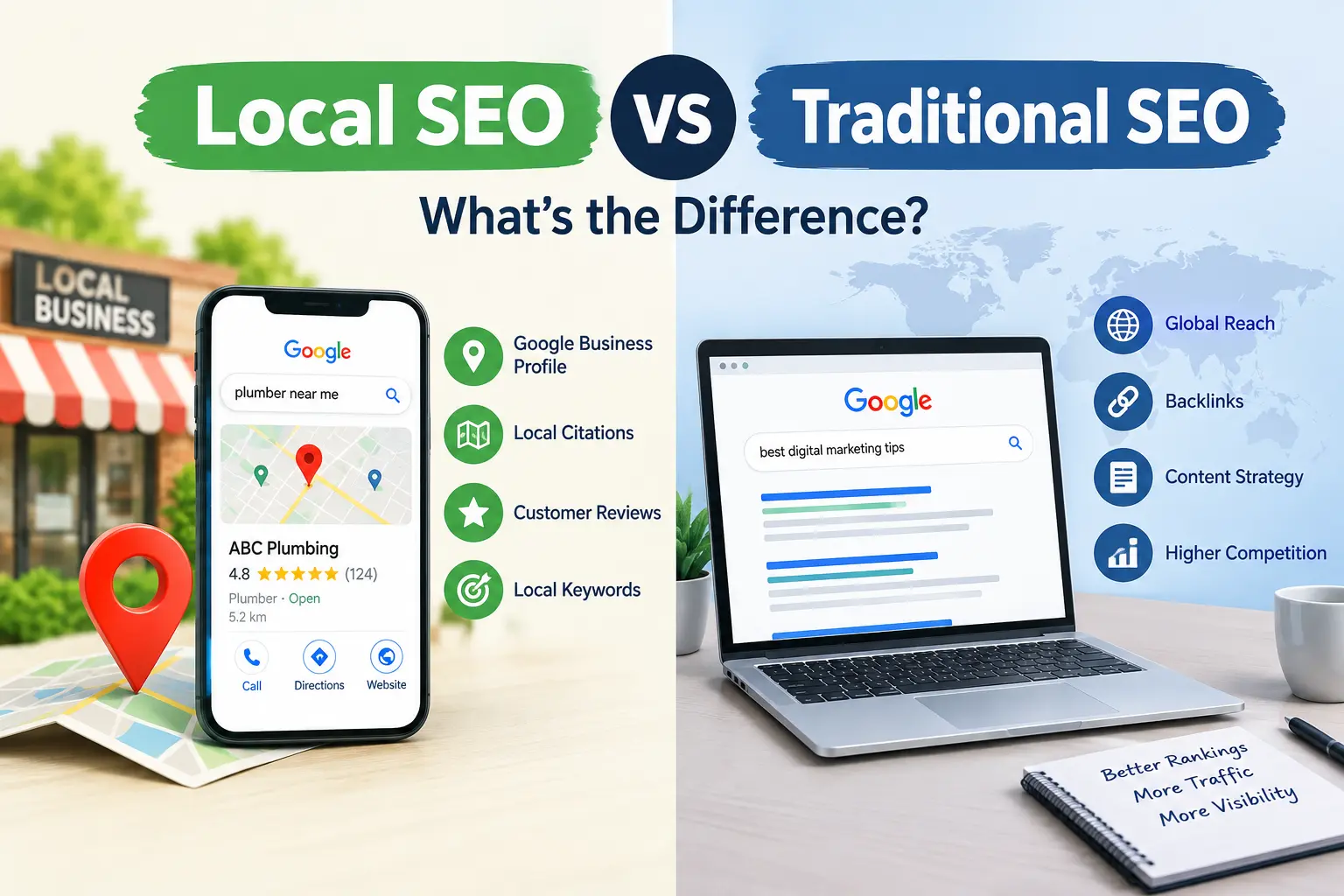
If you run a service business and you’ve spent even ten minutes researching how to get found online, you’ve probably run into the debate over local SEO vs SEO. The two terms get thrown around like they mean the same thing, but they don’t, and mixing them up can waste months of effort and budget on the wrong strategy.
This guide breaks down local SEO vs SEO in plain language: what each one actually does, where they overlap, where they completely diverge, and — most importantly — which one your business should be investing in right now. By the end, you won’t just understand the local SEO vs SEO debate in theory; you’ll know exactly how to apply it to your own website.
What Is SEO?
SEO, or search engine optimization, is the practice of improving a website so it ranks higher in search engine results for relevant keywords. Traditional SEO focuses on visibility at a national or even global scale. If you sell an ebook, run a SaaS product, or ship physical products anywhere in the country, general SEO is the discipline that gets your pages in front of searchers regardless of where they’re physically located.
Core SEO work includes keyword research, on-page SEO, technical SEO, content creation, and backlink acquisition. None of it is tied to a physical address. A well-optimized blog post about “best project management software” can rank for someone searching in Chicago or someone searching in London — location simply doesn’t factor into the equation. If you want a deeper primer on how the process works end-to-end, this guide on how SEO works is a solid starting point before you dive into the local SEO vs SEO comparison.
Traditional SEO is measured across a wide range of signals: overall domain authority, the number and quality of referring domains, page load speed, content depth, keyword coverage across an entire site, and how well internal pages link to one another to distribute relevance. Because there’s no geographic filter applied by the search engine, every website in that niche, anywhere on the planet, is a potential competitor. That scale is precisely why traditional SEO campaigns typically take longer to show results and require a steadier investment in content and outreach.
What Is Local SEO?
Local SEO is a specialized branch of search optimization built for businesses that serve customers in a specific geographic area — think electricians, plumbers, HVAC companies, locksmiths, dentists, and restaurants. Instead of competing for broad, location-agnostic keywords, local SEO targets searches like “electrician near me” or “24 hour locksmith in Dallas.”
The engine behind local SEO is Google’s local pack and Google Business Profile. When someone searches for a service “near me,” Google doesn’t just look at your website; it looks at your business listing, your reviews, your proximity to the searcher, and your local citations. This is the single biggest reason the local SEO vs SEO conversation exists at all — local SEO plays by a different set of ranking rules than the rest of the search results page.
Think about the last time you searched for a restaurant or a repair service while out and about. Google likely showed you a map with three pinned businesses before it showed you a single traditional blue link. That map — the local pack — is entirely governed by local SEO signals, and it’s often the very first thing a potential customer sees. Winning a spot there can matter more to a plumbing company’s revenue than ranking on page one for a broad, informational keyword ever would.
Local SEO vs SEO: The Core Difference
At its heart, the local SEO vs SEO debate comes down to one word: geography. Traditional SEO optimizes for relevance and authority on a national or global scale. Local SEO optimizes for relevance, authority, and proximity within a defined service area.
Here’s the simplest way to frame local SEO vs SEO: if your customer could be anywhere in the world, you need SEO. If your customer needs to be physically near you to buy from you — a plumber can’t fix a leak in another state — you need local SEO. Most local service businesses actually need both, but understanding this split is the first step to spending your marketing budget correctly.
Local SEO vs SEO: Key Ranking Factors Compared
The ranking factors are where local SEO vs SEO differences become the most obvious. Google uses different signals to decide who shows up in a local pack versus who shows up in standard organic results.
| Ranking Factor | Local SEO | Traditional SEO |
|---|---|---|
| Google Business Profile | Critical | Not a factor |
| Proximity to searcher | Major factor | Rarely relevant |
| Online reviews | Heavy weight | Minor weight |
| Local citations (NAP consistency) | Essential | Not applicable |
| Backlinks from local sites | High value | Domain authority matters more |
| Keyword targeting | “Near me,” city + service | Broad, high-volume terms |
| Content depth | Service pages by location | Long-form authority content |
| Website domain authority | Helpful, not decisive | Central to rankings |
Looking at this table, the local SEO vs SEO gap becomes clear: local SEO leans on off-site trust signals like reviews and citations, while traditional SEO leans almost entirely on content quality and backlink authority. If you want a full walkthrough of these local ranking signals, our local SEO checklist covers each one in detail.
Local SEO vs SEO: Target Audience and Search Intent
Search intent is another area where local SEO vs SEO splits sharply. Local searches carry high commercial intent paired with immediate need — someone searching “emergency plumber near me” wants a phone number in the next five minutes, not a blog post to read later.
Traditional SEO, by contrast, often captures searchers earlier in their journey. Someone searching “how does SEO work” or “what is SEO” is usually researching, not ready to buy today. That’s an important distinction in the local SEO vs SEO discussion: local SEO tends to convert faster because the searcher’s intent is already narrowed down to “I need this service, right now, close to me.”
Understanding this difference changes how you write content. Local SEO pages should answer questions like “how much does this cost in my city” and “are you open now.” Traditional SEO content should answer broader, top-of-funnel questions that build authority over time. If you’re still fuzzy on the fundamentals of intent-driven optimization, this explainer on what SEO is is a helpful companion piece to this local SEO vs SEO comparison.
Local SEO vs SEO: On-Page Optimization Differences
On-page work also diverges once you dig into local SEO vs SEO. Traditional on-page SEO focuses on keyword placement, header structure, internal linking, and content comprehensiveness for a single, universal audience.
Local on-page SEO adds a layer on top of that: city and neighborhood names in title tags, schema markup for LocalBusiness, embedded Google Maps, and dedicated location pages for every service area you cover. A national ecommerce brand doesn’t need a page for every city it ships to, but a locksmith operating across five towns absolutely needs five separate, uniquely written location pages. This is one of the most practical, day-to-day differences in the local SEO vs SEO comparison — it directly affects how many pages you build and what goes on them.
Local SEO vs SEO: The Role of Google Business Profile
No conversation about local SEO vs SEO is complete without Google Business Profile (formerly Google My Business). This free listing is arguably the single most important local SEO asset a business can control, and it has zero equivalent in traditional SEO.
An optimized profile includes accurate business hours, a complete list of services, high-quality photos, and a steady stream of new reviews. Google uses this data heavily when deciding who appears in the local three-pack. If your profile is thin or outdated, you’ll lose the local SEO vs SEO battle before your website even gets a chance to compete. We cover this in depth in our guide to Google Business Profile optimization and how to get more Google reviews.
Local SEO vs SEO: Link Building Approaches
Link building strategy is another clear dividing line in local SEO vs SEO. Traditional SEO chases high-authority backlinks from industry publications, guest posts, and digital PR campaigns that boost domain-wide authority.
Local SEO link building looks completely different. It relies on local citations, chamber of commerce listings, local news mentions, sponsorships of community events, and partnerships with nearby businesses. A single link from your city’s local newspaper can move the needle more for local rankings than a generic guest post ever would. This is a subtle but important part of the local SEO vs SEO puzzle that a lot of business owners overlook. For a broader look at acquiring links at scale, our link building guide and the link building strategies resource both go into more detail.
Local SEO vs SEO: Content Strategy Differences
Content strategy is where a lot of business owners get the local SEO vs SEO decision wrong. They publish long, generic blog posts when what they actually need are tight, location-specific service pages — or the reverse, where they build dozens of thin city pages but never publish the authority content that earns backlinks.
The right approach usually blends both. Local SEO content should include city-specific service pages, local FAQs, and community-focused posts. Traditional SEO content should include comprehensive guides, comparison posts, and evergreen resources that attract links from other sites. Balancing both sides of the local SEO vs SEO equation is what separates businesses that dominate their market from ones that plateau after a few months.
Local SEO vs SEO: Technical SEO Considerations
Technical SEO underpins both sides of the local SEO vs SEO comparison, but the priorities shift slightly. For traditional SEO, site speed, crawlability, and Core Web Vitals matter primarily because they affect user experience and organic rankings broadly.
For local SEO, technical elements like structured data (LocalBusiness schema), consistent NAP information across the entire site, and mobile page speed carry extra weight — most local searches happen on a phone, often while someone is already out and needs a service urgently. If your site is slow, you lose local customers on the spot. Our guides on technical SEO and Core Web Vitals dig deeper into fixing these issues, and this technical SEO checklist is a good companion resource.
Local SEO vs SEO: Which One Does Your Business Need?
By now the local SEO vs SEO decision should be getting clearer, but let’s make it concrete. You need local SEO if:
- You operate in one or a handful of physical service areas
- Customers need to visit your location or you visit theirs
- You rely on “near me” or “[service] in [city]” searches
- Your competitors show up in the Google local pack
You need traditional SEO if:
- You sell products or services nationally or internationally
- Your customers don’t care where you’re physically based
- You’re building a content brand, SaaS product, or ecommerce store
- You want to rank for broad, high-volume informational or commercial keywords
Most local service businesses — electricians, HVAC companies, plumbers, roofers, and appliance repair technicians — actually need a hybrid of both. That’s the real answer to the local SEO vs SEO question for the majority of readers of this blog.
Local SEO vs SEO Across Different Service Industries
The local SEO vs SEO balance shifts depending on your industry, since service radius and customer urgency vary widely.
- Electricians: Heavy local SEO focus, since jobs are almost always tied to a specific address. See our electrician SEO guide for specifics.
- HVAC companies: A mix of local SEO for emergency repairs and broader content for seasonal maintenance searches. Our HVAC SEO and HVAC website SEO guides cover both angles.
- Plumbers: Local SEO dominates here too, given the urgency of most plumbing searches — our plumbing SEO guide explains the priorities.
- Locksmiths: Almost entirely local SEO driven, since locksmith searches are overwhelmingly “near me” and emergency-based. Check out our locksmith SEO guide.
- Roofers: A blend of local SEO for repairs and traditional SEO content for research-heavy purchases like full roof replacements — see our roofing SEO guide.
- Appliance repair: Primarily local SEO, since customers search by city and need same-day help; our appliance repair SEO guide breaks this down further.
Whichever industry you’re in, understanding local SEO vs SEO for your specific niche will save you from copying a generic strategy that doesn’t fit how your customers actually search.
Local SEO vs SEO: How to Measure Success
Measurement is another area where local SEO vs SEO strategies part ways. Tracking the wrong metrics for the wrong strategy is a common reason business owners feel like their SEO spend isn’t working, even when it actually is.
For local SEO, the metrics that matter most are local pack rankings for city and service keywords, the volume and average rating of new Google reviews, phone calls and direction requests generated from your Google Business Profile, and consistency of your business name, address, and phone number across directories. Rank tracking should be done from within your actual service area, since local results can vary block by block in larger cities.
For traditional SEO, the more relevant metrics are organic traffic growth across the whole site, keyword rankings for broad commercial and informational terms, referring domain growth, and how much of your traffic is landing on blog and resource pages versus service pages. A Google Search Console account is essential for both sides of the local SEO vs SEO comparison, but you’ll be looking at different reports depending on which strategy you’re evaluating — location-filtered queries for local SEO, and site-wide impression and click trends for traditional SEO.
Common Mistakes When Comparing Local SEO vs SEO
Business owners make a handful of recurring mistakes in the local SEO vs SEO decision:
- Treating them as interchangeable. Applying a national SEO strategy to a single-location business wastes budget on keywords you’ll never realistically rank for.
- Ignoring Google Business Profile. No amount of traditional SEO work compensates for a neglected or unclaimed local listing.
- Skipping local citations. Inconsistent NAP data across directories quietly undermines local rankings even when the website itself is well optimized.
- Overbuilding thin location pages. Duplicating the same content across dozens of city pages hurts more than it helps in both local SEO vs SEO scenarios.
- Neglecting reviews. Reviews are a core local SEO ranking factor and one of the most overlooked pieces of the local SEO vs SEO puzzle.
Running a proper SEO audit will surface most of these issues before they cost you rankings. A good audit checks both sides of the equation at once: crawl errors and content gaps on the traditional side, and profile completeness, citation consistency, and review velocity on the local side. Catching a mismatch early — say, dozens of backlinks pointing to a homepage instead of the relevant service pages — can save months of wasted effort chasing rankings that were never achievable with the current setup.
Local SEO vs SEO: Cost and ROI Comparison
Budget is often the deciding factor in the local SEO vs SEO conversation. Local SEO is generally more affordable to execute because the keyword competition is narrower — you’re competing against a handful of businesses in your city rather than an entire industry worldwide.
Traditional SEO tends to require a larger investment in content production and link building because you’re competing against every business, in every location, targeting the same keyword. However, the payoff can be larger in absolute terms since traditional SEO opens the door to a much bigger addressable market. When you weigh local SEO vs SEO purely on ROI, local SEO usually wins for single-location service businesses, while traditional SEO wins for businesses with a scalable, location-independent offer.
There’s also a timing dimension to consider. Local rankings can shift within weeks once citations are cleaned up and reviews start rolling in consistently, which means a local campaign can start generating phone calls well before a comparable national campaign starts generating organic traffic. That faster feedback loop is one reason agencies often recommend local-first budgets for new service businesses that need cash flow quickly, before layering in the slower-burning, higher-ceiling investment of a full content and link-building program aimed at national visibility.
How to Combine Local SEO and Traditional SEO
The smartest businesses don’t pick a side in the local SEO vs SEO debate — they run both strategies in parallel. Start with a strong local foundation: a fully optimized Google Business Profile, consistent citations, and location-specific service pages. Layer traditional SEO on top with authority-building blog content, comparison guides, and broader keyword targeting.
This combined approach lets you capture urgent, nearby customers through local SEO while also building long-term organic visibility through traditional SEO. It also protects you against algorithm volatility: if a local pack update temporarily shakes up rankings, a healthy base of organic traffic from broader content keeps the phones ringing while things settle, and vice versa. Over time, the content you publish for traditional SEO purposes — like this very comparison of local SEO vs SEO — also strengthens your domain authority, which indirectly helps your local rankings too. For a step-by-step framework, check out our complete local SEO guide for small businesses and our broader SEO strategy guide.
Frequently Asked Questions About Local SEO vs SEO
Is local SEO a subset of SEO? Yes. Local SEO is a specialized branch of the broader SEO discipline. The local SEO vs SEO relationship isn’t really “either/or” — local SEO borrows core principles from traditional SEO and adds geographic-specific ranking factors on top.
Which is more important for a small local business: local SEO vs SEO? For most small, single-location service businesses, local SEO delivers faster, more relevant results. Traditional SEO still matters for building long-term authority, but local SEO should usually get priority in the budget.
Can I do both local SEO and traditional SEO at the same time? Absolutely, and for most service businesses this is the recommended approach. Running local SEO vs SEO as competing priorities rather than complementary ones is one of the biggest strategic mistakes a business can make.
Does local SEO require a different website than traditional SEO? Not necessarily a different website, but it does require different pages — location-specific service pages, schema markup, and embedded maps that a purely national SEO strategy wouldn’t need.
How long does it take to see results in the local SEO vs SEO comparison? Local SEO often shows measurable movement in the local pack within a few months, especially with active review generation and citation building. Traditional SEO typically takes longer — often six months or more — to see significant ranking movement for competitive terms.
What’s the biggest budgeting mistake businesses make? Splitting the budget evenly between local and national efforts without first checking which one actually matches customer behavior. A single-location HVAC company pouring money into broad national keywords is spending against an audience that mostly can’t become paying customers, while a national ecommerce brand building out dozens of city pages is investing in a ranking factor that barely applies to how it sells.
Final Thoughts on Local SEO vs SEO
The local SEO vs SEO decision isn’t about picking a winner; it’s about understanding which strategy matches how your customers actually search for you. If your business depends on people nearby finding you fast, local SEO deserves the bulk of your attention. If your customer base isn’t tied to a location, traditional SEO is where your budget should go.
For most service-based businesses reading this, the real answer to the local SEO vs SEO question is “both, in the right proportions.” Start local, build your foundation, then expand into broader SEO content as your site grows in authority. Get the local SEO vs SEO balance right, and you’ll be visible to the customers who are ready to buy today, while also building the long-term organic presence that keeps paying off for years.
