
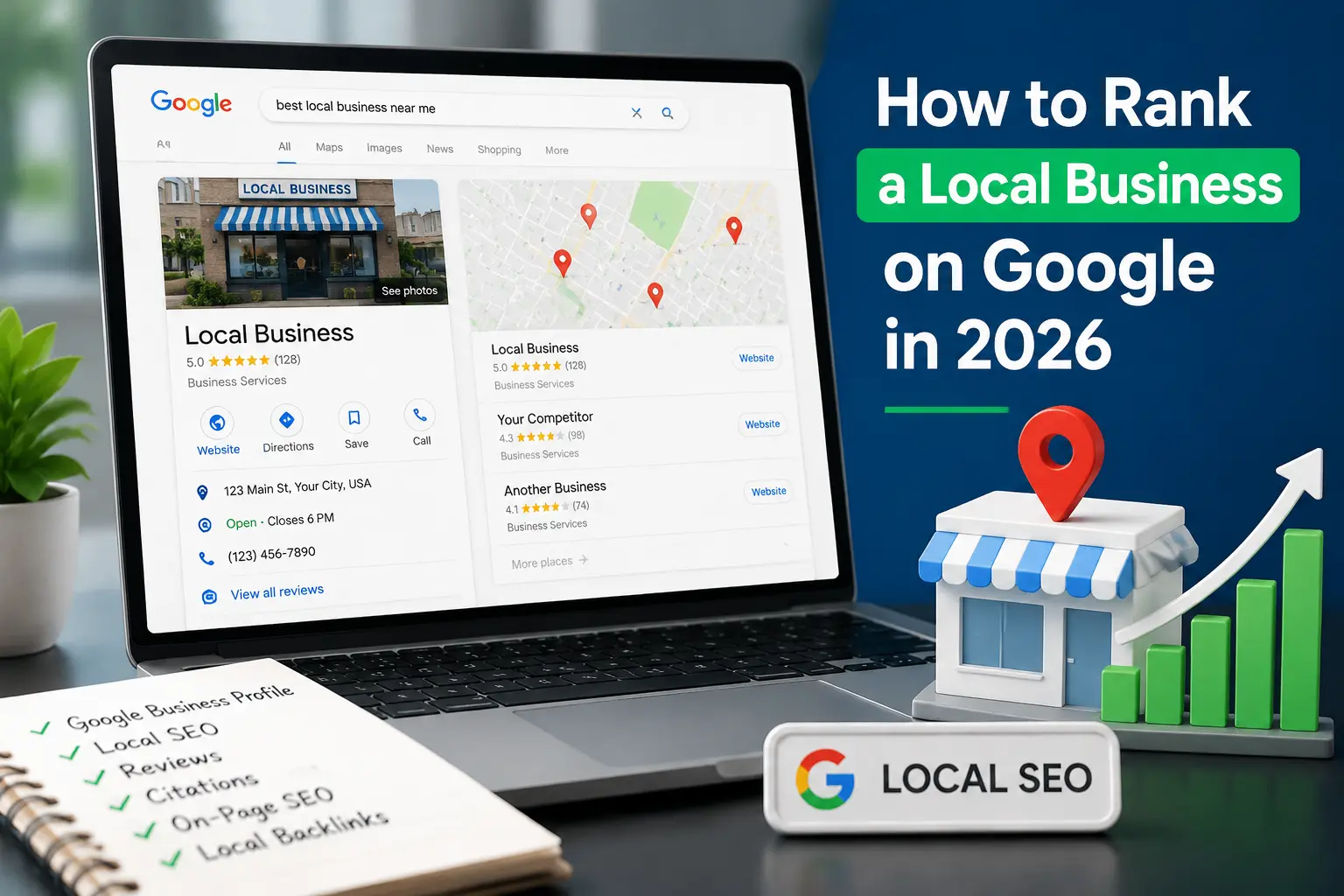
Every local business owner eventually asks the same question: how to rank on Google when it feels like every competitor is already ahead of you. The good news is that ranking a local business is not a mystery reserved for large companies with big marketing budgets. It is a repeatable process built on a handful of well-understood signals that anyone can learn and apply consistently.
This guide walks through exactly how to rank on Google in 2026, covering everything from Google Business Profile optimization to on-page SEO, citations, reviews, backlinks, and technical performance. Whether you run a single-location shop or a multi-city service business, the same core framework applies. By the end of this article, you will have a clear, step-by-step understanding of how to rank on Google and a practical checklist you can start using today.
Why Learning How to Rank on Google Matters More Than Ever in 2026
Search behavior has shifted dramatically over the past several years. More local searches now happen on mobile devices, more searches include “near me” or a specific neighborhood, and more customers make a decision within minutes of searching rather than comparing options over several days. This makes understanding how to rank on Google not just a marketing nice-to-have but a core requirement for staying visible to the customers actively looking for what you offer.
Businesses that rank in the top three results of the local map pack tend to capture the overwhelming majority of clicks, calls, and direction requests for a given search. Everyone else splits what remains. This is exactly why learning how to rank on Google in a competitive, ever-evolving search landscape has become one of the highest-leverage skills a small business owner can develop.
Understanding How Google Ranks Local Businesses
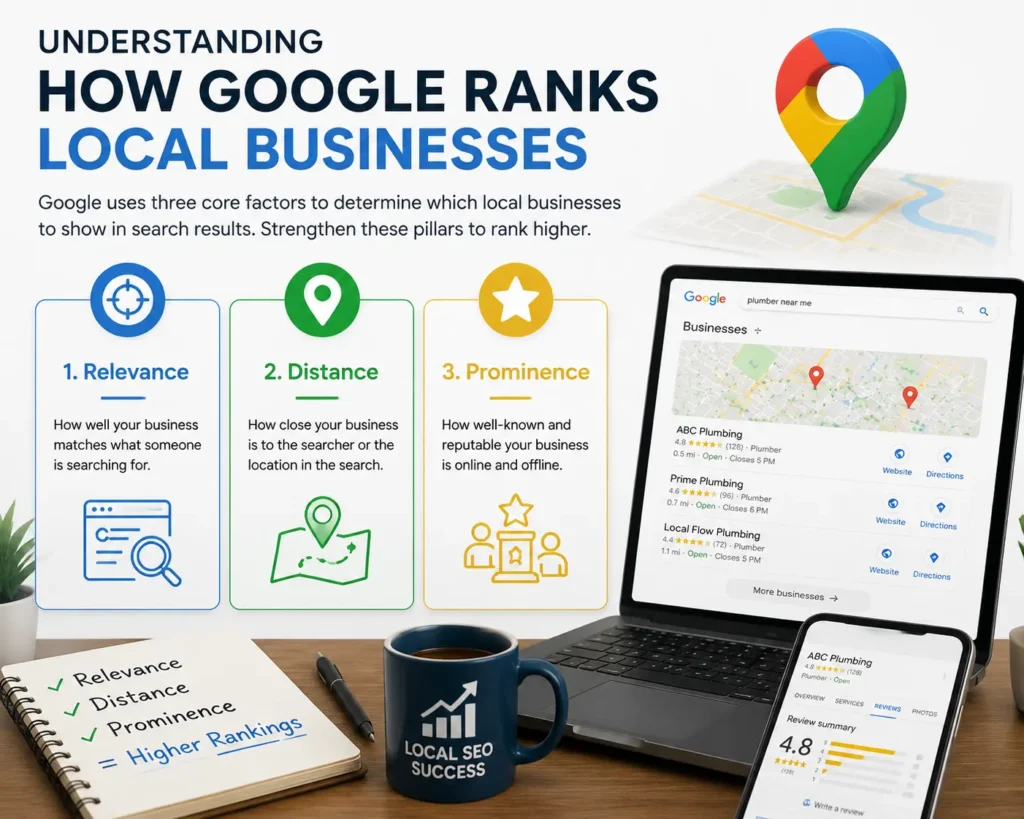
Before diving into tactics, it helps to understand the framework Google itself uses. Google has confirmed that local rankings are built around three core factors: relevance, distance, and prominence. Relevance measures how well your business matches what someone is searching for. Distance measures how close your business is to the searcher or the location implied in the search. Prominence measures how well-known and reputable your business is, both online and offline.
Every tactic covered in this guide on how to rank on Google ultimately maps back to strengthening one or more of these three pillars. Our detailed breakdown of Google Business Profile ranking factors goes deeper into how each of these pillars is evaluated specifically within your Google Business Profile, which is often the single most influential asset for local visibility.
Step 1: Claim and Fully Optimize Your Google Business Profile
If you only do one thing after reading this guide on how to rank on Google, make it this. Your Google Business Profile is frequently the very first thing a potential customer sees, and it directly feeds the map pack results that drive most local clicks and calls.
Start by claiming and verifying your listing if you have not already. Choose the most accurate primary category available, fill out every relevant attribute, write a clear business description, and keep your hours accurate and up to date. Upload fresh, genuine photos regularly, and respond promptly to every customer question in the Q&A section.
This single step has an outsized impact on how to rank on Google for local searches, because an incomplete or outdated profile actively works against every other optimization effort you make elsewhere. Our comprehensive Google Business Profile optimization guide and the companion Google Profile optimization checklist walk through every field and setting in detail. If your listing has ever run into verification trouble, our article on why Google Business Profiles get suspended explains the common causes and how to recover.
Step 2: Do Proper Local Keyword Research
You cannot learn how to rank on Google for the right searches if you do not know what those searches actually are. Local keyword research involves identifying the specific terms your potential customers type in, including service-based searches, location-based modifiers, and question-based searches people ask before they are ready to buy.
Group your keywords by intent: emergency or urgent searches, comparison searches, and informational searches all deserve different types of pages and content. Our guide to keyword research for local businesses walks through the full process of finding and prioritizing these terms, which forms the foundation for every page you build afterward.
Once you understand what people are searching for, mapping each keyword group to a specific, dedicated page on your website is one of the most important structural decisions in how to rank on Google successfully over time.
Step 3: Build Strong On-Page and Website SEO
With your keyword research complete, the next step in how to rank on Google is making sure your website itself clearly communicates relevance to both users and search engines.
- Write unique, descriptive title tags and meta descriptions for every page, incorporating your target keyword naturally.
- Create dedicated service pages rather than cramming everything onto a single homepage.
- Build location-specific pages for every city or neighborhood you genuinely serve, each with unique, locally relevant content.
- Use clear header structure, with one primary heading per page and logical subheadings underneath.
- Include your business name, address, and phone number consistently across the site, ideally in the footer of every page.
On-page SEO is often the most controllable part of how to rank on Google because it does not depend on external factors like reviews or backlinks. A well-structured, clearly written website gives Google everything it needs to understand exactly what your business offers and where.
Step 4: Build Consistent Citations Across the Web
Citations are mentions of your business name, address, and phone number on other websites, typically directories and industry listings. Consistency across these citations is a foundational trust signal in how to rank on Google for local searches, because conflicting information confuses both search engines and potential customers trying to verify your business is legitimate.
Start with major general directories, then move to industry-specific and locally relevant listings. Audit your existing citations for outdated addresses, old phone numbers, or duplicate listings that may have been created accidentally over the years. Our complete local SEO guide for small businesses covers citation building strategy in more depth, along with the broader local SEO fundamentals that support this step.
Step 5: Generate a Steady Stream of Genuine Reviews
Reviews are one of the most heavily weighted prominence signals in how to rank on Google locally, and they also directly influence whether a searcher clicks on your listing once they see it. A business with dozens of recent, detailed, positive reviews signals both quality and trustworthiness far more effectively than any amount of self-written marketing copy.
Build a simple, repeatable process for requesting reviews after every completed job or transaction, whether through a text message link, email follow-up, or a printed card handed to customers directly. Respond to every review, both positive and negative, professionally and promptly. Review velocity, meaning a steady, ongoing stream of new reviews rather than a single burst followed by silence, tends to matter as much as total review count when it comes to how to rank on Google over the long term.
Step 6: Build Local Backlinks and Community Authority
Backlinks from relevant, authoritative websites strengthen the prominence signals that support how to rank on Google against competitors in your area. For local businesses, some of the most effective backlink opportunities include sponsoring community events, partnering with complementary local businesses for cross-promotion, and contributing expert commentary to local news coverage related to your industry.
Our guides on link building fundamentals and practical link building techniques cover the broader strategy behind earning quality backlinks, which applies directly to strengthening your prominence signals as part of a complete approach to how to rank on Google.
Step 7: Get Your Technical SEO in Order
A slow, poorly structured, or difficult-to-crawl website undermines every other effort covered in this guide on how to rank on Google, because it prevents search engines from properly indexing your content and frustrates real visitors before they ever convert into customers.
Page speed and Core Web Vitals are especially important, since Google has increasingly tied these experience-based metrics to ranking outcomes. Our detailed guides on Core Web Vitals and website speed and SEO explain how to diagnose and fix the most common performance issues. For a complete overview of the technical fundamentals that support local rankings, our technical SEO hub covers crawlability, mobile usability, structured data, and more.
Monitoring your site through Google Search Console is another essential habit, since undiscovered crawl errors or indexing issues can quietly prevent new pages from ever being found, no matter how well they were written or optimized.
How to Rank on Google: Industry-Specific Considerations
While the core framework for how to rank on Google applies broadly across industries, certain trades face unique challenges worth understanding. Service-area businesses like HVAC companies often need to rank across multiple cities simultaneously, which our guides on HVAC SEO strategy and HVAC website architecture and on-page SEO address directly.
Emergency-driven trades face their own set of considerations. Our plumbing SEO guide, locksmith SEO strategies, and electrician SEO guide all cover how urgency-driven search behavior changes the priorities for how to rank on Google in those specific fields, particularly around Google Business Profile accuracy and page speed. Businesses focused on repeat, brand-specific service work will also find our appliance repair SEO guide useful for handling near-duplicate content challenges across similar service pages.
How to Rank on Google Maps vs. Organic Search Results
It helps to understand that “ranking on Google” for a local business actually involves two related but distinct systems: the local map pack and traditional organic search results. The map pack, which shows a small cluster of business listings alongside a map, is driven primarily by your Google Business Profile and the relevance, distance, and prominence signals covered earlier. Organic results, by contrast, are driven more heavily by your website’s content, structure, and backlink profile.
Many businesses focus entirely on one system while ignoring the other, which limits their overall visibility. A locksmith might rank beautifully in the map pack thanks to a strong profile and reviews, but their website may never appear in the organic results below the map for informational searches like “how much does rekeying a house cost.” Understanding how to rank on Google across both systems, rather than optimizing for just one, captures a wider range of search intent and protects against algorithm changes that might temporarily affect one system more than the other.
In practice, this means treating your Google Business Profile and your website as two connected but separately optimized assets, each requiring its own attention within a broader strategy for how to rank on Google.
Tools to Track How Your Business Ranks on Google
You do not need an expensive enterprise platform to monitor your progress. A handful of accessible tools cover most of what a local business needs:
- Google Business Profile Insights shows how customers find and interact with your listing, including searches, calls, and direction requests.
- Google Search Console reveals how your website performs in organic search, including which queries are driving impressions and clicks.
- Local rank tracking tools show your map pack position for target keywords across different neighborhoods or cities.
- Review monitoring tools help you respond quickly and track review velocity over time.
Checking these tools monthly, rather than obsessing over daily fluctuations, gives a much clearer picture of whether your approach to how to rank on Google is actually working. Local rankings can shift day to day for reasons unrelated to the quality of your optimization work, so focus on the broader trend over eight to twelve weeks rather than short-term noise.
Signs Your Business Isn’t Ranking on Google the Way It Should
Certain warning signs typically indicate that a business has unresolved issues holding back its visibility:
- Organic and map pack impressions have stayed flat for several months despite consistent effort.
- Competitors with fewer reviews or a smaller website consistently outrank you.
- Your Google Business Profile shows low view counts relative to your search volume expectations.
- Website traffic exists but rarely converts into calls or form submissions.
- Recent changes to your website or listing have not been followed by any audit of the results.
Any one of these signs on its own might not be significant, but several appearing together usually points to a specific, fixable gap in your overall strategy for how to rank on Google, whether that gap sits in your profile, your website, your reviews, or your citations.
Common Mistakes That Prevent Businesses From Ranking on Google
Even businesses that invest real effort into local SEO often fall into the same avoidable traps:
- Leaving the Google Business Profile incomplete, missing categories, attributes, or an updated description.
- Publishing thin, duplicate location pages that offer no unique value beyond a swapped city name.
- Ignoring reviews, especially negative ones, instead of responding professionally.
- Inconsistent NAP information across directories and the website itself.
- Neglecting page speed and mobile usability, which quietly caps rankings regardless of other efforts.
- Chasing backlinks from irrelevant or low-quality sources instead of building genuine local relationships.
- Treating local SEO as a one-time project rather than an ongoing, repeatable process.
Avoiding these mistakes is often more valuable than chasing advanced tactics, since even one unresolved issue can offset months of otherwise solid work toward learning how to rank on Google effectively.
A Practical Checklist for How to Rank on Google in 2026
Use this checklist as a starting framework:
- Claim and fully optimize your Google Business Profile, including categories, attributes, and photos.
- Complete local keyword research grouped by search intent.
- Build dedicated, unique pages for each core service and location.
- Establish consistent citations across relevant directories.
- Set up a repeatable review request process after every completed job.
- Respond to every review within 24 to 48 hours.
- Pursue genuine local backlinks through partnerships and community involvement.
- Audit and improve page speed and mobile usability.
- Monitor performance through Google Search Console and Business Profile Insights.
- Revisit and refresh your strategy quarterly as competitors and algorithms evolve.
Working through this checklist methodically gives any local business a structured, defensible answer to the question of how to rank on Google, rather than a scattered collection of one-off tactics applied inconsistently.
How Much Does It Cost to Rank on Google?
One of the most common questions behind how to rank on Google is what kind of budget is actually required. The honest answer is that cost varies widely depending on how much can be done in-house versus outsourced, and how competitive the local market is. A business owner with time to spare can handle much of the Google Business Profile optimization, citation cleanup, and review requests covered in this guide without spending anything beyond their own time.
Where costs typically enter the picture is technical website work, professional photography, and ongoing content creation, particularly for businesses in competitive metro markets facing well-funded competitors. Even then, learning how to rank on Google does not require a large recurring budget so much as consistent, correctly prioritized effort over several months. Businesses that try to shortcut the process with paid tools alone, without addressing the underlying fundamentals covered earlier, tend to see disappointing results regardless of how much they spend.
Local SEO for Businesses With Multiple Locations
Businesses operating in more than one city face additional considerations when working out how to rank on Google across an entire service area. Each location should have its own Google Business Profile, its own dedicated page on the website, and enough locally specific content to avoid appearing as a duplicate of another location’s page with only the city name changed.
Internal linking between location pages, and between location pages and core service pages, helps both users and search engines understand the full footprint of the business. Coordinating review generation across locations matters too; concentrating all your reviews on one flagship location while newer branches sit empty creates an uneven trust profile that can slow growth in those secondary markets. Businesses that invest in this structure from the start typically find it far easier to scale their approach to how to rank on Google as they expand into new areas, compared to retrofitting a single-location strategy after the fact.
How Long Does It Take to Rank on Google?
Most businesses see measurable movement within four to eight weeks after implementing the core steps in this guide, particularly around Google Business Profile optimization and citation cleanup. More competitive markets, or businesses starting with significant existing issues, may take two to four months to see substantial ranking improvement. Learning how to rank on Google is rarely instant, but the timeline is far more predictable than most business owners expect once the fundamentals are addressed in the right order.
Frequently Asked Questions About How to Rank on Google
What is the fastest way to improve how to rank on Google for a local business? Fully optimizing your Google Business Profile typically produces the fastest visible movement, since it directly feeds the map pack results most local searchers see first.
Do I need a website to figure out how to rank on Google locally? A website significantly strengthens your ability to rank on Google by supporting relevance and prominence signals, but a well-optimized Google Business Profile alone can still generate meaningful visibility, especially in less competitive markets.
How important are reviews when learning how to rank on Google? Reviews are one of the most influential prominence signals for local rankings. Both the quantity and the recency of reviews matter, and steady review generation over time tends to outperform sporadic bursts.
Can a new business compete with established competitors on Google? Yes. A new business with an accurate, fully optimized profile, genuine reviews, and solid technical fundamentals can often outrank older competitors who have neglected their online presence, particularly in markets where established businesses have stopped actively managing their listings.
Does paid advertising help with how to rank on Google organically? Paid search and organic rankings are evaluated separately by Google, so running ads does not directly boost organic or map pack rankings. However, many businesses use paid campaigns alongside organic efforts during the early stages while their organic strategy matures.
Should I hire an agency to figure out how to rank on Google, or handle it myself? Many of the steps in this guide, particularly Google Business Profile optimization, citation cleanup, and review requests, are within reach for a business owner willing to invest a few hours a week. Technical website work, ongoing content production, and competitive link building are where an experienced agency or freelancer often accelerates results, especially in markets where competitors are already investing heavily in their own visibility.
Final Thoughts on How to Rank on Google in 2026
Learning how to rank on Google is not about chasing a single trick or shortcut. It is about consistently strengthening the same core signals Google has relied on for years: relevance, distance, and prominence. A fully optimized Google Business Profile, a well-structured website, consistent citations, genuine reviews, and a handful of quality local backlinks together create a foundation that is difficult for less disciplined competitors to match.
Start with the highest-leverage steps first, particularly your Google Business Profile and technical website health, then layer in reviews, citations, and backlinks over the following months. Local search rewards consistency far more than intensity, and businesses that treat this as an ongoing habit rather than a one-time project will continue climbing the rankings long after competitors who set things up once and walked away.
There is no single algorithm update or trick that changes the fundamentals covered throughout this guide. The businesses that consistently figure out how to rank on Google year after year are simply the ones that keep their profile accurate, keep their website fast and well-structured, keep earning genuine reviews, and keep showing up in relevant local conversations. None of that requires a large team or an enterprise budget, just a clear framework and the discipline to work through it steadily rather than in occasional bursts.
Master these fundamentals, apply them consistently, and how to rank on Google stops being an intimidating question and becomes a repeatable process your business can rely on for sustainable growth in 2026 and beyond.
