
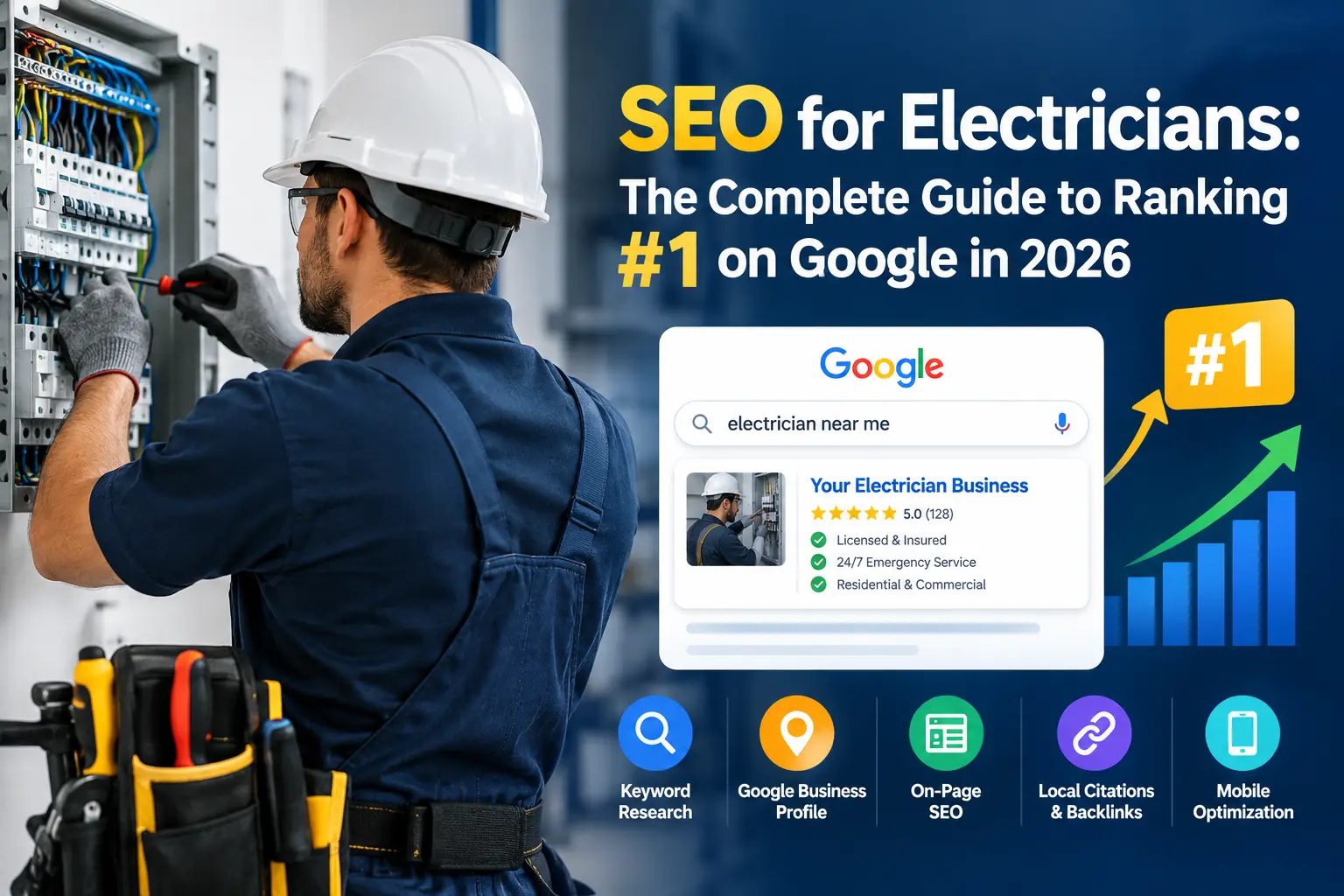
If you run an electrical contracting business, you already know that most homeowners and property managers don’t flip through the phone book anymore — they open Google, type “electrician near me,” and call whoever shows up first. That’s exactly why SEO for electricians has become one of the highest-return marketing investments an electrical contractor can make. Done right, SEO for electricians puts your business in front of ready-to-hire customers at the exact moment they’re searching, without the recurring cost of paid ads.
In this guide, we’ll walk through everything that matters for SEO for electricians in 2026 — from keyword research and on-page optimization to Google Business Profile, technical SEO, link building, and how to track results. Whether you’re a solo electrician just getting started online or you run a multi-crew electrical company, this guide will give you a practical roadmap for SEO for electricians that you can start applying today.
What Is SEO for Electricians?
SEO for electricians is the process of optimizing an electrical contracting website and its online presence so it ranks higher in Google’s organic (non-paid) search results for terms that potential customers actually search — things like “emergency electrician,” “electrical panel upgrade near me,” or “licensed electrician [city name].” Unlike general SEO, SEO for electricians has to account for the way people search for trade services: urgently, locally, and often on mobile devices while dealing with an active problem like a tripped breaker or a flickering light.
Good SEO for electricians combines four core pillars:
- On-page SEO — optimizing the content, structure, and metadata on your own pages
- Local SEO — making sure Google understands where you operate and what you do
- Technical SEO — making sure your site is fast, crawlable, and mobile-friendly
- Off-page SEO — building the reviews, citations, and backlinks that establish trust
When these four pillars work together, SEO for electricians can generate a steady stream of inbound calls and form submissions without you having to pay for every single lead.
Why SEO for Electricians Matters More Than Ever
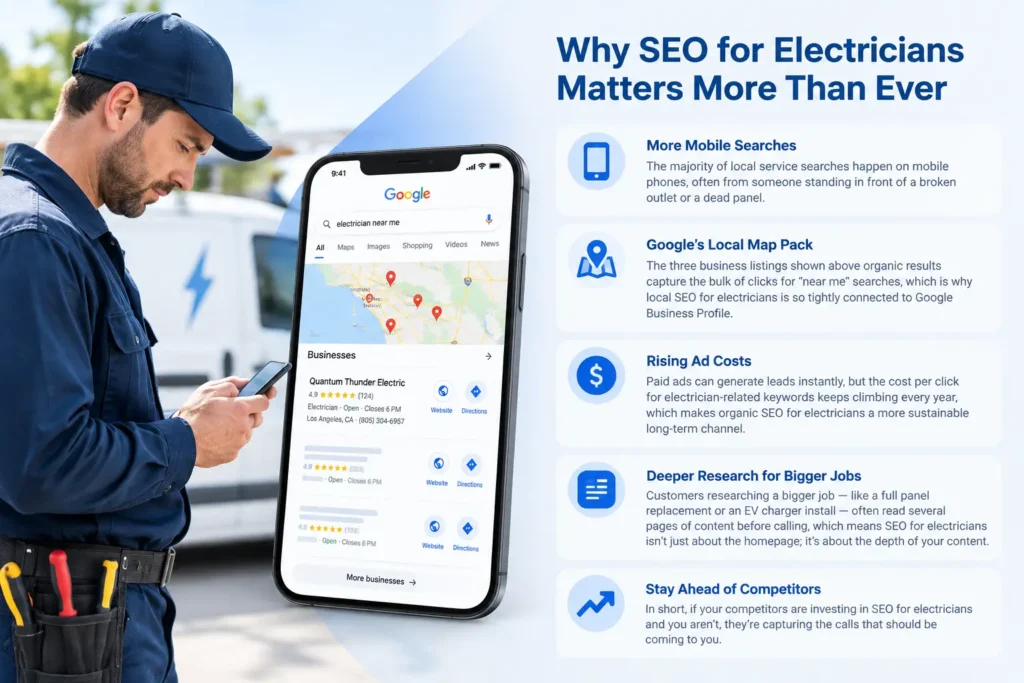
A few years ago, a listing in the local paper or a truck wrap was enough to generate leads. Today, the buyer’s journey almost always starts with a search engine. Consider a few realities that make SEO for electricians essential rather than optional:
- The majority of local service searches happen on mobile phones, often from someone standing in front of a broken outlet or a dead panel.
- Google’s local map pack — the three business listings shown above organic results — captures the bulk of clicks for “near me” searches, which is why local SEO for electricians is so tightly connected to Google Business Profile.
- Paid ads can generate leads instantly, but the cost per click for electrician-related keywords keeps climbing every year, which makes organic SEO for electricians a more sustainable long-term channel.
- Customers researching a bigger job — like a full panel replacement or an EV charger install — often read several pages of content before calling, which means SEO for electricians isn’t just about the homepage; it’s about the depth of your content.
In short, if your competitors are investing in SEO for electricians and you aren’t, they’re capturing the calls that should be coming to you.
Keyword Research for Electrician SEO
Every successful SEO for electricians strategy starts with understanding what your customers are actually typing into Google. Keyword research for electricians typically falls into three buckets:
1. Service Keywords
These describe the specific electrical work someone needs: panel upgrades, rewiring, EV charger installation, generator installation, lighting installation, or troubleshooting. Building a dedicated page for each core service is one of the most effective moves in SEO for electricians because it lets you match search intent precisely instead of trying to rank one general “services” page for everything.
2. Local + Service Keywords
Pairing a service with a location — “electrician in [city],” “electrical panel upgrade [city]” — is where most of the buying-intent traffic lives. This is the backbone of local SEO for electricians, and it’s why every service page should include a location-specific version for each area you actually serve.
3. Problem-Based and Emergency Keywords
Many people search based on the symptom, not the solution: “lights keep flickering,” “breaker keeps tripping,” “no power in one room.” Targeting these problem-based searches is an underused tactic in SEO for electricians, since fewer competitors bother writing content that answers the actual question a homeowner is Googling at 11pm.
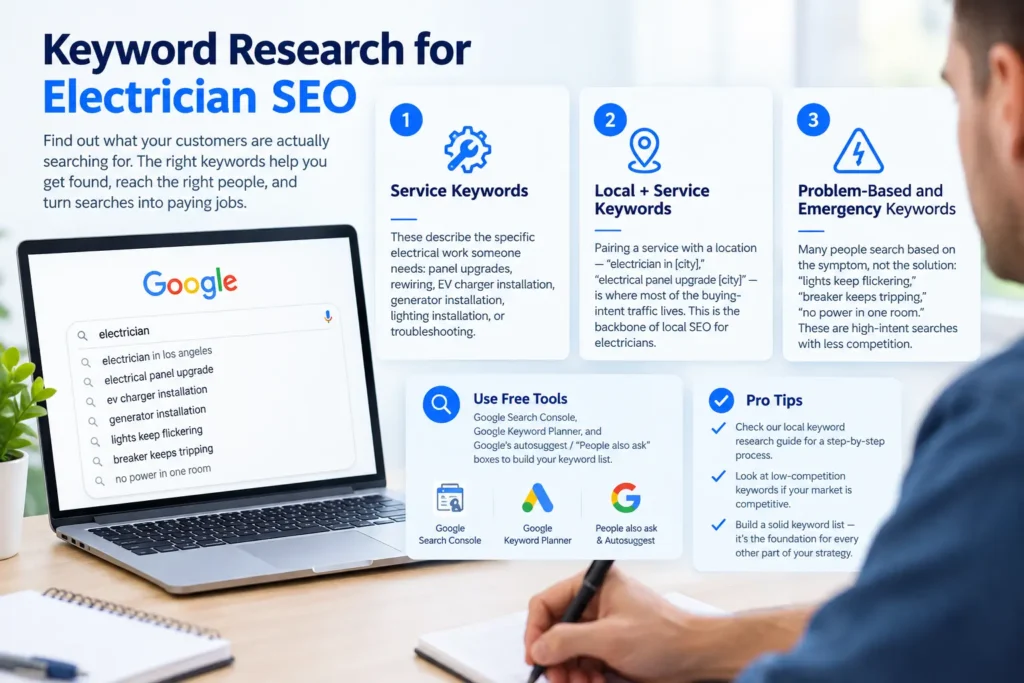
Use free tools like Google Search Console, Google Keyword Planner, and Google’s autosuggest/”People also ask” boxes to build out your keyword list before you write a single page. Our local keyword research guide walks through this process step by step, and if your market has heavy competition, it’s worth checking our list of low-competition keywords that can be easier to rank for early on. A solid keyword list is the foundation every other part of this strategy is built on.
Understanding Search Intent
Not every keyword deserves the same treatment. Someone searching “how does a circuit breaker work” is early in the research process and probably isn’t ready to book a job yet — that visitor is better served by an educational blog post. Someone searching “24 hour electrician [city]” is almost certainly ready to call right now, and that visitor needs a fast-loading service page with a phone number front and center. Mapping each keyword to the right type of page — informational content versus a conversion-focused service page — is a step many contractors skip, and it’s one of the fastest ways to improve results without writing a single additional word.
Voice Search and Conversational Queries
More homeowners are searching by voice through phones and smart speakers, which tends to produce longer, more conversational queries like “who can fix a tripped breaker near me tonight.” Because voice queries often mirror natural speech, writing FAQ-style content that directly answers common questions in plain language helps you capture this growing segment of local search traffic.
On-Page SEO for Electricians
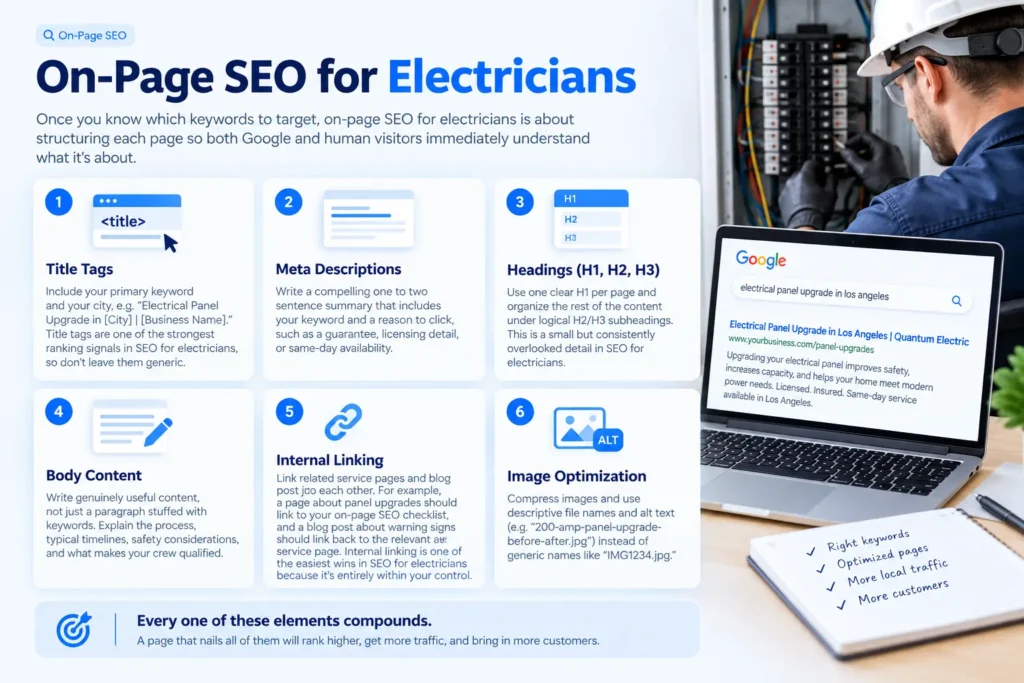
Once you know which keywords to target, on-page SEO for electricians is about structuring each page so both Google and human visitors immediately understand what it’s about.
- Title tags — Include your primary keyword and your city, e.g. “Electrical Panel Upgrade in [City] | [Business Name].” Title tags are one of the strongest ranking signals in SEO for electricians, so don’t leave them generic.
- Meta descriptions — Write a compelling one to two sentence summary that includes your keyword and a reason to click, such as a guarantee, licensing detail, or same-day availability.
- Headings (H1, H2, H3) — Use one clear H1 per page and organize the rest of the content under logical H2/H3 subheadings. This is a small but consistently overlooked detail in SEO for electricians.
- Body content — Write genuinely useful content, not just a paragraph stuffed with keywords. Explain the process, typical timelines, safety considerations, and what makes your crew qualified.
- Internal linking — Link related service pages and blog posts to each other. For example, a page about panel upgrades should link to your on-page SEO checklist, and a blog post explaining warning signs should link back to the relevant service page. Internal linking is one of the easiest wins in SEO for electricians because it’s entirely within your control.
- Image optimization — Compress images and use descriptive file names and alt text (e.g., “200-amp-panel-upgrade-before-after.jpg”) instead of generic names like “IMG1234.jpg.”
Every one of these elements compounds. A page that nails all of them will consistently outperform a competitor’s thin page, even if that competitor has more overall domain authority.
Local SEO for Electricians: Google Business Profile
If you only have time to focus on one thing, make it your Google Business Profile (GBP). For local SEO for electricians, GBP is arguably more important than your website itself, because it’s what shows up in the map pack and in Google Maps searches.
Steps to optimize your Google Business Profile for SEO for electricians:
- Claim and verify your listing if you haven’t already.
- Choose accurate categories — “Electrician” as your primary category, with secondary categories like “Electrical installation service” if applicable.
- Use your full, consistent business name, address, and phone number (NAP) — and make sure it matches exactly across your website, GBP, and every directory listing.
- Add your service areas so Google knows which cities and neighborhoods you cover, which directly supports local SEO for electricians outside your immediate address.
- Upload real photos of your crew, vehicles, and completed jobs — profiles with photos get significantly more engagement.
- Post updates regularly — seasonal tips, completed job photos, and promotions all signal an active business.
- Collect and respond to reviews — more on this below, since reviews are one of the biggest local ranking factors in SEO for electricians.
Pairing a well-optimized GBP with consistent local citations (listings on directories like Yelp, Angi, HomeAdvisor, and industry-specific directories) rounds out the local side of SEO for electricians. If you want a deeper walkthrough, our guide on Google Maps SEO covers map pack ranking factors in more detail, and our Google Business Profile checklist is worth running through before you move on to the rest of your strategy.
Technical SEO for Electrician Websites
Technical SEO for electricians is the unglamorous but essential foundation that determines whether Google can properly crawl, index, and rank your site in the first place. Key areas to check:
- Site speed — A slow-loading site frustrates mobile visitors and hurts rankings. Compress images, use a caching plugin, and choose reliable hosting.
- Mobile-friendliness — Since the majority of “electrician near me” searches happen on phones, a responsive, easy-to-tap design isn’t optional for SEO for electricians — it’s baseline.
- HTTPS and security — An SSL certificate is a minimum requirement; Google flags non-secure sites, which erodes trust before a visitor even reads your content.
- XML sitemap and robots.txt — Make sure your sitemap is submitted to Google Search Console and that nothing important is accidentally blocked from crawling.
- Structured data (schema markup) — Adding local business schema and Service schema helps Google understand your business details and can enable rich results, which is a technical SEO for electricians tactic that’s often skipped by smaller contractors.
- Broken links and redirects — Regularly audit for 404 errors and fix broken internal links, especially after a site redesign.
Site speed deserves its own mention here too — our guide on website speed and SEO walks through the specific fixes that tend to move the needle most for trade business websites. We generally recommend running a full technical check as part of any SEO audit before investing heavily in new content, since fixing technical issues first means every future page benefits.
Core Web Vitals and Site Performance
Google’s Core Web Vitals — Largest Contentful Paint, Interaction to Next Paint, and Cumulative Layout Shift — measure real-world loading speed, interactivity, and visual stability. While Core Web Vitals are just one of many ranking signals, they matter more in SEO for electricians than most contractors realize, because a slow, clunky site directly increases the chance a frustrated visitor bounces back to Google and calls a competitor instead. Run your site through Google PageSpeed Insights periodically and address the specific recommendations it gives — usually image compression, reducing unnecessary scripts, and improving server response time.
Content Marketing for Electricians
Beyond your core service pages, a blog or resource section is one of the most underused tools in SEO for electricians. Useful, non-salesy content builds trust, answers pre-purchase questions, and gives Google more relevant pages to rank. Content ideas that consistently perform well in SEO for electricians include:
- “Signs you need an electrical panel upgrade”
- “How much does rewiring a house cost?”
- “Is it safe to install an EV charger myself?”
- “What to do when your breaker keeps tripping”
- Seasonal guides (holiday lighting safety, storm preparedness, generator maintenance)
Each piece of content should naturally link back to the relevant service page, reinforcing both user experience and the internal linking structure that supports this strategy sitewide. If you’re weighing how AI tools fit into a content strategy like this, iffaris.com’s piece on AI and SEO breaks down where AI genuinely helps and where it still requires a human editor.
Consistency matters more than volume. A single well-researched, genuinely useful article published every week or two will outperform a burst of ten thin, rushed posts published once and then abandoned. Over a year, that steady rhythm adds up to dozens of indexed pages, each capable of ranking for its own cluster of long-tail searches — searches that, individually, might only bring in a handful of visitors a month, but collectively add up to a meaningful share of your total organic traffic.
Repurposing Content Across Channels
Once a blog post is published, its useful life doesn’t have to end there. A guide on generator maintenance can be trimmed into a series of social media posts, turned into a short customer-facing PDF handout, or referenced in email follow-ups after a service call. Repurposing content this way stretches the value of the time you invested in writing it in the first place, without requiring an entirely new topic for every channel.
Reviews and Reputation Management
Reviews influence both rankings and conversion rate, which makes them a dual-purpose lever in this strategy. A steady flow of recent, detailed reviews signals to Google that your business is active and trusted, while also reassuring prospective customers who are comparing you against two or three competitors.
Our guide on how to get more Google reviews goes deeper into this, but the practical basics are:
- Ask for a review immediately after a job is completed, while the experience is still fresh.
- Make it easy — send a direct link via text message rather than asking customers to search for you.
- Respond to every review, positive or negative, professionally and promptly.
- Never buy or fake reviews — Google actively penalizes this, and it can undo months of legitimate SEO for electricians work overnight.
Link Building for Electricians
Backlinks — other websites linking to yours — remain one of the strongest ranking factors in any SEO strategy, including SEO for electricians. Because most electrical contractors operate locally, link building doesn’t need to be complicated or expensive. Effective approaches include:
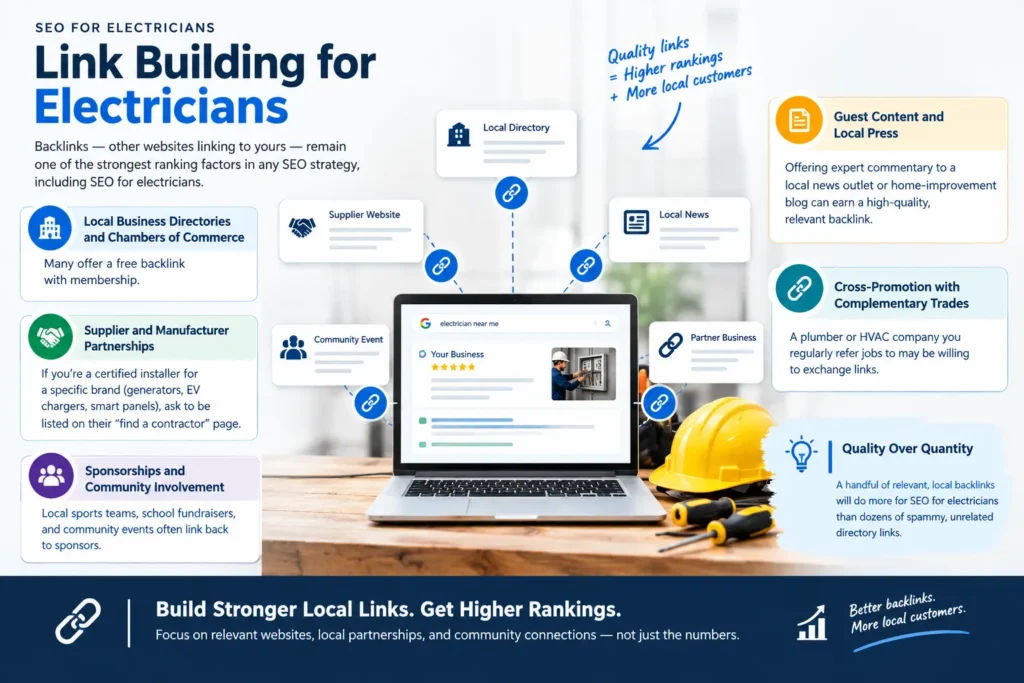
- Local business directories and chambers of commerce — many offer a free backlink with membership.
- Supplier and manufacturer partnerships — if you’re a certified installer for a specific brand (generators, EV chargers, smart panels), ask to be listed on their “find a contractor” page.
- Sponsorships and community involvement — local sports teams, school fundraisers, and community events often link back to sponsors.
- Guest content and local press — offering expert commentary to a local news outlet or home-improvement blog can earn a high-quality, relevant backlink.
- Cross-promotion with complementary trades — a plumber or HVAC company you regularly refer jobs to may be willing to exchange links.
Quality matters far more than quantity here. A handful of relevant, local backlinks will do more for SEO for electricians than dozens of spammy, unrelated directory links. Our guide on local link building covers additional outreach tactics specific to trade businesses, and iffaris.com’s guide to getting backlinks is a useful reference if you want to go deeper on outreach strategy in general.
Tracking and Measuring SEO for Electricians
You can’t improve what you don’t measure. At minimum, every electrical contractor running SEO for electricians should track:
- Google Search Console — impressions, clicks, average position, and which queries are actually bringing in traffic.
- Google Analytics — traffic sources, page-level engagement, and conversion paths (form fills, click-to-call).
- Google Business Profile Insights — calls, direction requests, and website clicks generated directly from your GBP listing.
- Call tracking — a dedicated tracking number on your website lets you tie phone calls directly back to organic search.
- Keyword rank tracking — monitoring your position for the specific service and local keywords you’re targeting shows whether your SEO for electricians efforts are trending in the right direction.
Review this data monthly. Organic search is a compounding channel — the goal isn’t a single spike in traffic, but a steady upward trend over 6 to 12 months as your site accumulates authority, content, and reviews.
It also helps to separate vanity metrics from business metrics. A jump in impressions or keyword rankings feels good, but the numbers that actually matter are calls, form submissions, and booked jobs. Tie your tracking setup back to those outcomes wherever possible — for example, by tagging form submissions from organic traffic differently than those from paid ads or referrals — so you can see, in dollar terms, what your investment in ranking higher is actually returning.
Common Mistakes in SEO for Electricians
Even well-intentioned contractors make avoidable mistakes that hold back their SEO for electricians results — our full breakdown of common SEO mistakes covers more of these in detail, but here are the ones that matter most for electrical contractors specifically:
- Building one generic “services” page instead of individual pages per service. Google rewards specificity.
- Ignoring Google Business Profile after the initial setup. An unmaintained listing loses ground to active competitors.
- Copying service descriptions from a template or competitor site. Duplicate or thin content rarely ranks.
- Neglecting mobile experience. A site that looks fine on desktop but is hard to navigate on a phone loses the majority of local searchers.
- Chasing keyword stuffing instead of useful content. Overusing a keyword unnaturally can hurt readability and, in extreme cases, rankings.
- Not tracking results. Without data, it’s impossible to know which parts of your SEO for electricians strategy are actually working.
- Expecting overnight results. This is a medium-to-long-term investment; sustainable rankings typically build over several months, not days.
Avoiding these pitfalls alone will put many electrical contractors ahead of a meaningful share of their local competition.
DIY SEO for Electricians vs. Hiring an Agency
Should you handle SEO for electricians in-house or bring in outside help? It depends on your time, budget, and how competitive your local market is.
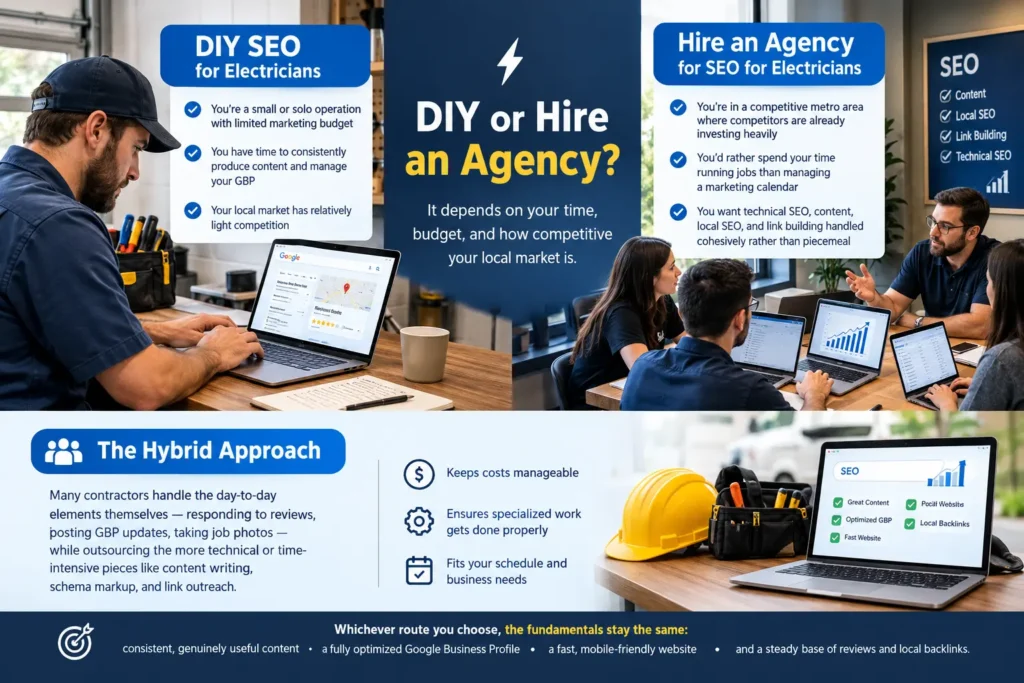
DIY SEO for electricians makes sense if:
- You’re a small or solo operation with limited marketing budget
- You have time to consistently produce content and manage your GBP
- Your local market has relatively light competition
Hiring an agency for SEO for electricians makes sense if:
- You’re in a competitive metro area where competitors are already investing heavily
- You’d rather spend your time running jobs than managing a marketing calendar
- You want technical SEO, content, local SEO, and link building handled cohesively rather than piecemeal
Whichever route you choose, the fundamentals stay the same: consistent, genuinely useful content; a fully optimized Google Business Profile; a fast, mobile-friendly website; and a steady base of reviews and local backlinks.
A hybrid approach is also worth considering: many contractors handle the day-to-day elements themselves — responding to reviews, posting GBP updates, taking job photos — while outsourcing the more technical or time-intensive pieces like content writing, schema markup, and link outreach. This keeps costs manageable while still ensuring the more specialized parts of the strategy get done properly and consistently, rather than falling to the bottom of an already-full schedule.
Frequently Asked Questions About SEO for Electricians
How long does SEO for electricians take to show results? Most electrical contractors start seeing meaningful movement within 3 to 6 months, with stronger results compounding over 6 to 12 months as content, reviews, and backlinks accumulate.
Is SEO for electricians better than paid ads? They serve different purposes. Paid ads can generate leads immediately but stop the moment you stop paying. SEO for electricians takes longer to build but keeps generating leads without an ongoing cost per click, making it a stronger long-term investment for most electrical contractors.
How much does SEO for electricians cost? Costs vary widely depending on your market and whether you DIY or hire an agency, ranging from a few hundred dollars a month for a light DIY approach to several thousand for a full-service agency handling content, technical SEO, and link building.
Do I need a blog for SEO for electricians to work? It’s not strictly required, but a blog or resource section significantly expands the number of relevant keywords you can rank for and gives Google more reasons to view your site as an authority in the electrical trade.
Can I do SEO for electricians myself without any technical background? Yes, to a point. Many of the highest-impact tasks — claiming and updating your Google Business Profile, asking happy customers for reviews, writing genuinely helpful service pages — require no coding knowledge at all. The more technical pieces, like schema markup and site speed optimization, are where most non-technical business owners eventually bring in outside help, but they aren’t prerequisites for getting started.
Final Thoughts on SEO for Electricians
SEO for electricians isn’t a one-time project — it’s an ongoing process of refining your website, your Google Business Profile, your content, and your reputation so that Google consistently recognizes your business as a relevant, trustworthy result for the searches your customers are already making. None of the individual pieces covered here are complicated on their own; the businesses that win are simply the ones that keep at it consistently, month after month, instead of doing a one-time push and moving on.
Much of what’s covered here applies just as directly to other trades — if you also run or work alongside an HVAC company, a plumbing business, or a locksmith service, the same fundamentals apply with only minor adjustments to keywords and service pages.
If you’re not sure where your website currently stands, the smartest first step is usually a full audit rather than guessing which piece to tackle first. Start with the fundamentals covered in this guide — solid on-page structure, a fully optimized GBP, fast and mobile-friendly technical performance, useful content, and a steady flow of reviews and local backlinks — and this strategy will steadily turn into one of your most reliable, lowest-cost sources of new business, long after any single ad campaign would have stopped generating calls.
