
A homeowner does not type “electrician” into Google when the lights start flickering at 9 p.m. They type something like “emergency electrician near me open now” or “why do my lights flicker when the AC turns on.” Those searches are longer, more specific, and much closer to a phone call than any single generic word could ever be. That is exactly why long tail keywords are the most valuable asset in a local SEO campaign.
If you run a local service business, or you manage SEO for one, competing for short and broad terms is a losing game. National directories, big brands, and lead-generation sites own those results. Long tail keywords give a small plumber, towing operator, or appliance repair shop a realistic way in. They match what real customers type, they are easier to rank for, and they convert at a higher rate because the searcher already knows what they need.
In this guide, you will learn how to find long tail keywords for local businesses step by step. We will cover what they are, why they work, nine practical research methods (most of them free), how to judge search intent, how to map each phrase to the right page, and the mistakes that waste months of effort. You will also see real examples for electricians, appliance repair companies, and towing services, so you can copy the process for any trade.
What Are Long Tail Keywords?
Long tail keywords are longer, more specific search phrases, usually three to six words or more, that show a clear need. Instead of “plumber,” a long tail search looks like “24 hour plumber for burst pipe in Austin.” Each extra word narrows the request and reveals what the person actually wants.
The name comes from the shape of a search demand curve. A small number of “head” terms, such as “electrician” or “car repair,” get huge search volume. Behind them sits a very long “tail” of thousands of specific phrases, each searched only a handful of times per month. Individually those phrases look small. Together they add up to most of the searches people make every day.
A simple way to separate the three groups:
| Keyword Type | Example | Searches | Competition | Buyer Intent |
|---|---|---|---|---|
| Head term | electrician | Very high | Very high | Low, vague |
| Middle term | electrician Houston | Medium | High | Medium |
| Long tail | licensed electrician to install EV charger in Houston | Low | Low | High |
Notice that the length of the phrase is not the real definition. What matters is specificity and intent. A phrase like “water heater repair” is short, but “tankless water heater not heating up after power outage” is a long tail phrase that tells you the exact problem, the exact product, and the urgency. Good long tail keywords describe a situation, not just a service.
Why Long Tail Keywords Matter So Much for Local Businesses
Local businesses have a few natural constraints: a limited service area, a limited budget, and usually a small website. Long tail keywords fit those constraints better than any other tactic. Here is why.
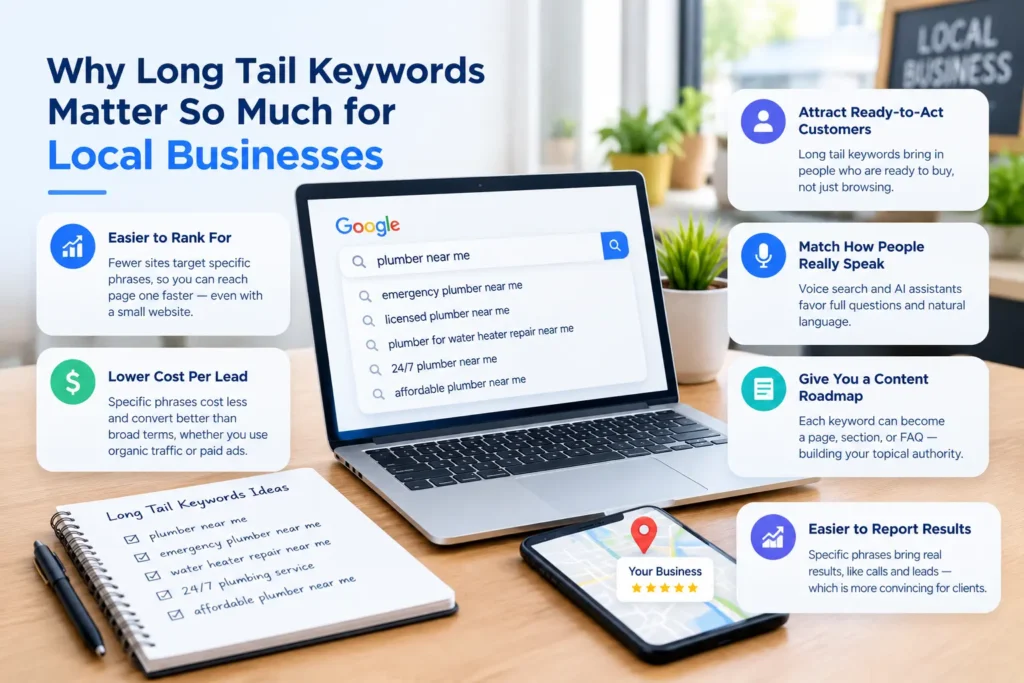
They are easier to rank for. Fewer sites target very specific phrases, so a well-written page on a small site can reach page one without hundreds of backlinks. If you are still building authority, this is the fastest path to visibility. Pairing this with a strong Google Business Profile multiplies the effect.
They attract people who are ready to act. Someone searching “emergency towing service near me open late” is standing beside a broken-down car. Someone searching “towing” might be researching a career. Long tail keywords filter out the curious and bring in the customer.
They match how people really speak. Voice search and AI assistants push queries toward full sentences and questions. People ask their phones “who can fix a dishwasher that won’t drain today,” and long tail keywords are how your pages get matched to those questions.
They give you a content roadmap. Every one of the long tail keywords you find is a page, a section, or an FAQ you can write. A single service can produce dozens of supporting posts, and each one builds topical authority for the main service page.
They lower your cost per lead. Whether you use organic traffic or paid ads, specific phrases cost less and convert better than head terms. That matters when a single job is worth a few hundred dollars and you cannot afford wasted clicks.
For agencies and freelancers, long tail keywords also make results easier to report. A client can see that “ac repair for older homes in Dubai” now brings ten calls a month, which is more convincing than a chart of impressions for a broad term.
The Main Types of Long Tail Keywords for Local Businesses
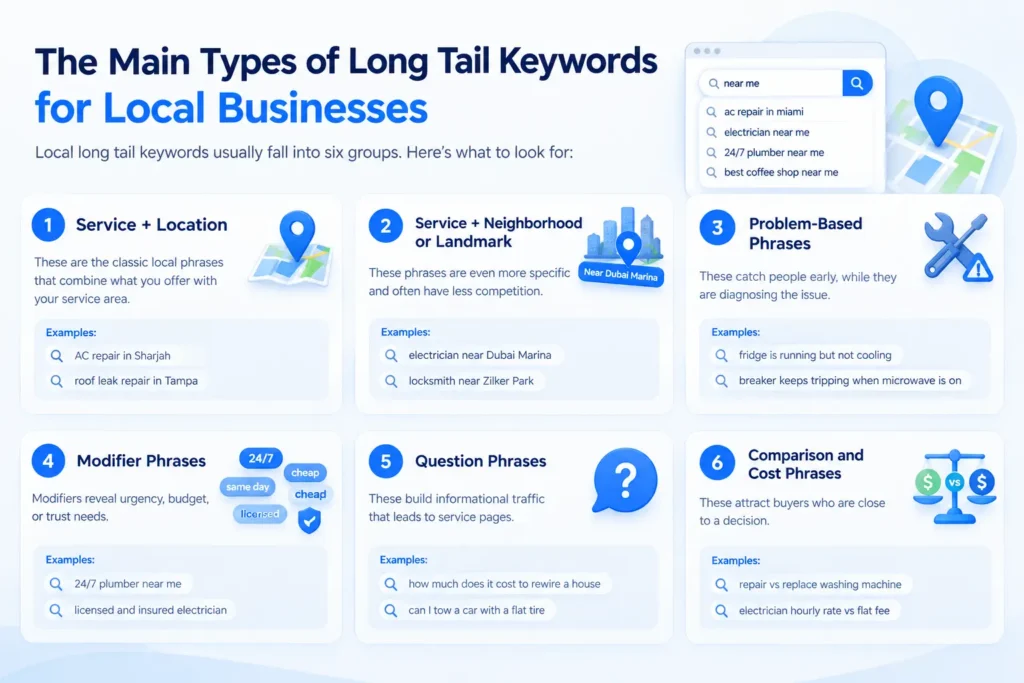
Before you open a research tool, it helps to know the categories you are hunting for. Local long tail keywords usually fall into six groups.
- Service plus location: “AC repair in Sharjah,” “roof leak repair in Tampa.” These are the classic local phrases.
- Service plus neighborhood or landmark: “electrician near Dubai Marina,” “locksmith near Zilker Park.” These are excellent because almost nobody targets them.
- Problem-based phrases: “fridge is running but not cooling,” “breaker keeps tripping when microwave is on.” These catch people early, while they are diagnosing the issue.
- Modifier phrases: “same day,” “24/7,” “cheap,” “licensed and insured,” “open Sunday,” “for landlords.” Modifiers reveal urgency, budget, or trust needs.
- Question phrases: “how much does it cost to rewire a house,” “can I tow a car with a flat tire.” These build informational traffic that leads to service pages.
- Comparison and cost phrases: “repair vs replace washing machine,” “electrician hourly rate vs flat fee.” These attract buyers who are close to a decision.
A healthy strategy uses all six. Service and location phrases usually go on service pages, while problem, question, and cost phrases go into blog posts and FAQs that link back to those pages.
Step 1: Start With a Seed List Built From Your Real Services
Every good local keyword research session starts with a plain list, not a tool. Write down every service the business sells, every problem it solves, and every place it serves. Do this before you look at any volume data.
Create three columns:
- Services: panel upgrade, EV charger installation, ceiling fan installation, generator hookup.
- Problems: flickering lights, tripping breaker, no power in one room, burning smell from outlet.
- Locations: cities, suburbs, neighborhoods, zip codes, and well-known landmarks in the service area.
Then combine them. Ten services, ten problems, and fifteen locations already give you hundreds of possible phrases. Most of these long tail keywords will never get searched, and that is fine. The goal is a rich set of seed ideas that you will test and filter in later steps.
If you want the wider process behind this step, read our guide to keyword research for local businesses. If you work with clients across different trades, keep a reusable template for this step. It saves hours, and it prevents the common mistake of only listing the two or three services the owner talks about most.
Step 2: Mine Your Customers’ Own Words for Long Tail Keywords
The best long tail keywords are already sitting in your inbox, call log, and review profile. Real customers describe problems in language that marketing teams rarely use, and that language is what people type into Google.
Look at these sources:
- Phone call notes and voicemails. Ask the front desk or dispatcher to list the exact words callers use. “My oven clicks but won’t light” is more useful than “oven ignition failure.”
- Contact form messages. Pull the last hundred submissions and highlight repeated phrases.
- Google reviews. Customers often describe the job in detail: “He fixed our washer that was leaking from the bottom the same afternoon.” That sentence contains at least three usable long tail keywords.
- Email and chat transcripts. Look at the first message a new customer sends. It usually states the problem in natural language.
- Technician stories. Ask the team what the strangest, most common, or most expensive problems were this year.
Copy the phrases exactly as written, including spelling mistakes and slang. Later, you can group them by theme. This method is powerful because it produces long tail keywords that no research tool will suggest, since they come straight from your own market. It also supports the details you include in your local citations and business descriptions.
Step 3: Use Google Autocomplete, People Also Ask, and Related Searches
Google shows you what people search for, for free. Three features are especially useful.
Autocomplete. Type a seed phrase such as “emergency electrician” and read the suggestions. Then add a space and each letter of the alphabet, one at a time: “emergency electrician a,” “emergency electrician b,” and so on. You will uncover dozens of long tail keywords in ten minutes. Try adding words like “near,” “for,” “without,” “after,” “cost,” and “open.”
People Also Ask. Search a core phrase and open the question boxes. Every time you click one, more questions load. These are genuine questions from real users, and they are perfect for FAQ sections and blog subheadings.
Related searches. Scroll to the bottom of the results page. Google lists eight or so related phrases. Many are longer variations that you can add to your list.
Search in an incognito window and set the location to your target city when possible, because results shift by area. A phrase that appears for a searcher in Dallas might not appear in Denver. If you serve several cities, repeat the process for each one.
Step 4: Pull Free Data From Google Search Console
If the site already has traffic, Google Search Console is the most reliable source of long tail keywords you can get. It shows the exact queries that triggered your pages, including ones you never planned to target.
Here is a quick way to use it:
- Open the Performance report and set the date range to the last 12 months.
- Filter queries using a regular expression that matches phrases with five or more words. For example, use “Custom (regex)” with
([^" "]*\s){4,}[^" "]*. - Sort by impressions. Phrases with many impressions and an average position between 8 and 30 are your best opportunities.
- Check which page each query lands on. If the wrong page ranks, you need a better-matched page or a stronger section.
Queries where you already rank on page two are low-hanging fruit among your long tail keywords. A small content update, a clearer heading, and a couple of internal links can push them onto page one. If you need a full walkthrough of the reports, see our Google Search Console guide. For a brand-new site with no data, skip to the next steps and return here after a few months.
Step 5: Use Keyword Research Tools the Smart Way
Tools help you expand and validate your long tail keywords. You do not need to buy everything. A practical setup looks like this:
- Free: Google Keyword Planner (needs a free Google Ads account), Google Trends, AnswerThePublic’s free searches, and Ubersuggest’s daily limit.
- Paid: Semrush, Ahrefs, or Moz, which show difficulty scores, SERP features, and competitor rankings.
- Extensions: Keywords Everywhere or similar browser add-ons that show volume beside autocomplete suggestions.
When you use a tool, enter your seed phrases and look at the “questions,” “phrase match,” and “also rank for” reports. Filter for phrases with four or more words, then sort by low difficulty to surface low competition keywords. For most local businesses, a phrase with 10 to 100 monthly searches is a great target. Do not ignore keywords that show zero or “less than 10” searches. Tools underreport local and very specific queries, and a phrase with zero recorded volume can still bring a lead each month.
Another important point: local volume data is often unreliable. If a tool shows 20 searches for “ac repair in Ajman for villas,” treat that as a signal of existence, not as an exact forecast. Use it to rank ideas against each other, then confirm with the real search results page. To see how these tools fit into a full strategy, read this local SEO guide from our sister site.
Step 6: Study Your Local Competitors
Your competitors have already spent money finding out which long tail keywords work. You can learn from that without copying them.
Start by searching your main service plus city and note the top five organic results and the map pack. Then:
- Read their service page headings and FAQ sections. Headings often contain the exact long tail keywords they target.
- Look at their blog categories. Which problems and questions do they cover?
- Check their URL structure. Slugs such as
/emergency-electrician-brooklyn/reveal targeted phrases. - Use a tool to run a keyword gap analysis. Enter your domain and three competitors, then list phrases they rank for and you do not.
Pay special attention to small competitors that rank well. If a small shop with a modest site is on page one for “appliance repair for condos in Miami,” that phrase is clearly winnable. Large national sites are less useful models because their authority hides weaknesses in the content.
A quick audit of a competitor page can also reveal gaps: thin content, no local proof, no photos, no FAQ, no schema. Any of these is your opening. A structured SEO audit of both your site and theirs makes those gaps easy to see.
Step 7: Explore Communities, Forums, and Social Platforms
People often describe their problems in forums and social groups before they search on Google. Those threads contain natural language you can turn into long tail keywords.
Good places to look:
- Reddit: Subreddits about home improvement, cars, or your city. Search for your trade and read the titles.
- Facebook groups: Neighborhood and homeowner groups where people ask for recommendations.
- Quora and Q&A sites: Detailed questions with a lot of context.
- YouTube comments and suggestions: Type a repair topic and read what YouTube completes. Comments show which parts confuse viewers.
- Nextdoor and local WhatsApp or Telegram groups, where relevant.
Write down repeating questions, not one-off stories. If ten people ask “can I use a portable generator during a storm safely,” you have found a topic worth a full article and a service page for generator installation. Community research also helps you phrase long tail keywords the way real people do. You will notice that most people say “AC” rather than “air conditioning system,” and your content should follow their wording.
Step 8: Use AI Tools to Expand and Cluster Your Long Tail Keywords
AI assistants are useful for brainstorming long tail keywords at speed, provided you treat their output as ideas that need checking. Try prompts such as:
- “List 50 problems a homeowner might search for before hiring an appliance repair company.”
- “Give me 30 question-style searches about towing costs in the United States.”
- “Group these 200 keywords by search intent and suggest a page for each group.”
AI is strongest at clustering, which means grouping similar phrases so you can assign one page to each cluster. It is weakest at volume and difficulty, because it can invent numbers. Our sister site also reviews the best AI SEO tools. Always verify promising phrases in Search Console, Keyword Planner, or a paid tool, and check the live search results yourself.
Also watch for the AI answer boxes in Google. If a question is fully answered in an overview and rarely sends clicks, it may be better as a supporting FAQ than as a main target. Focus on phrases where a business is the natural answer, such as “who can repair a garage door spring today near me.”
Step 9: Validate Search Intent Before You Commit
Finding long tail keywords is only half the work. You must confirm that Google shows the type of page you plan to build. This is called checking search intent.
Search the phrase and look at the first page:
- If the results are service pages and map listings, the intent is transactional or local. Build a service page.
- If the results are guides, videos, and how-to articles, the intent is informational. Write a blog post.
- If the results are lists and comparisons, the intent is commercial. Build a comparison or cost guide.
- If the results are a mix, make a page that satisfies both, with the service pitch near the top and helpful detail below.
Then judge competition. Ask yourself three quick questions. Are the top results from local businesses or from huge directories? Are the pages recent and detailed, or thin and outdated? Does the map pack appear? A phrase with a map pack and local results suits a business with a strong profile. A phrase dominated by national brands may not be worth the effort yet.
Finally, check business value. A phrase can be easy and still be useless if the job is not profitable or is outside your service area. Score each keyword on relevance, intent, difficulty, and profit. Start with those that score high across all four.
How to Map Long Tail Keywords to the Right Pages
A common failure is stuffing dozens of long tail keywords into a single page. Instead, group them by topic and intent, then assign each group of long tail keywords to one URL.
A clean structure for a local service business looks like this:
- Core service page: “Electrical panel upgrade” targets the main service and its close variations.
- Location pages: “Electrician in Plano,” “Electrician in Frisco.” Each needs unique content, local proof, and real photos, and each should follow the same principles as strong service pages. Never copy the same text and swap city names.
- Problem pages or blog posts: “Why does my breaker keep tripping?” answers a specific question and links to the service page.
- FAQ sections: Short answers to question-style phrases, placed on the relevant service page.
- Cost and comparison guides: “How much does a panel upgrade cost in Texas?” targets buyers who are almost ready.
Avoid keyword cannibalization, which happens when two pages target the same phrase and compete against each other. Keep a spreadsheet with one row per page: the primary phrase, three to five supporting phrases, the search intent, and the URL. This sheet becomes the backbone of your content plan.
If you build local landing pages at scale, our guide to Google Maps SEO explains how location content and your map listing work together.
Real Examples: Long Tail Keywords for Three Local Trades
The examples below show how one service turns into many searchable phrases. Use them as models, not as a copy-paste list.
Electrician
- emergency electrician for tripping breaker near me
- cost to install EV charger in garage
- licensed electrician for panel upgrade in older home
- electrician who works on weekends in Dubai Marina
- why do my lights flicker when the AC starts
Appliance Repair
- washing machine leaking from bottom same day repair
- samsung fridge not cooling but freezer works
- dishwasher won’t drain and smells bad
- appliance repair for landlords with multiple units
- is it worth repairing a 10 year old dryer
Towing
- 24 hour towing for flat tire on highway
- how much does a flatbed tow cost per mile
- tow truck for locked car without key near me
- motorcycle towing service open now
- cheap towing for junk car removal
Notice the patterns. Each phrase includes a problem, a modifier, a place, or a cost signal. That is the recipe you can apply to plumbers, HVAC companies, locksmiths, roofers, and pest control businesses. Our team has also covered this approach for specific trades, including SEO for Electricians, HVAC SEO and appliance repair SEO.
Where to Place Long Tail Keywords on the Page
Once you know your targets, place them where both people and search engines expect to find them. Good on-page placement does not require stuffing. It requires clarity.
- Title tag: Put the main phrase near the start and keep it under about 60 characters.
- Meta description: Write a benefit-focused sentence that includes the phrase naturally and invites a click.
- H1 and subheadings: Use the primary phrase in the H1 and variations in H2 and H3 headings.
- First 100 words: State the service, the place, and the problem quickly.
- URL slug: Short and descriptive, such as
/emergency-ac-repair-sharjah/. - Image alt text: Describe the photo accurately, for example “technician replacing capacitor in an outdoor AC unit.”
- FAQ section: Turn question-style phrases into real questions with clear answers, and consider adding FAQ schema.
- Internal links: Link related posts and service pages with descriptive anchor text.
Write for the customer first. Read the page out loud. If a sentence sounds strange because a keyword was forced in, rewrite it. Modern search engines understand synonyms and context, so you can vary wording without losing relevance. Following a consistent on-page SEO checklist makes this repeatable across every page you publish.
Common Mistakes to Avoid
Even experienced marketers slip on these points, and each one can quietly cut your results.
Chasing volume only. Long tail keywords are low volume by design. A phrase with 500 searches and no buying intent will not help a repair company. A phrase with 15 searches and a ready-to-buy customer often beats it.
Ignoring the service area. Ranking for a city you do not serve creates leads you cannot close. Keep your targets inside your real map radius.
Duplicate location pages. Swapping the city name on identical text is thin content. Add local projects, neighborhoods, reviews, and photos to each page.
Keyword stuffing. Repeating the same phrase in every sentence hurts readability and can trigger quality problems. Aim for natural use and keep density modest.
Writing without a next step. Every page should tell the reader what to do: call, book, or request a quote. Put the phone number and a button above the fold.
Never updating. Prices, regulations, and search trends change. Review your top pages every few months and refresh statistics, examples, and FAQs.
Skipping measurement. If you do not track results, you cannot tell which long tail keywords are working. That leads us to the next section.
How to Track the Results of Your Long Tail Keywords
Long tail keywords rarely produce overnight jumps. They produce steady growth from many small wins. Track these signals monthly:
- Impressions and clicks in Search Console for each target phrase or page group.
- Average position for your top 20 phrases. Watch for movement from page three to page two, then to page one.
- Calls, form submissions, and direction requests from your Google Business Profile and website. Use call tracking numbers where possible.
- Conversion rate per landing page, not only traffic.
- Revenue per lead source, if the client shares job data. This is the number that justifies the campaign.
Report on groups rather than single phrases. Because each phrase has low volume, individual numbers swing a lot. A group of 30 phrases targeting emergency electrical work shows the real trend. Give it three to six months before judging a new cluster, and keep publishing while you wait.
A Simple Workflow You Can Repeat Every Month
To make this sustainable, turn the process into a routine:
- Week 1: Collect new long tail keywords from calls, reviews, forms, and Search Console.
- Week 2: Expand with autocomplete, People Also Ask, and one research tool. Validate intent.
- Week 3: Map phrases to pages and write or update two to four pieces of content.
- Week 4: Add internal links, request reviews that mention specific services, and review the report.
Small, consistent steps beat one giant research project. After six months, you will have a database of hundreds of long tail keywords, a strong internal link structure, and a library of pages that answer the real questions of your market. For the bigger picture on how content and rankings connect, see this explainer on how SEO works from our sister site.
Frequently Asked Questions About Long Tail Keywords
How many words should long tail keywords have?
There is no fixed rule, but most long tail keywords have three to six words. What matters more is specificity. A phrase that clearly states a problem, a place, or a need is a long tail keyword even when it is short.
Do long tail keywords work for very small towns?
Yes. In small towns, the total search volume is low, so specific phrases are often the only searches that exist. Ranking for a handful of well-chosen phrases can fill a calendar for a small business.
How many long tail keywords should I target per page?
Choose one primary phrase and three to five close supporting variations per page. If you find yourself targeting more than that, split the topic into separate pages.
How long do long tail keywords take to rank?
New pages on an established site can start moving in four to eight weeks. New sites often need three to six months. Results depend on competition, content quality, internal links, and how well your business profile is optimized.
Are long tail keywords still relevant with AI search?
Yes. AI search and voice assistants favor natural, conversational questions, which is the exact style of long tail keywords. Clear, specific, well-structured pages are easier for both search engines and AI tools to understand and cite.
Should I use long tail keywords in Google Ads too?
Absolutely. Phrase and exact match versions of long tail keywords usually have lower cost per click and higher conversion rates. You can also use your organic winners to guide paid campaigns.
Final Thoughts
Finding long tail keywords is not about clever tricks. It is about listening to how customers describe their problems, checking what Google shows for those words, and building pages that answer them better than anyone else in your area. Start with your services and locations, mine your own customer language, expand with autocomplete, Search Console, and a good tool, then validate the intent before you write.
For local businesses, long tail keywords are the difference between fighting for a crowded head term and owning dozens of specific searches that lead straight to a phone call. Pick one service this week, build a list of twenty long tail keywords, map them to pages, and publish your first cluster. Repeat the process each month, and your visibility, your leads, and your revenue will grow together.
