

Choosing the best AI website builder used to mean comparing a handful of drag-and-drop tools with slightly different templates. In 2026, it means something much bigger: picking a platform that can write your copy, design your layout, optimize your images, and even suggest SEO improvements before you publish a single page. If you are a small business owner, a freelancer, or an agency spinning up sites for clients, finding the best AI website builder for your specific needs can save you weeks of work and thousands of dollars in development costs.
This guide breaks down what an AI website builder actually does, the features that separate a genuinely useful platform from a gimmicky one, and a detailed look at the tools currently leading the market. By the end, you will know exactly how to shortlist the best AI website builder for your project, whether you are launching a local service business, an online store, or a personal portfolio.
What Is an AI Website Builder?
An AI website builder is a platform that uses machine learning and generative AI to automate the parts of web design that used to require a designer or developer. Instead of starting from a blank canvas, you answer a few questions about your business, and the tool generates a complete layout, writes draft copy, picks a color palette, and sometimes even builds out your navigation and internal pages automatically.
The best AI website builder platforms go further than basic automation. They analyze your industry, pull in relevant images, generate meta titles and descriptions, and flag technical issues like slow-loading pages or missing alt text. Some even connect directly to analytics dashboards so you can see how your traffic is performing without leaving the builder.
If you already understand how a traditional website builder works, the AI layer simply removes several manual steps from that process and replaces them with automated suggestions you can accept, edit, or reject.
Why the Best AI Website Builder Matters for Your Business in 2026
Search behavior has changed. Buyers expect a polished, mobile-friendly, fast-loading site the first time they click through from Google or social media. A slow or outdated design costs conversions, and most small business owners do not have the time or budget to hire a full design team. This is exactly the gap the best AI website builder tools are built to close.
Here is why the decision carries more weight than it used to:
- Speed to launch. The best AI website builder can take you from an empty account to a published site in under an hour, compared to days or weeks with a custom build.
- Lower cost. You skip the upfront cost of hiring a designer or developer, which matters most for startups and local service businesses.
- Built-in SEO groundwork. Many AI builders now generate basic on-page SEO elements automatically, which pairs well with a broader on-page SEO strategy.
- Easier maintenance. Once your site is live, AI tools can suggest content updates, flag broken links, and recommend design refreshes without a developer.
- Consistency across pages. AI keeps your branding, tone, and layout consistent even as you add dozens of new pages over time.
Because of these advantages, more agencies (including teams like ours) are recommending the best AI website builder options to clients who need a professional online presence fast, without sacrificing long-term SEO performance.
Key Features to Look for in the Best AI Website Builder
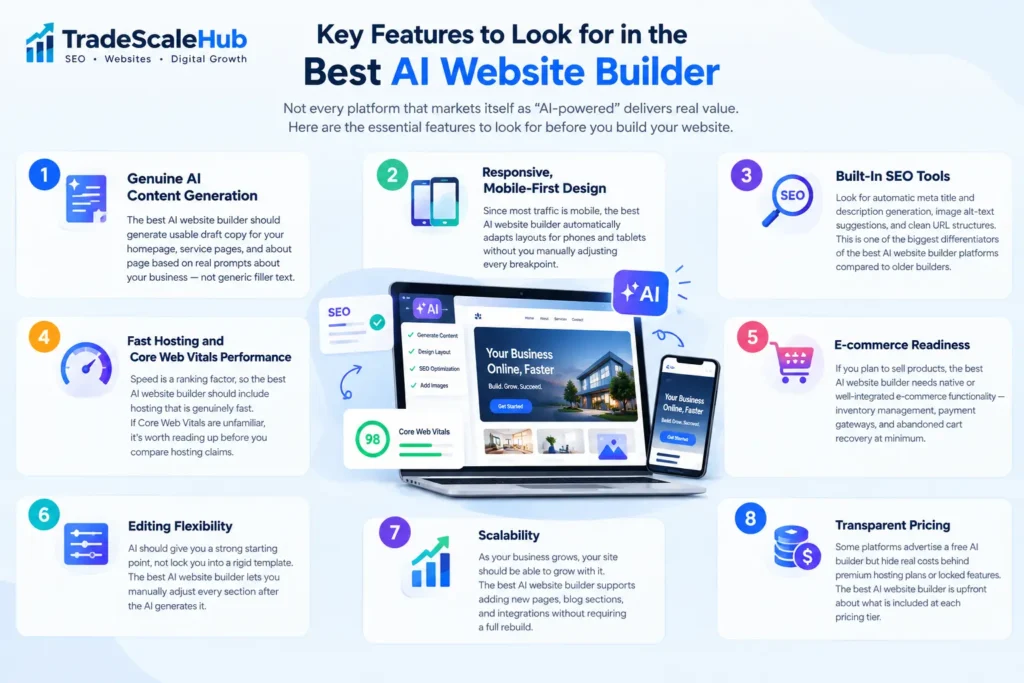
Not every platform that markets itself as “AI-powered” delivers real value. Before you commit, evaluate any candidate against these core features. This checklist is the fastest way to separate the best AI website builder options from tools that just bolt AI branding onto an old template system.
1. Genuine AI Content Generation
The best AI website builder should generate usable draft copy for your homepage, service pages, and about page based on real prompts about your business — not generic filler text you have to rewrite from scratch.
2. Responsive, Mobile-First Design
Since most traffic is mobile, the best AI website builder automatically adapts layouts for phones and tablets without you manually adjusting every breakpoint.
3. Built-In SEO Tools
Look for automatic meta title and description generation, image alt-text suggestions, and clean URL structures. This is one of the biggest differentiators of the best AI website builder platforms compared to older, purely visual builders. Pairing this with a solid technical SEO checklist will give your new site a real head start in search rankings.
4. Fast Hosting and Core Web Vitals Performance
Speed is a ranking factor, so the best AI website builder should include hosting that is genuinely fast, not just marketed as fast. If Core Web Vitals are unfamiliar territory, it is worth reading up before you compare hosting claims between platforms.
5. E-commerce Readiness
If you plan to sell products, the best AI website builder you choose needs native or well-integrated e-commerce functionality — inventory management, payment gateways, and abandoned cart recovery at minimum.
6. Editing Flexibility
AI should give you a strong starting point, not lock you into a rigid template. The best AI website builder lets you manually adjust every section after the AI generates it.
7. Scalability
As your business grows, your site should be able to grow with it. The best AI website builder supports adding new pages, blog sections, and integrations without requiring a full rebuild.
8. Transparent Pricing
Some platforms advertise a free AI builder but hide real costs behind premium hosting plans or locked features. The best AI website builder is upfront about what is included at each pricing tier.
Top AI Website Builders in 2026
Below is a breakdown of platforms that consistently rank among the best AI website builder options this year, based on feature depth, design quality, and real-world usability.
Wix ADI (Artificial Design Intelligence)
Wix remains one of the most recognizable names in the space, and its ADI tool is often the first stop for beginners searching for the best AI website builder. It asks a series of questions about your business and generates a full site, including copy and stock imagery, in minutes.
Pros: Huge app marketplace, strong design flexibility after generation, solid e-commerce tools. Cons: Can feel bloated for very simple sites; some advanced SEO settings are buried in menus.
Hostinger AI Website Builder
Hostinger’s AI tool has grown into a genuine contender for the best AI website builder title, particularly for budget-conscious users. It bundles fast hosting with AI-generated layouts, logo creation, and a built-in heatmap tool to see how visitors interact with your pages.
Pros: Competitive pricing, fast servers, simple interface for non-technical users. Cons: Fewer third-party integrations than larger platforms; design customization is more limited.
Framer AI
Framer has positioned itself as the best AI website builder for designers who still want granular, pixel-level control. It generates a complete site from a text prompt but keeps the underlying editor closer to a professional design tool than a simplified drag-and-drop system.
Pros: Extremely polished, modern design output; excellent animation and interaction tools. Cons: Steeper learning curve; less beginner-friendly than more simplified builders.
10Web
Built specifically around WordPress, 10Web is frequently cited as the best AI website builder for anyone who wants AI-assisted design without giving up the flexibility of the WordPress ecosystem. If you’re weighing WordPress against a fully hosted builder, our comparison of WordPress.com vs WordPress.org is a useful companion read.
Pros: Full WordPress compatibility, automated speed optimization, real plugin access. Cons: Can be more technical than fully no-code alternatives; pricing scales with traffic.
Durable
Durable markets itself around speed, generating a usable business site in under 30 seconds. For freelancers and solo service providers who need something online today, it is a strong candidate for the best AI website builder in the “fast launch” category.
Pros: Extremely quick setup, built-in CRM and invoicing tools, low starting price. Cons: Design customization is limited compared to more design-focused platforms.
Shopify Magic
For merchants specifically, Shopify’s AI features push it toward being the best AI website builder for e-commerce. Magic generates product descriptions, suggests email copy, and helps optimize product pages automatically.
Pros: Best-in-class e-commerce infrastructure, huge app ecosystem, reliable checkout experience. Cons: Higher monthly cost once you add apps; less suited to non-store content sites.
Squarespace AI
Squarespace’s AI writing and layout assistant appeals to creatives and small businesses that care deeply about visual polish. It is often shortlisted as the best AI website builder for portfolios, photographers, and boutique brands.
Pros: Beautiful default templates, strong blogging tools, reliable uptime. Cons: Fewer advanced SEO controls than dedicated SEO-first platforms.
Dorik AI
Dorik is a newer entrant but has quickly built a reputation as a genuinely capable, budget-friendly best AI website builder alternative for startups. It focuses on clean, fast-loading pages with minimal bloat.
Pros: Lightweight output, affordable pricing tiers, straightforward interface. Cons: Smaller template library and fewer integrations than established competitors.
AI Website Builders vs. Traditional Website Builders vs. Hiring a Developer
It helps to understand where the best AI website builder actually sits between two older options: a traditional drag-and-drop builder and a custom-coded site from a developer.
Traditional website builders (the pre-AI generation of tools like early Wix or Weebly) still require you to pick a template and manually place every section, write every line of copy, and choose every image yourself. They are flexible but slow, and results depend heavily on your own design skills.
Custom development gives you the most control and the best long-term performance ceiling, but it comes with the highest cost and the longest timeline — often weeks or months before launch, plus ongoing developer fees for updates.
The best AI website builder sits in the middle. It automates the repetitive parts of the traditional process — layout decisions, first-draft copy, image selection — while still giving you a real editor to adjust anything the AI gets wrong. For most small businesses and solo operators, that middle ground offers the best return on time and money, which is exactly why demand for the best AI website builder tools has grown so quickly since 2024.
That said, custom development still makes sense for larger businesses with complex functionality needs — booking systems with unusual logic, custom integrations, or highly specific user permissions that go beyond what any AI website builder currently supports out of the box. If your project fits that description, an AI builder can still be useful for a quick landing page while the custom build is in progress.
Where AI Website Builders Are Headed Next
The category is moving fast, and understanding the direction of travel can help you pick a platform that will still be relevant in a year or two, not just today.
- Deeper personalization. Expect the best AI website builder platforms to start generating different homepage variations for different visitor segments automatically, based on referral source or location.
- Voice and conversational editing. Instead of clicking through menus, more platforms are adding chat-based editing, where you simply describe the change you want and the AI applies it.
- Tighter SEO feedback loops. Rather than generating SEO settings once at launch, the best AI website builder tools are starting to monitor search performance and suggest ongoing content updates automatically.
- Better accessibility defaults. Automated alt text, color contrast checks, and keyboard navigation support are becoming standard rather than optional add-ons.
- Multilingual generation. As more businesses serve international audiences, AI builders are adding one-click translation and localization, a feature that used to require a separate agency project.
None of these trends change the core advice: test a real draft of your own site before paying for a plan, and judge the best AI website builder for your situation by how much genuine time it saves you, not by how impressive the marketing demo looks.
A Quick Real-World Example
Consider a local electrician who needs a professional site fast. Using the best AI website builder for their situation, they could generate a homepage, service pages for each offering, and a contact page in under an hour. From there, the priority shifts to the details that actually drive calls and bookings: clear service descriptions, real photos of completed jobs, and a fast-loading mobile experience. The AI handles the framework; the business owner (or their agency) fills in the details that make the site trustworthy to a local customer searching on their phone.
This pattern repeats across almost every industry. The best AI website builder gets you 70 to 80 percent of the way to a finished, professional site. The remaining work — refining copy, adding real testimonials, tightening up SEO — is what turns a generic AI draft into a site that actually converts visitors into customers.
Best AI Website Builder by Use Case
Since no single platform wins every category, here is a quick breakdown of the best AI website builder depending on what you are building.
- Best AI website builder for small local businesses: Hostinger AI or Durable, thanks to fast setup and affordable pricing.
- Best AI website builder for e-commerce: Shopify Magic, for its payment infrastructure and inventory tools.
- Best AI website builder for designers: Framer AI, for its pixel-level control and animation options.
- Best AI website builder for WordPress users: 10Web, for combining AI generation with full plugin access.
- Best AI website builder for portfolios and creatives: Squarespace AI, for its visual-first templates.
- Best AI website builder for beginners: Wix ADI, for its guided setup process and large support library.
How to Choose the Best AI Website Builder for Your Business
Picking the best AI website builder is not just about features on a comparison chart. Walk through these steps before you commit to a plan:
- Define your goal first. A lead-generation site for a service business has different needs than an online store, so the best AI website builder for one may not fit the other.
- Test the free trial. Nearly every platform on this list offers some form of free tier. Generate a real draft of your site before paying for anything.
- Check mobile output. Preview the AI-generated design on an actual phone, not just the desktop editor.
- Review the SEO settings. Confirm the platform lets you edit meta titles, descriptions, and URL slugs — non-negotiable features for the best AI website builder in 2026.
- Evaluate support. Look for live chat or fast email response times in case something breaks after launch.
- Compare total cost. Add hosting, apps, and any premium AI credits together before comparing final pricing across platforms.
Common Mistakes When Choosing an AI Website Builder
Even with a clear shortlist, business owners often make avoidable mistakes when picking the best AI website builder for their needs.
- Judging only by the demo. A polished sales demo does not always reflect how flexible the editor feels once you’re customizing your own content.
- Ignoring page speed. A visually stunning AI-generated site that loads slowly will lose rankings and visitors. Always test performance against the metrics covered in our website speed and SEO guide.
- Skipping the SEO fundamentals. AI tools handle the basics, but they do not replace a real SEO strategy built around your target keywords and audience.
- Overlooking scalability. A great starter plan can become restrictive once you need more pages, forms, or products.
- Forgetting about ownership. Confirm you can export your content or migrate away if the platform ever changes its pricing or shuts down a feature you rely on.
Best AI Website Builder: Pricing Snapshot
Pricing shifts often, so treat these as general positioning rather than fixed numbers, and always confirm current rates directly with each provider before you buy.
| Platform | Starting Tier | Best For |
|---|---|---|
| Wix ADI | Free plan available, paid plans for custom domains | Beginners wanting guided setup |
| Hostinger AI | Budget-friendly entry plans | Small businesses on a tight budget |
| Framer AI | Free trial, premium plans for full publishing | Designers wanting granular control |
| 10Web | Mid-range, scales with traffic | WordPress users wanting AI assistance |
| Durable | Low-cost monthly plans | Fast launches for solo service providers |
| Shopify Magic | Standard Shopify pricing plus app costs | E-commerce merchants |
| Squarespace AI | Mid-range annual plans | Portfolios and creative brands |
| Dorik AI | Budget-friendly tiers | Startups wanting lightweight sites |
When comparing these numbers, remember that the best AI website builder for your budget is not always the cheapest option upfront — factor in hosting reliability, SEO tools, and how much time you’ll save on editing before making a final call.
Security and Ongoing Maintenance
Launching your site is only step one. Once it’s live, a few ongoing habits keep it running smoothly and protect it from the kind of downtime that quietly costs you leads:
- Keep plugins and integrations updated. If your platform connects to third-party apps for booking, payments, or email marketing, outdated integrations are one of the most common causes of broken forms and failed checkouts.
- Back up regularly. Most hosted platforms handle this automatically, but it’s worth confirming your provider keeps at least 30 days of restore points in case something goes wrong.
- Monitor uptime. A free uptime monitoring tool can alert you the moment your site goes down, rather than finding out from a frustrated customer.
- Review analytics monthly. Traffic patterns, top-performing pages, and bounce rates tell you where to focus your next round of content or design updates.
- Renew your domain and SSL certificate on time. Expired domains and certificates are avoidable but surprisingly common causes of lost traffic and broken trust signals in the browser.
Handled consistently, these habits keep a site running reliably for years without needing a full rebuild, which is ultimately the point of investing time in the right platform from the start.
Frequently Asked Questions
Is the best AI website builder always the most expensive one? No. Price does not always correlate with quality. Several budget-friendly platforms, like Hostinger AI and Dorik, deliver strong results for straightforward business sites, while premium platforms make more sense for complex e-commerce or highly custom designs.
Can I switch AI website builders later if I’m unhappy? Usually, but migration is easier on some platforms than others. WordPress-based tools like 10Web tend to offer more export flexibility than fully closed, proprietary systems.
Does using an AI website builder hurt my SEO? Not inherently. In fact, the best AI website builder platforms often include stronger default SEO settings than a manually coded site built without SEO knowledge. The key is reviewing and refining what the AI generates rather than publishing it untouched.
How long does it take to launch a site with the best AI website builder? Most platforms can generate a working draft in under an hour, though refining copy, images, and settings before launch typically takes a few additional hours or days depending on the complexity of your site.
Do I still need a developer if I use an AI website builder? For most small business sites, no. Developers become more valuable for highly custom functionality that goes beyond what any AI website builder currently offers out of the box.
Will an AI-generated site look generic compared to a custom design? It can, if you publish the first draft without edits. The best AI website builder platforms give you a strong starting layout, but swapping in real photos, adjusting the color palette, and rewriting the generated copy in your own voice makes a significant difference in how polished and original the final site feels to visitors.
Final Thoughts
The best AI website builder for your business depends heavily on your goals, budget, and technical comfort level. A solo service provider chasing a fast launch will have different priorities than an e-commerce brand scaling across multiple product lines. What matters most is testing a real draft with your own content before committing to a paid plan, checking how the platform handles mobile design and page speed, and confirming the SEO tools go beyond surface-level settings.
Whichever platform you choose, remember that the builder is only the starting point. Ongoing content, technical maintenance, and a real SEO strategy are what turn a good-looking AI-generated site into one that actually ranks and converts. Take the time to shortlist two or three options, generate a real draft with your own business details on each, and compare the results side by side before you commit to a paid plan. If you want a deeper look at related topics, our guide to avoiding common AI website mistakes and this broader guide to AI website builders are worth reading next.
