
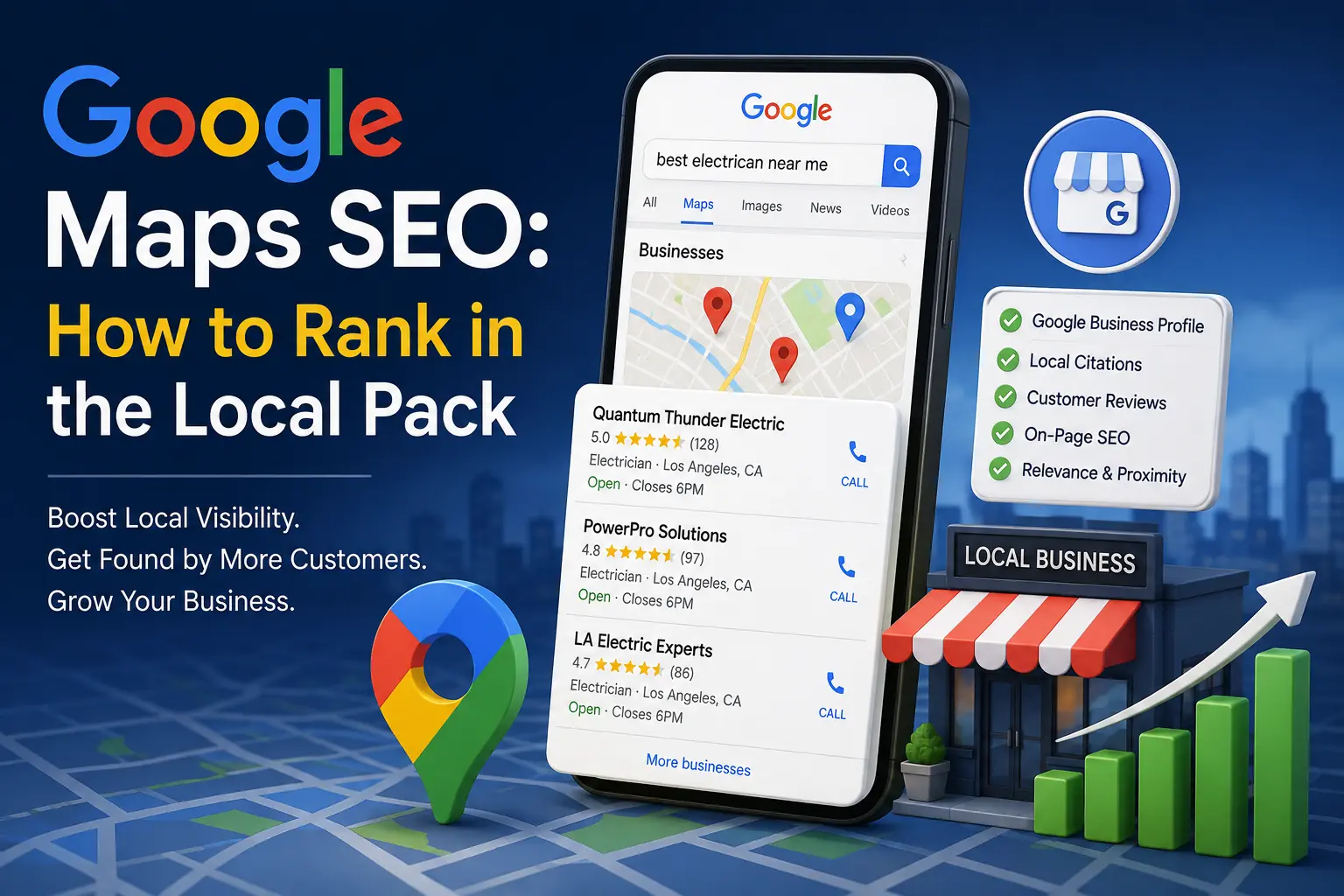
Ranking on Google Maps is no longer a bonus channel for local businesses — it’s often the first thing a potential customer sees before they ever visit a website. When someone searches “electrician near me” or “HVAC repair in my city,” the three listings above the standard results usually get more clicks than anything below them. That’s why understanding Google Maps SEO has become one of the most valuable skills a local business owner or marketer can develop in 2026.
At its core, Google Maps SEO is the practice of optimizing your Google Business Profile, your website, and your off-site reputation so your business appears prominently when people search for services in your area — either directly on the Maps app or in the Local Pack that shows up on a standard Google search. Unlike traditional organic optimization, which competes for a spot on a results page, this discipline competes for a spot on a map, and that map is driven by a very different set of signals.
In this guide, we’ll break down exactly how local map rankings work, the ranking factors that matter most, and a step-by-step process you can follow to move your business into the coveted three-pack. Whether you run a single-location service business or manage several locations, the principles covered here apply directly to your growth strategy.
What Is Google Maps SEO?
Google Maps SEO refers to the set of strategies used to improve a business’s visibility within Google Maps and the Local Pack (also called the Map Pack or 3-Pack). When a person searches for a local service, Google shows a small map with three business listings, pulled largely from Google Business Profile data, on-page website signals, and off-site trust signals like reviews and citations.
A solid strategy for local map visibility combines three major pillars:
- Google Business Profile optimization — the foundation of any local ranking effort
- On-page and technical SEO — making sure your website reinforces the same signals Google sees on your listing
- Off-site trust signals — reviews, citations, and local backlinks that prove your business is legitimate and relevant
If any one of these pillars is weak, your visibility on the map will suffer, even if the other two are strong. That’s why a comprehensive approach matters more than chasing a single tactic, and why Google Maps SEO should be treated as an ongoing discipline rather than a one-time project.
Why Google Maps SEO Matters More Than Ever
Consumer behavior has shifted dramatically toward map-based, mobile-first search. A large share of “near me” searches now happen on a phone, often while a person is actively looking for a business to call within the next hour. For service-based businesses like electricians, plumbers, towing companies, and appliance repair technicians, this makes Google Maps SEO arguably more important than traditional organic rankings.
Here’s why local map visibility deserves a dedicated strategy rather than an afterthought:
- Visibility above organic results: The Local Pack typically appears above traditional blue-link results, meaning a strong presence there can outrank competitors who only focus on organic content.
- Higher purchase intent: People browsing the map are frequently ready to book, call, or visit immediately, so this channel tends to convert at a higher rate than generic organic traffic.
- Mobile dominance: Since most map searches happen on mobile devices, strong Google Maps SEO puts your business directly in front of users at the exact moment they’re deciding who to contact.
- Free exposure: Unlike paid ads, ranking through organic map visibility is free — once your listing and website are optimized, you keep earning exposure without paying per click.
Because of these advantages, any business with a physical location or a defined service area should treat Google Maps SEO as a core part of its digital marketing plan, not a side project.
How Google Ranks Businesses on Google Maps
To succeed at Google Maps SEO, you need to understand the three ranking factors Google itself has confirmed influence Local Pack placement: relevance, distance, and prominence.
1. Relevance
Relevance measures how well your Google Business Profile and website match what the searcher is looking for. This is where map optimization overlaps heavily with keyword strategy. If someone searches “emergency plumber,” your profile category, business description, services list, and website content all need to clearly communicate that you offer emergency plumbing. Vague categories or thin service descriptions weaken relevance and hurt your standing in local search results.
2. Distance
Distance refers to how close your business — or service area — is to the location implied in the search. You can’t control where the searcher is standing, but you can improve your odds by making sure your service areas, address, and website content account for every neighborhood or city you actually serve. This is a critical piece of any local Google Maps SEO plan for businesses covering multiple towns or districts.
3. Prominence
Prominence reflects how well-known and trusted your business is, both online and offline. It’s shaped by review volume and quality, citation consistency, backlink authority, and general brand mentions across the web. Of the three ranking factors, prominence is usually where the most ongoing effort should be spent, since it’s the factor most directly influenced by everyday marketing activity.
Understanding these three pillars is the foundation of any effective Google Maps SEO campaign — everything else in this guide maps back to improving relevance, distance, or prominence.
Step 1: Fully Optimize Your Google Business Profile
Your Google Business Profile is the single most important asset in your Google Maps SEO toolkit. It’s the listing Google actually displays on the map, so every field you fill out — or leave blank — directly affects how you’re ranked.
Choose the Right Primary and Secondary Categories
Category selection is one of the most overlooked levers in this process. Your primary category should describe your core business as precisely as possible (“Appliance Repair Service” rather than a generic “Business”). Add secondary categories for any additional services you offer, since Google leans on these categories heavily when matching search intent to businesses in the Local Pack.
Write a Keyword-Aware Business Description
Your business description should naturally reference your services and location without keyword stuffing. A well-written description that mentions your city, service type, and specialties supports your broader Google Maps SEO effort by reinforcing relevance signals Google already sees elsewhere on your profile.
Add Complete Business Information
Fill out every available field: hours, phone number, website, service areas, attributes, and products or services. Incomplete profiles consistently underperform in local rankings because Google has less data to match against searcher intent.
Upload High-Quality Photos Regularly
Businesses that upload fresh photos tend to see stronger engagement metrics, which is one of the quieter contributors to long-term visibility on the map. Photos of your team, vehicles, completed jobs, and storefront all help build trust with both Google and potential customers.
For a deeper walkthrough of every profile field worth optimizing, see our complete Google Business Profile optimization guide, which pairs well with the Google Maps SEO steps in this article.
Step 2: Keep Your NAP Consistent Everywhere
NAP stands for Name, Address, and Phone number, and consistency across the web is one of the clearest trust signals Google uses when evaluating a listing. If your business is listed as “Smith Electric LLC” on your website but “Smith Electric” on Yelp and “Smith Electrical Services” on a directory, Google struggles to confirm these are the same business — which weakens the prominence score behind your Google Maps SEO results.
To strengthen this part of your strategy:
- Audit every directory, citation, and social profile for NAP accuracy
- Standardize formatting (abbreviations, suite numbers, phone format) across all platforms
- Update outdated listings from old addresses or previous phone numbers
- Claim and verify listings on major directories, not just Google
Local citations are a foundational piece of any Google Maps SEO campaign, and getting them wrong quietly undermines everything else you do. Our detailed breakdown on building accurate local citations walks through the exact process for cleaning up and expanding your citation profile.
Step 3: Generate and Manage Google Reviews
Review signals carry significant weight in Google Maps SEO because they speak directly to prominence and, indirectly, to relevance when reviews mention specific services or locations. A steady stream of recent, detailed, positive reviews tells Google — and customers — that your business is active and trustworthy.
Why Review Velocity Matters
Google doesn’t just look at your total review count; it also considers how recently and how consistently reviews come in. A business with two hundred reviews from three years ago and nothing since sends a weaker signal than a business steadily earning a handful of reviews every week, which matters a great deal for Google Maps SEO.
How to Encourage More Reviews
- Ask satisfied customers directly, ideally right after a completed job
- Send a simple text or email with a direct link to your review page
- Make leaving a review as frictionless as possible
- Respond to every review, positive or negative, since responses are themselves a ranking signal for active profile management
We cover this process in much more depth in our guide on how to get more Google reviews, which includes templates and timing strategies that plug directly into your Google Maps SEO plan.
Responding to Negative Reviews
How you handle criticism matters too. A calm, professional response to a negative review demonstrates accountability and can even reassure future customers reading through your profile. Never ignore negative feedback — unanswered complaints can quietly erode the trust signals that support your standing in the Local Pack.
Step 4: Align Your Website’s On-Page SEO With Your Map Listing
Google cross-references your website against your Google Business Profile, so on-page SEO plays a bigger role in Google Maps SEO than many business owners realize.
Location Pages
If you serve multiple cities or neighborhoods, dedicated location pages help reinforce the distance and relevance signals central to strong map rankings. Each page should include unique content about that specific service area rather than duplicating the same text with a swapped city name.
Title Tags and Headers
Include your primary service and city in title tags, H1s, and key subheadings. This isn’t about stuffing keywords — it’s about making sure your website content clearly matches the same relevance signals Google is evaluating for Google Maps SEO purposes.
Embedded Map and NAP on Every Page
Embedding your Google Map and displaying your NAP consistently in the footer of every page reinforces the same information Google already sees on your profile, which supports both technical SEO and your map rankings simultaneously.
Schema Markup
LocalBusiness schema markup gives Google structured data about your name, address, hours, and service area, directly supporting your Google Maps SEO efforts by making it easier for Google to confirm the information already submitted through your listing.
For a broader foundation on how on-page elements affect rankings generally, our guide to on-page SEO fundamentals is a useful companion piece, since strong on-page SEO underpins both organic rankings and Google Maps SEO.
Step 5: Build Local Relevance Through Content and Links
Content marketing might not seem directly connected to Google Maps SEO, but it plays a supporting role by strengthening the prominence and relevance signals Google relies on.
Publish Locally Focused Content
Blog posts about local events, community involvement, or city-specific service tips give Google more contextual signals tying your business to a geographic area — a subtle but real contributor to stronger local visibility.
Earn Local Backlinks
Links from local news outlets, chambers of commerce, sponsorships, and community organizations help build the kind of prominence that moves the needle for Google Maps SEO. These links don’t need to be high-volume; a handful of genuinely local, relevant links often outperforms dozens of generic directory links. If you want a wider framework for earning these kinds of links, our guide on link building strategies is a helpful reference point.
Get Involved With Local Directories Beyond Google
While your Google Business Profile is central, listings on Yelp, Apple Maps, Bing Places, and industry-specific directories all contribute supporting signals that reinforce your overall footprint on the map.
Step 6: Don’t Ignore Technical SEO
Website performance issues can quietly hold back your Google Maps SEO results, even when your listing is fully optimized.
- Site speed: Slow-loading pages hurt user experience and can indirectly affect how Google evaluates your overall web presence, which ties back into local rankings.
- Mobile usability: Since most local searches happen on mobile, a website that isn’t fully responsive undermines the conversions your Google Maps SEO strategy is meant to generate.
- Indexing: If your location pages aren’t indexed, they can’t reinforce your relevance signals at all. Regularly check Search Console to confirm key pages are indexed — our guide on fixing indexing issues in Search Console walks through the process step by step.
- Secure, accessible hosting: Broken links, expired SSL certificates, or downtime all chip away at the trust signals feeding into Google Maps SEO.
If you haven’t run a full technical review recently, our SEO audit guide for 2026 is a good place to start before layering in more advanced Google Maps SEO tactics.
Common Google Maps SEO Mistakes to Avoid
Even businesses that understand the fundamentals often stumble on these common mistakes:
- Keyword-stuffing the business name field — adding extra keywords to your Google Business Profile name violates Google’s guidelines and can get your listing suspended, undoing any progress you’ve made with Google Maps SEO.
- Using a virtual office or P.O. box — Google requires a legitimate physical location or defined service area for most business categories, and misrepresenting this can tank your visibility on the map.
- Ignoring duplicate listings — multiple profiles for the same business confuse Google and dilute the prominence signals your Google Maps SEO strategy depends on.
- Neglecting the Q&A section — an unanswered or outdated Q&A section is a missed opportunity to reinforce relevance.
- Inconsistent posting activity — Google Business Profile posts that go unused for months can make your listing appear inactive, weakening your Google Maps SEO standing over time.
- Overlooking mobile experience — a clunky mobile site undoes much of the value that strong Local Pack visibility is supposed to deliver.
If you suspect your profile has already run into trouble, our guide on recovering a suspended Google Business Profile explains the most common causes and how to fix them before they derail your Google Maps SEO progress.
Measuring and Tracking Google Maps SEO Performance
Like any marketing channel, Google Maps SEO needs consistent measurement to know what’s working.
Key Metrics to Track
- Map views and search views: Available directly inside your Google Business Profile dashboard, these show how often your listing appeared for relevant searches.
- Customer actions: Calls, website clicks, and direction requests all indicate how well your Google Maps SEO efforts are converting visibility into real business activity.
- Keyword rank tracking: Local rank tracking tools show where you appear in the Local Pack for target terms, giving you a clear picture of progress over time.
- Review growth rate: Tracking new reviews monthly helps you spot whether your review strategy is keeping pace with the prominence signals that support Google Maps SEO.
Tools Worth Using
Several tools specialize in local rank tracking and Google Business Profile insights, letting you monitor performance across multiple keywords and locations at once. Pair these with Google Search Console and Google Analytics to connect map visibility with actual website traffic and conversions. Understanding what factors Google weighs behind the scenes also helps — our breakdown of Google Business Profile ranking factors is a good companion resource here.
Managing Multiple Locations on the Map
Businesses with more than one physical location or service hub face a slightly different set of challenges. Each location typically needs its own verified profile, its own set of local citations, and its own dedicated page on your website. Treating every branch as a standalone entity — rather than lumping them under a single generic listing — tends to produce far stronger results in the Local Pack for each individual city or neighborhood you serve.
A few practices help multi-location businesses stay organized:
- Separate profiles per address: Never try to represent two physical branches with a single listing, even if they’re operated by the same parent company.
- Unique content per location page: Reuse your overall brand voice, but write distinct service descriptions, testimonials, and local details for each city page rather than copying and pasting the same paragraph with the city name swapped out.
- Local phone numbers where possible: A local area code can slightly reinforce the geographic relevance of a branch listing compared to a single shared toll-free number.
- Centralized reporting: Use a dashboard or spreadsheet to track review counts, citation accuracy, and ranking positions for each branch separately, since averaging performance across locations can hide underperforming branches.
Franchise and multi-branch operators who follow this structure typically see faster, more predictable improvements across every branch they manage, rather than one strong flagship location carrying the rest.
A Simple Google Maps SEO Checklist
Use this checklist as a quick reference for maintaining a healthy strategy:
- Claim and fully verify your Google Business Profile
- Choose accurate primary and secondary categories
- Write a complete, keyword-aware business description
- Upload fresh photos on a regular schedule
- Standardize NAP across your website and all directories
- Build and audit local citations regularly
- Actively request and respond to reviews
- Create dedicated location pages for each service area
- Add LocalBusiness schema markup
- Publish locally relevant content regularly
- Earn local backlinks from community sources
- Monitor site speed and mobile usability
- Track Local Pack rankings and profile insights monthly
Working through this checklist consistently, rather than as a one-time project, is what separates businesses with lasting Google Maps SEO results from those that see a short-term bump and then plateau.
How Long Does Google Maps SEO Take to Show Results?
Timelines vary depending on competition, but most businesses start seeing measurable movement in Local Pack rankings within 60 to 90 days of consistent optimization work, especially when Google Business Profile updates, citation cleanup, and review generation are tackled together rather than sequentially. Highly competitive markets or industries may take longer, while less competitive niches can see Google Maps SEO improvements even faster.
Patience matters here — Google needs time to recrawl your profile, index updated website content, and accumulate the review and citation signals that feed into prominence. Businesses that abandon their Google Maps SEO strategy after a few weeks often miss the compounding benefits that show up several months in. Pairing this patience with a solid keyword research process for local businesses also helps you prioritize which service terms to target first.
Frequently Asked Questions About Google Maps SEO
Does Google Maps SEO require a physical storefront? No. Service-area businesses without a public-facing storefront can still rank well by defining accurate service areas and following the same optimization steps outlined above.
Is Google Maps SEO different from local SEO? Google Maps SEO is a subset of local SEO focused specifically on Google Maps and the Local Pack, while local SEO more broadly includes organic local rankings, directory presence, and localized content strategy. Our guide on what local SEO actually covers breaks down where the two overlap and where they differ.
How many reviews do I need for a strong Google Maps SEO profile? There’s no fixed number, but consistent review growth over time matters more than hitting an arbitrary total.
Can I do Google Maps SEO myself, or do I need an agency? Many of the steps in this guide can be handled in-house, but ongoing citation management, content production, and link building are areas where an experienced partner can accelerate your Google Maps SEO results.
Does posting on social media affect my map rankings? Social activity isn’t a direct ranking input, but an active, consistent brand presence tends to generate more searches for your business name and more traffic to your website, both of which can indirectly reinforce the prominence signals behind strong Local Pack visibility.
What’s the single highest-impact action for a business just getting started? Fully completing and verifying your Google Business Profile, then focusing on a steady flow of genuine customer reviews, tends to produce the fastest visible movement for businesses that haven’t done any prior optimization work.
Final Thoughts on Google Maps SEO
Google Maps SEO sits at the intersection of your Google Business Profile, your website, and your broader online reputation. None of these pieces work in isolation — a fully optimized profile paired with a weak website, or a great website with an unmanaged profile, will both underperform in the Local Pack. The businesses that consistently rank at the top are the ones treating relevance, distance, and prominence as an ongoing system rather than a one-time checklist.
Start with your Google Business Profile, tighten up NAP consistency across the web, build a steady review pipeline, and make sure your website reinforces every signal your profile already sends. Do this consistently, and Google Maps SEO becomes one of the most reliable, cost-effective growth channels available to any local business.
If you’re ready to go deeper, our guides on local SEO for small businesses and ranking on Google both build naturally on the framework covered in this Google Maps SEO guide.
