

If you run a local business — a plumbing company, a roofing crew, a dental clinic, a law firm — your website’s service pages are doing more heavy lifting than almost any other part of your site. Homepages get the traffic, but service pages are usually where the buying decision actually happens. That’s exactly why service pages SEO deserves its own dedicated strategy instead of being treated as an afterthought bolted onto your homepage or your blog.
Most local businesses spend their SEO budget on blog content and Google Business Profile tweaks, then wonder why they’re not showing up when someone searches “emergency plumber near me” or “roof replacement [city].” The answer, more often than not, is a weak, under-built page. A thin, generic service page can’t compete against a competitor who has built a genuinely optimized, locally relevant page targeting the exact same search intent.
In this guide, we’ll walk through everything that goes into strong service pages SEO — from keyword research and page structure to schema markup, internal linking, and the local trust signals that convince both Google and real customers that you’re the right choice. Whether you’re building service pages from scratch or auditing existing ones, this guide gives you a practical, repeatable framework you can apply to every location and every service you offer.
What Is Service Pages SEO and Why It Matters for Local Businesses
Service pages SEO refers to the process of optimizing the individual pages on your website that describe a specific service — such as “AC Repair,” “Kitchen Remodeling,” or “Personal Injury Consultation” — so they rank well in local search results and convert visitors into leads or customers. Unlike blog posts, which typically target informational searches, service pages target commercial and transactional intent: people who are actively looking to hire someone, right now, in their area.
This distinction matters enormously here. Someone searching “how to unclog a drain” wants a DIY tutorial. Someone searching “drain cleaning service [city]” wants a phone number and a quote. If your service page reads like a blog post — full of general tips and light on specifics about what you actually do, where you do it, and why someone should choose you — it will struggle to rank and struggle to convert even when it does.
A good approach treats each page as a standalone landing page built around one core service and one core service area (or a tightly related cluster of areas). This is very different from generic “About Us” style pages that try to cover everything a company does in one paragraph. When service pages SEO is done correctly, each page becomes a dedicated entry point that Google can match precisely to a specific local search query.
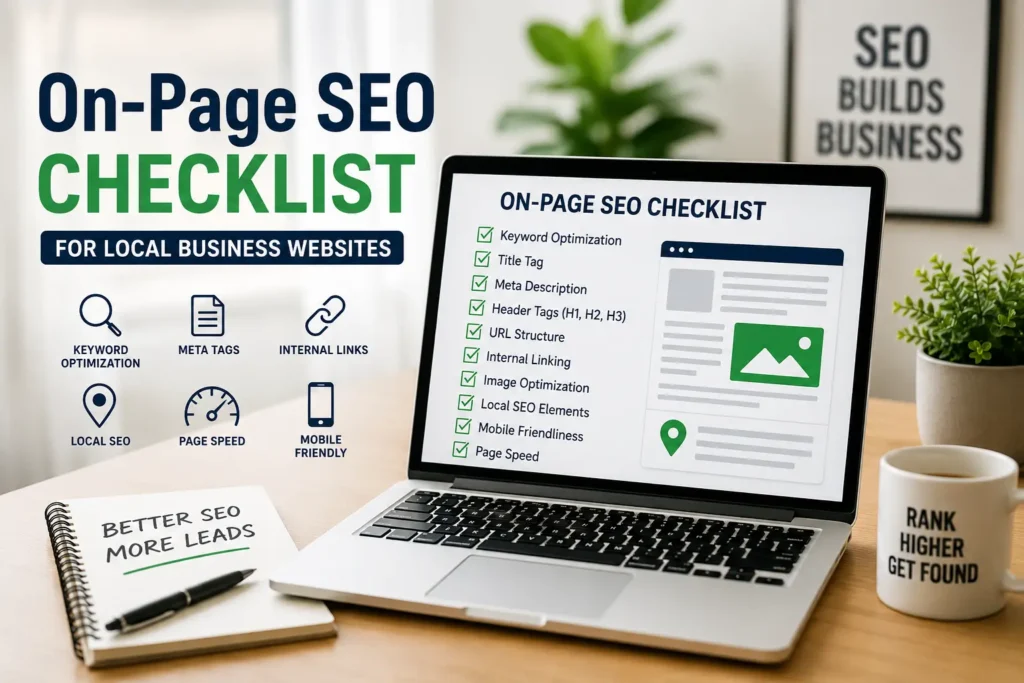
If you haven’t already reviewed the fundamentals, it’s worth pairing this guide with our broader on-page SEO resource, since everything we cover here builds on those same core principles applied specifically to service-based pages.
Service Pages SEO vs. Location Pages: Know the Difference
Before diving into tactics, it’s important to separate the two concepts, because businesses often conflate the two and end up with confusing, overlapping content.
- Service pages answer “what do you do?” — plumbing repair, roof replacement, HVAC installation.
- Location pages answer “where do you do it?” — Chicago, Naperville, Aurora.
- Service + location pages combine both — “Roof Replacement in Naperville, IL.”
For most local businesses serving multiple areas, the strongest service pages SEO strategy is to create a dedicated service page for each core offering, then build location-specific variants for your primary service areas if you serve a wide geographic footprint. A single national-style service page rarely competes well against a hyper-local competitor, so if local rankings matter to you, service and location content need to work together rather than in isolation. Our guide on local SEO vs. SEO breaks down this distinction in more depth if you want additional context.
Step 1: Do Keyword Research Before You Write a Single Word
Every solid service pages SEO campaign starts with keyword research — not with writing. Too many businesses write the page first and try to “SEO it” afterward, which almost always produces awkward, keyword-stuffed copy that reads badly and still doesn’t rank.
For this kind of page, you’re generally looking for three types of keywords:
- Head terms — “roof replacement,” “personal injury lawyer,” “HVAC repair”
- Local modifiers — “roof replacement in [city],” “HVAC repair near me”
- Long-tail service variations — “emergency roof leak repair,” “24 hour HVAC repair,” “flat fee personal injury consultation”
A page built around service pages SEO best practices will typically target one head term plus its local modifier as the primary focus, while naturally weaving in long-tail variations throughout the body copy, FAQs, and subheadings. Tools like Google Keyword Planner, Ahrefs, or even Google’s autocomplete and “People also ask” boxes are useful here, but so is simply searching your own target terms and studying what’s already ranking.
If you’re newer to this process, our detailed walkthrough on keyword research for local businesses is a good companion resource — it covers search volume interpretation, competitor gap analysis, and how to prioritize which keywords deserve their own dedicated page versus which can be folded into an existing one. This step alone often determines whether your optimization efforts succeed or stall, because targeting the wrong keyword means optimizing perfectly for a term nobody searches.
Step 2: Build a URL Structure That Supports Service Pages SEO
URL structure is one of the most overlooked components of service pages SEO, yet it’s one of the easiest to get right. Your URLs should be short, descriptive, and include your primary keyword without unnecessary clutter.
Compare these two examples:
- Weak:
yoursite.com/services/page-id-4471 - Strong:
yoursite.com/roof-replacement/
The second example immediately tells both users and search engines what the page is about. If you’re running location-specific pages, a clean structure like yoursite.com/roof-replacement/naperville/ keeps your site architecture logical and scalable, which matters a great deal as your site grows to cover more services and more cities.
Avoid deep nesting for the sake of “organization.” A URL buried four folders deep dilutes relevance signals and makes the page harder for both crawlers and users to find. Flat, keyword-relevant URLs are consistently one of the simplest wins in service pages SEO.
Step 3: Write Title Tags and Meta Descriptions That Earn Clicks
Your title tag is arguably the single most important on-page element in service pages SEO. It’s the first thing Google evaluates for relevance, and it’s the first thing a searcher sees in the results. A weak or generic title tag — “Services | Company Name” — wastes prime real estate that could otherwise be doing real work for your rankings.
A strong title tag for service pages SEO typically follows a pattern like:
[Service] in [City] | [Brand Name]
For example: “Emergency Plumbing Repair in Denver | ABC Plumbing Co.”
This structure hits the primary keyword, the local modifier, and the brand name, all within Google’s roughly 60-character display limit. Meta descriptions don’t directly influence rankings, but they heavily influence click-through rate, which is a meaningful indirect signal. A well-written meta description should include the keyword naturally, state a clear benefit, and end with a soft call to action — “Call today for a free quote” or “Same-day appointments available.”
Don’t underestimate this step. Two pages with identical rankings can see dramatically different traffic simply because one has a compelling meta description and the other doesn’t.
Step 4: Structure Your Page With Proper Headings
Header structure is a foundational piece of service pages SEO because it tells Google how your content is organized and helps users scan the page quickly — most visitors don’t read every word, they skim for relevant sections.
Your H1 should appear once and clearly state the service and, ideally, the location: “Professional Roof Replacement in Naperville, IL.” From there, H2s should break the page into logical sections such as:
- What the service includes
- Why choose your company
- Pricing or estimate information
- The process, step by step
- Frequently asked questions
- Service area coverage
Each H2 is an opportunity to reinforce relevant keywords without stuffing them unnaturally. A page with clean, hierarchical headings almost always outperforms a wall-of-text page with no structure, both in rankings and in user engagement metrics like time on page and bounce rate — both of which feed back into how Google evaluates the page over time.
Step 5: Write Content That’s Actually Useful, Not Just Optimized
Here’s where a lot of service pages SEO advice goes wrong: it treats keyword placement as the whole job. In reality, Google’s algorithms — and real human visitors — reward pages that genuinely answer the questions a potential customer has before hiring someone.
A strong service page should answer:
- What exactly is included in this service?
- How long does it typically take?
- What does it cost, or how is pricing determined?
- What makes your company different from competitors?
- What should the customer expect during the process?
- Are you licensed, insured, or certified for this work?
Aim for genuine depth — most well-ranking service pages run somewhere between 800 and 1,500 words, though this varies by industry and competition level. Thin, 150-word pages rarely hold up in competitive local markets. That said, more words for the sake of more words isn’t the goal either; every paragraph should earn its place. Effective service pages SEO content answers real questions concisely rather than padding the page with filler just to hit a word count.
Avoid duplicating content across multiple location pages for the same service — this is one of the most common service pages SEO mistakes. If you’re building ten location variants of the same service page, each one needs unique details: local landmarks, service-area specifics, city-specific pricing notes, or testimonials from customers in that area. Google can and does detect near-duplicate content, and it will suppress rankings for pages that look like copy-paste templates.
Step 6: Add Local Trust Signals Throughout the Page
Trust signals are a crucial but often skipped part of service pages SEO. Local customers — and Google’s local ranking algorithms — respond strongly to evidence that you’re a real, established, credible business operating in their area.
Effective trust signals to weave into these pages include:
- Your business name, address, and phone number (NAP) clearly visible
- Customer reviews or testimonials specific to that service
- Photos of completed work, ideally with geotagged or location-relevant captions
- License numbers, certifications, or insurance details
- Years in business or number of local customers served
- Embedded Google Maps showing your service area
These elements don’t just build trust with visitors — they reinforce local relevance signals that support your broader local SEO efforts. If you haven’t audited your Google Business Profile lately, our Google Business Profile checklist pairs well with this step, since a strong profile and strong service pages SEO reinforce each other in the local pack.
Step 7: Use Schema Markup to Help Google Understand Your Service Pages
Structured data (schema markup) is a technical layer of service pages SEO that many local businesses skip entirely, which is a missed opportunity. Adding LocalBusiness or Service schema to your service pages gives Google explicit, machine-readable information about what the page offers, where you’re located, and what areas you serve.
At minimum, your schema should include:
- Business name, address, and phone number
- Service type and description
- Service area (city, region, or radius)
- Aggregate review rating, if available
- Price range, if applicable
This markup doesn’t guarantee rich results, but it does reduce ambiguity for search engines trying to match your page to a specific local query. Combined with clean HTML structure, schema markup rounds out the technical side of service pages SEO and often produces a noticeable lift in how consistently a page ranks for its target terms.
Step 8: Optimize Images for Service Pages SEO
Images matter more for service pages SEO than most businesses realize. Photos of actual completed jobs, team members, or equipment do double duty: they build trust with visitors and provide additional optimization opportunities through file names and alt text.
A few practical habits to build into your image workflow:
- Rename image files descriptively before uploading — “roof-replacement-naperville-il.jpg” instead of “IMG_4471.jpg”
- Write alt text that describes the image naturally, including location context where relevant
- Compress images so they don’t slow down page load — a bloated image gallery can quietly undo a lot of otherwise solid service pages SEO work
- Use real photos of your work rather than generic stock imagery wherever possible, since this also strengthens the trust signals discussed earlier
Page speed is closely tied to this step. If you haven’t reviewed your site’s performance recently, our guide to website speed and SEO and our breakdown of Core Web Vitals are worth reviewing alongside your service pages SEO audit, since a slow page undermines even the best-optimized content.
Step 9: Build a Strong Internal Linking Strategy
Internal linking is one of the most underrated levers in service pages SEO. Every service page should link out to related services, relevant location pages, and helpful blog content — and it should receive links back from your homepage, navigation menu, and related blog posts.
A few internal linking practices that consistently strengthen service pages SEO:
- Link from your homepage directly to your most important service pages, not buried three clicks deep
- Cross-link related services to one another (e.g., “AC Repair” linking to “AC Installation” and “Duct Cleaning”)
- Link from blog posts back to relevant service pages using descriptive, keyword-relevant anchor text rather than generic “click here” links
- Include a clear path from location pages to their corresponding service pages, and vice versa
This internal structure helps distribute authority across your site and gives Google a clearer picture of which pages matter most. It also keeps visitors moving toward a conversion point instead of dead-ending on a page with nowhere else to go. For a broader checklist covering this and other local ranking factors, see our full local SEO checklist.
Step 10: Include Calls to Action That Convert
Ranking well is only half the goal of service pages SEO — the other half is turning that visibility into actual leads. Every service page should include multiple, clearly visible calls to action: a phone number in the header, a contact form above the fold, and a repeated CTA near the bottom of the page after the visitor has had a chance to read through the content.
Strong calls to action for service pages SEO purposes typically:
- Use direct, low-friction language (“Get a Free Quote” rather than “Learn More”)
- Appear at least twice on the page — once near the top, once near the bottom
- Include urgency where genuinely applicable (“Same-Day Service Available”)
- Make phone numbers clickable on mobile devices
A page that ranks perfectly but fails to convert isn’t actually succeeding at its job. Treat conversion optimization as an inseparable part of your service pages SEO process, not a separate task to handle later.
Step 11: Avoid the Most Common Service Pages SEO Mistakes
Even businesses that understand the fundamentals often undermine their own service pages SEO with a handful of recurring mistakes:
- Combining too many services on one page. A page trying to rank for “plumbing, HVAC, and electrical services” all at once rarely ranks well for any of them.
- Duplicating content across location pages. Near-identical pages confuse Google and can trigger content cannibalization.
- Ignoring mobile experience. A large share of local searches happen on mobile, and a clunky mobile layout directly hurts both rankings and conversions.
- Skipping schema markup. As covered above, this is a quick technical win that’s frequently left on the table.
- Writing for search engines instead of people. Over-optimized, robotic copy tends to underperform naturally written, genuinely helpful content, even when the latter uses the keyword slightly less often.
If you want a broader audit of these kinds of pitfalls across your whole site, our guide on common SEO mistakes covers many of the same issues in more general terms, and it’s a useful cross-check once your service pages SEO work is in place.
A Quick Service Pages SEO Checklist
Before publishing or updating a service page, run through this shortlist:
- One clearly defined service per page, with location context where relevant
- Primary keyword in the title tag, H1, URL, and first paragraph
- Genuine, unique content — no copy-pasted location variants
- NAP, reviews, and trust signals visible on the page
- LocalBusiness or Service schema markup added
- Optimized, compressed images with descriptive alt text
- Internal links to and from related services, locations, and blog content
- At least two clear, mobile-friendly calls to action
- Fast page load and clean mobile layout
Running through this list consistently is what separates a one-off optimization effort from a repeatable service pages SEO system you can apply every time you launch a new service or expand into a new city.
Frequently Asked Questions About Service Pages SEO
How many service pages should my site have? One dedicated page per core service, and typically one per major service area if you cover multiple cities. Avoid combining unrelated services into a single page just to reduce the total page count — it usually hurts service pages SEO more than it helps.
Should service pages be blog posts or standalone pages? Standalone pages, structured outside your blog. They target transactional intent, not informational intent, and should be treated as landing pages rather than articles.
How long should a service page be? There’s no universal number, but most competitive service pages SEO efforts land somewhere between 800 and 1,500 words of genuinely useful content, with length driven by what the topic actually requires rather than an arbitrary target.
Do I need separate pages for every city I serve? Only if you have a meaningful, differentiated presence in that city — a real service history, local reviews, or a physical presence. Thin, near-duplicate location pages built purely for service pages SEO purposes often do more harm than good.
How often should I update my service pages? Review them at least twice a year — refresh pricing details, add new reviews or completed project photos, and confirm your service area information is still accurate. Search engines tend to favor pages that show signs of ongoing maintenance.
Final Thoughts on Service Pages SEO
Service pages SEO isn’t a one-time task you check off and forget — it’s an ongoing discipline that combines keyword strategy, technical structure, genuine content quality, and conversion-focused design. The businesses that consistently win local search visibility are the ones treating each service page as its own dedicated asset, built with the same care as a paid landing page, rather than as a throwaway section of the website.
Start by auditing your existing service pages against the checklist above, prioritize the services that drive the most revenue, and work through the steps in this guide one page at a time. Done consistently, strong service pages SEO compounds — each well-optimized page reinforces your overall local authority, making the next page just a little easier to rank. If you want to go deeper on the broader local SEO picture that service pages fit into, our complete local SEO guide for small businesses is a solid next read, and for a technical companion piece, Iffaris’ on-page SEO checklist covers additional on-page fundamentals worth cross-referencing as you refine your pages.
