
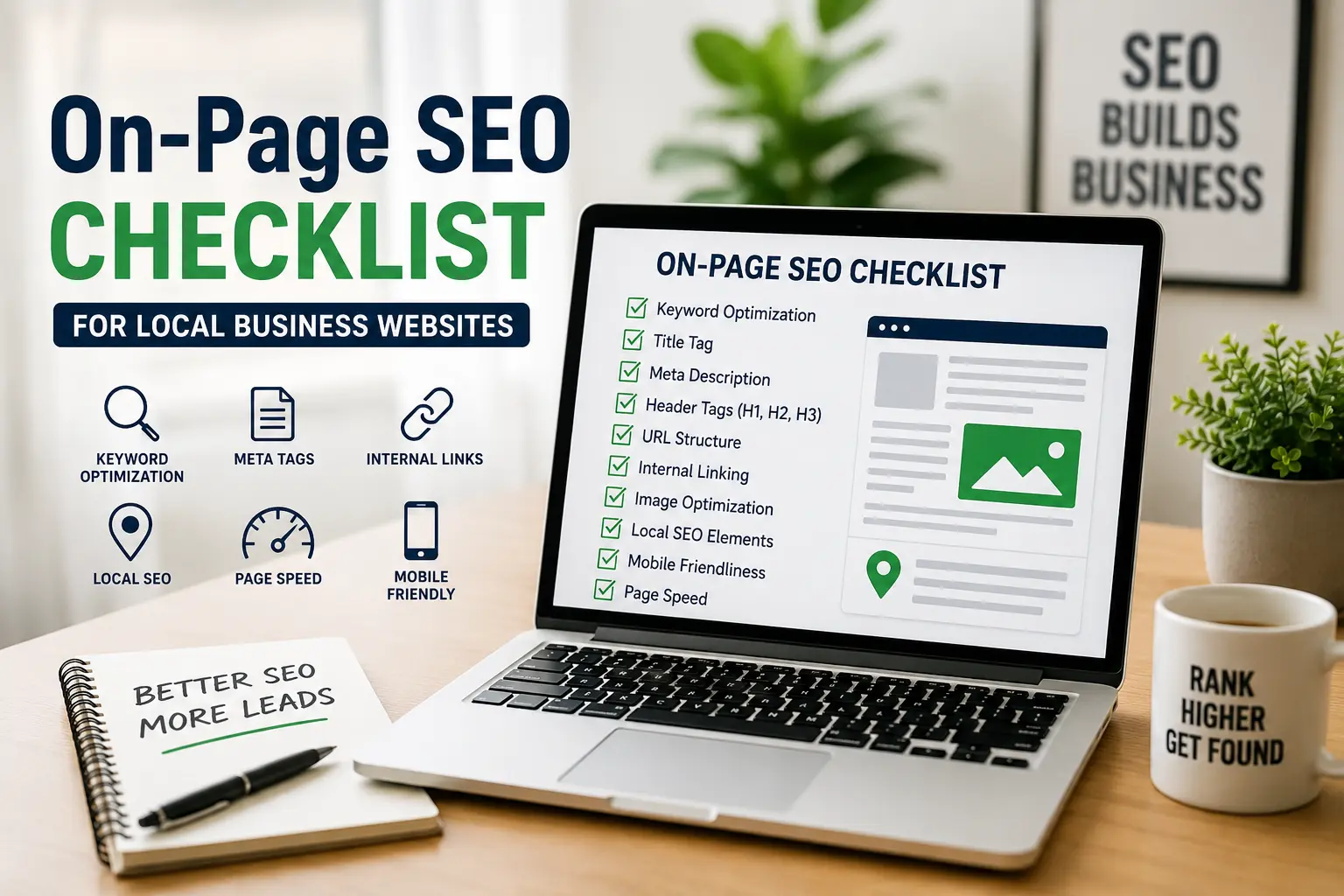
If you run a local business, you already know that showing up on Google when someone nearby searches for what you offer can make or break your month. But before you spend money on ads or chase backlinks, there is one area you should master first: on page seo. This practice is the foundation that everything else in your local search strategy is built on, and most local business owners either ignore it completely or only do it halfway.
In this guide, you will get a complete, practical on page seo checklist built specifically for local business websites — plumbers, electricians, HVAC companies, locksmiths, dentists, salons, restaurants, and every other business that depends on customers finding them nearby. We will walk through every element of this discipline, from title tags to schema markup, and explain exactly what to fix and why it matters.
What Is On Page SEO and Why It Matters for Local Businesses
On page seo refers to all the optimizations you make directly on your website’s pages to help search engines understand your content and rank it higher. This is different from off page seo, which involves activities like link building and citations that happen outside your website. This on-page work covers things like your page titles, headings, content quality, images, internal links, URL structure, and technical elements like page speed and mobile-friendliness.
For local businesses, on page seo is even more important than for many other types of websites because local search results are highly competitive within a small geographic radius. If a plumber in Multan and a plumber three streets away are both trying to rank for “plumber near me,” the business with a stronger page-level foundation often wins, even if their off-page authority is similar. Good optimization signals to Google exactly what your business does, where you operate, and why your page deserves to rank for local searches.
Ignoring on page seo means leaving rankings on the table. Even well-established local businesses lose visibility because their websites are not properly optimized. A solid checklist ensures nothing important gets missed, whether you are launching a new site or auditing an existing one. Once you understand how search engines actually work, this work becomes much easier to apply consistently across every page of your site.
1. Start With Keyword Research Before Any On Page SEO Work
You cannot do effective on page seo without knowing which keywords your local customers are actually typing into Google. Before you touch a single title tag, spend time researching the terms people use to find businesses like yours. This includes service keywords (“emergency plumber,” “AC repair”), location-based keywords (“plumber in [city]”), and long-tail phrases (“24 hour plumber near me open now”).
Every on page seo decision you make afterward — from page titles to header tags to content — should be guided by this research. Skipping this step is one of the most common mistakes local business owners make, because they end up optimizing pages around the wrong terms entirely. If you need a structured approach, our guide on keyword research for local businesses walks through the exact process.
2. Optimize Title Tags for Every Page
The title tag is one of the most important on page seo elements because it is the first thing both users and search engines see. Each page on your local business website should have a unique, descriptive title tag that includes your primary keyword and, where relevant, your city or service area.
A strong title tag typically follows a pattern like: “Service + Location + Brand Name.” For example, “Emergency Plumbing Services in Multan | YourBusiness Name.” Keep titles under 60 characters so they do not get cut off in search results, and avoid keyword stuffing. Good on page seo practice means writing titles for humans first, while still including the keywords your customers search for.
Never duplicate title tags across pages. Duplicate titles confuse search engines and hurt your rankings across your entire site, since Google cannot tell which page should rank for which query.
3. Write Compelling Meta Descriptions
Meta descriptions do not directly influence rankings the way title tags do, but they are still a critical part of on page seo because they affect click-through rate. A well-written meta description tells searchers exactly what they will get if they click, and it should include your target keyword naturally.
For local business on page seo, mention your service area, a key benefit, and a call to action within the 150–160 character limit. Something like: “Need fast, reliable plumbing repairs in Multan? Our licensed plumbers offer same-day service. Call now for a free quote.” This kind of meta description supports your broader optimization strategy by improving how your listing performs in search results, even before someone visits your site.
4. Structure Content With Proper Header Tags
Header tags (H1, H2, H3) are a core part of on page seo because they help both users and search engines understand the structure and hierarchy of your content. Every page should have exactly one H1 tag that clearly states the main topic of the page, ideally including your primary keyword phrase.
After the H1, use H2 and H3 tags to break your content into logical sections. This is especially important for local business pages that combine service information, service area details, and frequently asked questions. Proper header structure is a simple but often overlooked on page seo tactic that makes a real difference in both readability and rankings.
Avoid skipping header levels (jumping from H1 straight to H4) and avoid using headers purely for styling purposes. Search engines use header tags as ranking signals, so treating this as a checkbox item rather than a real optimization opportunity is a missed chance to rank higher.
5. Create High-Quality, Locally Relevant Content
Content quality sits at the heart of on page seo. Thin, generic content that could apply to any city or any business does not perform well in local search. Instead, your content should speak directly to your local audience, mention neighborhoods or landmarks where relevant, and answer the specific questions your customers are asking.
For service pages, go beyond a one-paragraph description. Explain what the service involves, why it matters, what customers can expect, and any local factors that make your approach unique — like weather conditions affecting HVAC needs or building codes affecting electrical work. This kind of depth is exactly what strong on page seo requires, because search engines reward pages that comprehensively answer the searcher’s intent.
Aim for content that is genuinely useful rather than padded with keywords. Good on page seo content naturally includes your target keyword and related terms without feeling forced. If you serve multiple industries, tailored guides like our electrician SEO and HVAC SEO resources show how industry-specific content strengthens overall page performance.
6. Optimize Images for On Page SEO
Images are frequently neglected in on-page checklists, but they matter more than most local business owners realize. Every image on your website should be compressed for fast loading, have a descriptive file name (not “IMG_1234.jpg”), and include alt text that describes the image while naturally incorporating relevant keywords.
For local businesses, this might mean naming an image “emergency-electrician-multan.jpg” instead of a generic file name, and writing alt text like “Licensed electrician repairing a residential panel in Multan.” This approach supports on page seo by helping images rank in Google Image Search and by improving accessibility for visually impaired users.
Large, uncompressed images also slow down your website, which directly hurts page-level performance since page speed is a confirmed ranking factor. Use modern formats like WebP and lazy loading to keep your site fast without sacrificing visual quality.
7. Improve URL Structure
Clean, descriptive URLs are a small but meaningful part of the on page seo picture. Your URLs should be short, readable, and include your target keyword where natural. Compare “yoursite.com/p?id=4829” to “yoursite.com/plumbing-services-multan” — the second option is far better for both users and search engines.
Avoid unnecessary parameters, dates, or category strings that add length without adding meaning. Consistent, logical URL structure across your site also makes it easier for you to manage internal linking, which is another important on page seo element we will cover shortly.
8. Nail Your Internal Linking Strategy
Internal linking is one of the most underused on page seo tools available to local businesses. Every time you link from one page on your site to another using relevant anchor text, you help search engines understand how your content is related and you help visitors discover more of what you offer.
For example, a blog post about local search visibility should link to your dedicated guide on local SEO for small businesses, and a post about ranking factors should point readers toward your breakdown of Google Business Profile ranking factors. If you are discussing page speed as part of on page seo, link to a deeper resource like your guide on website speed and SEO or Core Web Vitals.
A strong internal linking structure spreads authority across your site and keeps visitors engaged longer, both of which support your overall on page seo performance. Avoid linking the same anchor text to different pages, and make sure every important page can be reached within a few clicks from your homepage.
9. Use Schema Markup for Local Businesses
Structured data, often called schema markup, is a technical on-page element that helps search engines understand exactly what your business is, where it is located, and what services you offer. LocalBusiness schema, along with review, FAQ, and service schema, can help your pages qualify for rich results in search, like star ratings or business hours displayed directly in the search listing.
While schema markup is more technical than other on-page tasks, it is worth the investment because it increases the amount of information Google can extract from your page without guesswork. This is especially valuable for local businesses competing in crowded map pack results.
10. Optimize for Mobile and Page Speed
Page speed and mobile-friendliness are no longer optional parts of on page seo — they are baseline requirements. Most local searches happen on mobile devices, often from someone standing outside a business or searching while driving. If your site loads slowly or displays poorly on a phone, you will lose potential customers before they even see your content.
Google’s Core Web Vitals measure real-world loading performance, interactivity, and visual stability, and these metrics are directly tied to on page seo success. Compress images, minimize unnecessary scripts, use a reliable hosting provider, and test your site regularly. For a full technical breakdown, review our guide on Core Web Vitals and how they affect rankings.
11. Add Clear Calls to Action
While calls to action are often thought of as a conversion element rather than an SEO one, they are still part of a complete on page seo strategy for local businesses. Clear CTAs like “Call Now,” “Get a Free Quote,” or “Book an Appointment Today” improve user engagement metrics such as time on page and reduce bounce rate, both of which can indirectly support your rankings.
Place CTAs near the top of the page and repeat them throughout longer content, especially on service pages where visitors are close to making a decision.
12. Optimize for Local Search Intent
Local search intent is different from general informational intent, and your page-level strategy needs to reflect that. Someone searching “best pizza near me” wants a fast answer with location, hours, and a way to order — not a 2,000-word history of pizza. Make sure your most important information (service area, hours, contact details, and a clear description of what you offer) is visible without scrolling.
Including your city and neighboring service areas naturally throughout your content is a simple but effective on page seo tactic. Just avoid repeating location names excessively, since this can look like keyword stuffing and may actually hurt rankings rather than help them.
13. Fix Duplicate Content Issues
Duplicate content across service area pages is a common problem for local businesses that serve multiple cities or neighborhoods. If you simply copy the same page and swap out the city name, search engines may struggle to determine which version should rank, or may not index all of them at all.
Each location page should have genuinely unique content that reflects real details about that area — nearby landmarks, specific customer needs, or local regulations. This is more work upfront, but it is essential on page seo practice if you want each location page to have a real chance of ranking.
14. Use Google Search Console to Monitor On Page SEO Performance
This kind of page-level optimization is not a one-time task; it requires ongoing monitoring. Google Search Console shows you which pages are getting impressions and clicks, which keywords you are ranking for, and where technical issues might be holding your pages back.
Regularly reviewing this data allows you to refine your optimization efforts over time — updating titles that are underperforming, expanding content on pages with high impressions but low clicks, and fixing indexing errors before they hurt your rankings. If you are new to the tool, our guide on Google Search Console explains how to read and act on this data.
15. Keep Your Google Business Profile Aligned With Your On Page SEO
Although your Google Business Profile is technically separate from your website, it should be treated as an extension of your on page seo strategy. The business name, categories, services, and description in your profile should align closely with the keywords and messaging on your website.
Consistency between your website’s on page seo and your Google Business Profile strengthens your overall local search presence. For a deeper walkthrough, see our complete Google profile optimization checklist, and if your profile has ever been suspended, our guide on Google Business Profile suspensions can help you recover.
Common On Page SEO Mistakes Local Businesses Make
Even with a checklist in hand, certain mistakes show up again and again on local business websites:
- Duplicate or missing title tags across service and location pages.
- Thin content that does not answer real customer questions.
- Ignoring image optimization, which slows down pages and misses ranking opportunities.
- Overstuffing keywords, which can trigger spam signals instead of helping rankings.
- Weak or missing internal linking, leaving valuable pages isolated from the rest of the site.
- No mobile optimization, despite most local searches happening on phones.
- Neglecting technical on page seo, like broken links, slow load times, and missing schema markup.
Avoiding these mistakes is just as important as implementing the positive on page seo tactics covered earlier in this checklist. For a broader technical audit approach, this complete technical SEO checklist pairs well with the on-page fixes outlined here.
How Often Should You Review Your On Page SEO?
On page seo is not something you set once and forget. Search algorithms change, competitors update their own pages, and your business itself evolves with new services or locations. A good rule of thumb is to review this checklist at least quarterly, checking title tags, content freshness, page speed, and internal links.
If you notice a drop in rankings or traffic, on page seo should be one of the first areas you investigate, since many ranking drops are tied to technical issues, outdated content, or competitors simply doing better on-page work than you currently are.
Building an On Page SEO Checklist Into Your Workflow
Rather than treating on page seo as a one-time project, build it into your regular website workflow. Every time you publish a new page — whether it is a new service, a new location, or a blog post — run through the same checklist: title tag, meta description, header structure, content quality, image optimization, URL structure, internal links, and mobile performance.
This consistency compounds over time. A local business that applies solid on page seo practices to every new page will steadily outperform competitors who only think about it occasionally or as an afterthought. Combine this page-level checklist with a broader SEO strategy so your on-page work supports your long-term visibility goals rather than existing in isolation.
Measuring the Impact of Your Changes
Once you start implementing this checklist, track the results so you know what is actually working. Rankings alone do not tell the whole story — pair them with organic traffic, click-through rate, and conversion data (calls, form submissions, direction requests) to understand whether your optimizations are translating into real business outcomes.
Set a baseline before you make changes. Note current rankings for your priority keywords, current organic traffic to key pages, and current conversion rates. Then revisit these numbers every four to six weeks after implementing fixes. Because search engines need time to re-crawl and re-evaluate pages, early data can be noisy, so look for trends over several weeks rather than reacting to a single day’s fluctuation.
It also helps to prioritize your fixes rather than tackling everything at once. Start with your highest-traffic or highest-revenue pages — usually your homepage and top service pages — since improvements there have the biggest impact. From there, work through location pages, blog content, and lower-priority pages. This staged approach keeps the work manageable, especially for small business owners handling optimization alongside running their actual business.
Finally, document what you change and when. A simple spreadsheet listing the page, the date, and the specific edit (new title tag, added schema, compressed images, and so on) makes it far easier to connect cause and effect later, and it keeps your ongoing checklist organized as your site grows.
Frequently Asked Questions
Is on page seo more important than off page seo for local businesses? Both matter, but this practice is usually the better starting point because it is completely within your control and it lays the groundwork that off-page efforts build on. Backlinks and citations rarely help much if the underlying page cannot satisfy the searcher once they arrive. Most local businesses see faster, more predictable gains from tightening up titles, content, and structure before spending heavily on link building.
How long does it take to see results from on page seo changes? Search engines usually re-crawl and reassess updated pages within days to a few weeks, but noticeable ranking movement often takes one to three months, especially for competitive local terms. Consistency matters more than speed — businesses that keep refining their checklist over several months tend to outperform those looking for an instant jump.
Can I do on page seo myself, or do I need an agency? Many of the fixes covered in this checklist, like writing better titles, cleaning up headers, and adding alt text, can be handled by a business owner with a basic understanding of their website’s admin panel. More technical elements, such as schema markup or Core Web Vitals fixes, may benefit from a developer or SEO professional, but the core checklist is approachable for most non-technical users.
How many keywords should one page target? Focus each page on one primary keyword and a small cluster of closely related terms rather than trying to rank a single page for dozens of unrelated phrases. Spreading a page too thin across many topics weakens its relevance for any one of them, which works against solid on page seo practice.
Does on page seo still matter with AI-generated search results? Yes. Even as search results incorporate AI-generated summaries, the underlying pages still need to be well-structured, accurate, and clearly written for those systems to reference them. Clean headings, direct answers, and trustworthy content — the same elements this checklist covers — remain essential for visibility in both traditional and AI-assisted search results.
Final Thoughts
On page seo is one of the highest-leverage activities a local business can invest in. Unlike off-page tactics that depend on external factors, this work is entirely within your control. Every title tag you write, every image you optimize, and every internal link you add is a direct opportunity to improve how search engines and customers understand your business.
Use this checklist as a living document. Revisit it regularly, apply it to every new page you publish, and pair it with strong local SEO fundamentals like citations, reviews, and a well-optimized Google Business Profile. When your on page seo is solid, everything else you do to grow your local visibility works that much better.
If you are ready to go deeper, explore our complete local SEO guide for small businesses for a full picture of how on page seo fits into your broader local search strategy.
