
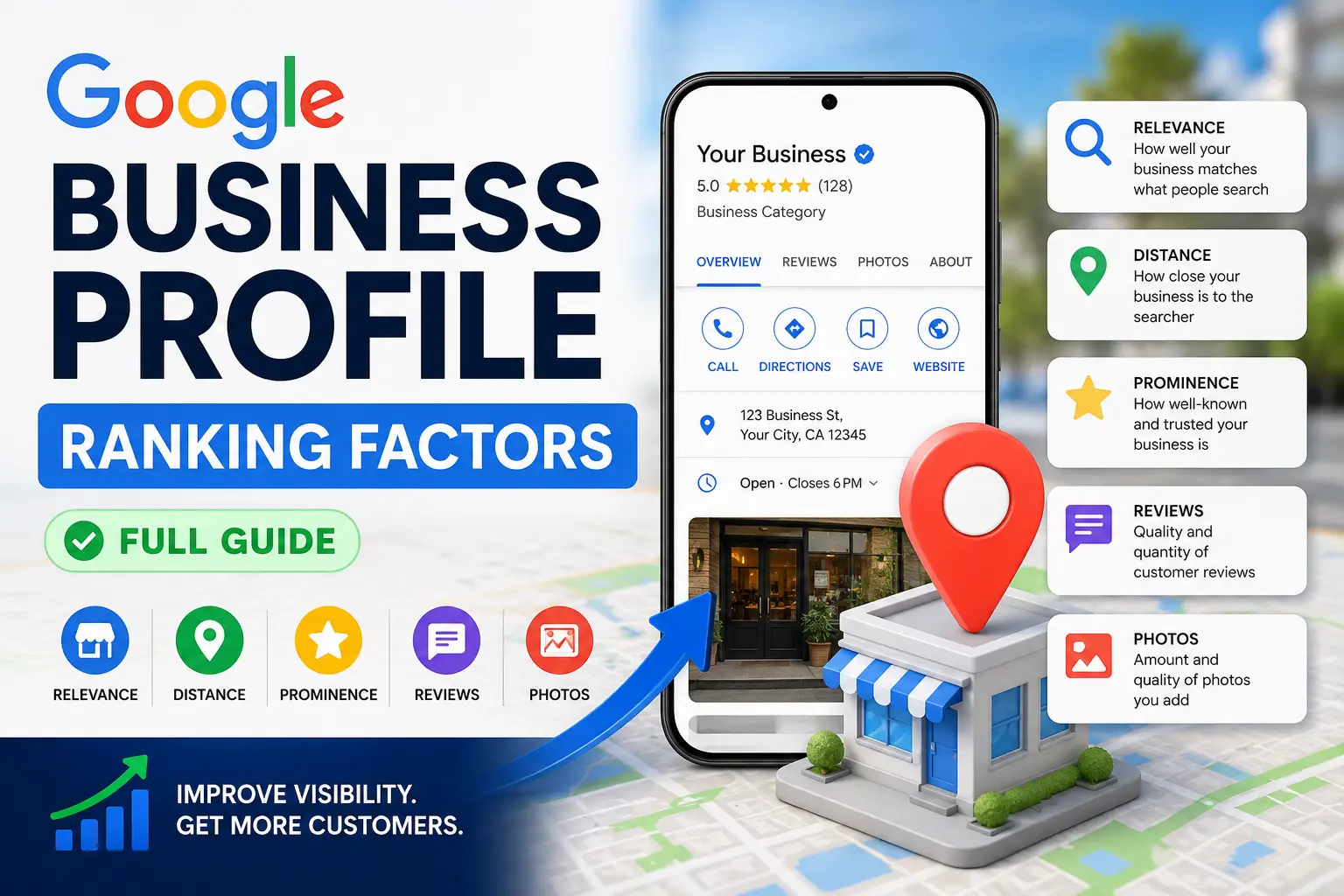
If you run a local business, you have probably asked yourself why some companies always show up at the top of the Google Map Pack while others stay buried on page two. The answer almost always comes back to the same thing: Google Business Profile ranking factors. These are the signals Google uses to decide which businesses deserve the top spots when someone searches for a product or service near them.
Understanding Google Business Profile ranking factors is no longer optional for local businesses. Whether you run a plumbing company, a dental clinic, an HVAC service, or a small retail store, your visibility in local search results depends almost entirely on how well you align with these factors. In this guide, we will break down every major local ranking factor in plain language, explain how each one works, and show you exactly how to improve your local rankings step by step.
By the end of this article, you will have a complete understanding of Google Business Profile ranking factors and a practical roadmap for using them to grow your business.
What Are Google Business Profile Ranking Factors?
Google Business Profile ranking factors are the specific signals Google’s algorithm evaluates when deciding how to rank a business listing in local search results and the Google Map Pack. These factors determine whether your business appears in the coveted “top three” local results, on the second page of the map pack, or not at all.
Google has publicly confirmed that its local ranking system relies on three broad categories: relevance, distance, and prominence. However, within those three categories sit dozens of individual Google Business Profile ranking factors that businesses can directly influence. This is important because it means local rankings are not random or purely luck-based. They respond to consistent, deliberate optimization work.
Many business owners assume that simply creating a Google Business Profile is enough. Unfortunately, that is only the starting point. The real competition begins with how well you optimize the profile against these known signals, and how consistently you maintain that optimization over time.
Why Google Business Profile Ranking Factors Matter for Local SEO
Local search has become the primary way people find nearby businesses. Most local searches lead to either a phone call, a website visit, or a store visit within 24 hours. If your business is not ranking well because you have ignored key Google Business Profile ranking factors, you are losing customers to competitors who have taken the time to optimize their listings properly.
Ranking well is not just about vanity. It directly impacts revenue. A business that ranks in the top three map pack results typically receives significantly more calls, direction requests, and website clicks than businesses ranking lower. This is why so many agencies and consultants build their entire local SEO strategy around mastering Google Business Profile ranking factors.
It also matters because Google’s local algorithm updates regularly. What worked two years ago may not carry the same weight today. Staying current with these ranking signals is an ongoing process, not a one-time setup task.
The Three Core Google Business Profile Ranking Factors
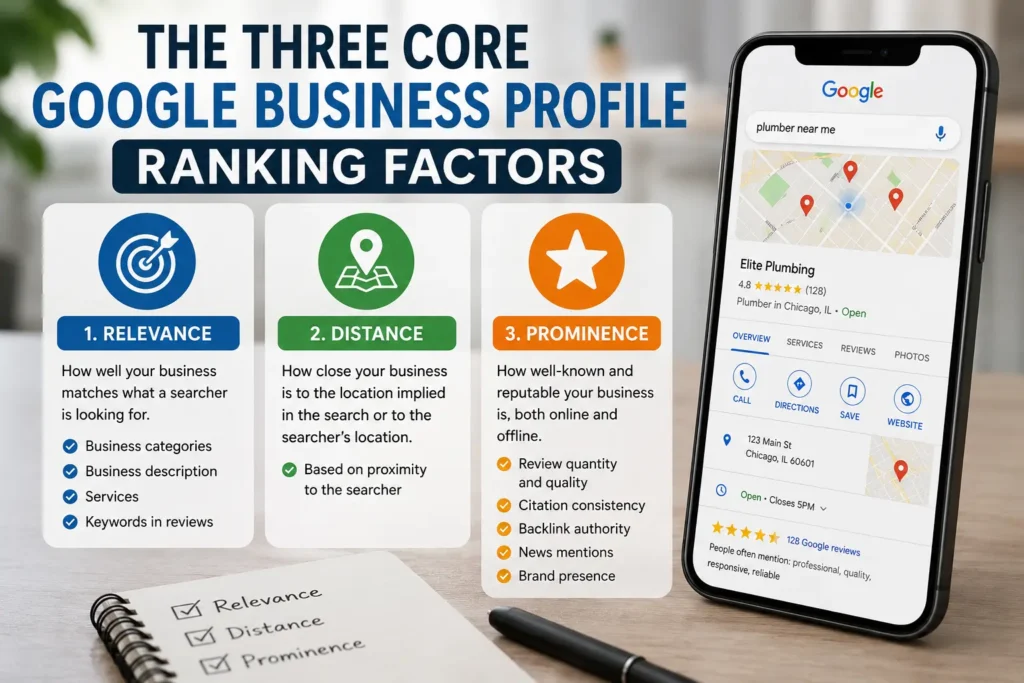
Before diving into specific tactics, it helps to understand the three foundational categories that all other Google Business Profile ranking factors fall under.
1. Relevance
Relevance measures how well your Google Business Profile matches what a searcher is looking for. This is one of the most fundamental Google Business Profile ranking factors because if your listing does not clearly describe what you offer, Google has no reason to show it for a related search. Relevance is influenced by your business category selection, your business description, your services list, and even the keywords used in your customer reviews.
2. Distance
Distance refers to how close your business is to the location implied in the search, or to the searcher’s physical location if no location is specified. While you cannot change where your business is physically located, understanding this factor helps explain why two businesses offering identical services can rank differently depending on who is searching and from where.
3. Prominence
Prominence is arguably the most complex of the three core Google Business Profile ranking factors because it accounts for how well-known and reputable your business is, both online and offline. Prominence is shaped by review quantity and quality, citation consistency, backlink authority, news mentions, and general brand presence across the web.
Together, these three categories form the foundation that every other local ranking signal builds upon.
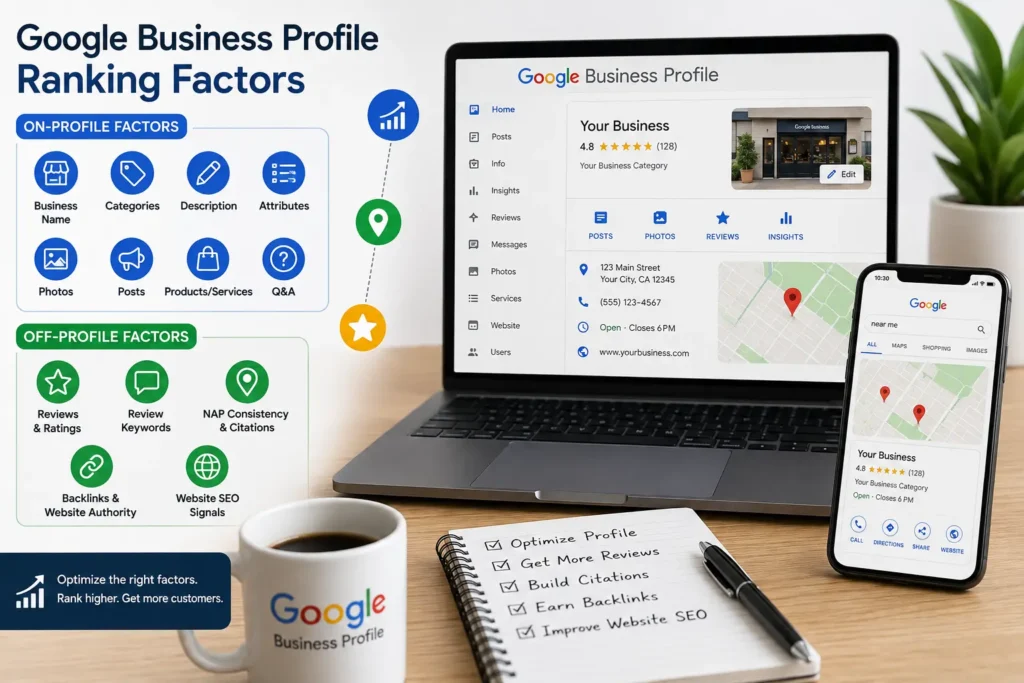
On-Profile Google Business Profile Ranking Factors
These are the elements you control directly inside your Google Business Profile dashboard. Optimizing them properly is the fastest way to influence your local rankings.
Business Name
Your business name should reflect your actual, legally registered name. Adding unnecessary keywords to your business name is a violation of Google’s guidelines and can result in suspension. This might seem like a minor detail, but name accuracy is one of the underrated Google Business Profile ranking factors that many businesses get wrong. If your profile has ever been flagged or suspended for this reason, our guide on why Google Business Profiles get suspended walks through common causes and recovery steps.
Primary and Secondary Categories
Category selection is one of the single most influential Google Business Profile ranking factors. Your primary category should describe your core business as precisely as possible, and secondary categories should cover any additional services you offer. Businesses that choose overly broad or inaccurate categories consistently underperform in local search, regardless of how well-optimized the rest of their profile is.
Business Description
Your business description gives you an opportunity to naturally include relevant keywords while explaining what makes your business unique. A well-written description that reflects your services and location supports several ranking signals at once, particularly relevance.
Attributes
Attributes are small details like “wheelchair accessible,” “free Wi-Fi,” or “women-led business.” While they seem minor, attributes contribute to relevance and can be the deciding factor between two competing businesses. Filling out every applicable attribute is a simple but often overlooked way to improve your standing across Google Business Profile ranking factors.
Photos and Videos
Profiles with regularly updated, high-quality photos tend to perform better than profiles with outdated or stock imagery. Google has indicated that photo activity is one of the engagement-related Google Business Profile ranking factors, since it signals an active, well-maintained business. Aim to upload new photos monthly, including photos of your team, your storefront, completed projects, and your products.
Posts
Google Business Profile posts allow you to share updates, offers, and events directly on your listing. While the direct ranking impact of posts is debated, consistent posting keeps your profile active, which is itself one of the behavioral signals Google appears to reward.
Products and Services List
Listing your specific products and services with detailed descriptions reinforces relevance signals. This is especially important for service-area businesses that want to rank for multiple related search terms. A detailed services list is one of the easiest Google Business Profile ranking factors to optimize because it requires no technical skill, just thoroughness.
Questions and Answers
The Q&A section is often ignored, but it plays a role in relevance because it contains additional keyword-rich content tied directly to your profile. Proactively seeding your own frequently asked questions is a smart tactic many businesses overlook when addressing Google Business Profile ranking factors.
Off-Profile Google Business Profile Ranking Factors
Not every ranking signal lives inside your dashboard. Several critical ranking signals are determined by activity happening elsewhere on the web.
Reviews and Ratings
Review count, review recency, review velocity, and average star rating are among the most powerful Google Business Profile ranking factors tied to prominence. Businesses with a steady stream of new, positive reviews consistently outrank competitors with stagnant or older review profiles. Responding to every review, positive or negative, also signals to Google that a business is actively engaged with its customers.
Review Keywords
The actual content of your reviews matters too. When customers naturally mention your services, products, or location in their reviews, it reinforces relevance in ways your own profile content cannot replicate. Encouraging detailed reviews rather than one-line ratings can meaningfully strengthen this category of Google Business Profile ranking factors.
NAP Consistency and Citations
NAP stands for Name, Address, and Phone number. Consistency of this information across directories, your website, and other citation sources is one of the trust-related local ranking signals. Inconsistent information across the web confuses Google’s algorithm and can suppress your rankings, even if your on-profile optimization is excellent.
Backlinks and Website Authority
Your website’s backlink profile indirectly feeds into your local rankings because Google associates a strong, authoritative website with a more prominent business. If you have not yet worked on this, our guide covering link building fundamentals and our deeper dive into practical link building techniques both explain how to build authority that supports your local rankings alongside your Google Business Profile ranking factors.
Website SEO Signals
Google frequently checks your website to confirm that your Google Business Profile information matches what is published on your site. Ensuring your NAP details, service pages, and location pages all align with your profile strengthens multiple ranking signals simultaneously.
Behavioral Google Business Profile Ranking Factors
Google also pays attention to how real users interact with your listing. These engagement-based Google Business Profile ranking factors include:
- Click-through rate from search results
- Number of direction requests
- Number of phone calls placed directly from the listing
- Website clicks originating from the profile
- Photo views and photo uploads by customers
A profile that generates strong engagement tells Google that searchers find it useful and relevant, which reinforces future rankings. This creates a compounding effect: better rankings lead to more engagement, and more engagement leads to even better rankings.
Technical Google Business Profile Ranking Factors
While most people associate Google Business Profile ranking factors purely with the profile itself, technical website performance plays a supporting role that should not be ignored.
Page speed, mobile usability, and Core Web Vitals all influence how Google evaluates the overall quality of the business behind the profile. If your website is slow or difficult to navigate, it can undermine the prominence signals that strengthen your local visibility. We cover this in detail in our guide to Core Web Vitals and our related article on how website speed affects SEO.
Additionally, tracking your website’s performance in Google Search Console can reveal indexing or crawl issues that indirectly affect how Google perceives your overall online presence, which ties back into the prominence category of Google Business Profile ranking factors.
Google Business Profile Ranking Factors vs. Traditional Organic SEO Factors
It’s worth pausing to clarify how these local signals relate to traditional organic SEO, because the two are often confused. Traditional organic ranking depends heavily on domain authority, content depth, technical crawlability, and backlink profiles across the entire web. Local ranking signals share some of that DNA, but they layer in a physical, geographic dimension that organic SEO simply does not have.
A website can rank well nationally for a keyword without ever appearing in a local map pack, and a business can dominate the map pack in its city while its website struggles to rank organically for the same terms elsewhere. This is precisely why Google Business Profile ranking factors deserve their own dedicated strategy rather than being treated as an afterthought bolted onto a general SEO plan.
That said, the two systems are not entirely separate. A strong, fast, well-structured website supports prominence, one of the three pillars behind these local signals, while a well-optimized profile can drive traffic and engagement that indirectly benefits your organic rankings too. Businesses that treat local and organic SEO as complementary, rather than competing, priorities tend to see the fastest overall growth in visibility.
Case Study: Applying These Principles in a Competitive Local Market
Consider a mid-sized HVAC company operating in a metro area with a dozen established competitors. Before any optimization work, the business ranked outside the map pack for its core service terms, despite having a functional website and a handful of scattered reviews across different directories.
The first step was a full audit against the categories discussed earlier in this guide: relevance, distance, and prominence. The audit revealed an overly broad primary category, an incomplete services list, and NAP details that did not match across citation sources. None of these issues were dramatic on their own, but together they were quietly suppressing the business’s visibility.
Over the following three months, the business corrected its primary category, filled out every attribute and service listing, launched a structured review request process, and cleaned up citation inconsistencies across major directories. Photos were updated monthly, and weekly posts highlighted completed jobs and seasonal offers.
By the end of the third month, the business had moved from absent in the map pack to appearing in the top three results for its primary service terms in its city, with a measurable increase in phone calls and direction requests. This kind of outcome is common when a business systematically works through each of the known local ranking signals rather than guessing at what might help. It also illustrates why patience matters: meaningful movement in Google Business Profile ranking factors typically shows up in weeks, not days.
Common Mistakes That Hurt Google Business Profile Ranking Factors
Even well-intentioned businesses make mistakes that quietly damage their standing across these ranking signals. Some of the most common issues include:
- Choosing the wrong primary category — this single mistake can undermine relevance more than almost any other factor.
- Inconsistent NAP information across directories and citation sites.
- Ignoring reviews, especially negative ones, which signals disengagement.
- Keyword stuffing the business name, which violates Google’s guidelines and risks suspension.
- Neglecting photo updates, leaving a stale, inactive impression.
- Duplicate listings, which split review counts and confuse Google’s algorithm.
- Incomplete profile sections, leaving attributes, services, or business hours blank.
Avoiding these mistakes is just as important as actively optimizing the positive signals discussed above, because a single major error can offset weeks of otherwise solid optimization work.
How to Improve Your Google Business Profile Ranking Factors: A Step-by-Step Checklist
If you want a structured approach to improving your local rankings, follow this checklist. Each step directly targets one or more Google Business Profile ranking factors discussed above.
- Audit your current profile for accuracy in name, address, phone number, categories, and hours.
- Select the most precise primary category available, and add relevant secondary categories.
- Write a keyword-rich but natural business description that reflects your actual services and location.
- Upload fresh photos monthly, including team photos, completed jobs, and storefront images.
- Request reviews consistently from happy customers, aiming for steady velocity rather than sporadic bursts.
- Respond to every review within 48 hours whenever possible.
- Publish weekly or biweekly posts highlighting offers, updates, or projects.
- Fill out every attribute that applies to your business.
- Build citations on major directories, ensuring NAP consistency everywhere.
- Strengthen your website with location-specific pages and internal links that reinforce relevance.
- Monitor performance using Google Search Console and the Google Business Profile insights dashboard.
For a more comprehensive walkthrough of this process, our detailed Google Business Profile optimization guide and companion Google Profile optimization checklist both expand on these steps in more depth.
Google Business Profile Ranking Factors by Industry
While the core Google Business Profile ranking factors apply universally, certain industries face unique challenges. Service-area businesses like HVAC companies, for example, often compete across multiple cities or zip codes, which makes category selection and service-area configuration especially important. Our industry-specific guide on HVAC SEO strategy explains how these businesses can adapt general local SEO principles to their specific market.
Similarly, appliance repair businesses often deal with high review velocity requirements because of frequent, repeat service calls. Our guide to appliance repair SEO covers how this industry can use the same Google Business Profile ranking factors to outperform larger competitors in local search.
If you are just getting started with local SEO more broadly, our complete local SEO guide for small businesses provides helpful context for how these local ranking signals fit into the bigger local search picture.
Tools to Track Your Google Business Profile Ranking Factors
You cannot improve what you do not measure. Several tools can help you track progress across the key Google Business Profile ranking factors:
- Google Business Profile Insights — shows searches, views, calls, and direction requests directly from your dashboard.
- Google Search Console — reveals how your website performs in organic search, which indirectly supports prominence.
- Local rank tracking tools — show your position in the map pack for target keywords across different locations.
- Review monitoring tools — help you respond quickly and track review velocity over time.
Regularly reviewing this data allows you to identify which Google Business Profile ranking factors need more attention and which are already performing well.
Beyond dashboards and trackers, it also helps to schedule a recurring monthly review of your profile. Set aside time to check for new reviews that need responses, confirm your business hours are accurate around holidays, verify that your photos still represent your current work, and compare your standing against two or three direct competitors in the map pack. This habit turns local optimization from a one-time project into a repeatable system, which is ultimately how the strongest local businesses maintain their rankings over the long term rather than losing ground every time a competitor becomes more active.
Frequently Asked Questions About Google Business Profile Ranking Factors
How many Google Business Profile ranking factors are there? There is no official fixed number, but most local SEO experts group the known signals into dozens of individual local ranking elements that fall under the three core categories of relevance, distance, and prominence.
Which Google Business Profile ranking factor matters most? Category selection and reviews are widely considered the two most influential Google Business Profile ranking factors, though all factors work together rather than in isolation.
Can I improve my Google Business Profile ranking factors without a website? Yes, to a degree. Many on-profile Google Business Profile ranking factors, like categories, photos, and reviews, can be optimized without a website. However, a strong website significantly boosts the prominence-related factors.
How long does it take to see results after optimizing Google Business Profile ranking factors? Most businesses see measurable improvement within four to eight weeks, though highly competitive markets may take longer for the full impact of Google Business Profile ranking factors to show in rankings.
Do keyword-stuffed reviews help with Google Business Profile ranking factors? No. Google’s systems are designed to detect manipulation. Focus on encouraging genuine, detailed reviews rather than trying to game the review-related Google Business Profile ranking factors.
Do Google Business Profile ranking factors differ between cities and small towns? The underlying signals stay the same, but competition levels differ significantly. In smaller towns with fewer competing businesses, even modest optimization can produce a top ranking quickly, while dense metro areas require more sustained effort across every ranking signal to stand out.
Does having multiple locations affect Google Business Profile ranking factors? Yes. Each location needs its own fully optimized profile with unique photos, accurate service areas, and its own review base. Treating multi-location profiles as identical copies of one another tends to weaken relevance and prominence for every location involved.
Final Thoughts on Google Business Profile Ranking Factors
Mastering Google Business Profile ranking factors is not a one-time project. It requires ongoing attention to your profile’s accuracy, consistent review generation, active engagement with customers, and a website that reinforces the same signals Google is already evaluating inside your profile.
Businesses that treat their Google Business Profile ranking factors as a living, evolving part of their marketing strategy consistently outperform competitors who set up a profile once and never return to it. Start with the checklist above, prioritize the highest-impact factors like category selection and reviews, and revisit your profile regularly as Google’s local algorithm continues to evolve.
If you focus consistently on these Google Business Profile ranking factors, your business will be far better positioned to earn visibility, calls, and customers directly from local search.
The businesses that win the map pack over the long run are rarely the ones with the biggest marketing budget. They are the ones that treat their profile as a living asset: reviewed monthly, updated with fresh photos and posts, backed by a website that reinforces the same story, and supported by a steady, honest stream of customer reviews. Start with one or two of the highest-leverage items from the checklist above, measure the change in your insights over the following month, and then move on to the next item. Small, consistent improvements compound quickly in local search, and within a few optimization cycles most businesses find themselves competing seriously for the top three spots in their category and city.
