
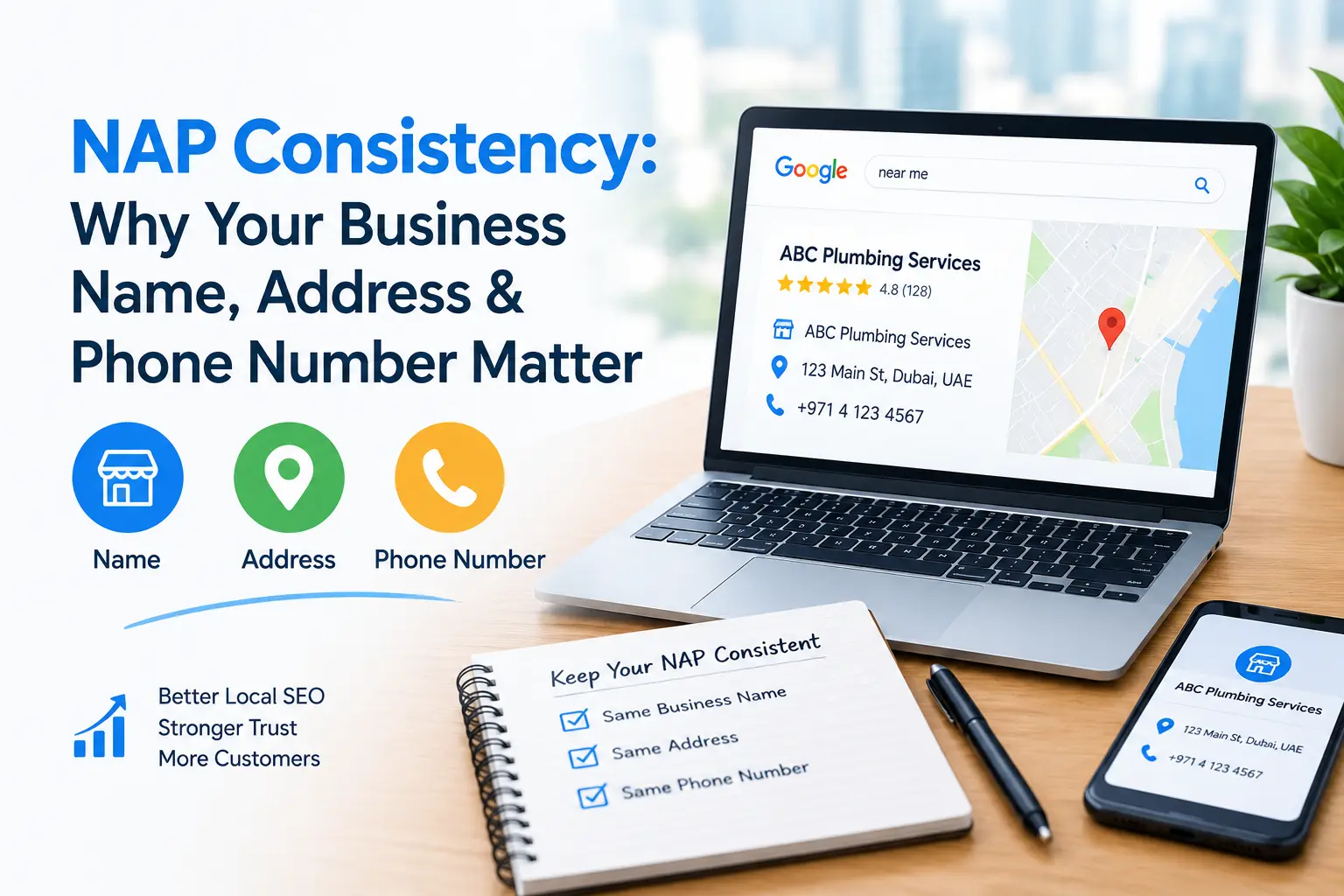
If you run a local business and want to show up in Google’s local pack, on Google Maps, or in local search results, there’s one unglamorous but critical factor you cannot afford to ignore: NAP consistency. It doesn’t matter how great your website looks or how many keywords you’ve stuffed into your homepage — if your business Name, Address, and Phone number are inconsistent across the web, you’re actively working against your own local SEO efforts.
In this guide, we’ll break down exactly what NAP consistency means, why search engines care about it so much, the most common mistakes businesses make, and a step-by-step process to audit and fix your listings. By the end, you’ll understand why NAP consistency is often called the foundation of local SEO — and why skipping it can quietly sabotage everything else you’re doing to rank locally.
What Is NAP Consistency?
NAP stands for Name, Address, and Phone number — the three core pieces of information that identify your business across the internet. NAP consistency simply means that this information appears exactly the same way everywhere it’s listed: on your website, your Google Business Profile, Yelp, Facebook, industry directories, and any other platform where your business is mentioned.
For example, if your business is listed as “Smith’s Plumbing Co.” on your website but appears as “Smith Plumbing Company” on Yelp and “Smith’s Plumbing” on Facebook, that’s a NAP consistency problem. Even small differences — abbreviating “Street” as “St.” on one platform and spelling it out on another — count as inconsistencies that can confuse both users and search engines.
Maintaining NAP consistency isn’t just a nice-to-have. It’s one of the most foundational local SEO ranking factors, and it directly affects how much search engines trust your business information.
Why NAP Consistency Matters for Local SEO
Search engines like Google rely on a network of signals to determine whether a business is legitimate, trustworthy, and worth ranking for local searches. NAP consistency is one of the strongest of these trust signals. Here’s why it matters so much.
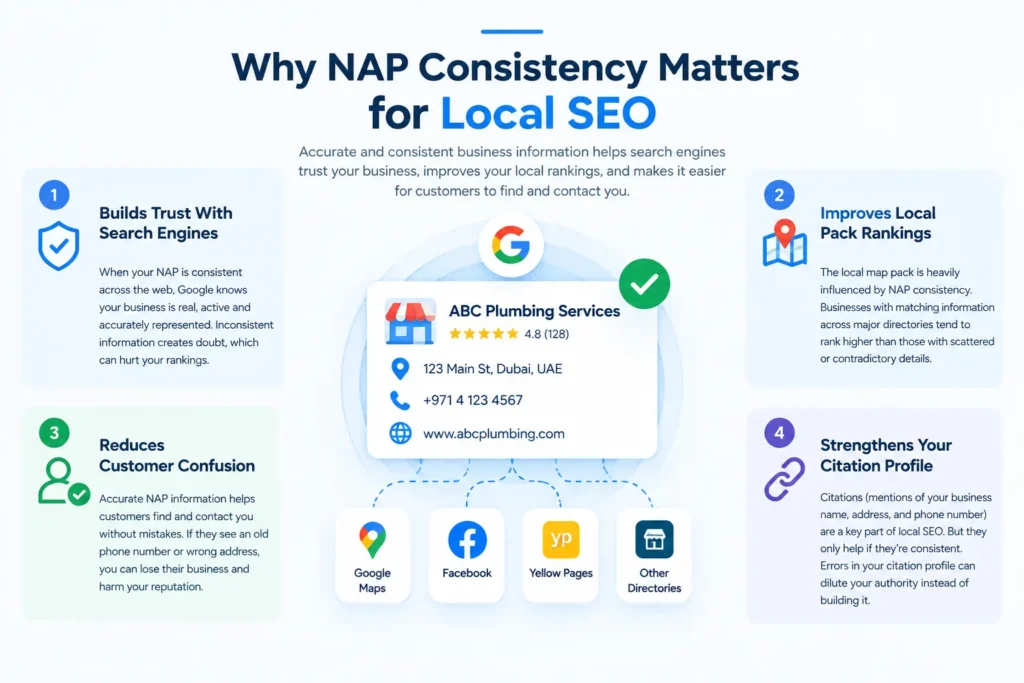
1. It Builds Trust With Search Engines
Google cross-references your business information across multiple sources on the web. When your NAP consistency is strong — meaning your name, address, and phone number match everywhere — Google gains confidence that your business is real, active, and accurately represented. When NAP consistency is weak, Google has to guess which version of your information is correct, and that uncertainty can hurt your rankings.
2. It Improves Local Pack Rankings
Local pack rankings (the map results that show up for searches like “plumber near me”) are heavily influenced by NAP consistency. Businesses with consistent citations across major directories tend to outperform competitors whose information is scattered or contradictory. If you’re serious about ranking in the local map pack, NAP consistency should be one of your top priorities.
3. It Reduces Customer Confusion
Beyond SEO, NAP consistency matters for the simple reason that customers need accurate information to find and contact you. If someone finds an old phone number or a wrong address because your NAP consistency wasn’t maintained, you risk losing that customer entirely — and possibly damaging your reputation.
4. It Strengthens Your Citation Profile
Citations — mentions of your business name, address, and phone number on other websites — are a major component of local SEO. But citations only help if they’re consistent. A citation profile riddled with NAP consistency errors can actually work against you, diluting the authority you’ve built rather than reinforcing it.
How Search Engines Use NAP Consistency to Rank Local Businesses
Search engines like Google use complex algorithms that pull data from hundreds of sources — directories, review sites, social media, government records, and your own website — to build a comprehensive profile of your business. NAP consistency plays a central role in this process for a few key reasons.
First, Google uses NAP data to verify that a business actually exists at the location it claims. This is part of a broader trust-building process that also considers reviews, website content, and engagement signals. When your NAP consistency is solid, Google can confirm this information quickly and confidently.
Second, Google uses NAP consistency as a de-duplication mechanism. If your business appears under slightly different names or addresses across the web, Google’s systems may treat these as separate entities, splitting your authority and diluting your local ranking potential. Fixing NAP consistency issues consolidates that authority back into a single, strong profile.
Third, NAP consistency contributes to what’s often called “prominence” in Google’s local ranking algorithm — a measure of how well-known and well-documented a business is online. A business with consistent, widespread citations signals higher prominence than one with sparse or conflicting information.
Common NAP Consistency Mistakes Businesses Make
Even well-intentioned businesses often struggle with NAP consistency. Here are the most frequent mistakes we see.
Inconsistent Business Name Formatting
Using “LLC,” “Inc.,” or “Co.” in some listings but not others is a subtle but common NAP consistency issue. Similarly, using a shortened version of your business name on some platforms (like dropping “The” from “The Coffee House”) creates mismatches that hurt NAP consistency.
Address Formatting Differences
This is one of the most common NAP consistency problems. Examples include:
- “Suite 100” vs. “Ste. 100” vs. “#100”
- “Street” vs. “St.”
- Missing or inconsistent ZIP+4 codes
- Old addresses left live after a business relocation
Even though these might seem like minor stylistic choices to a human, they can register as different addresses to search engine algorithms, which is exactly the kind of NAP consistency gap that hurts rankings.
Multiple or Outdated Phone Numbers
Businesses that have changed phone numbers, added call-tracking numbers, or use different numbers for different marketing campaigns often unintentionally break NAP consistency. If your call-tracking number appears on your Google Business Profile but your website shows your main line, that mismatch counts against your NAP consistency.
Duplicate Listings
Duplicate Google Business Profiles or directory listings — often created accidentally when a business changes its name, moves locations, or gets listed by multiple employees — are a major source of NAP consistency problems. Duplicates split your reviews, citations, and authority across multiple profiles instead of consolidating them into one strong listing.
Inconsistent Formatting Across Directories
Third-party directories often auto-format or truncate business information, which can silently break your NAP consistency without you realizing it. Regularly auditing how your business appears on these platforms is essential to catching these issues early.
How to Audit Your NAP Consistency
Before you can fix NAP consistency issues, you need to know where they exist. Here’s a practical process for auditing your current NAP consistency across the web.
Step 1: Establish Your “Master” NAP
Start by deciding on the exact, official format of your business name, address, and phone number. This becomes your reference point for every other listing. Write it down exactly as it should appear — including punctuation, abbreviations, and suite numbers — and treat this as the single source of truth for your NAP consistency efforts going forward.
Step 2: Check Your Google Business Profile
Your Google Business Profile is arguably the most important place to maintain NAP consistency, since it directly feeds into Google Maps and local search results. Compare the information there against your master NAP and correct any discrepancies immediately.
Step 3: Review Your Website
Check your homepage, contact page, and footer for NAP consistency. Many businesses forget that their footer — which appears on every page — is a prime opportunity to reinforce NAP consistency site-wide. If your website has multiple location pages, each one needs to reflect the correct, consistent NAP for that specific location.
Step 4: Audit Major Directories and Citation Sites
Check your listings on major platforms like Yelp, Facebook, Bing Places, Apple Maps, and industry-specific directories. Look for old addresses, outdated phone numbers, or name variations that break NAP consistency.
Step 5: Use a Citation Tracking Tool
Manually checking every directory is time-consuming, so many businesses use citation tracking tools to scan the web for NAP consistency issues automatically. These tools flag inconsistencies so you can prioritize which ones to fix first based on the authority of the site or platform.
Best Practices for Maintaining NAP Consistency
Once you’ve cleaned up existing NAP consistency issues, the next challenge is keeping things consistent going forward. Here are some best practices.
Standardize Before You Expand
Before creating new listings or citations, always reference your master NAP. This simple habit prevents new NAP consistency issues from creeping in as your business grows its online presence.
Update Everywhere When Anything Changes
Whenever your business moves, changes its name, or updates its phone number, treat it as a full NAP consistency audit trigger. Update your website first, then work through your Google Business Profile, directories, and social profiles systematically.
Use Structured Data Markup
Adding local business schema markup to your website helps search engines clearly identify your NAP information in a machine-readable format. This reinforces NAP consistency by giving search engines an unambiguous source to cross-reference against other listings.
Claim and Verify All Listings
Unclaimed listings are more likely to contain outdated or incorrect information, since you have no control over them. Claiming every listing where your business appears gives you the ability to correct and maintain NAP consistency proactively rather than reactively.
Monitor Regularly
NAP consistency isn’t a one-time fix — it requires ongoing monitoring. Directories update their data, third parties scrape old information, and employees sometimes create duplicate listings without realizing it. Set a recurring schedule (quarterly is a good starting point) to check your NAP consistency across your most important platforms.
NAP Consistency and Your Google Business Profile
Your Google Business Profile deserves special attention when it comes to NAP consistency because it’s the primary data source Google uses for local search and Maps results. A few specific tips for this platform:
- Make sure the business name in your Google Business Profile exactly matches your legal or commonly used business name — don’t add keywords or extra descriptors, as this violates Google’s guidelines and can hurt more than help.
- Double-check that your address format matches what’s on your website and other citations, right down to suite numbers and abbreviations.
- Use a local phone number rather than a call-tracking number where possible, since call-tracking numbers can create NAP consistency mismatches unless properly configured with dynamic number insertion.
If you haven’t already optimized your Google Business Profile setup, pairing that work with a full NAP consistency check will give you a much stronger foundation for local visibility.
NAP Consistency Across Citations and Directories
Citations are one of the most direct ways NAP consistency impacts your local SEO. A citation is simply any online mention of your business’s name, address, and phone number — even without a link back to your website. The more consistent and widespread your citations are, the stronger your local SEO signals become.
When building or auditing citations, focus on:
- Data aggregators like Data Axle, Neustar Localeze, and Foursquare, which distribute your NAP information to dozens of smaller directories. Fixing NAP consistency at the aggregator level can cascade improvements across many listings at once.
- Industry-specific directories relevant to your niche (for example, legal directories for law firms or home service directories for contractors).
- General directories like Yelp, Yellow Pages, and Better Business Bureau, which carry significant authority and are commonly checked by both users and search engines.
Every new citation you build should match your master NAP exactly. This is one of the easiest ways to prevent future NAP consistency issues rather than having to fix them later.
Tools to Check and Fix NAP Consistency
Several tools can help streamline your NAP consistency management:
- Moz Local – scans and helps correct NAP consistency across major directories.
- BrightLocal – offers citation tracking and NAP consistency audits tailored for local SEO.
- Whitespark – helps find and fix citation inconsistencies, including NAP consistency issues across niche directories.
- Yext – allows centralized management of your NAP information across a large network of platforms.
Using one of these tools can save significant time compared to manually checking every directory, especially if your business has multiple locations where NAP consistency needs to be maintained separately for each address.
NAP Consistency for Multi-Location Businesses
If you manage multiple business locations, NAP consistency becomes more complex — but even more important. Each location needs its own accurate, consistent NAP, and none of them should be confused with another.
Key considerations for multi-location NAP consistency:
- Create a separate landing page for each location on your website, with the correct NAP for that specific address.
- Set up individual Google Business Profiles for each location rather than one profile covering multiple addresses.
- Make sure directory listings clearly distinguish between locations, especially if your business name is identical across all of them.
- Regularly audit each location’s NAP consistency independently, since fixing one location’s data doesn’t guarantee the others are correct.
For businesses expanding into new markets, building a local SEO checklist that includes NAP consistency as a required step for every new location can prevent costly errors down the line.
The Real Impact of NAP Consistency on Local Rankings
It’s worth emphasizing just how much NAP consistency can influence your visibility. Businesses with strong, consistent NAP data across the web tend to see:
- Higher placement in Google’s local map pack
- Improved click-through rates, since accurate information builds user trust
- Fewer lost customers due to wrong contact details
- Stronger citation authority, since consolidated NAP consistency means all your citation “votes” count toward one unified profile rather than being split across duplicates
On the flip side, poor NAP consistency can quietly cap your local SEO performance no matter how much content you publish or how many backlinks you earn. It’s often the invisible ceiling that keeps otherwise well-optimized businesses from ranking where they should.
Final Thoughts on NAP Consistency
NAP consistency might not be the flashiest part of local SEO, but it’s one of the most foundational. Search engines depend on accurate, consistent business information to build trust, verify legitimacy, and rank businesses fairly in local search results. Without solid NAP consistency, even the best content strategy or link-building campaign will struggle to reach its full potential.
The good news is that fixing NAP consistency issues is a one-time investment that pays off continuously. Start by establishing your master NAP, audit your most important listings (starting with Google Business Profile and your website), and work through directories and citations systematically. Once your NAP consistency is solid, maintain it with regular checks — especially after any business changes like a move, rebrand, or new phone number.
If you’re building out a broader local SEO strategy, pairing your NAP consistency efforts with strong on-page optimization, quality citations, and consistent review management will give your business the best chance of dominating local search results in your area.
