
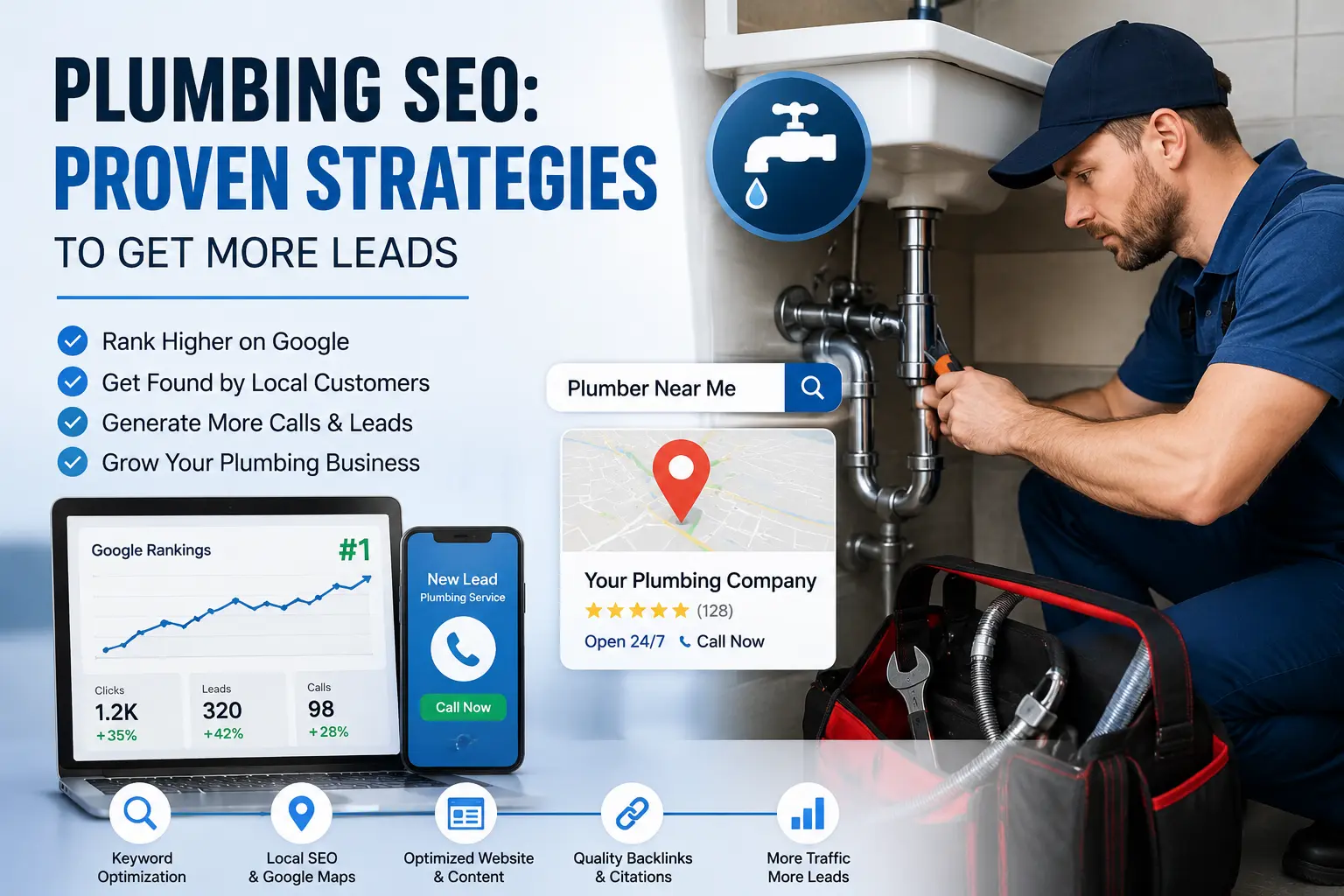
If you run a plumbing company, you already know that most of your customers don’t scroll through the Yellow Pages anymore. They pull out a phone, type “plumber near me” or “emergency plumber,” and call whoever shows up first. That single behavior is why plumbing SEO has become the most important marketing investment a plumbing business can make in 2026. Without a solid plumbing SEO strategy, even the best plumbers in town stay invisible to the very customers searching for them right now.
This guide breaks down exactly what plumbing SEO is, why it matters, and how to build a plumbing SEO strategy that generates consistent, high-intent leads month after month — without wasting money on tactics that don’t move the needle.
What Is Plumbing SEO?
Plumbing SEO is the process of optimizing a plumbing company’s website and online presence so it ranks higher on Google and other search engines for terms potential customers actually use — things like “drain cleaning near me,” “water heater repair,” or “24-hour emergency plumber.” Unlike paid ads, which stop generating traffic the moment you stop paying, plumbing SEO builds long-term, compounding visibility that keeps bringing in leads even while you sleep.
At its core, plumbing SEO combines several disciplines: local search optimization, on-page content strategy, technical website health, link building, and reputation management. When these pieces work together, a plumbing SEO campaign can turn a company’s website into its highest-performing salesperson — one that never takes a day off.
Why Plumbing SEO Matters More Than Ever
The plumbing industry is intensely local and intensely competitive. In almost every city, there are dozens of plumbing companies fighting for the same “near me” searches. Here’s why plumbing SEO has become non-negotiable for anyone serious about growing a plumbing business:
1. Most Plumbing Searches Have High Buying Intent
When someone searches “burst pipe repair” or “sump pump installation,” they aren’t browsing — they need help immediately. A well-executed plumbing SEO strategy puts your business in front of these ready-to-buy customers at the exact moment they’re searching.
2. Local Search Dominates the Plumbing Industry
Plumbing is a hyper-local service. Customers want someone nearby who can arrive fast. This is why local plumbing SEO — optimizing your Google Business Profile, building local citations, and targeting neighborhood-specific keywords — is often more valuable than broad national rankings. Our guide to local SEO for small businesses breaks down the fundamentals that apply directly to plumbing companies competing in their local market.
3. Plumbing SEO Is Cheaper Than Paid Ads Over Time
Pay-per-click ads can cost plumbing companies $40–$100+ per click in competitive markets. Plumbing SEO, on the other hand, is an investment that keeps paying dividends. Once a page ranks, it can generate free leads for years with proper maintenance — something no ad budget can replicate.
4. Trust and Credibility
Customers trust organic search results more than ads. Ranking naturally through plumbing SEO signals to potential customers that your business is established, reputable, and worth calling — before they’ve even spoken to you.
Core Components of a Winning Plumbing SEO Strategy
A results-driven plumbing SEO strategy isn’t one single tactic — it’s a combination of interconnected efforts. Let’s break down each pillar.
1. Keyword Research for Plumbing SEO
Every effective plumbing SEO campaign starts with knowing exactly what your customers are typing into Google. This means going beyond generic terms like “plumber” and digging into specific, high-intent phrases such as:
- “emergency plumber [city name]”
- “water heater repair near me”
- “drain cleaning service [neighborhood]”
- “sewer line repair cost”
- “leak detection plumber”
- “24 hour plumbing service”
Service-specific and location-specific keywords convert far better than broad, generic terms because they match exactly what a customer needs. If you want a deeper walkthrough on finding these terms, our keyword research guide for local businesses covers practical tools and techniques you can apply directly to a plumbing SEO campaign.
Long-tail keywords deserve special attention in plumbing SEO. Phrases like “why is my water heater leaking from the bottom” attract customers earlier in their decision-making journey, and answering these questions through blog content builds authority while capturing additional plumbing SEO traffic that competitors overlook.
2. On-Page SEO for Plumbing Websites
Once you know your target keywords, the next stage of plumbing SEO is making sure every page on your website is properly optimized. This includes:
- Title tags and meta descriptions that include your primary keyword and location
- Header tags (H1, H2, H3) structured logically around search intent
- Service pages for every offering — drain cleaning, water heater installation, pipe repair, gas line services, and more
- Location pages if you serve multiple cities or service areas
- Internal linking connecting related service and blog pages
- Fast-loading, mobile-friendly design, since most plumbing searches happen on phones
On-page plumbing SEO isn’t a one-time task. Search engines reward websites that continuously improve, update, and expand their content, so treat your site as a living asset rather than something you build once and forget.
3. Local SEO — The Backbone of Plumbing SEO
For a service business like plumbing, local SEO is arguably the single most important part of any plumbing SEO strategy. Here’s what to focus on:
Google Business Profile Optimization Your Google Business Profile (GBP) is often the very first thing a potential customer sees. A fully optimized profile — complete with accurate categories, service areas, photos, business hours, and regularly posted updates — can dramatically increase calls and direction requests. We cover this in detail in our Google Business Profile optimization guide and our companion piece on optimizing your Google Business Profile for local rankings, both of which are essential reading for any plumbing SEO campaign.
It’s also worth understanding what can go wrong. Profiles occasionally get flagged or suspended due to policy violations or suspicious activity, which can wipe out your local visibility overnight. Our article on why Google Business Profiles get suspended explains the common causes and how to recover quickly — critical knowledge for any plumbing SEO strategy that depends heavily on local map rankings.
NAP Consistency Your Name, Address, and Phone number (NAP) must be identical across every directory, citation site, and your own website. Inconsistent NAP data confuses search engines and weakens the local trust signals that plumbing SEO depends on.
Customer Reviews Reviews are one of the strongest local ranking factors in plumbing SEO. Actively request reviews after every completed job, respond to all feedback (positive and negative), and never use fake reviews — Google penalizes this heavily.
Local Citations Getting your plumbing business listed accurately on directories like Yelp, Angi, HomeAdvisor, and industry-specific plumbing directories builds the citation network that supports local plumbing SEO rankings.
4. Technical SEO for Plumbing Websites
Technical SEO forms the foundation that everything else in your plumbing SEO strategy is built on. If your website is slow, broken, or hard for search engines to crawl, even the best content and keywords won’t rank.
Site Speed Page speed is a direct ranking factor and a major driver of conversions. A slow-loading website causes potential customers to bounce before they even see your services. Our breakdown of website speed and its impact on SEO</cite> explains exactly how loading times affect rankings and what to fix first.
Core Web Vitals Google’s Core Web Vitals — measuring loading performance, interactivity, and visual stability — directly influence how your site performs in search. Our detailed guide to Core Web Vitals walks through how these metrics are measured and the most common mistakes that hurt plumbing websites specifically.
Mobile Optimization The majority of plumbing SEO traffic comes from mobile devices, especially during emergencies. A mobile-unfriendly website is one of the fastest ways to lose a customer who’s standing in a flooded basement searching for help.
Schema Markup Adding LocalBusiness and Service schema markup helps search engines understand exactly what your plumbing business offers and where you operate, which strengthens your plumbing SEO visibility in rich results and local packs.
Search Console Monitoring Ongoing plumbing SEO success requires tracking what’s actually happening on your site. Our guide to <cite index=”1-4″>Google Search Console</cite> explains how to monitor indexing issues, search performance, and technical errors that could be quietly undermining your rankings.
5. Content Marketing for Plumbing SEO
Content is the fuel that powers long-term plumbing SEO growth. Beyond your core service pages, a consistent blog strategy answering customer questions builds authority and captures additional search traffic. Strong plumbing SEO content ideas include:
- “How to know if you need a water heater replacement”
- “5 signs of a hidden slab leak”
- “What to do during a plumbing emergency”
- “How much does drain cleaning cost?”
- “Signs your sewer line needs repair”
Each piece of content should target a specific keyword, answer the question thoroughly, and include a clear call to action encouraging readers to book a service. Over time, this content compounds, feeding your overall plumbing SEO performance and establishing your business as the local authority on plumbing issues.
6. Link Building for Plumbing SEO
Backlinks — links from other reputable websites pointing to yours — remain one of the strongest ranking signals in any plumbing SEO campaign. Quality matters far more than quantity. A handful of links from relevant, authoritative local sources will outperform hundreds of spammy directory links.
Effective link building strategies for plumbing SEO include:
- Getting listed in local chamber of commerce directories
- Sponsoring local youth sports teams or community events
- Partnering with home improvement bloggers for guest content
- Getting featured in local news for community involvement
- Building relationships with complementary trades like HVAC and electrical contractors
Our detailed resource on <cite index=”1-3″>link building techniques</cite> and our broader guide to <cite index=”1-5″>link building fundamentals</cite> both offer strategies that translate directly into effective plumbing SEO link acquisition.
Building a Step-by-Step Plumbing SEO Roadmap
Here’s how to put all these pieces together into a practical plumbing SEO plan:
Step 1: Audit your current website. Identify technical issues, missing service pages, slow load times, and weak on-page optimization before starting any new plumbing SEO work.
Step 2: Complete keyword research. Map out primary and long-tail keywords for every service and every city or neighborhood you serve.
Step 3: Optimize your Google Business Profile. This single step often produces the fastest visible results in any plumbing SEO campaign.
Step 4: Build out service and location pages. Every service you offer deserves its own optimized page targeting its own set of keywords.
Step 5: Fix technical SEO issues. Improve site speed, mobile responsiveness, and Core Web Vitals scores.
Step 6: Launch a content calendar. Publish helpful, keyword-targeted blog content on a consistent schedule.
Step 7: Build local citations and backlinks. Focus on quality, relevant sources over volume.
Step 8: Collect and manage reviews. Make review generation part of your standard job-completion process.
Step 9: Track and refine. Use Search Console and analytics data to see what’s working and adjust your plumbing SEO strategy accordingly.
Plumbing SEO isn’t a “set it and forget it” project — it’s an ongoing process that compounds over months and years, delivering increasingly better results the longer you stay consistent.
Common Plumbing SEO Mistakes to Avoid
Even well-intentioned plumbing SEO efforts can stall out due to avoidable mistakes:
- Ignoring local SEO in favor of broad national keywords. Plumbing is a local service — chasing generic national terms wastes resources that should go toward local plumbing SEO.
- Thin or duplicate service pages. Copy-pasting the same content across city pages with only the location swapped out hurts rankings rather than helping them.
- Neglecting mobile experience. A clunky mobile site kills conversions from emergency searches.
- Buying cheap, spammy backlinks. This can actively damage a plumbing SEO campaign and trigger search engine penalties.
- No review generation strategy. Reviews are too important to leave to chance in a competitive plumbing SEO landscape.
- Inconsistent NAP information. Even small discrepancies across directories weaken local trust signals.
- Treating plumbing SEO as a one-time project. Search algorithms evolve constantly, and competitors are always working to outrank you.
How Long Does Plumbing SEO Take to Work?
This is one of the most common questions plumbing business owners ask. Realistically, most plumbing SEO campaigns start showing measurable movement within 3–6 months, with significant results — like ranking on page one for competitive local terms — typically taking 6–12 months. Newer websites or highly competitive markets may take longer. The key is consistency: plumbing SEO is a compounding investment, and the businesses that stick with it consistently outperform those that start and stop.
Measuring the Success of Your Plumbing SEO Campaign
To know whether your plumbing SEO strategy is working, track these key metrics:
- Organic traffic growth — Is more qualified traffic reaching your site over time?
- Local pack rankings — Are you appearing in the top three Google Maps results for target keywords?
- Keyword rankings — Are your priority service and location keywords climbing?
- Conversion rate — Are website visitors turning into calls, form submissions, or bookings?
- Google Business Profile insights — Are calls, direction requests, and profile views increasing?
- Review volume and rating — Is your reputation growing alongside your rankings?
Regularly reviewing these metrics through Google Search Console and analytics tools ensures your plumbing SEO strategy stays on track and adapts to what’s actually working.
Should You Hire a Plumbing SEO Agency?
Many plumbing business owners are excellent at their trade but don’t have the time or expertise to manage a full plumbing SEO strategy alongside running daily operations. In that case, working with an experienced agency can accelerate results significantly.
When evaluating a plumbing SEO partner, look for:
- A proven track record with local service businesses, not just generic SEO experience
- Transparent reporting on rankings, traffic, and leads
- A strategy that covers technical SEO, content, local SEO, and link building together
- No shortcuts like spammy link schemes or keyword stuffing
If you’re looking for support with the broader digital groundwork that plumbing SEO depends on — things like <cite index=”3-6″>local SEO services</cite> or <cite index=”3-9″>professional content writing</cite> — providers like Uphex Digital offer services that can complement an in-house plumbing SEO effort. Similarly, if your plumbing website needs technical work such as <cite index=”4-1″>website speed and performance optimization</cite> or dedicated <cite index=”4-2″>local SEO ranking services</cite>, agencies like Iffi Tech Sol specialize in the technical side that supports stronger plumbing SEO performance.
Whether you handle plumbing SEO in-house or bring in outside help, the principles stay the same: consistent optimization, genuine local relevance, quality content, and patience.
Plumbing SEO vs. Other Industries: What Makes It Unique
Plumbing SEO shares similarities with SEO for other home service trades, but it has its own nuances. For comparison, industries like HVAC face many of the same local search dynamics. Our guides on <cite index=”1-8″>HVAC SEO strategy</cite> and <cite index=”1-10″>HVAC website SEO structure</cite> illustrate how similar principles apply across home service trades — emergency search intent, heavy reliance on local pack rankings, and the need for fast, mobile-optimized websites. The same holds true for related trades, as shown in our <cite index=”1-11″>appliance repair SEO guide</cite>, which covers many tactics that overlap directly with an effective plumbing SEO approach.
Understanding these parallels can help plumbing business owners borrow proven strategies from adjacent industries and apply them to their own plumbing SEO campaigns.
Final Thoughts on Plumbing SEO
Plumbing SEO isn’t optional anymore — it’s the primary way modern customers find and choose a plumber. From local Google Business Profile optimization to technical site health, content marketing, and link building, every piece of a plumbing SEO strategy works together to build long-term, compounding visibility that paid ads simply can’t match.
The plumbing companies that invest seriously in plumbing SEO today will be the ones dominating local search results tomorrow — while their competitors are still waiting on the sidelines. Start with a website audit, optimize your Google Business Profile, build out real local content, and stay consistent. That’s the real formula behind every successful plumbing SEO strategy.
If you want to explore more strategies like this, browse our full library of guides, or learn more <cite index=”2-2″>about Trade Scale Hub</cite>, or simply <cite index=”2-6″>get in touch with our team</cite> if you’d like help building out a plumbing SEO strategy for your business.
Voice Search and the Future of Plumbing SEO
Voice search is quietly reshaping how customers find plumbing services. When someone asks a smart speaker or phone assistant “who’s the best plumber near me” or “find an emergency plumber open now,” the results pulled back are driven almost entirely by the same signals that power traditional plumbing SEO: accurate Google Business Profile data, strong local citations, and clear, conversational content.
To future-proof your plumbing SEO strategy for voice search, focus on:
- Writing FAQ-style content that mirrors natural spoken questions
- Keeping business hours, service areas, and contact details accurate everywhere online
- Targeting question-based long-tail keywords like “who fixes water heaters near me”
- Making sure your site loads quickly, since voice assistants favor fast, well-structured pages
As more customers rely on voice assistants for urgent, local needs, plumbing SEO strategies that ignore this shift risk losing ground to competitors who adapt early.
Seasonal Plumbing SEO Content Ideas
Plumbing problems follow predictable seasonal patterns, and a smart plumbing SEO content calendar takes advantage of this. Building seasonal content into your plumbing SEO strategy helps you capture searches exactly when demand spikes:
- Winter: “How to prevent frozen pipes,” “burst pipe emergency repair,” “why is my water heater struggling in cold weather”
- Spring: “Spring plumbing maintenance checklist,” “sump pump inspection tips,” “how to spot early leak damage”
- Summer: “Outdoor faucet and irrigation repair,” “signs your water heater needs replacing before summer travel”
- Fall: “Preparing your plumbing system for winter,” “water heater maintenance before the holidays”
Publishing seasonal content consistently is one of the easiest ways to keep a plumbing SEO campaign fresh, relevant, and aligned with what customers are actively searching for throughout the year.
A Quick Plumbing SEO Checklist
Use this condensed checklist to keep your plumbing SEO efforts organized and on track:
- Claim and fully optimize your Google Business Profile
- Ensure NAP consistency across all directories and citations
- Build dedicated, unique pages for every plumbing service offered
- Create location-specific pages if you serve multiple cities or neighborhoods
- Improve site speed and Core Web Vitals scores
- Add LocalBusiness and Service schema markup
- Publish keyword-targeted blog content on a consistent schedule
- Build genuine, relevant local backlinks
- Actively request and respond to customer reviews
- Monitor performance monthly through Search Console and analytics
Working through this checklist consistently is often the difference between a plumbing SEO campaign that stalls after a few months and one that keeps generating leads year after year.
Why Consistency Is the Real Secret to Plumbing SEO Success
Perhaps the most overlooked truth about plumbing SEO is that there’s no single trick or shortcut that guarantees rankings. Search engines reward businesses that consistently publish useful content, maintain a healthy website, earn genuine local trust, and keep improving month after month. Plumbing companies that treat plumbing SEO as an ongoing habit — rather than a one-time project — are the ones that dominate local search results over the long run.
If your competitors are already investing in plumbing SEO and you’re not, the gap between your visibility and theirs will only widen. The good news is that it’s never too late to start. Every optimized page, every earned review, and every quality backlink adds to the foundation of a stronger plumbing SEO presence over time.
Frequently Asked Questions About Plumbing SEO
Q: How much does plumbing SEO cost?
Costs vary widely depending on market competitiveness and scope, typically ranging from a few hundred to several thousand dollars per month for an ongoing plumbing SEO campaign.
Q: Can I do plumbing SEO myself?
Yes, especially the fundamentals like Google Business Profile optimization and basic on-page SEO. More advanced technical and link-building work often benefits from professional expertise.
Q: Is plumbing SEO better than paid ads?
They serve different purposes. Plumbing SEO builds long-term, sustainable visibility, while paid ads deliver immediate but temporary traffic. Most successful plumbing companies use both together.
Q: How often should I update my plumbing SEO strategy?
Plumbing SEO should be reviewed monthly, with major strategy updates every quarter as search trends, competitors, and algorithms evolve.
Plumbing SEO is a long game, but it’s one of the highest-return investments a plumbing business can make. Start today, stay consistent, and watch your rankings — and your leads — grow.
