
Your website is the foundation everything else in your marketing sits on. You can have a fully optimized Google Business Profile, dozens of five-star reviews, and strong local citations, but if your website is slow, poorly structured, or missing the content Google needs to understand your services, you’ll still struggle to rank. That’s what HVAC website SEO is really about — making sure the site itself is built to earn trust from both search engines and homeowners searching for heating and cooling help.
We’ve already covered the bigger picture in our HVAC SEO: Complete Guide to Ranking Higher, which walks through the full strategy — Google Business Profile, citations, reviews, and content. This guide goes deeper into one piece of that strategy: the website itself. Think of it as the technical and structural companion to that broader guide.
Good HVAC website SEO does two jobs at once. It helps your site rank higher in Google’s local and organic results, and it turns the visitors who land on your site into phone calls and booked jobs. A site that ranks well but doesn’t convert is just as much of a missed opportunity as a beautifully designed site nobody can find. This guide covers both sides — how to structure and optimize your HVAC Website SEO so it ranks, and how to build it so visitors actually pick up the phone.
By the end of this article, you’ll have a complete framework for HVAC website SEO you can apply whether you’re building a new site or improving an existing one.
Why HVAC Website SEO Matters
HVAC is a high-intent, often urgent industry. When someone’s air conditioner stops working in August or their furnace dies in January, they’re not casually browsing — they’re searching for a company they can call right now. HVAC website SEO determines whether your site is one of the options they see, and whether, once they land on it, they trust you enough to pick up the phone instead of clicking back to try a competitor.
A well-optimized HVAC website supports every other part of your marketing. It’s what your Google Business Profile links to. It’s what shows up when someone searches your business name after seeing a truck or a Google Ads listing. It’s what earns the backlinks, citations, and organic rankings that keep generating calls long after a single campaign ends. Weak HVAC website SEO puts a ceiling on everything else you do — no amount of review requests or citation building can fully compensate for a site that’s slow, thin on content, or structured in a way Google struggles to understand.
It also matters because HVAC is a seasonal, weather-driven business. Search volume for AC repair spikes hard in the summer, while furnace-related searches surge in winter. A website with strong HVAC website SEO stays visible and ready to convert during both peaks, rather than scrambling to catch up each time demand shifts. The businesses that treat their website as a long-term asset — built once, then continuously improved — are the ones that show up reliably every single season, not just when they happen to run a paid campaign.
HVAC Website Architecture and Structure
Before optimizing individual pages, your site needs the right structure. Good HVAC website SEO starts with a clear, logical architecture that both visitors and search engines can navigate easily.
A well-structured HVAC Website SEO typically includes:
- A homepage that clearly states your core services and service area
- Individual service pages for each major offering (AC repair, furnace repair, installation, maintenance, duct cleaning, indoor air quality)
- Dedicated location pages if you serve multiple cities or a wide metro area
- An About page establishing licensing, experience, and trust
- A blog or resources section for ongoing content
- A contact page with your phone number, service area map, and a contact form
Keep your navigation simple. Visitors and search engines should be able to reach any core page within two or three clicks from the homepage. Avoid burying your most important service pages deep in dropdown menus where they’re hard to find and harder for Google to crawl efficiently.
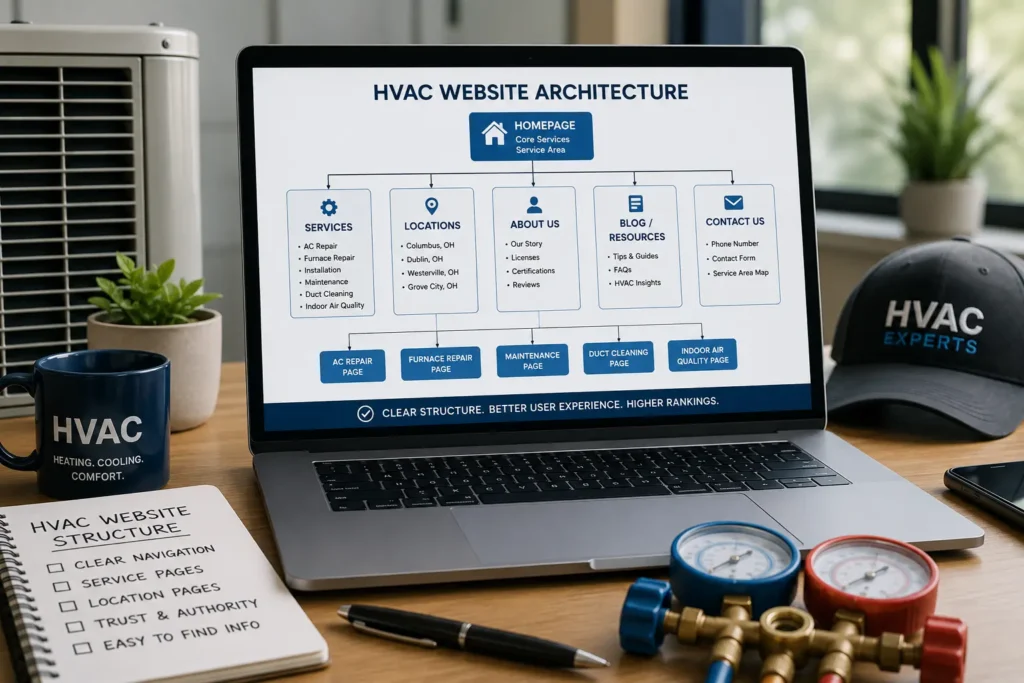
Think of your site architecture as a pyramid, with your homepage at the top, your main service and location category pages beneath it, and individual pages beneath those. This structure helps Google understand which pages matter most and how they relate to each other, while also making it far easier for visitors to find exactly what they’re looking for without hunting through irrelevant pages first.
On-Page SEO for HVAC Websites
Once your structure is in place, each page needs to be individually optimized. This is where a large share of practical HVAC website SEO work happens.
- Title tags should include your primary service and location, written naturally (e.g., “Furnace Repair in Columbus, OH | Same-Day Service”)
- Meta descriptions should be compelling and specific, giving searchers a clear reason to click
- H1 tags should clearly state the page’s topic, ideally matching the core keyword you’re targeting
- H2 and H3 subheadings should organize content logically, covering related questions and subtopics
- Image alt text should describe the image and reference your service or location where natural
- Internal links should connect related pages — for example, linking your AC repair page to your maintenance plans page
- URLs should be short and readable, like /ac-repair-columbus rather than a long string of parameters
Every page on your site should have one clear focus. Trying to rank a single page for too many unrelated keywords usually results in ranking well for none of them.
Service Pages: The Core of HVAC Website SEO
Service pages are the backbone of effective HVAC website SEO. Each core service — AC repair, furnace repair, heating and cooling installation, maintenance plans, duct cleaning, indoor air quality — deserves its own dedicated page rather than being grouped into one general “Services” page.
A strong HVAC service page typically includes:
- A clear explanation of what the service involves
- Common signs a customer might need the service (e.g., signs a furnace needs repair)
- Pricing guidance or a range, if you’re comfortable sharing it
- Trust elements like licensing, guarantees, or financing options
- A strong, visible call-to-action with your phone number
- Customer reviews specific to that service, if available
This level of depth does two things: it gives Google far more specific content to match against searches like “furnace repair” or “duct cleaning near me,” and it gives visitors the information they need to trust you enough to call.
It’s worth resisting the temptation to make service pages shorter just because the topic feels simple. A thin, 150-word service page rarely gives Google enough context to understand what you actually offer, and it rarely gives a hesitant homeowner enough reassurance to pick up the phone. Aim for genuinely useful depth — enough to answer the questions a real customer would have before booking — rather than padding a page just to hit a word count.
Location Pages for Multi-City HVAC Businesses
If your HVAC company serves more than one city or a broad metro area, dedicated location pages are essential to strong HVAC website SEO. Each location page should have genuinely unique content — not the same paragraph with the city name swapped out, which Google can recognize as thin, duplicated content.
A good location page includes:
- The specific neighborhoods or areas you serve within that city
- Any location-specific details (climate considerations, common local issues, permit requirements)
- Local trust signals, like reviews from customers in that area
- A locally relevant call-to-action and contact information
This structure pairs directly with your Google Business Profile strategy. For a full walkthrough of getting that side of your presence right, see our guide on how to optimize your Google Business Profile for higher rankings.
If you’re just starting to expand into a new city or region, resist the urge to publish a dozen thin location pages all at once. It’s far more effective to build one strong, well-researched location page, let it gain traction, and then expand methodically to the next area. Google tends to reward gradual, genuine growth over a sudden burst of near-identical pages, which can look more like an attempt to game rankings than a real expansion of service.
Content Strategy and Blogging
Publishing useful, locally relevant content is one of the most underused levers in HVAC website SEO. A blog gives you the ability to target a much wider range of keywords than your core service and location pages alone, while demonstrating expertise that builds trust with both visitors and Google.
Strong content ideas for an HVAC website include:
- Seasonal maintenance guides (spring AC tune-ups, fall furnace checks)
- Signs a system needs repair versus replacement
- Energy efficiency tips and cost-saving guidance
- Explanations of common HVAC terminology for homeowners
- Cost breakdowns for common services
Consistent content also earns backlinks and social shares more naturally than purely promotional pages, and every published article is another indexed page with the potential to rank for its own set of searches.
Aim for a realistic, sustainable publishing rhythm rather than a burst of posts followed by months of silence. A single well-researched article published every few weeks, tied to what’s actually happening seasonally in your service area, tends to outperform a large batch of thin posts published once and then abandoned. Over a year, that consistency adds up to a meaningful library of content that keeps working for you long after each individual post was published.
Mobile Optimization and Page Speed
The majority of HVAC searches happen on mobile devices, often from someone standing in an uncomfortably hot or cold house who wants an answer fast. This makes mobile experience and speed a non-negotiable part of HVAC website SEO.
Key priorities include:
- A fully responsive design that adapts cleanly to any screen size
- Fast loading times — compress images, minimize unnecessary scripts, and use reliable hosting
- Large, easy-to-tap buttons, especially your phone number and contact form
- Simplified navigation on mobile, avoiding cluttered menus
- Strong Core Web Vitals scores, which directly affect both user experience and rankings
A slow or clunky mobile experience doesn’t just hurt your rankings — it actively loses you customers who won’t wait around for a page to load when a competitor’s site is one search result away.
Test your site’s speed regularly using free tools like Google PageSpeed Insights, and pay particular attention to your largest images and any third-party scripts (chat widgets, tracking pixels, embedded videos) that can quietly slow a page down without being obvious during a casual glance. A site that looks fine on a fast office Wi-Fi connection can feel dramatically slower on a spotty cell signal, which is exactly the situation many HVAC customers are searching from.
Conversion Elements Every HVAC Website Needs
Ranking well is only half the goal of effective HVAC website SEO — turning that traffic into calls and bookings is the other half. Every page on your site should make it effortless for a visitor to take the next step.
Essential conversion elements include:
- ✅ A sticky click-to-call button, especially on mobile
- ✅ Clear emergency service availability (e.g., “24/7 Emergency Service”)
- ✅ Visible licensing and certification information
- ✅ Financing options, if available
- ✅ Service guarantees or warranties
- ✅ Recent, genuine customer reviews displayed prominently
- ✅ A simple, short contact form as an alternative to calling
A visitor who can’t quickly find your phone number or isn’t sure whether you handle emergencies is a visitor likely to leave for a competitor’s site instead.
It helps to think about your website the way you’d think about a technician showing up at someone’s door: the goal is to build enough trust, quickly enough, that the customer feels comfortable saying yes. Every second a visitor spends searching for basic information — your phone number, whether you’re licensed, whether you service their area tonight — is a second where doubt has room to creep in. Testing your own site on a phone, as if you were a stressed-out homeowner with no AC in July, is one of the simplest ways to catch friction points before they cost you a job.
Technical SEO for HVAC Websites
Technical fundamentals ensure Google can properly crawl, index, and understand your site — the foundation underneath every other part of your HVAC website SEO strategy.
- HTTPS: Your site must run on a secure connection; this is a baseline trust and ranking factor
- XML sitemap: Keep it current and submitted through Google Search Console
- Robots.txt: Confirm it isn’t accidentally blocking important pages from being crawled
- Indexing: Regularly check that your key service and location pages are indexed
- Broken links and redirects: Audit periodically to avoid dead ends that hurt both rankings and user experience
- Site speed: Test regularly using tools like Google PageSpeed Insights and address any flagged issues
Technical SEO issues are easy to overlook because they don’t show up visually the way a design flaw does — a broken sitemap or an accidentally blocked page can quietly limit your visibility for months without any obvious symptom on the surface. Building a habit of checking Google Search Console every few weeks helps catch these issues early, before they compound into a larger ranking problem.
Schema Markup for HVAC Businesses
Structured data, or schema markup, helps search engines understand exactly what your business does and where it operates — an important but often overlooked piece of HVAC website SEO. Implementing LocalBusiness and HVACBusiness schema on your site can help your listing display more prominently in search results, sometimes with added details like reviews, hours, or service areas shown directly in the results.
If you’re not familiar with implementing schema, most modern website platforms offer plugins or built-in tools that handle the technical markup without requiring you to write code by hand.
Beyond LocalBusiness schema, consider adding Review schema (if your platform supports displaying star ratings pulled from real customer reviews) and FAQ schema on pages where you’ve included a question-and-answer section. Both can help your listings stand out visually in search results with added detail like star ratings or expandable questions, which tends to improve click-through rates even before a visitor reaches your site.
Connecting Your Website to Local SEO
Your website doesn’t operate in isolation — it’s one piece of a broader local SEO strategy that includes your Google Business Profile, citations, and reviews. For the full picture of how these pieces fit together, our Complete Local SEO Guide for Small Businesses covers the end-to-end strategy in detail.
It’s also worth staying alert to issues outside your website that can undo your SEO progress. A suspended Google Business Profile, for example, can cut off a major source of local visibility overnight, regardless of how well your website is optimized. If you’re dealing with that specific issue, see our guide on what to do if your Google Business Profile is suspended.
Common HVAC Website SEO Mistakes
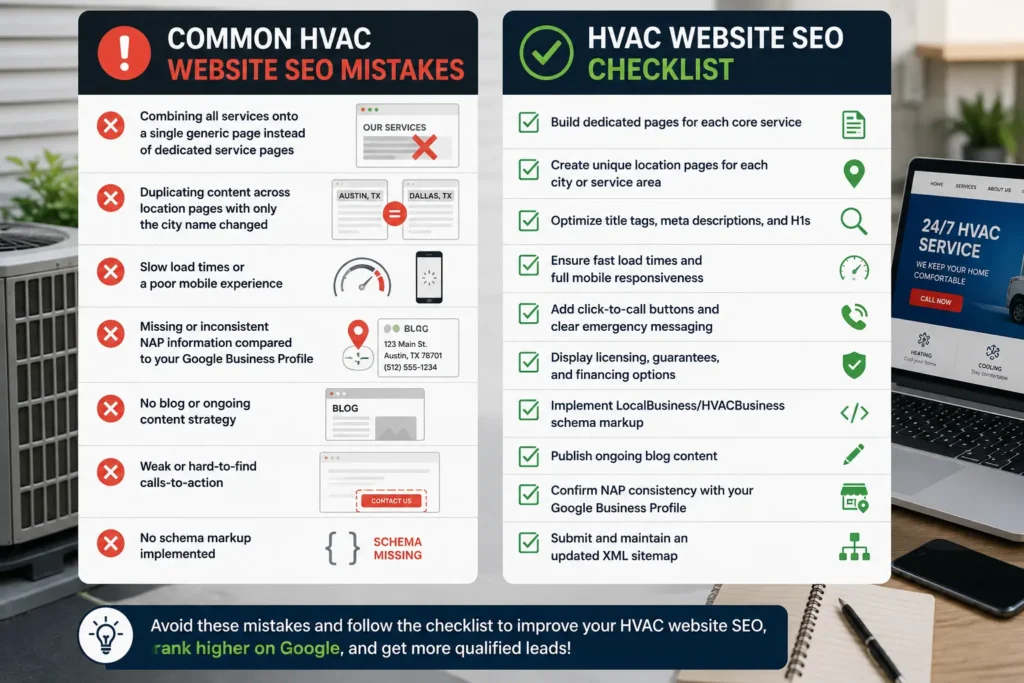
Even well-intentioned HVAC companies undermine their own results with avoidable mistakes:
- ❌ Combining all services onto a single generic page instead of dedicated service pages
- ❌ Duplicating content across location pages with only the city name changed
- ❌ Slow load times or a poor mobile experience
- ❌ Missing or inconsistent NAP information compared to your Google Business Profile
- ❌ No blog or ongoing content strategy
- ❌ Weak or hard-to-find calls-to-action
- ❌ No schema markup implemented
HVAC Website SEO Checklist
- ☐ Build dedicated pages for each core service
- ☐ Create unique location pages for each city or service area
- ☐ Optimize title tags, meta descriptions, and H1s
- ☐ Ensure fast load times and full mobile responsiveness
- ☐ Add click-to-call buttons and clear emergency messaging
- ☐ Display licensing, guarantees, and financing options
- ☐ Implement LocalBusiness/HVACBusiness schema markup
- ☐ Publish ongoing blog content
- ☐ Confirm NAP consistency with your Google Business Profile
- ☐ Submit and maintain an updated XML sitemap
Frequently Asked Questions
What is HVAC website SEO?
HVAC website SEO is the process of structuring and optimizing an HVAC company’s website — its pages, content, technical setup, and user experience — to rank higher in search results and convert visitors into calls and bookings.
How is HVAC website SEO different from general HVAC SEO?
HVAC website SEO focuses specifically on the website itself — structure, content, speed, and technical setup. Broader HVAC SEO also includes off-site factors like your Google Business Profile, citations, and reviews. Our complete HVAC SEO guide covers the full strategy.
How many service pages does an HVAC website need?
At minimum, one dedicated page per core service — AC repair, furnace repair, installation, maintenance, and any specialty services like duct cleaning or indoor air quality. Combining everything into one page limits how specifically you can rank for individual searches.
Does page speed really affect HVAC website SEO?
Yes. Page speed affects both search rankings and conversion rates, and it matters even more for HVAC websites since a large share of visitors are searching urgently from mobile devices.
Do I need a blog for HVAC website SEO? It’s not required, but it significantly expands the range of keywords your site can rank for and helps demonstrate expertise, which supports both rankings and customer trust.
How does my website work together with my Google Business Profile?
Your website and Google Business Profile should reinforce each other — matching NAP information, consistent service lists, and links from your profile back to relevant pages on your site. Our guide on Google Business Profile optimization covers this in detail.
Can I improve HVAC website SEO myself, or do I need an agency?
Many foundational elements — service pages, content, basic on-page optimization — can be handled in-house. More technical work, like schema markup and site architecture for larger multi-location businesses, often benefits from professional support.
Final Thoughts
Strong HVAC website SEO isn’t a single fix — it’s the combination of clear site structure, dedicated service and location pages, fast and mobile-friendly performance, useful content, and conversion-focused design working together. Get these fundamentals right, and your website becomes an asset that keeps generating calls long after any single marketing push ends.
Your website is only one part of the bigger picture, though. Pair strong HVAC website SEO with the broader strategy covered in our Complete Local SEO Guide for Small Businesses, keep your Google Business Profile fully optimized, and stay alert to issues like profile suspensions that can undo your progress overnight. Together, these pieces are what turn a website that simply exists into one that consistently brings in new HVAC customers.
None of this requires a complete rebuild to get started. Pick the single weakest area of your current site — whether that’s missing service pages, slow load times, or a lack of any recent content — and start there. HVAC website SEO is a compounding effort: small, consistent improvements to structure, content, and speed build on each other over months, and the businesses that stay patient with that process are the ones that end up owning the top spots in their market.
